Skip to main content Accessibility Policy

Sound advice at GamingFest

November
10
2017
By
Tags:

"I am a sound designer myself, and what that really means is that I am a storyteller," said Mitch Gettleman, SCAD chair of sound design, addressing an enthusiastic audience at SCADshow for GamingFest. "I believe that sound and sound design are where the emotion lives for the experience of the audience. There's really no bigger part of storytelling process and sound design than the voiceover performance."

Gettleman, whose professional credits include supervising sound editing on TV shows "Scrubs," "Californication" and "Lady Dynamite," was hosting "The Art of the Voiceover," a key panel during SCAD GamingFest, a two-day convocation of industry luminaries, working professionals and student talent to examine the evolving world of game design and development.

Joining Gettleman on stage were four leading industry creatives who through sound design and voiceover performance bring games to life: Dave Fennoy and Brian Bremer, voice actors of "The Walking Dead" game, Ariel Gross, audio director of QC Games, and Jeffrey Umberger, voice talent agent for The Umberger Agency. The panel shared their experiences, expertise and wit with a captivated GamingFest audience.

"The importance of characters in video games is that they're the human connection element," Gross remarked. "Voice acting is probably the most important thing in audio that we do in games."

Fennoy and Bremer lit up the panel with character riffs and charm. As trained actors who rely on talent, voice control and imagination to deliver performances that enhance the player experience, Fennoy and Bremer advised those interested in joining the world of voiceover work to take improv classes, acting classes and become familiar with the numerous resources, coaches and studios.

Hosted by SCAD, GamingFest is the newest professional engagement program through SCADFILM and highlights SCAD's support of Atlanta's growing gaming landscape. SCAD is the first and only university to offer a B.F.A., M.A. and M.F.A. in sound design. Over 2,800 SCAD alumni currently work in Georgia's entertainment industry.

Thomas, Mokgosi celebrate 'Lines of Influence'

October
26
2017
By
Tags:

"History is always there to be told," said artist Hank Willis Thomas, addressing attendees of "History and Iconography: The Power of Image," part of a two-day symposium at the SCAD Museum of Art to commemorate the centennial of the birth of painter, storyteller and educator Jacob Lawrence.

Moderated by Kimberly Drew, creator of the blog Black Contemporary Art and social media manager at The Metropolitan Museum of Art, the panel examined the creative processes of Thomas and fellow artist Meleko Mokgosi. Thomas and Mokgosi are both featured in "Legacy," part of the current SCAD MOA exhibition "Lines of Influence," which investigates Lawrence's impact on modern working artists.

Though their practices diverge, Mokgosi and Thomas steep their works in research, spending as much time mining archives for untold stories as in the tactile practice of creating. Both artists combat narrative clichés and shed light on overlooked issues — much like Lawrence, who pioneered new ways of portraying the African-American experience.

Thomas, working with themes relating to identity, history and popular culture, spoke about his piece "Untitled," a sculpture of powder-coated steel. The sculpture is based on runaway slave advertisements he uncovered, and points to the story of William and Ellen Craft, an enslaved African-American couple who, en route to freedom, passed through the Central of Georgia Railway depot — the very place where the SCAD Museum of Art stands today.

Thomas said that he owes his love of archives as well as his early encounters with the work of Jacob Lawrence to his mother, Deborah Willis, a renowned artist, curator and historian who celebrates and preserves the work of black photographers in books, exhibitions and documentaries.

Botswana-born Mokgosi identifies with Lawrence's research-based practice because it echoes his own. Moksogi's large-scale, project-based installations grapple with subjects including psychoanalysis, post-colonial theory and nation-building. He spends months reading, researching, taking pictures, traveling and sketching until his ideas solidify. A frequent theme is his native country's path to democracy after achieving independence 50 years ago.

"I don't paint until I have everything figured out," Mokgosi said.

His paintings typically take just a week or two to complete, he said. The diptych "Letter from Home (Letter from Africa)" features one 144" x 96" x 2" panel with lettering in permanent marker done in one session.

"That's amazing," Thomas said with a hint of jealousy, as the audience laughed.

When Drew asked what the artists want their legacies would be, Thomas said he hoped his own work will be preserved and catalogued for future generations. Mokgosi declared that, like Jacob Lawrence, he aims to "capture unspoken narratives" and make them part of the conversation.

"Jacob Lawrence: Lines of Influence" is on view through Sunday, Feb. 4, 2018. The exhibition is made possible by the generous support of the Jacob and Gwendolyn Knight Lawrence Foundation and the Ford Foundation.

Students and alumni garner Red Dot Awards for communication design

October
10
2017
By
Tags:

The Savannah College of Art and Design has again earned international honors in the esteemed Red Dot Award: Communication Design competition. With students and alumni receiving 39 total awards, the 2017 competition marks the most wins for SCAD to date.

SCAD entries earned 12 awards in the film and animation category, 10 in illustration, and five each advertising, and publishing and print media. Projects from SCAD students and alumni earned additional awards in the interface and user experience design, typography, apps, and posters categories. Award recipients include students from SCAD campuses in Hong Kong, Savannah and Atlanta.

"SCAD competed with design students across the globe to bring home an impressive number of awards this year," said Anthony Fisher, dean of the school of communication arts. "These honors speak to the unsurpassed quality of the curriculum and the dedication of our faculty. They exemplify the university's status as the preeminent source of knowledge in innovation and creativity."

Global design authority Design Zentrum Nordrhein Westfalen administers the annual Red Dot Awards. For the Communication Design competition, an international jury of 24 judges from 11 countries selected pieces of compelling quality and creativity. One of the most ambitious worldwide design competitions, the Red Dot Awards garnered submissions from 50 countries. This year's Communication Design program drew a total of 8,051 submissions across 18 categories.

SCAD alumna Whitney Renea Stephenson (B.F.A., film and television, 2016) received the coveted "Best of the Best" award for "Dreamkeeper," a narrative short film about Tom, a dream watchman, and how an encounter with an observant young girl alters his perspective on the world of dreams.

The Red Dot Gala on Friday, Oct. 27 will honor the distinguished recipients at the Konzerthaus Berlin in Berlin, Germany. Stephenson will receive her "Best of the Best" trophy and compete for the Red Dot: Grand Prix award, which recognizes the top work in each category. Following the ceremony, Red Dot winners will celebrate "Designers' Night" at E-Werk Berlin and an exclusive work showcase, "Design on Stage," exhibiting the winning pieces.

Congratulations to the following SCAD student and alumni recipients of Red Dot Awards in Communication Design 2017:

Illustration
Lidan Chen (M.A., illustration, 2017)
Nick Erickson (B.F.A., animation)
Irena Freitas (M.F.A., illustration, 2017)
Yevheniia Haidamaka (M.F.A., illustration, 2017)
Jamie Kao (B.F.A., graphic design, 2017)
Shann Larsson (B.F.A., graphic design, 2016)
Taylor McCaslin (B.F.A., illustration, 2017)
Amalia Restrepo (M.F.A., illustration)
Sunny B. Yazdani (M.A., illustration, 2017)

Film and Animation
Justin Boon (B.F.A., visual effects, 2016)
Meadhbh Deeney (B.F.A., film and television, 2016)
Mohamed Echkouna (B.F.A., visual effects, 2016)
Milena Goncalez (M.F.A., animation, 2016)
Kuozheng Hao (B.F.A., animation, 2016)
Robyn Hicks (M.F.A., film and television, 2017)
Melanie Amanda Ho (B.F.A., film and television, 2015)
Andy Koeger (B.F.A., film and television, 2016)
Lamia Lazrak (B.F.A., film and television, 2016)
Ieva Lukauskaite (B.F.A., film and television, 2016)
Paula Andrea Sprenger (B.F.A., film and television, 2016)
Whitney Renea Stephenson (B.F.A., film and television, 2016)

Advertising
Kendra Bergman (B.F.A., advertising, 2017)
Timothy Carvalho (M.F.A., advertising, 2017)
Hannah Gilbertson (B.F.A., advertising)
Nick Lamando (B.A., visual communication, 2016)
Mikayla Lapierre (B.F.A., advertising)
Isabel Taborga (B.F.A., advertising, 2017)
Brian Alexander Madert (B.F.A., advertising)
Bryson Schmidt (B.F.A., advertising, 2017)
Nick Taormina (B.F.A., advertising)
Yugendu Vyas (B.F.A., advertising, 2017)

Publishing and Print Media
Keeley Gribb (M.F.A., graphic design, 2016)
Shann Larsson (B.F.A., graphic design, 2016)
Sharon Martie (B.F.A., graphic design, 2016)
Alanna Minor (B.F.A., graphic design, 2017)
Carmen Rodriguez Lo (B.F.A., graphic design, 2017)

Interface and User Experience
Dipali Bajaj (B.F.A., user experience design)
Zhaolin Cai (B.F.A., user experience design)
Nolan Canady (B.F.A., user experience design)
Gonzalo Gelso (B.F.A., graphic design)
Je Sun Hwang (M.F.A., service design)
Hwang Hah Jeong (B.F.A., user experience design)
Yuri Jai Johnson (B.F.A., computer arts, 2004)
In Won Jong (M.F.A., interactive design/game development, 2017)
Joe Kennedy (B.F.A., user experience design)
Jenn Lee (B.F.A., user experience design)
Cody Reppert (B.F.A., user experience design)
Andrew Sibert (B.F.A., user experience design)
James Simmons (B.F.A., user experience design)
Fernando Zeledon (B.F.A., industrial design)

Apps
Gentry Baird (B.F.A., graphic design)

Typography
Jenna Sullivan (B.F.A., graphic design, 2017)
Katherine Weaver (M.A., visual effects)

Posters
India Torrez (B.F.A., graphic design, 2017)
WordCast offers media insights

October
4
2017
By
Tags:

Students filled the halls of the SCAD Museum of Art Saturday, Sept. 30, 2017, for WordCast, a day-long media conference connecting students with industry leaders in journalism, broadcast and multimedia storytelling through hands-on seminars, career advice workshops and one-on-one critiques.

Presented by SCAD Student Media, WordCast speakers included Adam Cole, science writer and multimedia journalist for National Public Radio, Mary Anthony Green, featured columnist for GQ magazine, Miguel Fuller, WPOI Hot 101.5 radio personality, and documentary filmmaker Gabriella Garcia-Pardo (B.F.A., film and television, 2012).
 
"Making it as a food and travel writer," a workshop led by Hannah Hayes (M.A., arts administration, 2013), associate travel editor at Southern Living, offered a meme-filled PowerPoint presentation complete with straight-talk about the business of being a freelancer. Hayes began her workshop discussing the current state of magazine industry, including recent editorial cutbacks and decreasing freelance rates.

"But there's good news!" Hayes said among a wave of relieved laughter. "There's never been a better time to be a younger person in the industry — we know how to do all the things!"

Hayes encouraged students to learn skills that complement their writing, including video production and editing, and experience with CMS, coding and analytics. On a slide titled "What do you need to show people to get a job?," Hayes spoke about the importance of holistic storytelling.

"Consider all the different ways to tell your story," she said. "If you can show an editor real reasons to spend money on a video component, they'll be impressed by the amount of research you already put into the story."

Following Hayes' class was "Editing for broadcast," a technical audio editing workshop taught by Tracie Hunte, a reporter for RadioLab/WNYC.

With the Avid Pro Tools application projected onto a monitor, Hunte reviewed the post-interview steps she took in one of her favorite RadioLab stories, "One Vote," about how a single state legislator's vote in 1920 changed the outcome of the American suffrage movement. Throughout her presentation, Hunte played clips from the both the edited and unedited versions of the interview, showing how audio was changed.

"The first thing I do with an interview is cut anything unusable and group by topic," Hunte said, cutting and pasting her favorite quotes from the interview to demonstrate. "I'm already thinking about the story arc when I do this—how should we open the story and what will make a good ending?"

Another tip Hunte shared concerned the process of finding and logging each interjection in an interview — every time a person says "and," "but," "yes," "no," and other connective words.

"Once I have a log of interjections, it is much easier for me to connect sentences and ideas when I edit an interview," Hunte said.

Hunte concluded her workshop by suggesting resources for students interested in podcasting, from books about ethical editing to the best microphones and other equipment.

"Always feel free to pitch me story ideas," Hunte said. "Maybe you're more interested in the storytelling aspect than the technical editing. We need it all!"

Wordcast logo

Joey Chu's extraordinary documentary

October
2
2017
By
Tags:

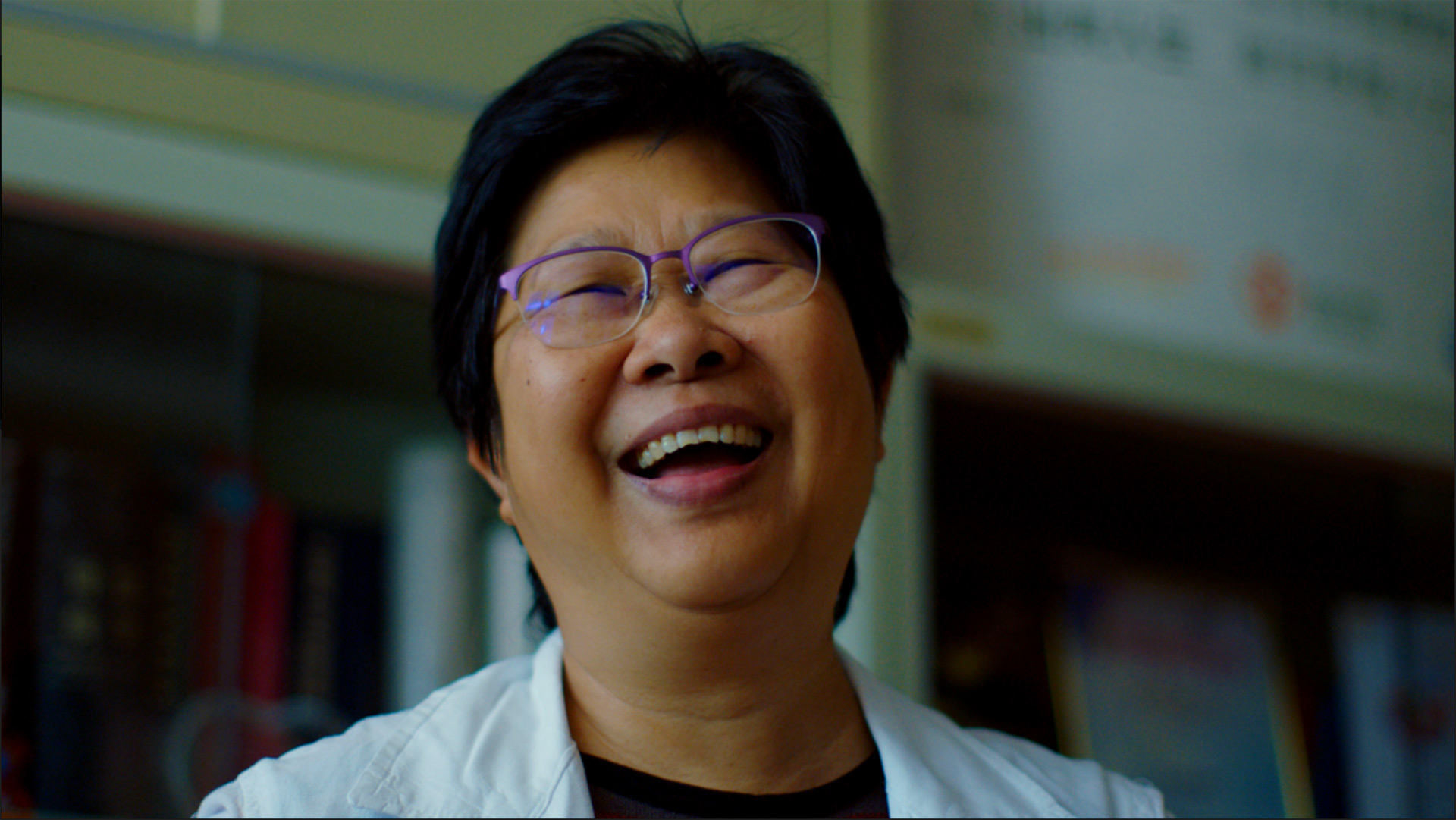
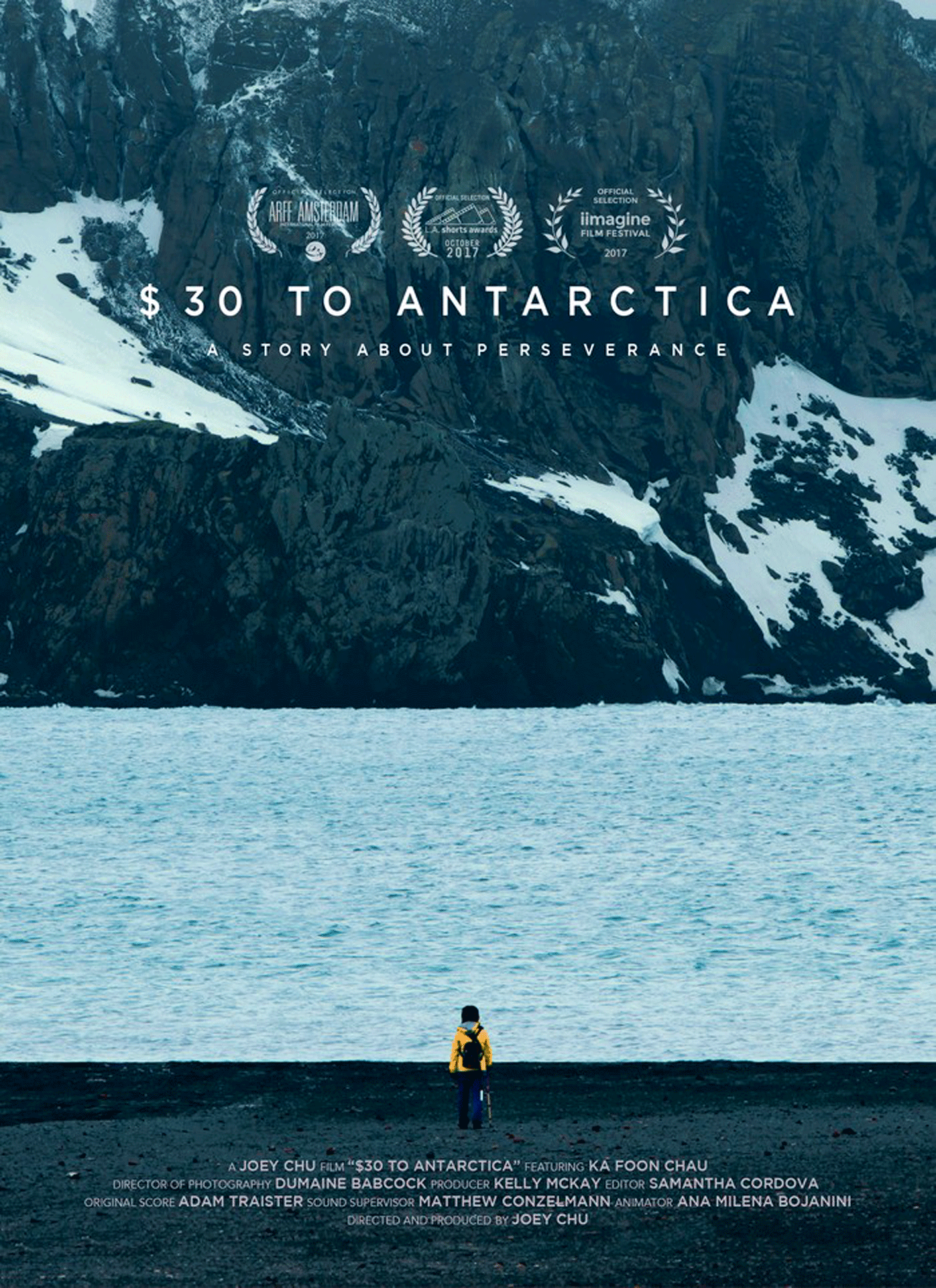
"I know a small person shouldn't hope for any attention," says Ka Foon Chau. "They should fulfill themselves, be the best they can be, and others will see your importance. There's no need to beg for any attention." This small, important scene, from the documentary "$30 to Antarctica," finds Dr. Chau reading from a personal diary composed during her exacting girlhood.

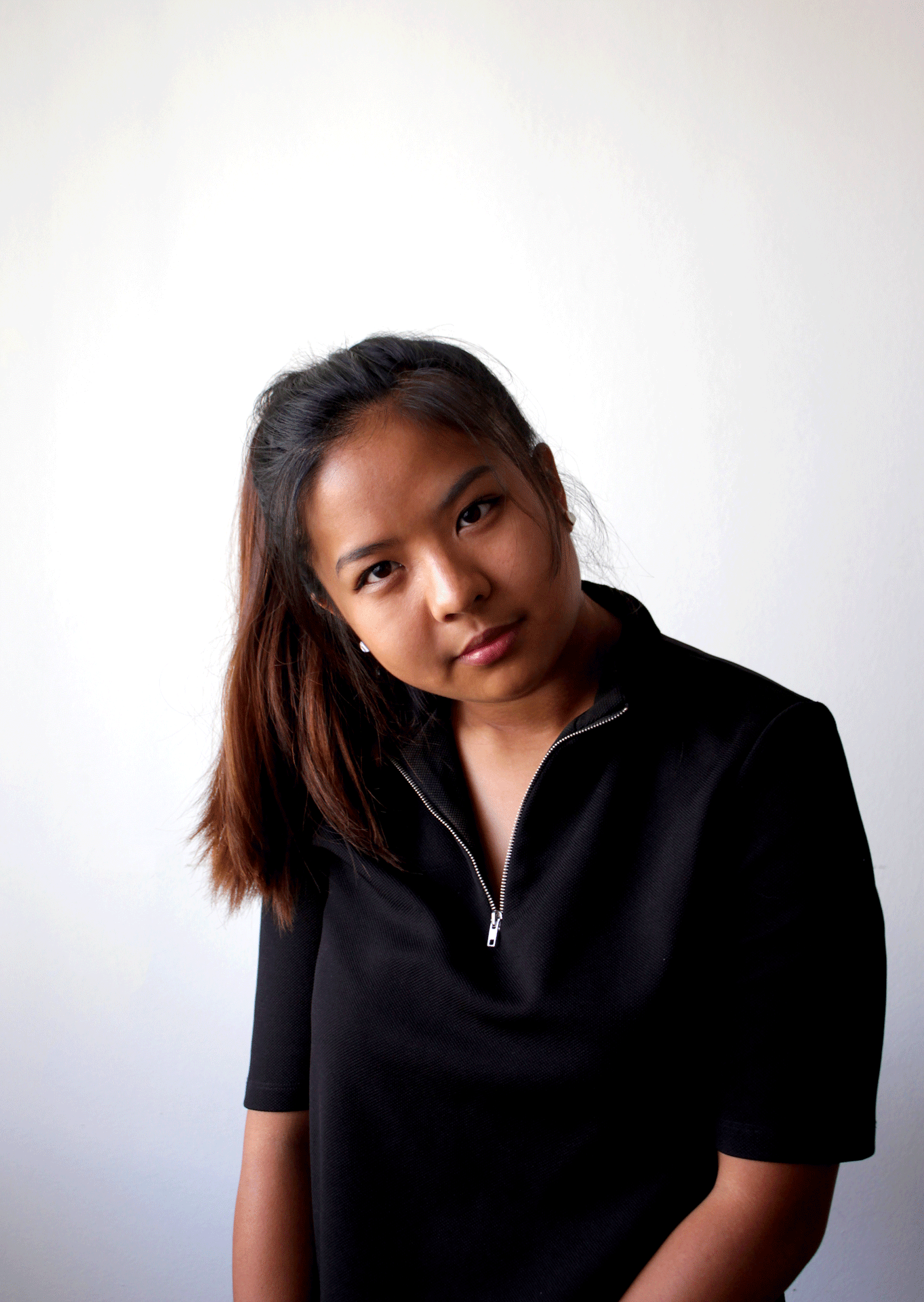
Concise in length and epic in breadth, the film charts the true story of how an impoverished child in Hong Kong became a nephrologist and transplant activist and eventually fulfilled a lifelong dream of travelling to Antarctica. Utilizing interviews with Dr. Chau's friends, husband, and former high school teacher, the film demonstrates how a seemingly token kindness lead to empowering self-belief, and how a commitment to learning and helping others can create transformative change in the lives of many. The film is a work of clear-eyed inspiration and natural beauty. It also reveals, in its end credits, that director Joey Chu (B.F.A., film and television, 2017) is Dr. Chau's daughter.

SCAD: How did "$30 to Antarctica" evolve?

JOEY CHU: I filmed the ending first, the trip to Antarctica. We were in a two-person kayak, my mother in front, and I put a GoPro between us, then filmed her walking on the beach of Deception Island. I had that footage, and mentioned to my mother that I'd develop it into a documentary someday. I told her it'd be powerful for people to see her story on film. She's been interviewed on TV many times for her work as a doctor, so being in front of a camera isn't a strange thing for her. The scene where she's reading from her diary she wrote while she was struggling as a kid, I was behind the camera with my DP Dumaine Babcock (B.F.A., film and television, 2017) and my mother started tearing up. I was crying but trying not to make a sound.

The fact that the subject of the film is my mother isn't really important to the film. If she wasn't my mother and I only learned about her and her incredible story, I would still want to make a film about her. Some people told me to make it more about her being my mother, some said not to mention it at all. Mentioning at the end credits felt like the right thing to do.

SCAD: What was your experience like as a SCAD student making this film?

CHU: Being at SCAD means being surrounded by passionate people and learning to collaborate. It's inspiring because it makes you want to work hard and see how your passions can connect. When I made "$30 to Antarctica" the entire crew were my friends. My professors Alexander Newton and Lubomir Kocka were incredibly helpful. They took extra steps to help the film fulfill its potential. And they're there for me now, after graduation, as resources.

SCAD: What's next for "$30 to Antarctica"?

CHU: This week it's going to screen at the I Imagine Film Festival in New York City. It just won Best Short Documentary at the Around International Film Festival Amsterdam monthly competition. I finished the film in August, and the deadline for the Savannah Film Festival had already passed, so I plan to submit it for the 2018 SAVFF. I look forward to bringing it back to Savannah.

'Temporal' wonders

September
25
2017
By
Tags:

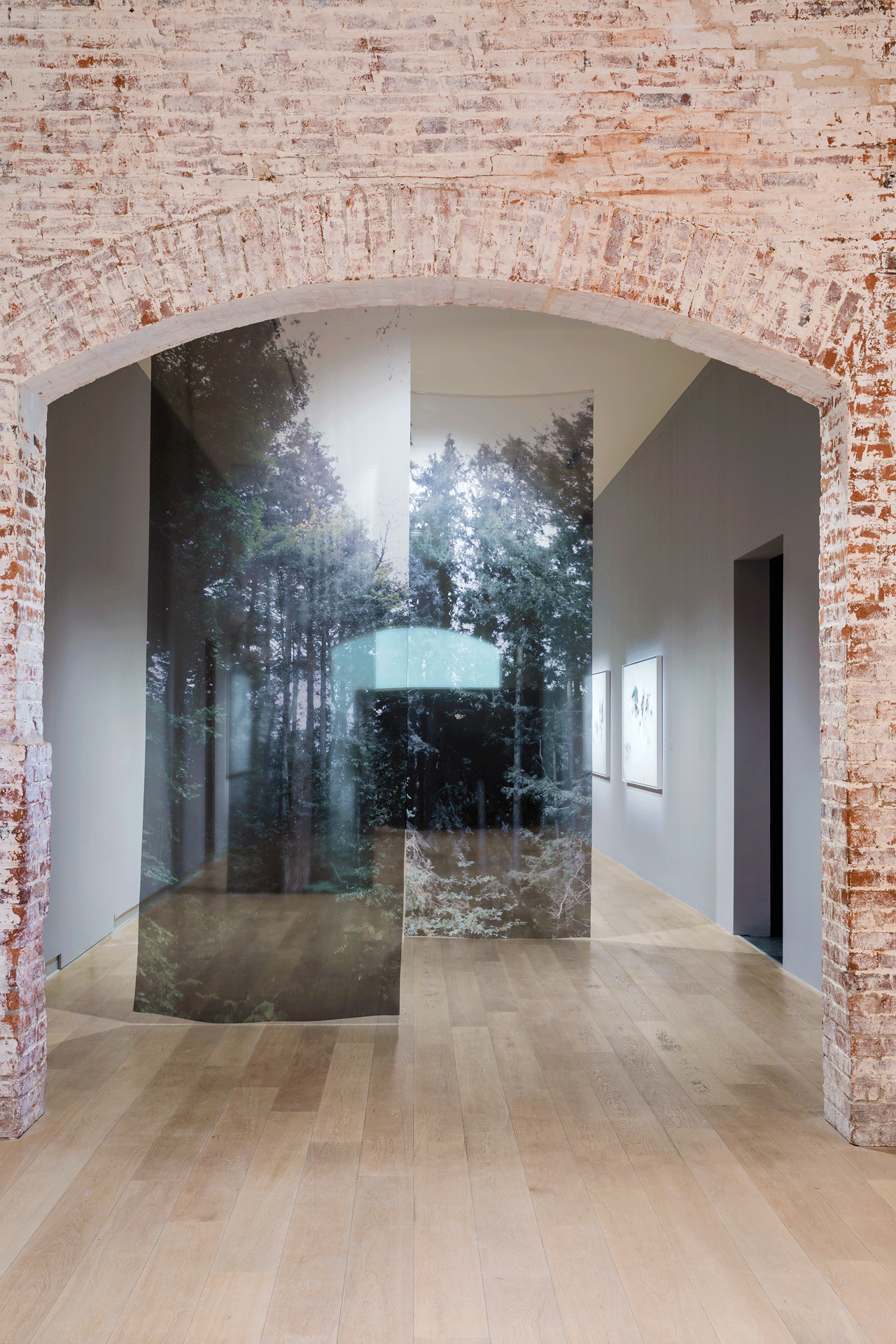
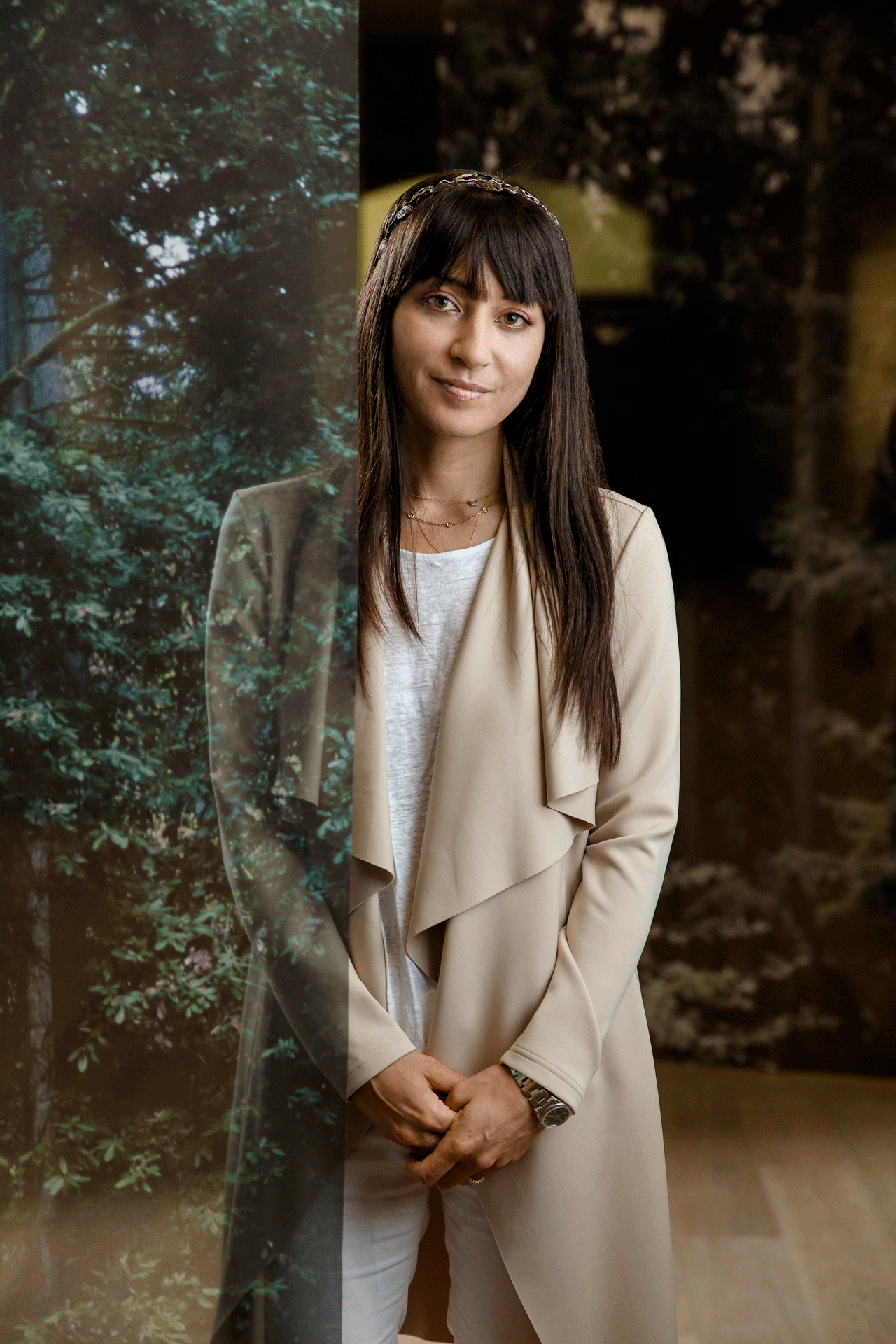
There are redwoods rising inside the museum. Printed on silk chiffon hung ceiling high, "Redwoods (Spirit)" are part of "Temporal," the ongoing show by Miya Ando at SCAD Museum of Art. Ando, of Japanese-Ukranian heritage, incorporates elements of her childhood in Japan and Northern California into works that soothe and move. During a gallery talk with SCAD head curator Storm Janse van Rensburg, Ando stated: "I'm looking for a vocabulary that is universal. I love the vernacular of nature." An edited version of her remarks follows.

MIYA ANDO:

We are all part of a system of nature. We are all having a transitory experience: the metal, the trees, our thoughts, we as people. There's beauty in recognizing the impermanent nature of our existence. There's a beauty in interconnectivity.

When I was a child living in the redwood forest in Santa Cruz, I saw that redwood trees, because they're so tall, would frequently get struck by lighting and become charred on the inside. My dad actually built my sister and I a fabulous redwood treehouse. I noticed that the charred wood on the inside of my treehouse was the same as the charred wood called Shou Sugi Ban, a traditional and regional exterior cladding in Japan.

Long vertical chiffon panels printed with redwood hang in gallery

My mother is Japanese and my grandfather was the head priest in a small Buddhist temple. Several generations prior to my grandfather becoming a Buddhist priest, my grandfather made swords. When I was a young woman being of mixed identity meant looking into my heritage. I became an apprentice in metalsmithing. There's a particular form of metalsmithing that is used on blades, it's very refined, and when the metal is folded and hammered and heated, something forms called a "hamon" – a cloudlike pattern on the edge of a sword.

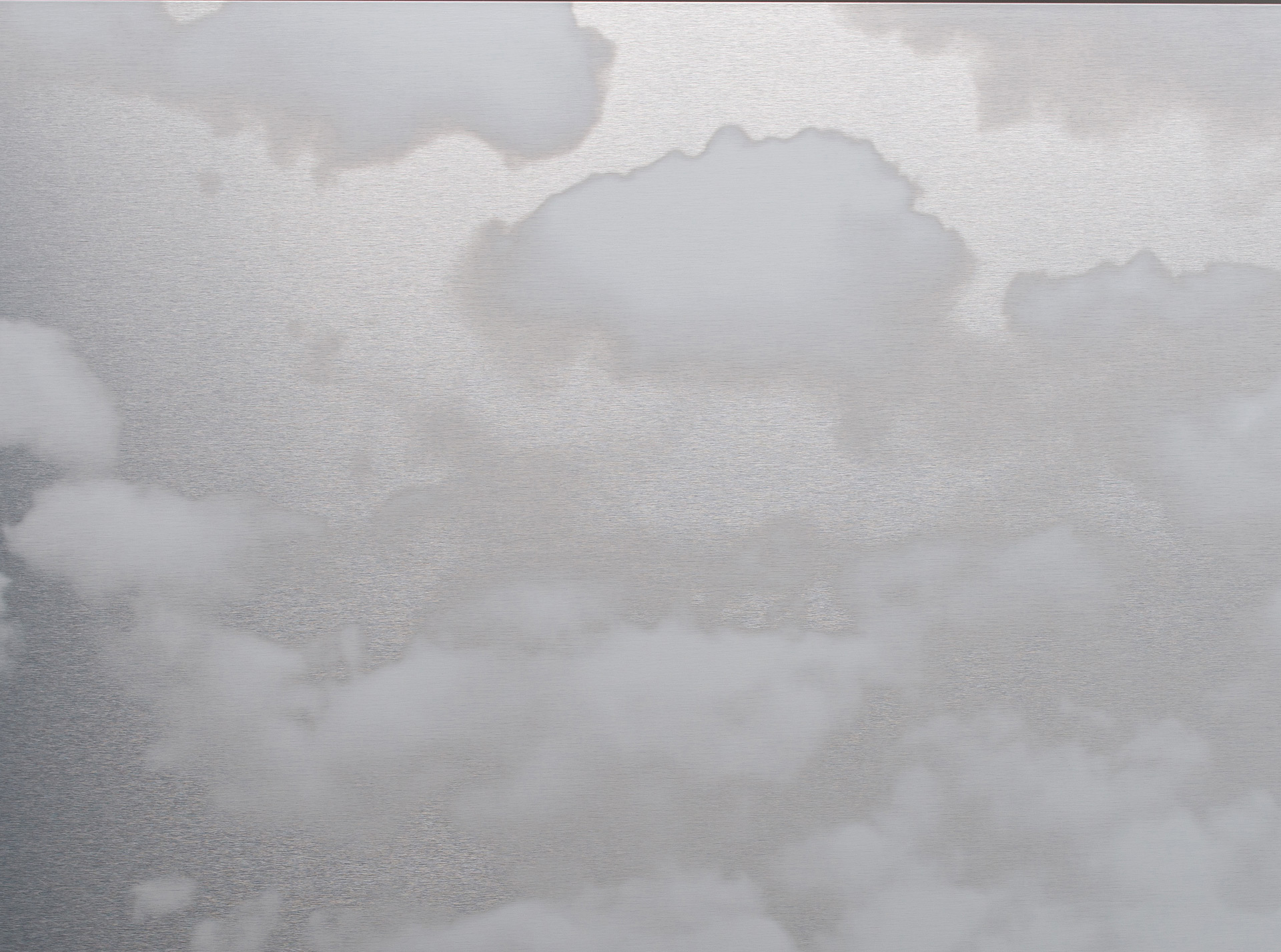
With this exhibition, I thought a lot about the five elements. In Japan, there is an element that is air, or void. The title of my piece "Emptiness the Sky" stems from a "kanji," a word called "Ku" which means empty, but its second meaning is "sky." A poetic notion. In the east you have a glass half full with water and half full with emptiness. There is thing-ness to space. There is such-ness that takes volume.

White clouds float against a steely gray background

The material choices of these works prepare one for what the metaphysical or spiritual underpinnings of the pieces are. The charred wood has been through a transformation, and then inside you have empty space.

These are experiential works, activated by the viewer, that change as your viewpoint changes, from different angles, as you move about the piece, so that one angle does not comprise "the piece." These are works that are difficult to Instagram.

We know we're inside of a museum but when trees are inside, when clouds are inside, it gives a different perception of what a space can be.

Miyo Ando poses amongst her work, half her body is covered by transparent panels featuring images of redwoods

"Temporal" is on display through Sunday, Jan. 14, 2018 at SCAD MOA.


'SCAD: The Architecture of a University'

September
1
2017
By
Tags:

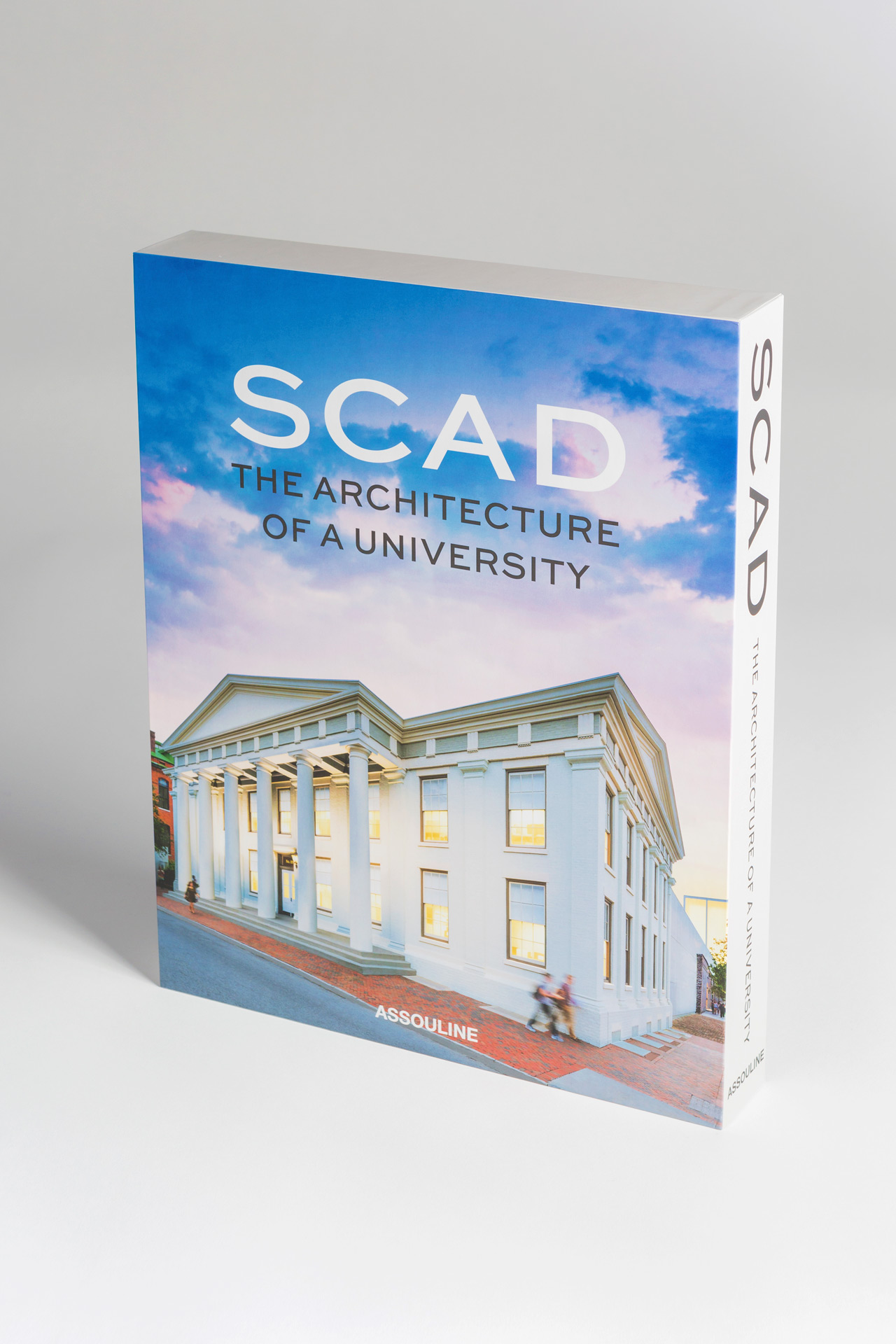
The venerable publishing house Assouline has released "SCAD: The Architecture of a University" by contributing authors Paula Wallace, Margaret Russell and Chuck Chewning. The 360-page volume, replete with 40 detailed narratives and 200 sublime photographs, highlights the university's most inspired and inspiring spaces. In this excerpt from the foreword, President and Founder Paula Wallace leads readers from the university's flagship building, Poetter Hall, to the panoply of SCAD architectural marvels around Savannah, and in Atlanta, Hong Kong and Lacoste.

By 1981, two years after we'd first cleaned its windows, the Armory was full. One building became two, then four, then ten, then twenty—the university flowered across the city like wisteria across a trellis. By the turn of the twenty-first century, the university had transformed old schoolhouses into thriving homes for fashion, fibers, foundation studies, and more. A bed and breakfast became the first SCAD dormitory. Savannah's first electric power station became the home of the university's department of film and television. The oldest extant railroad depot complex in North America is now the SCAD Museum of Art, recipient of the American Institute of Architects National Honor Award for Architecture. An empty downtown department store was rehabilitated into a world-class university library, honored by the American Library Association and by the International Interior Design Association. A decaying art deco playhouse is now home to the university's Savannah Film Festival. One of Savannah's oldest public high schools is now home to the SCAD School of Liberal Arts. The old and dying city was old, but it wasn't dying—it was just waiting for new life to fill its sidewalks and buildings. SCAD helped make that happen. Today, Savannah is a historical city with an inventive spirit and sparkling, bright future.
 
SCAD soon turned to other communities across the globe, offering students more opportunities to transform themselves and their world through art and design. In Atlanta, a former television studio is now home to the SCAD Digital Media Center, and one of the most beloved historic residences in all of Midtown is now home to the SCAD Atlanta Writing Center. In France, a former bakery has become the SCAD Lacoste library, while a decrepit farmhouse dating to the Middle Ages is now the best student housing in all of higher education. In the Sham Shui Po district of Asia's World City, a handsome midcentury magistracy is now home to the vibrant SCAD Hong Kong.
 
Out of more than one hundred SCAD properties around the world, fewer than ten have been newly built.
 
The world has taken note. In Savannah, it's not unusual to see wedding parties and families having their photographs taken around SCAD buildings, as often happens on the steps of Lai Wa Hall, a former residence now housing the executive administration. Anthropologie, J.Crew, and other fashion retailers have photographed in SCAD buildings. The brilliant interiors and memorable façades of SCAD can be seen in the occasional film, more of which are being produced in Georgia every year. The university's long history of adaptive new use has earned top awards from the National Trust for Historic Preservation, the American Institute of Architects, UNESCO, and others.

SCAD commissions original work from students and alumni for classrooms and offices, ensuring that students of art history, illustration, painting, and sculpture see their professions manifested within the walls of the university. SCAD has shaped the practice of architecture, yes, but architecture also has shaped SCAD.
 
The university's buildings radiantly depict to our students how resources can be reimagined and repurposed. Newer is not always better, as every generation—including millennials—must learn. In truth, the greenest building is the one that's already built.
 
As the university nears its fortieth anniversary, we have chosen forty SCAD buildings from around the world to feature in "SCAD: The Architecture of a University." It wasn't easy leaving out dozens of glorious properties, but to include any more would have required a building permit just to pick up the book. An eclectic mélange of historic and modern structures, the buildings are arranged by the date on which they were first inhabited by the university—as opposed to the date of original construction—beginning with Poetter Hall and moving to the present. In the latter half of the book, we've highlighted forty milestone moments from the university's past. These images and accounts, I hope, provide some sense of the history and beauty SCAD students are fortunate to call their own.

Cover of the book SCAD the Architecture of a University featuring Kiah Hall in Savannah

Life on Planet Fun

August
29
2017
By
Tags:

John Croley (B.F.A. animation, 2006) arrived in Savannah to study animation and ended up creating a retail oasis for serious collectibles and nifty toys. Learn from the master of character culture as he discusses how he makes our planet more fun.

SCAD: What was the big bang that started Planet Fun?   
 
CROLEY: When I attended SCAD, I always wondered why there wasn’t a place like this downtown. After I graduated, I decided to come back to Savannah and create the kind of store I wanted to see. We started off with a much smaller store down the block. The first day we were open, it was primarily stocked with my treasured personal collection of toys, comics and video games. I planted the seed with that fun stuff and hoped something bigger would grow. Of course, on our second day, someone showed up to sell me more, and it hasn’t stopped growing since!
 
SCAD: Would you say you’re a purveyor of fine fun goods?
 
CROLEY: My criterion for what we buy is really simple: Is it fun? We offer cash or store credit for the merchandise people bring to the store, and we’ve had all sorts of cool things come in. Popular video games, valuable collectables, bizarre memorabilia —you never know what will turn up. I order new items too, which I like to think of as a carefully curated selection. When ordering a toy, I try to find something children will want, but an adult might also find interesting. We really do try to have something for everyone. My main hope is for everyone visiting Planet Fun to have a good time.

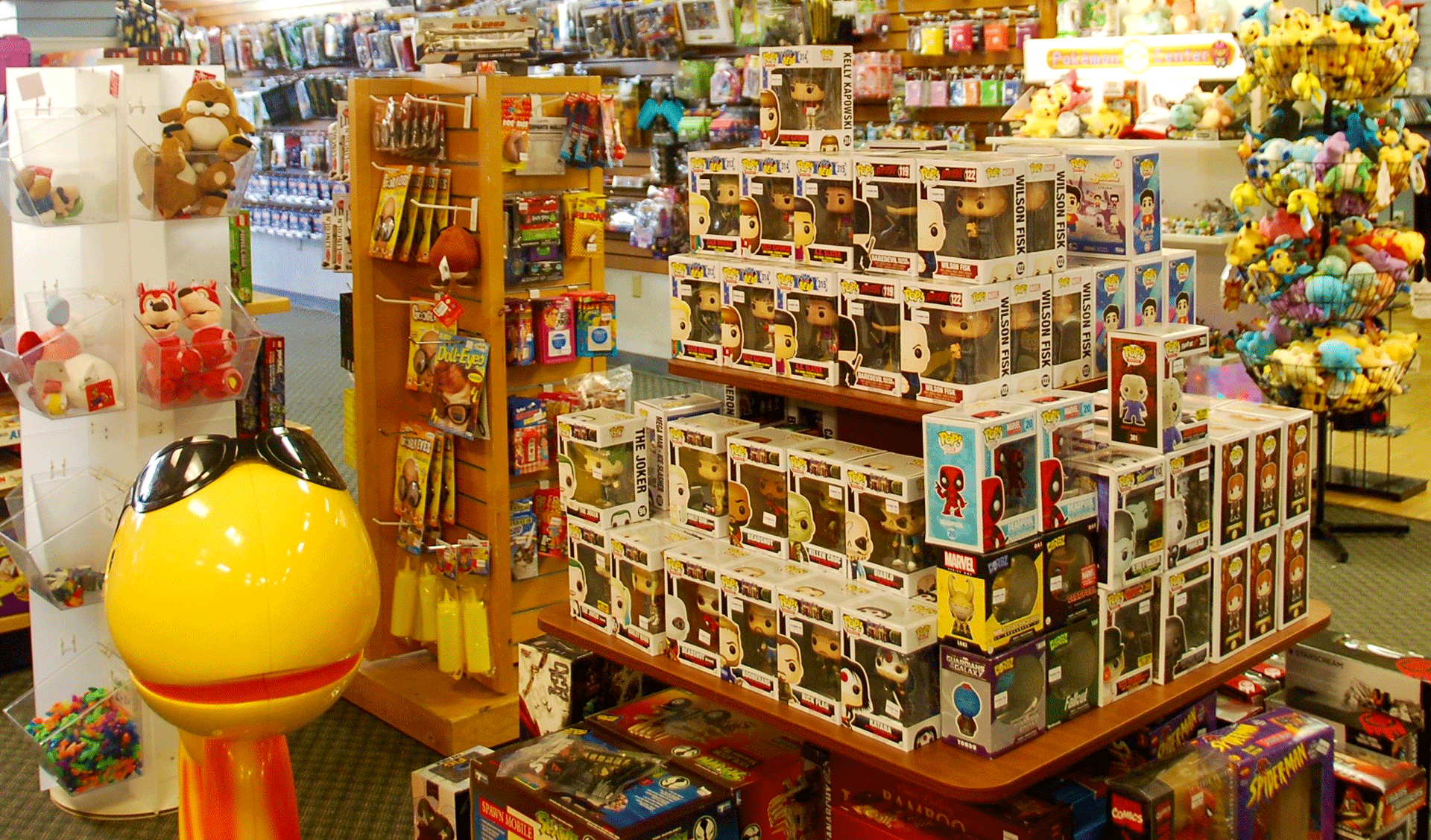
Inside store Planet Fun with shelves of small dolls and other merchandise

 
SCAD: How did your SCAD education help prepare you for this?
 
CROLEY: Just being in Savannah helped me get a sense how Planet Fun would fit in. Without SCAD, it never would have occurred to me to open a business in Georgia. And there are plenty of lessons I learned that helped. For example, I did a painting of the Ghostbusters’ ECTO-1 in a foundations class, but I cropped the bumper off. My professor asked me why, and I said I ran out of space. She explained that I control the drawing on the canvas, so I couldn’t run out of space.
 
That lesson can be applied to a lot of things in life, from properly composing a painting to trying to cram six arcade cabinets into a store. The animation department shaped me, as well, from the focus on pop culture to the art itself. In some ways, animation deals with creating spaces and arranging details to make things flow and fit. That’s an important part of making a store fun and lively.
 
SCAD: Any advice for those aspiring towards their own creative success?
 
CROLEY: Pay attention to what occupies your thoughts and try to create something out of it. It was important that I started small and worked to build something sustainable. Listen and keep your mind open so you don’t miss unexpected opportunities.

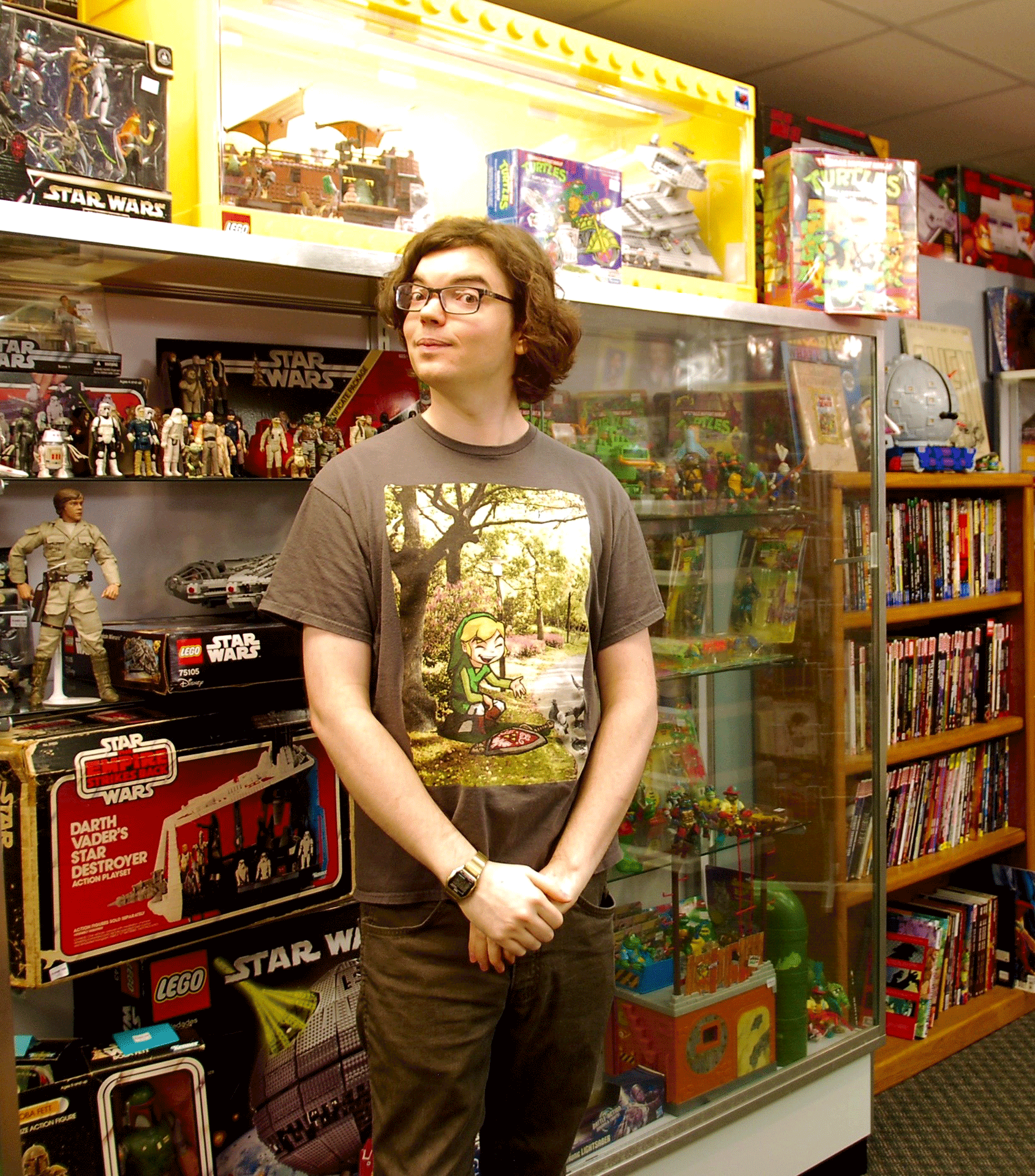
John Croley stands inside his store Planet Fun in front of shelves of toys and figurines


Visit: Planet Fun 127 E. Broughton St. Savannah, GA 31401

(912) 201-0228
 

Roger Mainwood delights AnimationFest

August
16
2017
By
Tags:

As students settled into their seats in a darkening SCADshow for "Ethel & Ernest," the buzz of SCAD AnimationFest was palpable. Adapted from a graphic novel by Raymond Briggs and voiced by actors including Brenda Blethyn and Jim Broadbent, the feature film is directed by animation master Roger Mainwood. At SCAD AnimationFest, Mainwood, who has seen the industry evolve significantly since his start in 1979, shared a sliver of his knowledge with SCAD students and readers.

SCAD: What do you hope SCAD animation students learn from seeing "Ethel & Ernest"?

ROGER MAINWOOD: I'm pleased that we are reviving the art of hand-drawn animation. One of my inspirations for using the software TVPaint was a film from 2009 called "My Dog Tulip." I thought if a two-person team can make a feature film using TVPaint, this gives us hope. We were going to make "Ethel & Ernest" using the traditional method of pencil on paper. We made a big decision around 2014, to move everyone over to TVPaint and draw directly onto Wacom tablets. You still have to do all the hard work of animation, but it does give a smooth workflow. I hope this inspires SCAD students to keep going with hand-drawn animation!

SCAD: How is technology affecting animation?

MAINWOOD: One of the big changes now is that there is so much work to do in post-production and compositing. Before, you had to get everything into the camera in one take. Now, you can play around with lighting and layers and compositing. Although I say "Ethel & Ernest" is a hand-drawn film, there is a lot of 3D computer work in there, on planes, buses and so forth. We gave the 3D animation the look of hand-drawn animation by making the linework around it sympathetic.

SCAD: How did the time period of the story influence the art direction for the film?

MAINWOOD: Researching the period was really pleasant. We had a lot of help from "Ethel & Ernest" author Raymond Briggs. He drew a plan for the house. In the book, you don't really get a sense for how the rooms connect to each other. I didn't realize there was a step from the kitchen into the scullery, where you had the sink. That kind of detail informed the way the animators animated, with a skip up and a skip down. Authenticity was the name of the game. We also researched the sound design. Our sound engineer went to Duxford Air Museum, where they still fly old World War II Spitfires. We had one of those fire up and take off, so he was able to capture that authenticity. We found a 1930s bike, so we could capture the ratchety sound of the wheels going ‘round. You aren't necessarily aware of it when you're watching the film, but if it wasn't there, you would be.

SCAD: What is your key piece of advice to SCAD animation students?

MAINWOOD: Draw, draw, draw, every chance you can. Even if you're working in 3D computer animation, you need that basis. I appreciate broad, cartoony animation but I've always done more naturalistic animation. No matter your style, I emphasize getting those drawing skills behind you. It's the best thing you can do.

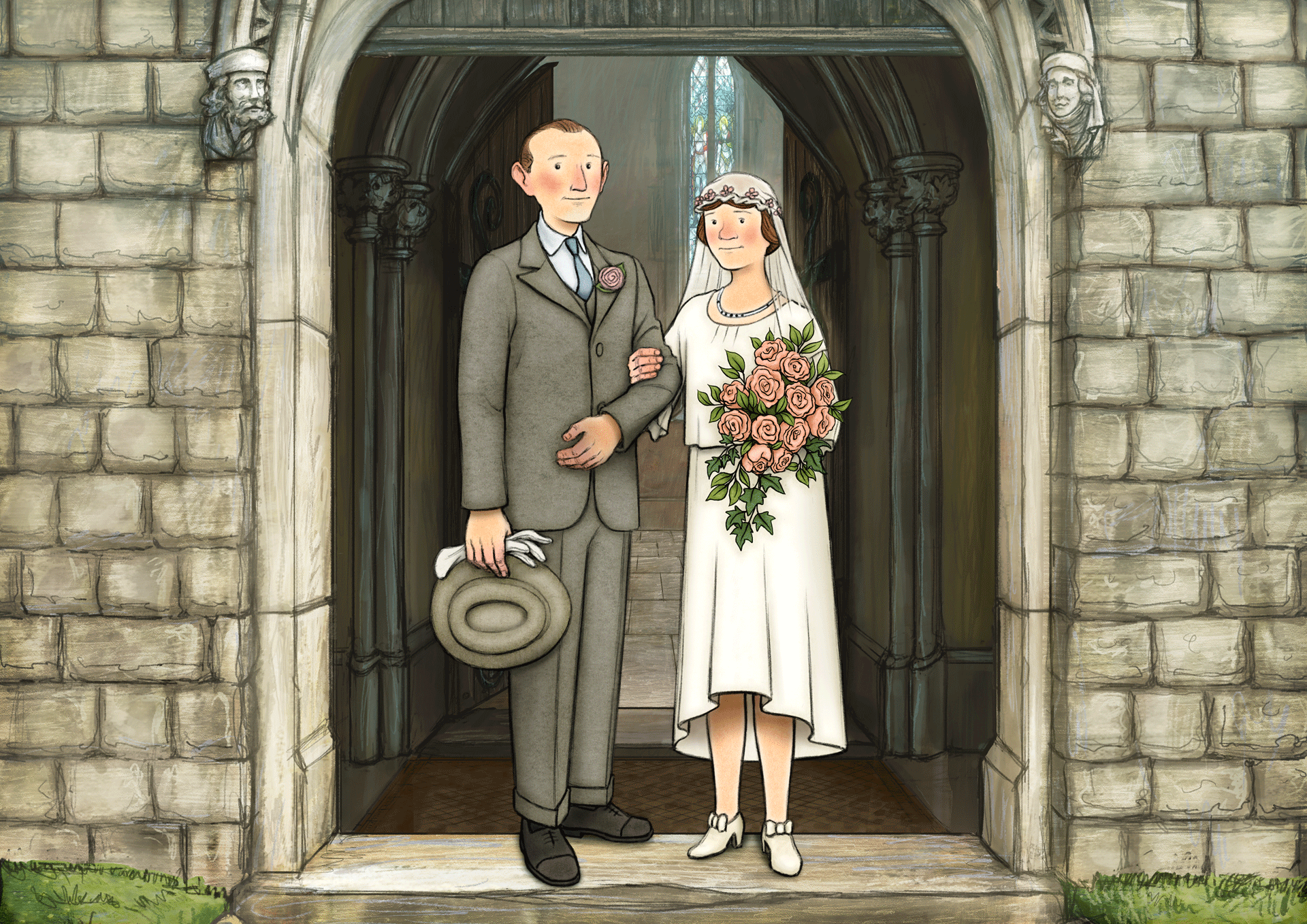
Scene from animation with Ethel and Ernest standing outside of church wearing suit and wedding dress

Visit the "Ethel & Ernest" website to find a screening near you.

Catlin Scroggie: Truth, justice and heroic lighting

August
15
2017
By
Tags:

Catlin Scroggie (B.F.A., animation, 2015) came from her New Market, Iowa hometown to SCAD Atlanta with her sights set on the entertainment industry. Within two years her work appeared in “Wonder Woman,” the summer blockbuster of 2017. As lighting technical director, Scroggie used her own super powers to bring the digital film set to life.

SCAD: What drew you to the field of animation?

CATLIN SCROGGIE: I always knew I wanted to be an artist. I started at a state school, trying to get a fine arts degree. A mentor recognized potential in my work and handed me a SCAD catalog. When I saw people studying to work in film and animation, I knew that this was exactly what I wanted to do. I transferred to SCAD and enrolled in animation. After working really hard, I put my portfolio together, applied at Pixar for the PUP internship in Technical Direction and I got an interview. Already, I had made it farther than I ever dreamed possible.

SCAD: What were your duties as lighting technical director for “Wonder Woman”?

SCROGGIE: If you imagine a film as a digital set, everything starts out in darkness. It’s the role of the lighter to craft a believable world and set the film's mood. In VFX, the lighter integrates live action footage with CGI elements by simulating the same lighting and atmospheric effects as the physical world. Lighters must have a scientific understanding of how light reacts in the real world to accurately simulate it in the digital world.

On “Wonder Woman” I was really fortunate to have an amazing team lead to help me grow and learn. The most challenging thing was the level of pressure placed on artists to overcome the stress of technical hurdles and impending deadlines. It was a huge payoff to see my work on the big screen for the first time.

SCAD: How did you begin your career as an animator after you graduated from SCAD?

SCROGGIE: At SCAD Career Fair, I interviewed with MPC and Method Studios, however MPC was the first to offer me a position in their Academy, thanks to a recommendation from a former SCAD classmate, James Lojo (B.F.A., visual effects, 2014). After graduating the MPC Academy, I went on to work on “Wonder Woman,” “The Mummy,” and “Jumanji: Welcome to the Jungle.” I am now working at Cinesite Studios on Sony Animation’s feature film “The Star,” a retelling of the first Christmas. This is my first feature animation film and I am hoping to use this experience to shift from visual effects to a career in feature animation.

SCAD: What is the most important lesson you learned at SCAD?

SCROGGIE: Success is not a linear path. Originally, I thought I wanted to work in classical hand drawn animation but after my time at SCAD I realized that a career in the technical side of film would help me to grow successfully within a rapidly changing industry. Ultimately, artists have to be willing to adapt to new technologies if they want to survive.

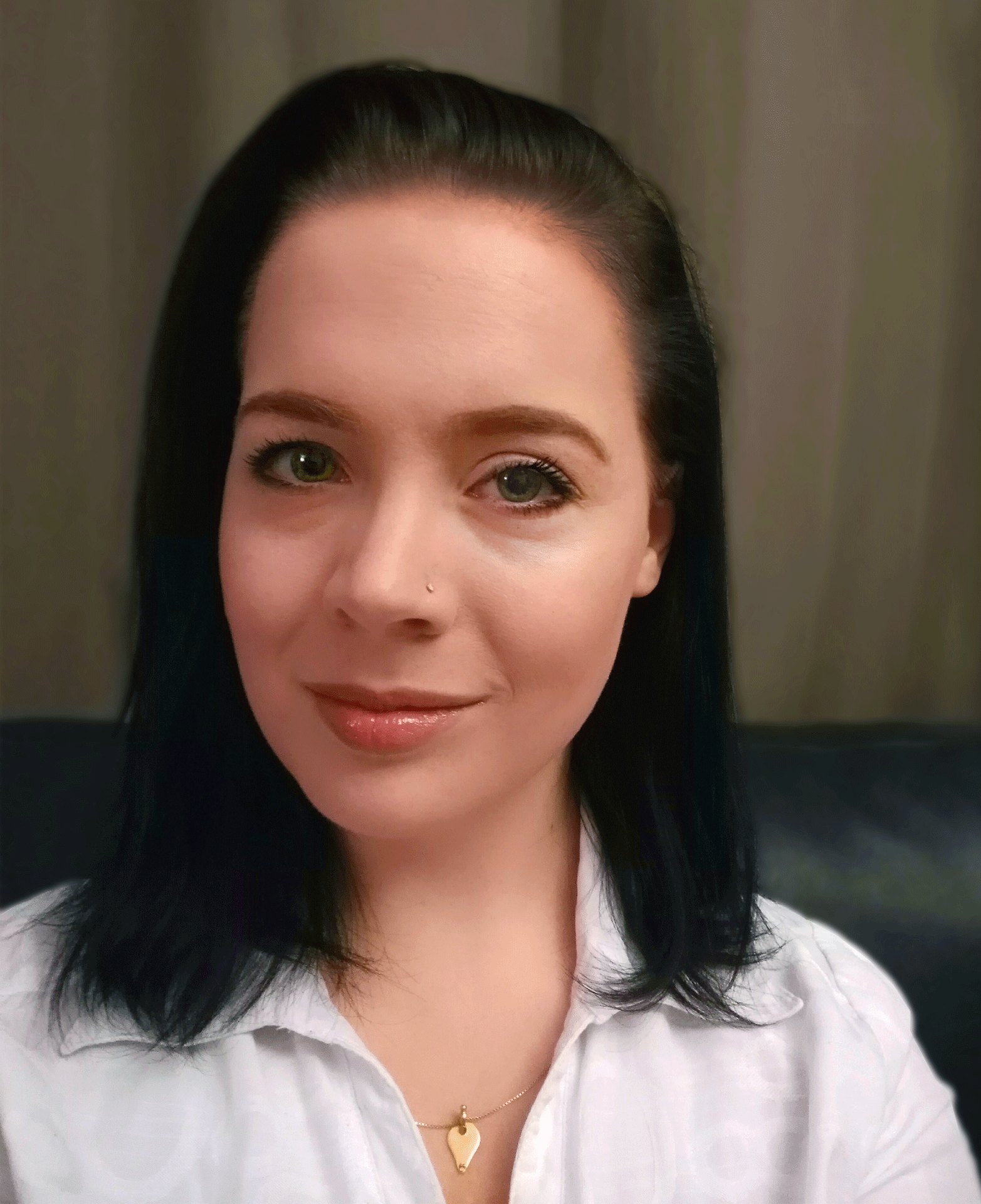
Catlin Scroggie smiles and wears white collar shirt, gold necklace and nose piercing

Congratulations to the following SCAD alumni who worked on the feature film “Wonder Woman”:
Carlos A. Alarcon (M.F.A., visual effects, 2010), compositor
Jenn Epstein (B.F.A., visual effects, 2005), senior digital compositor
Josh Evans (M.F.A., visual effects, 2013), matte painter
James Joshua Lojo (B.F.A., visual effects, 2014), VSFX artist
Andrew Maynard (B.F.A., visual effects, 2015), FX artist
Ryan Ruiz (M.F.A., visual effects), technical animator
Madeleine Scott-Spencer (B.F.A., animation, 2005), concept artist
Catlin Scroggie (B.F.A., animation, 2015), lighting TD