Skip to main content Accessibility Policy

Gayle Fichtinger illuminates Rome's great sculptor

March
6
2017
By
Tags:

"They say Rome was his city, and it really was," SCAD professor of foundation studies Gayle Fichtinger declared, referring to the preternaturally prolific 17th century Italian artist Gian Lorenzo Bernini (1598–1680). "Around every corner there's another Bernini."

Gian Lorenzo Bernini sculpture of winged angel in Rome

Fichtinger, herself an accomplished sculptor and ceramicist, delivered her lecture "Following Bernini's Terracotta Angels to Rome" in SCAD's Alexander Hall, detailing her recent trip to Italy's capital to investigate the Baroque master's work. Facilitated by a SCAD Presidential Fellowship for Faculty Development, Fichtinger's inquiry had its roots in her own academic experience.

"From Survey of Western Art, I remember Bernini's 'Ecstasy of Saint Teresa' the most," Fichtinger said. "It was very theatrical and didn't really appeal to me – I was more of a Renaissance person. But the more I looked at Bernini's work in recent years, I realized it was much more dynamic than Renaissance work, so much about light and narrative and the moment of something happening."

Having apprenticed in the workshop of his father, Mannerist sculptor Pietro Bernini, the prodigal Gian was operating his own workshop by the time he was 22. He earned commissions from religious patrons including Cardinal Scipione Borghese, who prized the dramatic naturalism of his sculptures. Bernini continued to create until completing his final commission at age 80, still driven by his desire to have his marble sculptures renderred "pliable as wax."

Fichtinger illustrated her insights with striking snapshots she and her husband Paul took during their trip. These included images of Ponte Sant'Angelo, the Tiber-spanning bridge adorned with sculptures of angels, as well as the travertine spiral staircase inside the Basilica di Santa Maria Maggiore and the distinctive water-supping bees of the Fontana delle Api.

Detail of a bee on a Gian Lorenzo Bernini sculpture

"We discovered things every step of the way," Fichtinger recounted of their wayfaring week. "The travel guides, the research I'd done, the lists didn't include everything. We'd arrive at another location and it was, 'There's another Bernini in here!'"

Keen to impart the lessons from Bernini's career to SCAD students, Fichtinger delineated Bernini's process, from initial charcoal sketches, to bozzetti, modelli and modelli grande, emphasizing the versioning of work in pursuit of an ideal. She quoted Bernini himself from the book "Bernini: Sculpting in Clay" (Metropolitan Museum of Art, 2012):

"You need to draw from your eye, that is imprint everything in your mind and always make sketches and drawings from your different ideas. Judge them and consider their errors against ancient and modern works. Always preserve that idea even in the most elaborately worked things and contemplate the many prints in order to see the variation within the idea."

Fichtinger's lecture was a masterclass in maintaining a conversational tone when speaking from a fount of deep knowledge. Ottimo lavoro, professore!

Madame Gandhi inspires students at deFINE ART

February
27
2017
By
Tags:

"We should look inward to discover our immediate passions," said artist-activist Madame Gandhi, addressing the packed theater inside the SCAD Museum of Art, with her hand on her heart. "What do we care about?"

As part of deFINE ART 2017, SCAD presented two events with Madame Gandhi, the stage name of Los Angeles-based musician and feminist activist Kiran Gandhi. During her opening-night performance, Gandhi shared insights from her own career path and stressed the importance of putting passion first.

After a camp counselor introduced her to the drums at a young age, Gandhi abandoned her "oppressive piano lessons" and took to practicing the drums every day. As she began to identify as a drummer, Gandhi realized her passion for percussion wasn't fully shared by her parents.


"I got the sense — especially from my dad — that drumming was just extracurricular," Gandhi told the audience. 


After studying mathematics as an undergraduate student, she landed an internship with Interscope Records, where she began accruing valuable experience in the music industry.

"[My dad] would call me, questioning 'What's the next move? Are you going to get a job?'" Gandhi told the audience. "I said 'Papa, I'm not going to take your calls if they're oppressive.'" At this, several students laughed and clapped in approval.

Post-internship, Gandhi accepted a job at Interscope analyzing Spotify streaming plays. Then, just as she'd been accepted to business school, a chance meeting with M.I.A. led to Gandhi securing a spot as the drummer in London-born Sri Lankan rapper and activist's all-female band.

With grad school approaching and M.I.A.'s world tour about to kick off, Gandhi knew she had to make a choice. She chose both. 


"On a Monday I'd go to class, and then catch a 3 p.m. shuttle from Boston's Logan to New York to play the first of five shows," Gandhi said, counting her steps on her fingers. "At 4 a.m. I'd go back to the airport and fly back for class. That was all week long. And it worked!"

As busy as this time was, Gandhi told the audience she felt "focused on her mission."

"I was an artist, traveling the word and getting to make music," Gandhi said. "What else is there?"


Madame Gandhi plays the drums at theater inside the SCAD Museum of Art

Gandhi closed the discussion with two songs from her 2016 EP "Voices," alternating from vocals to percussion and proudly proclaiming "the future is female" at the end of the evening.

The next day, Gandhi returned to the SCAD MOA theater to host a workshop titled "Own Your Voice," about "atomic living," which she explained means using spontaneity more productively.

"Teachers would ask about my 10-year plan," Gandhi admitted to the theater crowd, rolling her eyes. "A 10-year plan? I don't know what I'm doing 10 hours from now!"

Gandhi instructed students to fold a sheet of paper into three panels and number each section. In the first panel, students wrote things that brought them joy. The second panel was for students to write things they disliked about the world. The third panel was to brainstorm ideas on using the passions from panel one to correct the issues in panel two.

Gandhi concluded by encouraging students to revisit their lists and to always work towards their own happiness.

"Don't be afraid to fail," she said, as students and professors alike applauded. "Why do we teach perfection, but not bravery?"


High roller: coaster journalist Arthur Levine thrills SCAD

February
3
2017
By
Tags:

"Who has the best job in the world?" mused Gregory Beck, dean of SCAD's School of Entertainment Arts, striding the aisle of the theater at the SCAD Student Center. Bathed in blue light from the vaulted ceiling, Dean Beck clarified: "I think it's someone who gets to design theme parks for a living. But Arthur Levine may be able to top that."

As a travel writer for USA Today and Theme Parks Expert for about.com, journalist Arthur Levine has ridden rides worldwide most enthusiasts only dream about. Last week the "avowed park-aholic" visited SCAD to view student work and present his lecture "Theme parks and the future of fun." He'd come to the right place: SCAD offers the world's first and only M.F.A. program in themed entertainment design, a growing, multi-billion-dollar industry. SCAD alumni currently work at companies including Walt Disney Imagineering, Herschend Entertainment (Dollywood, Silver Dollar City), and Universal Studios.

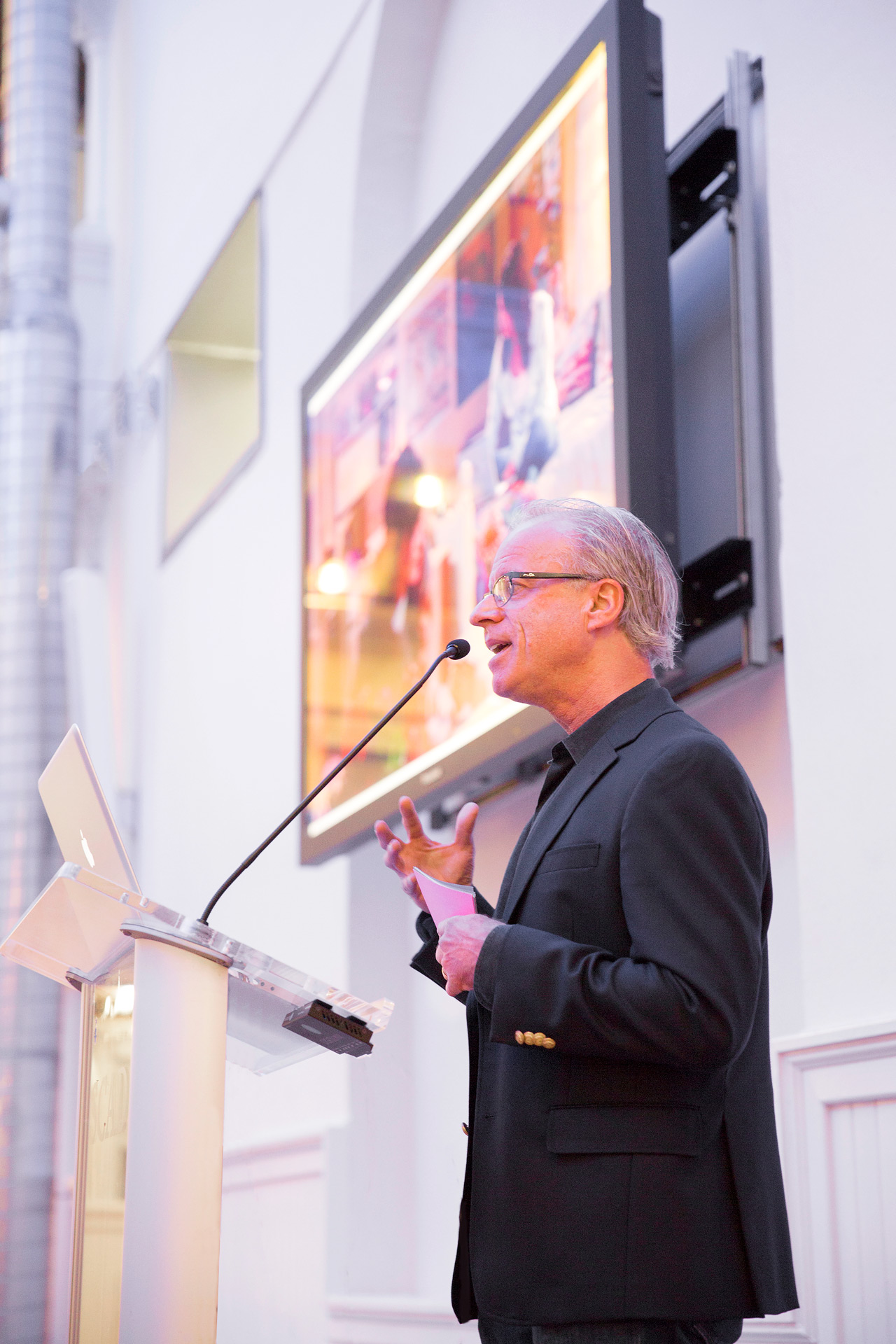
Journalist Arthur Levine stands at podium during talk with SCAD students about themed entertainment design

Approaching the podium Levine thanked Dean Beck for the preamble: "But if you don't mind, I brought my own introduction." Levine then screened a clip from an episode of "Gilmore Girls," where Lorelai and her daughter Rory plan their big rollercoaster adventure while consulting the online reviews of, in Rory's words, "the venerable Mr. Levine, a legend in coaster criticism."

His beaucoup bona fides pleasingly in place, Levine spoke of his experiences on hyped rides including TRON Lightcycle Power Run (Shanghai Disney), Twisted Colossus (Six Flags Magic Mountain) and Cobra's Curse (Busch Gardens Tampa Bay). Levine examined developments in themed entertainment from gamification (Legoland Florida's Ninjago The Ride) to drones (Disney World's Starbright Holidays show) and one of the biggest trends — virtual reality.

"Parks and designers are racing to incorporate virtual reality into attractions," Levine explained. "At its essence, going to a theme park is a very social experience. You go with your friends, with your family, with groups, and you love having the communal experience together, and with other people who are strangers. That's at odds with virtual reality where by its very nature you put the headset on and it's an isolating experience. The technology can't lead the attraction. The story has to come first."

Levine's point clearly connected with Bees whose coursework emphasizes the art of storytelling.

"Students here have great passion and are very collaborative," Levine said. "For that I applaud you. I'd like to see all of you continue to maintain that passion for what you do once you leave SCAD. For the students in the Themed Entertainment program, I pledge that if you continue to do what you love and design cool attractions and experiences, I will write about them and let the world know what you're doing."

With Levine's pledge in place, the ride has just begun.

A fashionable conversation: Brandon Maxwell and Ray A. Smith

January
27
2017
By
Tags:

“I’ve never had this many people listen to me talk,” Brandon Maxwell said, peering out at a packed SCAD Museum of Art theater, “although my family is close to this size.”

The quip from the designer was nearly as revealing as one of his deep-V dresses.

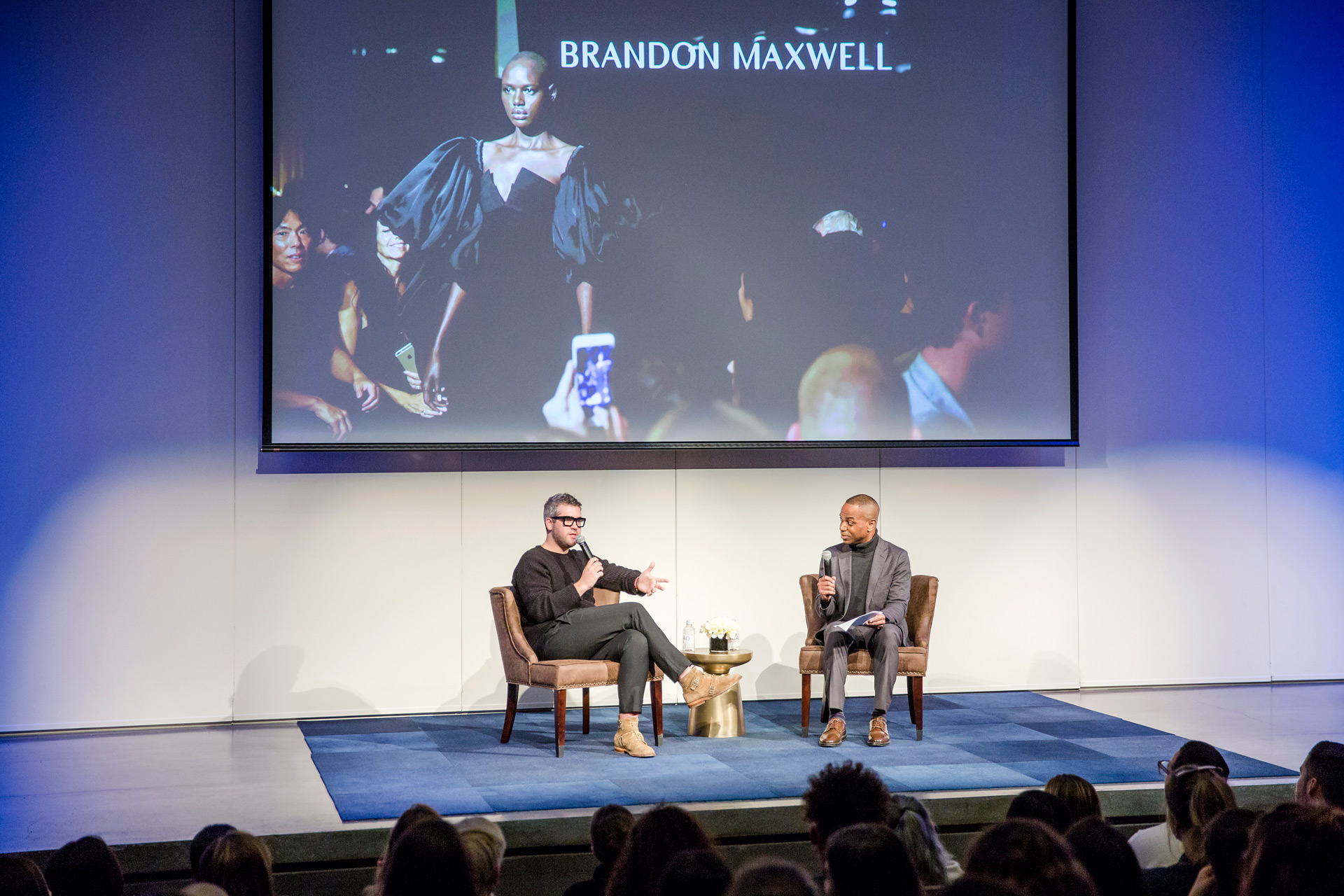
Brandon Maxwell and Ray A. Smith talk on stage, behind them is a large image of a runway show

Since launching his eponymous label in 2015, Maxwell’s strong, structural garments have been worn and adored by Kate Hudson, Jennifer Lawrence, Michelle Obama and Oprah Winfrey. Winner of the Fashion Group International Rising Star Award for Womenswear, the 32-year-old Maxwell has served as Lady Gaga’s fashion director since 2012. Yet his conversation with Wall Street Journal style reporter Ray A. Smith before a rapt crowd of SCAD students emphasized family over celebrity.

“My grandmother was a buyer who ran a clothing store,” Maxwell said of his east Texas boyhood. “Watching her set up every accessory and every shoe and every dress as all the women would come in, that’s where I learned to be a stylist. She made sure I had the tools to make things. I’d make outfits, put extensions in my girlfriends’ hair, dress them up and shoot photographs of them. I do the same thing now that I did was I was 10, 11, 12 years old. I was creating all the time.”

Prompted by Smith, Maxwell recounted his eventual arrival in New York, and his first adult gigs styling under art directors Deborah Afshani, Edward Enninful and Nicola Formichetti: “The through-story with all of them was they are kind people who treat other people really well. I learned you could have success and still be nice to people.”

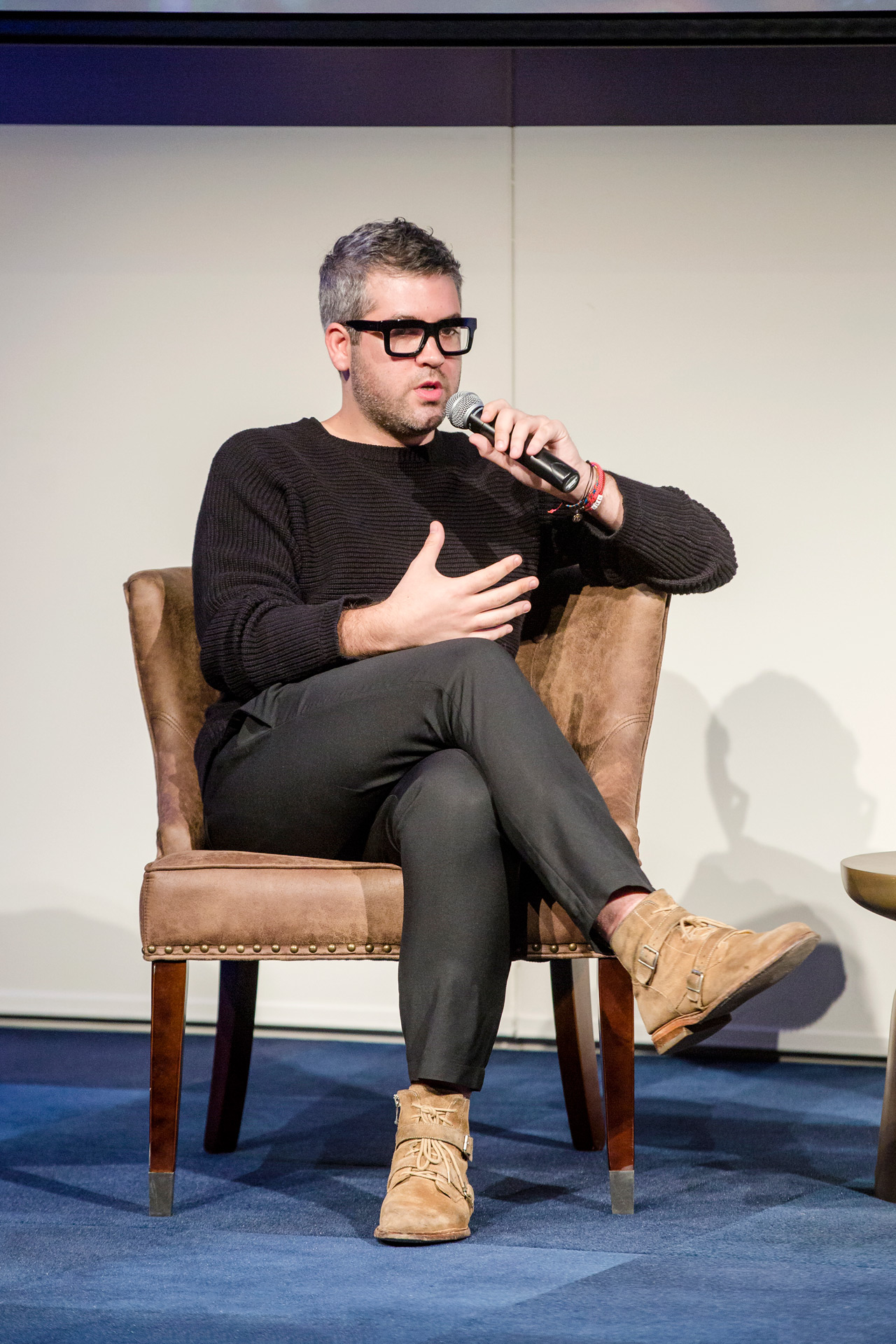
Brandon Maxwell sits with legs crossed on stage

Dressed in casual solid separates and buckled chukka boots, the affable Maxwell described his eventual leap to designing his first collection under his own name: “I didn’t think anyone would respond to it. I wasn’t in there sewing and thinking, ‘Wow, this is going to be super impactful!’”

Think again, Brandon. Bergdorf Goodman senior VP Linda Fargo bought the entire collection to be sold at the legendary New York department store.

Since then, Maxwell has been fêted widely while working incessantly to grow his label, creating four collections a year. When Smith asked if he was concerned people might believe his success is contingent on his long-term association with Lady Gaga, Maxwell replied: “Fantastic! I’m 100% fine with that, and 100% proud of the work we’ve created together for years.”

The SCAD students in attendance seemed to lean forward en masse as Maxwell concluded with some practical philosophy.

“There’s a lot of competition. Don’t let that fear bring you into circles of people who are not close to what you inherently are as a person,” Maxwell said.

“Never forget that your ideas are your ideas. When you have any success and everybody starts to chime in on what you should do and how you should act and what you should say, go look at yourself in the mirror and remember who you are. When everyone leaves you and the clothes aren’t popular, all you have is you. Stay by that and you’ll be fine.”

The applause began. Maxwell wasn’t done. “And call your mom!”

SCAD FASH presents a sartorial voyage through style and time

December
20
2016
By
Tags:

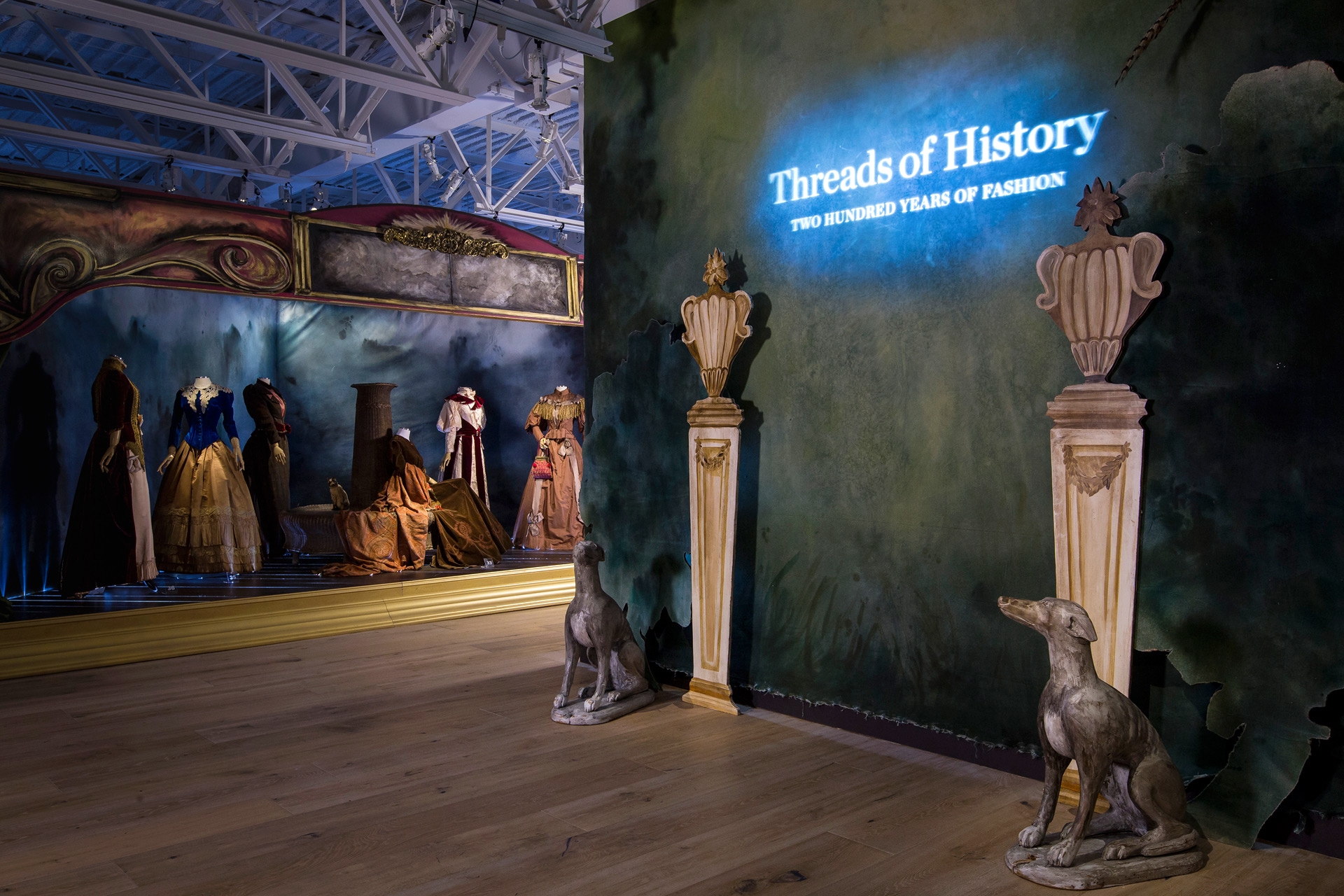
On display at SCAD FASH now through March 19, 2017, “Threads of History: Two Hundred Years Fashion” offers an unprecedented journey through womenswear, menswear and children’s ensembles from the Rococo era and the Belle Époque to the Roaring ’20s and the post-World War II New Look revolution. The exhibition illuminates society’s shifting values through the evolution of historic dress.

Over 70 rare European and American garments from the 18th through 20th centuries on display. The two oldest ensembles greet museumgoers at the exhibition entryway.

She wears a sack-back gown in brocade fabric with a floral pattern, silk tulle and lace sleeves from 1770. He wears an olive silk with embroidery in polychrome silks and a white silk satin vest with silver thread embroidery and metallic sequins from 1775. A closer look at the gown’s bustle shows that, in its prime, the garment was once a vibrant pink, though time has worn away its natural dyes.

The exhibition features artfully posed mannequins resting atop lit stages separated by ornate theatrical backdrops and props by SCAD painting professor Michael Brown (M.F.A., painting), associate dean of the School of Fine Arts Kent Knowles (B.F.A., painting, 1997) and Bryan Topczynski (M.F.A., historic preservation, 1996).

Original stop motion animations by SCAD associate chair of animation Matthew Maloney (M.F.A, animation, 2004; B.F.A, computer art, 2002) and motion media design professor Christina Maloney (M.F.A, broadcast design, 2008) accent the walls, bringing these mannequins to life.

Many of the garments on display appear courtesy of world-renowned Italian fashion professor and collector Raffaello Piraino, whose collection, housed in Palermo, Italy, consists of more than 5,000 garments and accessories that belonged to the Sicilian aristocracy and bourgeoisie. Notable items from the SCAD Permanent Collection punctuate the exhibition.

"Threads of History: Two Hundred Years of Fashion" is curated by Rafael Gomes, SCAD director of fashion exhibitions, with assistance from Luca Lo Sicco, SCAD professor of fashion marketing and management. Admission to the museum is free for museum members, and all SCAD students, faculty, staff with a SCAD CARD. "Threads of History: Two Hundred Years of Fashion" runs concurrently with "Embellished: Adornment Through the Ages." Both exhibitions are open to the public with the cost of museum admission.

Sound Advice: Erik Aadahl at Savannah Film Festival

November
2
2016
By
Tags:

What do a flying dumpling, an irate mob, and an asteroid striking Earth have in common?

The answer, of course, is Erik Aadahl.

As sound designer on “Kung Fu Panda,” “Argo,” and “Tree of Life,” Aadahl created the aural experiences for those on-screen events. On Friday, October 29, at the Savannah Film Festival, sound-savvy SCAD students and intrigued festivalgoers packed the SCAD Museum of Art theater as Aadahl discussed his work with host Michael Coleman (SoundWorks Collection).

SCAD, the first and only university to confer B.F.A., M.A. and M.F.A. degrees in sound design, provided the ideal venue for Aadahl’s insights.

“Think of sound like painting,” explained Aadahl. “If you use too many colors on your canvas and smear them together, it turns brown. A lot of times the trick is simplicity and imagining beforehand what you might be going for.”

Having worked with directors as diverse as Michael Bay (the “Transformers” series), Terrence Malick (“Tree of Life”), and Gareth Edwards (“Godzilla”), Aadahl pinpointed commonalities in his process: “It begins with the script. Read the script and start a discussion with the director. A lot of times filmmakers won’t even hear the sound until they get to the mixing stage, which is terrible. As soon as a scene starts to get cut together, do a pass on the sound and get it into the Avid. That allows sound to evolve with the picture. Sound affects the emotion of the scene, it affects the tempo. It helps inform the rest of the process.”

Aadahl enhanced his “Creating the Sound for Hollywood Movies” presentation with audio and film clips, emphasizing the interplay between sound and image. Running a serrated plastic knife down the tracks of a rubber tire, he revealed, led to one of his team’s most terrifying monster movie motifs.

“One thing we really enjoy doing is trying new things. A lot of experimentation went into creating the sounds for the characters from ‘Godzilla.’ We pulled in hundreds of props and played with them. One technique was using high-resolution microphones five times the range of human hearing. So there’s all this invisible sonic information in those recordings, but once it’s slowed down it becomes audible.”

Aadahl often records small things to massive effect, whereby “micro becomes macro.”

“In ‘Transformers’ we’ve got these enormous footsteps. One of my favorite ‘footsteps’ is made by slamming the door of my dryer at home. Slow it down and beef it up and it becomes huge.”   

A ripple of delight ran through the theater when Aadahl screened the “Kung Fu Panda” sequence where pupil and teacher grapple over the last steamed dumpling. Every chopstick click and slurping tongue sounded epic.

“When Po catches the dumpling and tosses it and says ‘I’m not hungry,’ then Shifu catches it and throws it off-screen,” Aadahl pointed out. “We were finishing the film and screened it for the Chinese distributors. They said, ‘That’s very disrespectful to throw away food.’ It was a big cultural issue. So we added the rrring! sound of a dumpling landing in a bowl off-screen.”

Sound decision, master. 

SCAD FASH: A journey through 200 years of fashion accessories

October
28
2016
By
Tags:

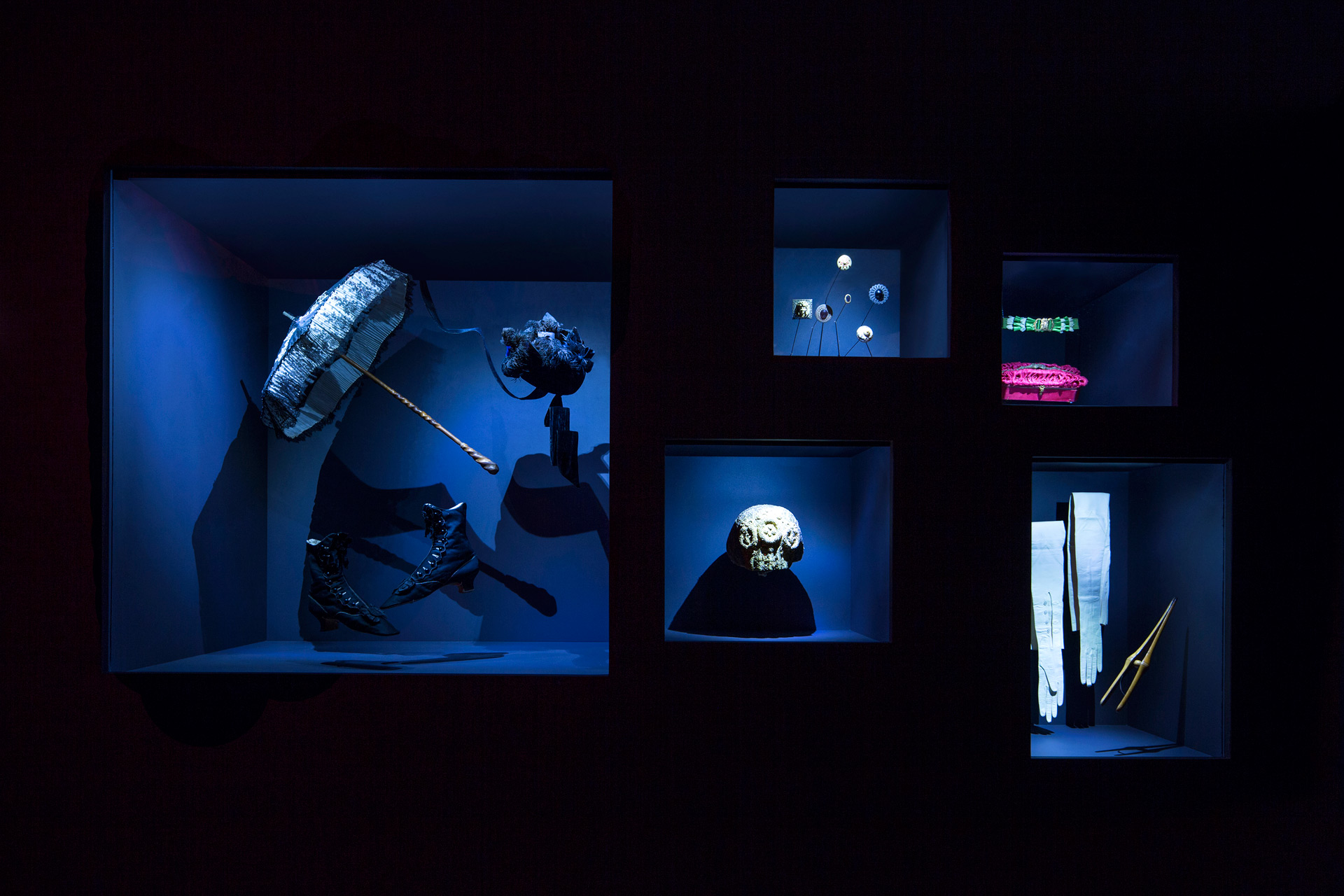
At the front entrance of SCAD FASH Museum of Fashion + Film in Atlanta, white-coat-clad student docents are eager to lead guests through the experience of the museum’s newest exhibition: a journey through 200 years of fashion. Now on display through January 29th, 2017, "Embellished: Adornment Through the Ages," is a chronicle of European and American fashion represented by hats, accessories and curios. It is the first SCAD FASH exhibition to focus exclusively on the evolution of fashion.

Guests begin their tour through the mysterious and romantically lit hallway, leading to the prominent display of the exhibition’s first piece: an Yves Saint Laurent rooster feather bolero jacket, circa 1970. From there, guests wind through a survey of adornment, from the lavish embellishments of the mid-18th century and the Belle Époque, to the sophisticated elegance of the years during and following the world wars.

Display at SCAD Fash Embellished: Adornment Through the Ages

Mystically lit to give each piece the illusion of suspension, headwear — such as a 1830s Florentine high drawn straw bonnet, a 1920s felt helmet cloche with silk embroidery and an early 20th century military felucca hat — are featured with a host of other accessories.

Interchangeable shoe buckles from the early 1700s, ornate parasols and a finger stretcher for shaping leather gloves catch the eye while strolling through the ages. Vintage magazines, a miniature fashion doll and numerous other historically significant pieces from the SCAD Permanent Collection complement these treasures, providing extensive insight into economic, cultural and political fashion history.

In addition to the captivating array of styles by Italian designer Elsa Schiaparelli, the House of Balenciaga, and French fashion icon Christian Dior, nearly all of the items on view appear courtesy of world-renowned Italian fashion professor and collector Raffaello Piraino.

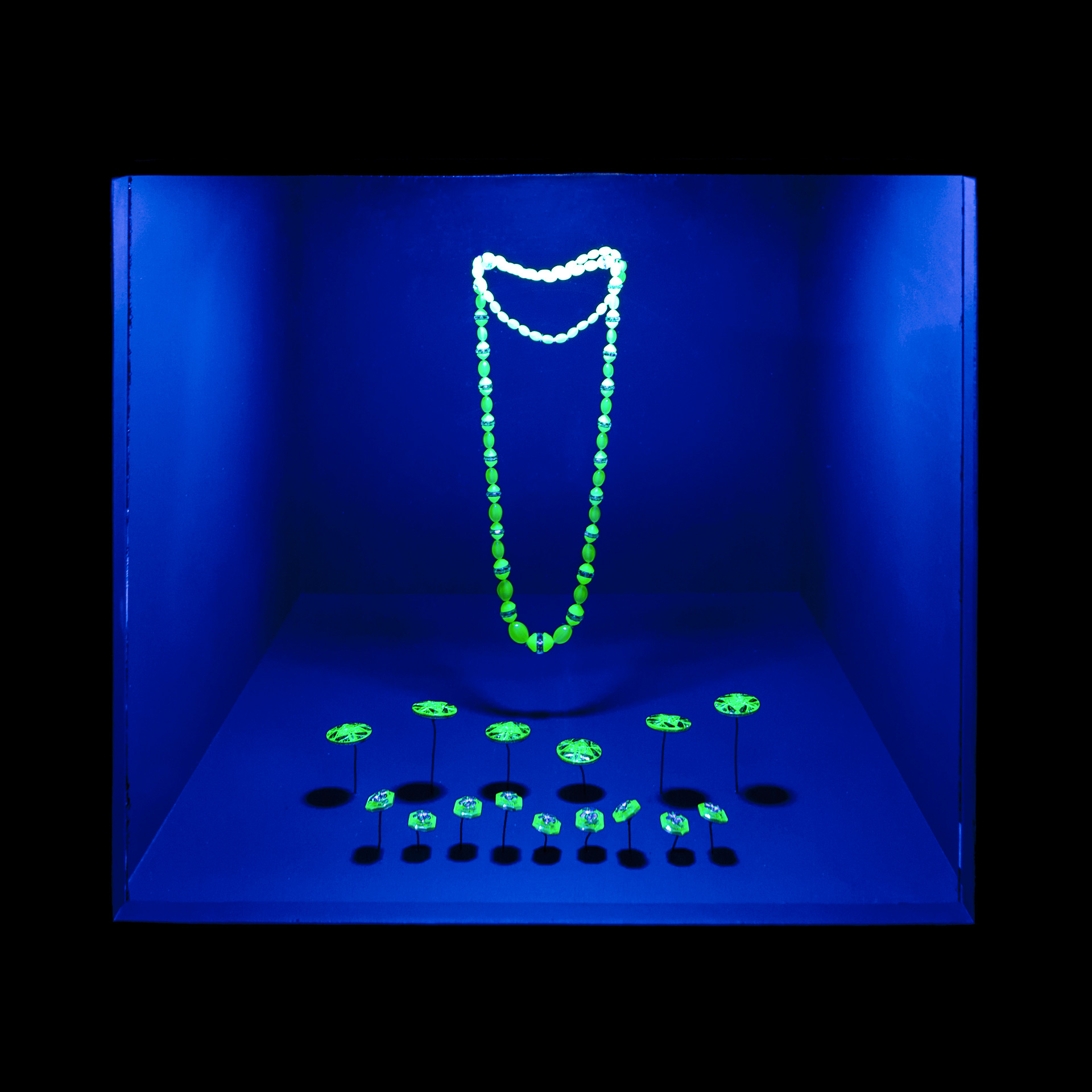
Glowing green necklace and buttons at SCAD Fash exhibition

This momentous exhibition marks the U.S. debut of selected pieces from the legendary Raffaello Piraino Collection. Housed in Palermo, Italy, the collection consists of more than 5,000 ornate garments and accessories that belonged to the Sicilian aristocracy and bourgeoisie.

"Embellished: Adornment Through the Ages" is curated by Rafael Gomes, SCAD director of fashion exhibitions, with assistance from Luca Lo Sicco, SCAD professor of fashion marketing and management. Admission to the museum is free for museum members, and all SCAD students, faculty, staff with a SCAD CARD. Open to the public with the cost of museum admission.

Animal logic: SCADFILM takes a tour on the wild side

September
15
2016
By
Tags:

Shelby the Falcon. Titus the Rottweiler. Apollo the African Pied Crow. Mangum the European Eagle Owl.

These are just a few of the four-legged and two-winged screen stars that a group of industry professionals met during a recent SCADFILM tour of Welcome Lake Movie Ranch in Newnan, GA.

Over the years, birds, dogs, horses and other animals trained at Welcome Lake have amassed more than 300 screen credits, including appearances in Marvel’s “Ant-Man” and the upcoming “Wolverine 3,” as well as on hit TV shows “True Detective,” “Stranger Things” and “The Walking Dead.”

The excursion to Welcome Lake is a prime example of the many unique educational opportunities afforded by SCADFILM. Participants learned how to ensure a professional-grade production environment for animal actors — while also having a hoot.

The Welcome Lake session covered best practices: Filmmakers must retain proper insurance, meet specific safety standards, and have professional trainers on set at all times. Two trainers are required for shots involving an animal moving from one point to another. Trainers require scripts and story boards well in advance, particularly when specialized preparation is required.

“We’ll break a script down,” said Sid Yost, tour guide and owner of Welcome Lake. “We’re not just animal trainers, we’re also coordinators. We can advise the director and the A.D. staff on a particular shot, how we would shoot it, how we’ll train to set it up.”

Through an ongoing series of sessions like the one at Welcome Lake, along with workshops, screenings, master classes and certification courses, SCADFILM educates creative professionals to become sought-after “above the line” crew members. SCAD students have the opportunity to participate in these high-end technical workshops and unrivaled networking opportunities for free or at a discounted rate.

SCADFILM is a sustainable, outcome-oriented initiative designed to educate and support entertainment professionals and advance the film world on an international scale. The need for skilled creative professionals outside traditional production hubs is increasing along with the rise in the number of film and TV productions taking place in states such as Georgia. In anticipation of this increased demand for talent, the university launched SCADFILM to offer students and professionals from around the world an unrivaled source of industry knowledge, fluency and career preparation. Ultimately, the program will expand the available pool of top-rate creative professionals available to production companies working in these burgeoning markets.

In August, SCADFILM hosted a five-day certification course in Avid Media Composer version 8.6. SCAD Professor Toby Yoshimura, a TV veteran whose credits include “Saturday Night Live” and “The Amazing Race,” led participants through the editing software, a platform used to edit every Oscar-winning film of the past three years.

All 11 participants passed the certification, immediately doubling the number of certified Avid editors available for hire in Atlanta. This sizable increase in Georgia’s pool of certified Avid editors will make it easier for local production companies to find and hire more locally-based workers, further strengthening the state’s $7 billion film industry.

And that’s a number that might even turn the head of Magnum the Owl.

Be on the lookout for several sessions SCADFILM is hosting this month, including:

  • The Secrets to a Strong First Draft (Sept. 16-19): An intensive screenwriting masterclass taught by Oscar-nominated writer Kim Krizan, whose credits include “Before Sunrise” and “Before Sunset.” Participants will take their projects from concept to a first draft as they learn about story and character development, dialogue writing and scene construction. Sign up here.
  • Screening of "Fast Times at Ridgemont High" (Sept. 23): A screening at SCADshow of the 80s teen comedy classic "Fast Times at Ridgemont High," followed by a Q-and-A session with director Amy Heckerling. Purchase tickets here.
  • Scales, Slime and Suckers (Oct. 6): After the previous special effects makeup workshop sold out within two weeks, SCADFILM is planning a special encore for October. For this session, veteran makeup artist Ondie Daniel will offer filmmakers helpful tips to recognize professional SFX makeup artists. SCADFILM attendees will also have the opportunity to flex their creative muscles by attempting to replicate the makeup techniques. RSVP here.

Please visit SCADFILM.com or email [email protected] for more information.

An Olympic prediction from SCAD running coach Patrick Reagan

August
19
2016
By
Tags:

Who will win the men’s Olympic Marathon on August 21 in Rio de Janeiro? SCAD Cross Country and Track & Field Coach Patrick Reagan has an informed idea — as well he should. Coach Reagan competed in February at this year’s Olympic trials in Los Angeles, where he ran against the nation’s best marathoners. Although he did not qualify to run in Rio, Reagan came away with some keen insights about this Olympic field. Reagan believes two Americans will make the podium, a feat last accomplished during in the 1908 Olympics when Johnny Hayes and Joseph Forshaw won the gold and bronze medals.

According to Reagan’s predictions, Oregon-born Galen “Dutch” Rupp is primed to take the silver, and 2004 silver medalist Meb Keflezighi to bring home the bronze. For Rupp, such a feat is further magnified by the fact that he decided to attempt “the Olympic double,” competing in both the 10,000 meters and the marathon. After a disappointing fifth place finish in the 10,000-meter event, Rupp now has his sights set on the marathon. Meanwhile, Eritrean-born Keflezighi will compete only in the marathon. Meb’s guiding principle of “better safe than sorry” has resulted in a training program where recovery is as rigorous as the workout. This has allowed him to compete in his fourth Olympics at the age of 41.

Reagan’s bold predictions flout the experts’ favorites from long-distance running powerhouses Ethiopia and Kenya. Temerity is nothing new to Coach Reagan, who is not only a marathoner, but an ultra-marathoner. In April, Reagan competed in the Mad City 100K in Madison, Wisconsin. He finished the race in 6 hours, 35 minutes, and 56 seconds, averaging 6:22 per mile for the entire course!

Reagan brings this same competitive drive to SCAD’s running programs. The Sun Conference named him its 2015 Women’s Cross Country Coach of the Year after he led the team to its third straight Sun Conference Championship. An astounding 42 runners from SCAD have qualified for the National Cross Country Championships since Reagan began coaching the Bees in 2011.      

Ideally, SCAD’s recent string of successes is only the beginning of Reagan’s long and prosperous coaching career. Tune in to the Olympic Marathon on August 21 to find out if Coach Reagan is as good as a prognosticator as he is a coach!

A scanner smartly: Visual Resource maestro Robin Miller

July
22
2016
By
Tags:

Set behind frosted glass on the third floor of the Jen Library, the SCAD Visual Resources Center (VRC) is a deceptively placid place. Actually, this engine room of images is essential to the SCAD experience. Abetted by a work-study prodigy and an Epson Perfection V700 scanner, VRC Manager Robin Miller has built a Digital Image Database (DID) of over 162,000 images, accessible to any SCAD student, staffer or faculty member. Visual stimulation is only a click away.

SCAD: How has the SCAD VRC evolved along with technology?

MILLER: Twenty years ago, Visual Resources was a slide library. We completed the transition to digital eight and a half years ago. Our priority has always been patron requests for resources. Whether that means faculty needing images for a new class they’re teaching next quarter or a lecture they’re delivering next week, they can bring in material for us to scan and upload. If a student is doing a presentation and they need visual documentation, or working on their thesis, or even, “A new book came into the library with some really great images. Can we add those?” Sure!

SCAD: How does the request process work?

MILLER: Go to library.scad.edu. There’s a section under Collections for the Visual Resources Center where you’ll find the online image request form. Patrons fill out their name, the book title, the images from the book they want added, and hit submit. That gets emailed to me, and I pull the book from the shelf and scan it.

SCAD: What’s a facet of the database worth highlighting?

MILLER: Architecture professor Tim Woods went on sabbatical two years ago to India and Nepal and contacted me and said, “Anything you want me to document while I’m there?” So we came up with a list of sites. He was in Nepal in the Summer of 2014, shortly before the big earthquake, so he photographed a lot of the temples in Kathmandu before they were destroyed. Those images are in our collection.

SCAD: A glance at your desk tells me you’re a highly organized person.

MILLER: When I was a kid my main hobby was stamp collecting. Stamps are little pictures, and you collect them and organize them. It took me years to realize that’s what I’m doing in my job. For me it’s always been about the process of looking for images, finding them, organizing them, then thinking, “What can I look for next?”

SCAD: How do you see your role fit into SCAD as a whole?

MILLER: SCAD students are visual learners. They’re used to being inspired by, and drawing connections with, visuals. By definition that’s a strength of our image database. My goal is for any student, no matter what they’re studying or interested in, to find something in our database that inspires them.