Skip to main content Accessibility Policy

Alfie Allen's Top 5 Pieces of Advice for Actors

October
30
2015
By
Tags:

The Savannah Film Festival brings incredible screenings, spanning from documentary to animation to shorts to featured films. Actors, producers, directors, casting agents, fans, movie-lovers and so many more attend the festival for the celebration of the creative spirit within the industry. But for SCAD film and performing arts students, the festival includes master classes: intimate, hour-long discussions with visiting established industry professionals. This year, HBO "Game of Thrones" star Alfie Allen was among those sharing his experiences and advice.

When Allen took his seat in the wing-backed chair situated on the stage of the Mondanaro Theater at Crites Hall, silence fell upon the audience. Then nearly every hand shot up to ask a question for their own career. These are the top five pieces of advice he gave:

  1. “The best acting advice I received was from my dad. It sounds cliché, but acting is really through the eyes. If you can show the emotion in your eyes then the rest of it will show, as well.”
  2. “I like to bond with people. The actor who plays Ramsey — I wanted to be friends so it’s a real relationship on screen. That way we are actually connecting on-screen.”
  3. “People can smell desperation and that’s not an attractive trait. So make sure you are acting for yourself and not for those you are auditioning in front of.”
  4. “Bring yourself into the character. Step into the character as much as you can. Make it naturalistic as possible. It’s tough, but can be done.”
  5. “A lot of people in this industry forget it’s about having fun. Too many people take themselves seriously. Don’t be too hard on yourself. This industry is incredible — enjoy it.”

Click here to request more information or apply to SCAD.

Fancy That

October
6
2015
By
Tags:

What are you reading? What do you like to eat? What are your latest discoveries? SCAD President Paula Wallace is asked questions like these on a daily basis. Enter “Fancy That,” the first of a monthly series in which she shares her inspirations, keepsakes and notions that are influencing her right now.

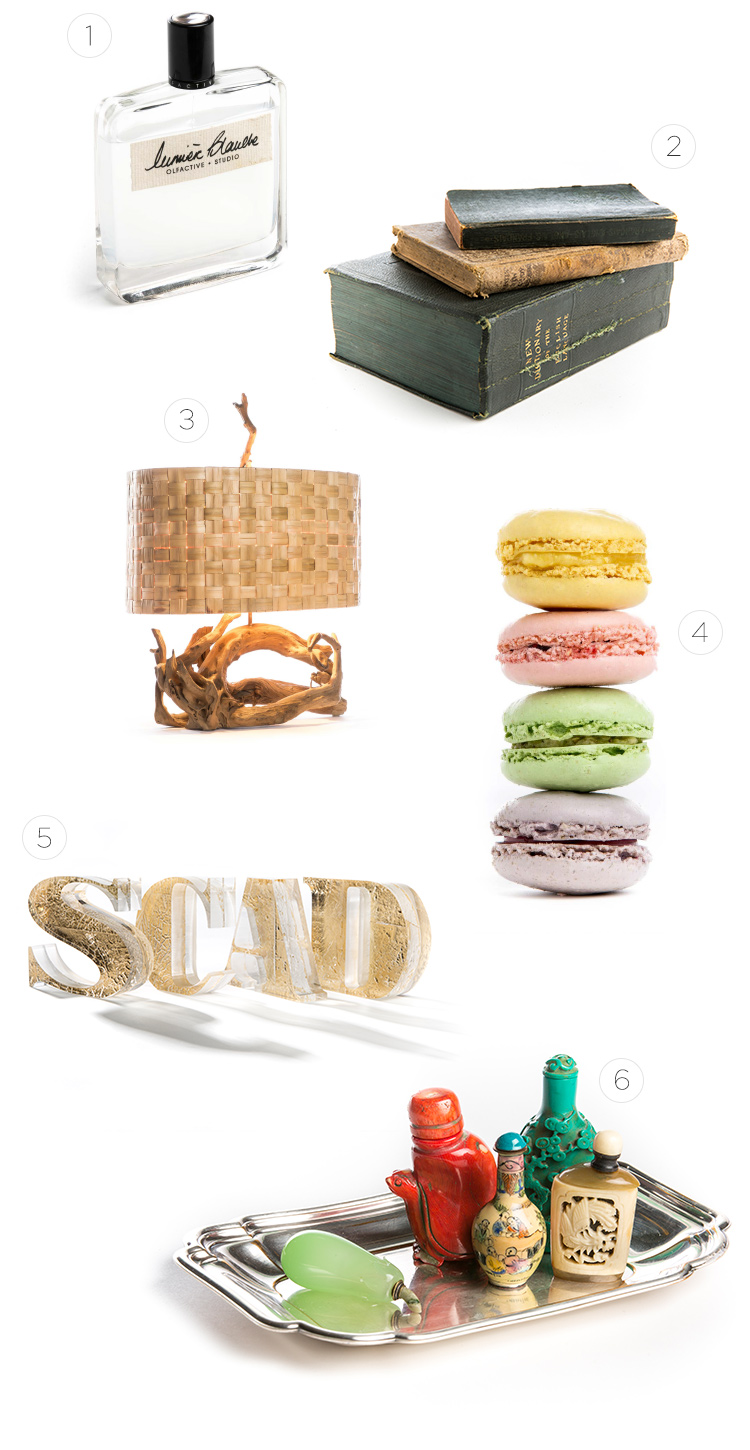
Series of six items University President Paula Wallace currently fancies

1. LUMIÈRE BLANCHE FRAGRANCE:
My husband gave me this perfume for my birthday. I told him I wanted something with a light and powdery scent, which is exactly what he found. I’ve been wearing it every day. The bottle is made of slightly iridescent glass with an unfussy label.

2. ANTIQUE DICTIONARIES:
I love words, so I love dictionaries — especially old ones. I often discover an elevated term by flipping through my vintage dictionaries. Certain words are so old that they feel new again! A couple of my current favorites include soporific and intelligentsia

3. DRIFTWOOD LAMP:
I came across this 1950’s lamp at a flea market in Atlanta. All we did was clean it up and replace the shade. The base is one sturdy piece of driftwood that has lived many lives — from sea to sand to someone’s home decades ago to my office today!

4. MARCHÉ DE MACARONS:
Trust me, these are the best macarons in Savannah. They’re just as pretty as they are delicious — especially the green-tea flavor. Eating just one is a true act in self-control — good thing they’re under 100 calories each!

5. LUCITE SCAD LETTERS:
In the South, we like our monograms — so much so that some Southerners choose their unborn child’s initials before the actual name. These gold-flecked, lucite SCAD letters are my version of a monogram. They sit atop my office mantel and appear stately yet welcoming.

6. CHINESE SNUFF BOTTLES:
These were created during the Qing Dynasty to store powdered tobacco. Whenever I’m visiting SCAD Hong Kong, I make it a point to buy one at a street fair — I own maybe 20 by now! I’m drawn to small things and each of the bottles has its own individual character. 

Emerging Alumni: Fashion grad Zach Selby

September
8
2015
By
Tags:

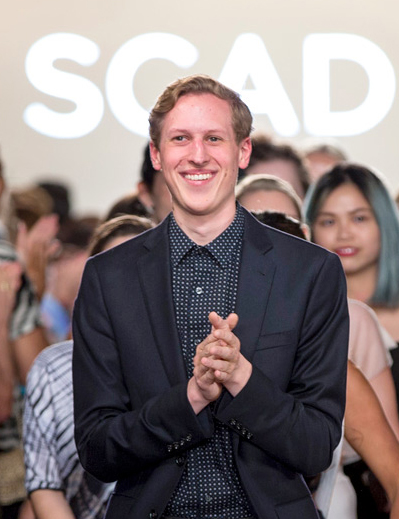
It's only been a few months since the 2015 Fashion Show and graduation, but Zach Selby (B.F.A., fashion 2015) is already working hard to put his mark on the industry. As an intern at Wes Gordon, he's getting some exciting guidance and experience in the professional fashion world.

We caught up with Zach to learn more about his post-grad life:

SCAD: It's been a long time since your first day at SCAD. What advice would you give your younger self?

ZS: I would tell myself to take any opportunity SCAD has to offer and take advantage of all the resources SCAD has, including career services and facilities within other majors. Think about collaborating with other talented students in other majors that will complement your creative passion for fashion.

SCAD: What have you been up to since graduating in May?

ZS: I am currently interning at Wes Gordon in New York City and am looking for a job in New York. I always wanted to be part of New York Fashion Week and interning here is enabling me to do so. At Wes Gordon I do a little of everything. I assist with pattern-making for the collection, make trips to local mills, embroiderers, pleaters, fabric stores, create technical flats for upcoming garments for their collection, spec sheets for fabrics and organize model castings and will eventually help with the show.

SCAD: Were there any opportunities you went out of your way to take?

ZS: I am so glad I took the opportunity to join competitions including the YMA Fashion Scholarship Fund. Winning the YMA twice has opened many doors, connected me to people within the industry of fashion and built long-lasting relationships. I also collaborated with different majors, including photographers to help present my work and create imagery for my portfolio. I am so grateful that I built relationships with every single fashion professor. That was really important to me because they really want to see you succeed and will help you in any way. I am so grateful for SCAD because of its abundance of opportunities.

SCAD: When you think about the future, where do you see yourself in the next few years?

ZS: I see myself working as a fashion designer at a growing fashion brand or label that will expose me to how a fashion business runs and allow me to learn from the best in fashion. I will eventually start my own label and open my own business under my full name: Oliver Zachary Selby. I am excited to see what the future holds and I am taking one step at a time toward making my dream of starting my own business come true.

SCAD: When you're working on your own designs, what do you look to for inspiration?

ZS: I really think that nature is a great influence on my designs — not just the image of it, but the adventure behind it. I want to see how I can fit functionality into a chic, sophisticated style while viewing my customer as someone who lives a chic, cool lifestyle, looking for adventure in the world.

Click here to request more information or apply to SCAD.

Hero image of Zach's work by Maddie Ivey

An internship of imagination at the Walt Disney Parks and Resorts

September
7
2015
By
Tags:

Walt Disney World Resort®—the stuff that dreams are made of. But the happiest place on earth isn’t just a destination for visitors. Students from all around the world apply to the Disney College Program (DCP) for the chance to become part of the magic. For Nicole Andrews (M.A., Design Management), participating in the DCP led her to a Professional Internship with the Worldwide Safety Communications Department at Walt Disney Parks and Resorts.

Here’s Andrews with more on her journey:

SCAD: The Disney College Program has been around since the '90s, offering paid internships and opportunities to participate in career development workshops. What drew you to the program?

NA: One of my dreams has always been to work for the Walt Disney Company, whether for ABC, ESPN®, or Walt Disney Studios®. When thinking about working for Disney, I knew where I needed to start: Walt Disney World. I applied to the DCP as a way to fulfill my desire. I sought to better understand what it was like to work as a frontline Disney cast member. I wanted to understand how to make magic happen for thousands of people all over the world.

SCAD: The Professional Internships cover many areas, including engineering, business, finance, communication, marketing, human resources and several others. What part of the magic are you in charge of making?

NA: As a Professional Intern with Safety Communications, I am responsible for producing internal communications collateral that reaches 100,000 cast members each week to promote a culture of safety. I create infographics, which are shared internally via the Disney internal network for cast members. Unlike my role in the College Program, my current role is more internal and does not directly involve guests. I also help create communication plans and develop articles that are printed for the internal Disney magazine. My skills in design management and graphic design help me to effectively communicate topics around safety to cast members through Walt Disney Parks and Resorts.

SCAD: After the DCP, the a Professional Internship is the "next step" in building a career with Disney. How did you take that step?

NA: Normally, one completes at least one DCP as an undergraduate. After that, one can apply for Professional Internships with Disney. These roles are more for the Disney cast to help the company backstage or to create new guest experiences.

I did not do a College Program while I was an undergrad. I previously applied for Professional Internships, but did not receive offers. So, I acknowledged I had a better chance of obtaining a professional internship with Disney by participating in the DCP.

Then, in one of my SCAD e-learning classes, I connected with a classmate who had participated and placed in the Walt Disney Imagineering Design Competition. She and I exchanged several emails until she invited me to meet her to learn more about what her department does for Disney. A couple weeks later, she told me she had an open spot for another professional intern and asked if I would like to interview. After, I received a call from the recruiter who worked with my classmate, offering a Professional Internship in Worldwide Safety Communications. I accepted the offer and transitioned to the new area.

SCAD: Sadly, the intership will eventually end. What's next for you?

NA: When my Professional Internship ends, I hope to receive an offer for a full-time role with the Walt Disney Company. I love working here and the culture that is built around each role and team. Every team plays an integral part in creating magical experiences for guests. Whether it is the newest Marvel® film or simply a custodial cast member providing directions to the nearest attraction, each role represents a part of the magical experience. But regardless when my internship ends, I know I developed skills that will help me in the future.

Click here to request more information or apply to SCAD.

Fateful finding: 1979 article discovered at Dyson House

August
3
2015
By
Tags:

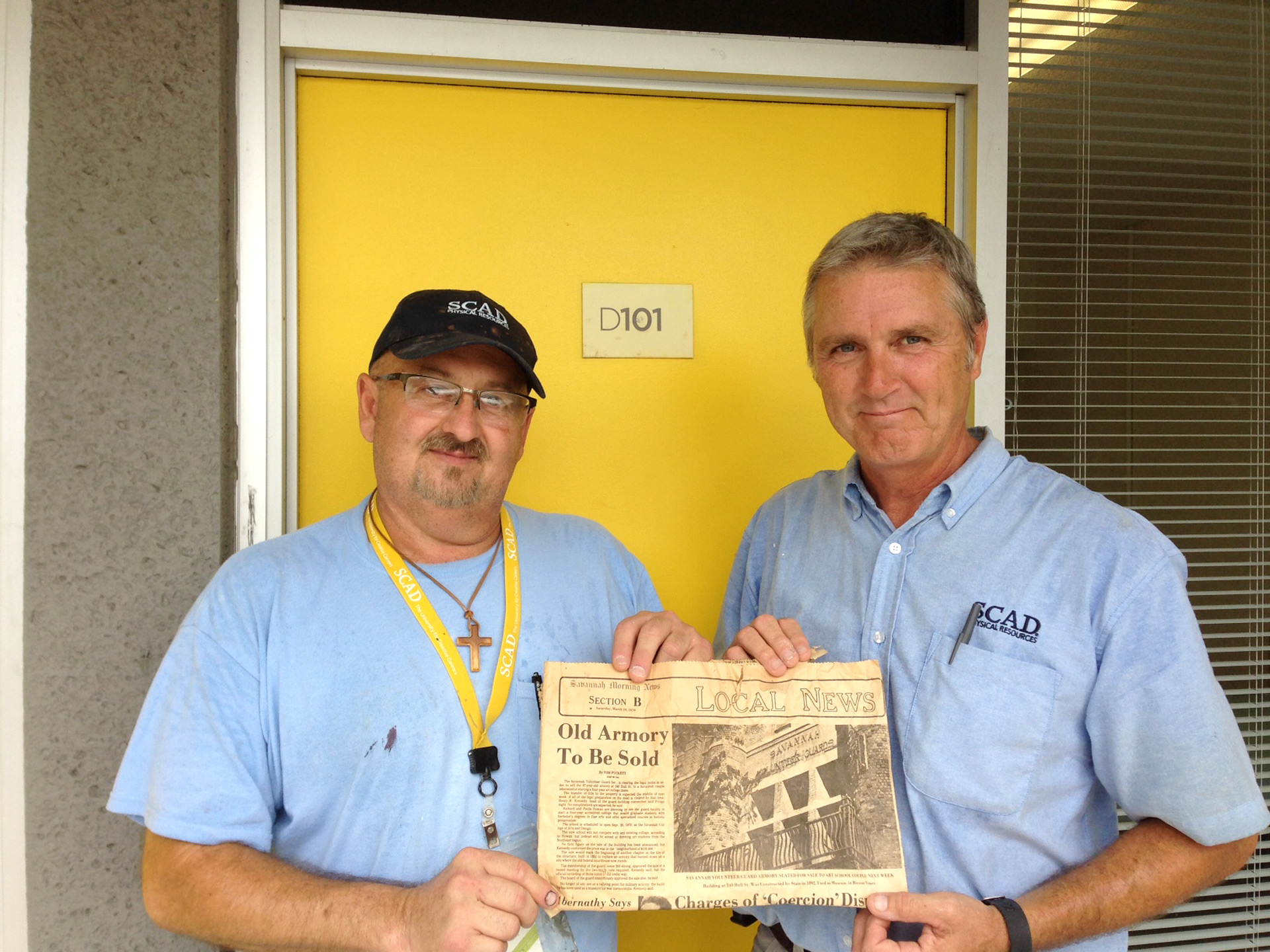
The date is March 10, 1979 and the Savannah College of Art and Design is on the brink of existence. As reported by a staff writer for the Savannah Morning News, SCAD founder and president Paula Wallace was preparing to purchase the university’s flagship building: the Savannah Volunteer Guard Armory, now Poetter Hall. The newspaper isn’t from SCAD’s archive, but thanks to Joao Poli and Ray Morgan, it will be soon. Their discovery gave them chills.

I thought it was ironic. We’re in the process of tearing down Dyson to build a new SCAD dorm and we find a paper that symbolizes the start of everything.
— Ray Morgan

Two SCAD staff hold newspaper

While performing routine maintenance, Morgan and Poli found the newspaper inside the wall of Room 101 at Dyson House. Next year, Dyson will be torn down and replaced with a new residence hall. Like most SCAD facilities, the residence hall, formerly a motel, had a previous life. Still, the newspaper finding leaves much to the imagination: “My theory is that there was a leak and the maintenance man couldn’t find it so he ended up stuffing as much newspaper in there as he could to absorb the water and then he forgot about it,” Morgan said. 

Like so many SCAD buildings, the newspaper is both artifact and harbinger of good things to come.

5 lessons on overcoming fear from the woman who took on 100

July
30
2015
By
Tags:

It could take a lifetime to conquer your fears, personal and professional. Michelle Poler (B.F.A., advertising, 2011) decided to face hers one day at a time. It’s just that the days will soon total 100. Thanks to her videographer and brother Daniel Poler (B.F.A, film and television), who also studied at Savannah College of Art and Design, she is broadcasting every stomach-turning, sweat-inducing moment on her blog 100dayswithoutfear.com

Watching Poler triumph over each challenge — like Bodypainting Day — is addictive. Her project has gone viral and Hollywood or Y'allywood may soon ring her for the rights. As she nears the end of her adventure, we asked Poler to share what she has learned about fear. Here’s what she told us after facing number 82: 

1. I learned that fear lives in our heads and it is completely up to us to replace it with other feelings. For example, I've been able to replace fear with curiosity in some cases.

2. I learned that even though fear is universal, no one has the same set of fears, but the way we deal with them is very similar, so we can all relate. That's why my project went viral: it is a human truth.

3. I learned about the power of asking for things. I was bad at asking people for favors and this project taught me that if you don’t ask you don't get.

4. I learned to always ask myself, 'What's the worst that could happen?' before saying no to the unknown.

5. I learned to trust myself and my ability to stand up for myself and defend myself in any situation. I proved that I'm capable of being alone and that I'm able to enjoy it.

Judging from her videos, Poler hasn't had much time to be alone, which brings up another lesson from 100 Days Without Fear: facing your fears also means asking for help. 

White House entrepreneur shares advice straight from ‘Shark Tank’

July
23
2015
By
Tags:

How important is entrepreneurship to creating a better world? So important that the White House bet $1 billion in private investment to promote it, half of which will go to promising young entrepreneurs like Kirk-Anthony Hamilton (M.Arch., 2010; B.F.A., architecture, 2008), founder of the Infiniti Partnership. In advance of the 2015 Global Entrepreneurship Summit in Nairobi, Kenya (July 25-26), President Obama recognized Hamilton as one of 75 emerging global entrepreneurs to watch. The panelists from ABC’s Shark Tank joined the White House celebration of these promising young leaders. 

Here are seven tips as told to the honorees by Mark Cuban, Barbara Corcoran and Daymond John, and passed on to us by Hamilton:

• Be obsessed with your business and love what you do. Money isn’t success. Entrepreneurs should aim to create value.

• The best entrepreneurs are those who respond well when the chips are down. Great entrepreneurs are those who have had to reinvent themselves.

• Invest in what you know. When pressed on his thoughts on investing in Africa, the Middle East or China, Mark Cuban said he doesn’t go after opportunities he doesn’t understand.

Good things happen if you keep on grinding. — Mark Cuban.

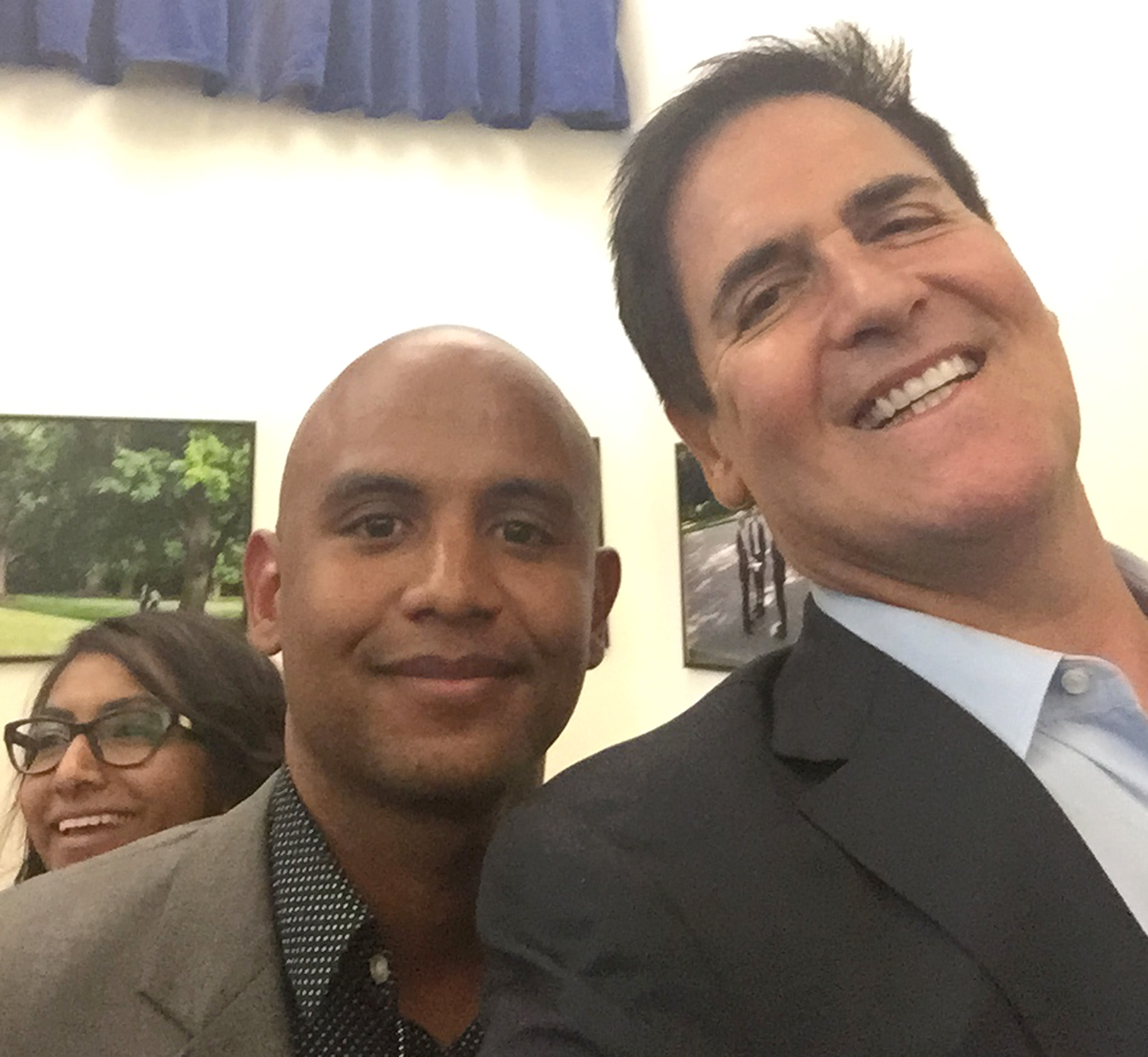
Architecture graduate Kirk-Anthony Hamilton poses with Mark Cuban

• Learn to say no. You cannot be everything to everyone.

• It’s ok if you don’t know the next steps. It’s ok to screw up. (Mark Cuban’s mom was so worried he wouldn’t make money that she encouraged him to learn to cut carpet. Now he's a billionaire.)

• It takes sacrifice. (Daymond John and his mother mortgaged their home for $100,000 to get the FUBU brand going.)

• Stop waiting for that perfect moment; it’s not going to come. There isn’t a point at which everything just clicks and it’s smooth sailing. If that’s what you’re searching for you’re in the wrong space.

For Hamilton, the seeds of entrepreneurship were sown in his home of Jamaica, where he grew up fascinated by designer homes, global travel and the power of influence. After studying architecture at the Savannah College of Art and Design, he became an investor, World Economic Forum Global Shaper and architect of opportunity. Hamilton used his social capital and creative experience to co-found a private investment firm in Florida, which focused on digital media acquisitions and eventually became the Infiniti Partnership. He later co-founded The Destination Experience, which connects decision makers with a network of ideas, people and opportunities through "social discovery experiences." So far, the most successful result to come from the initiative is a $90 million film project led by business titans Michael Rollins and Arthur Wylie and set in Jamaica.

Hamilton says he owes it all to something he calls 'creative confidence.' He’ll speak on the subject at SCAD in October. Look for more information soon from the Office of Career and Alumni Success.

A design solution for Atlanta bridges and traffic-weary drivers

July
15
2015
By
Tags:

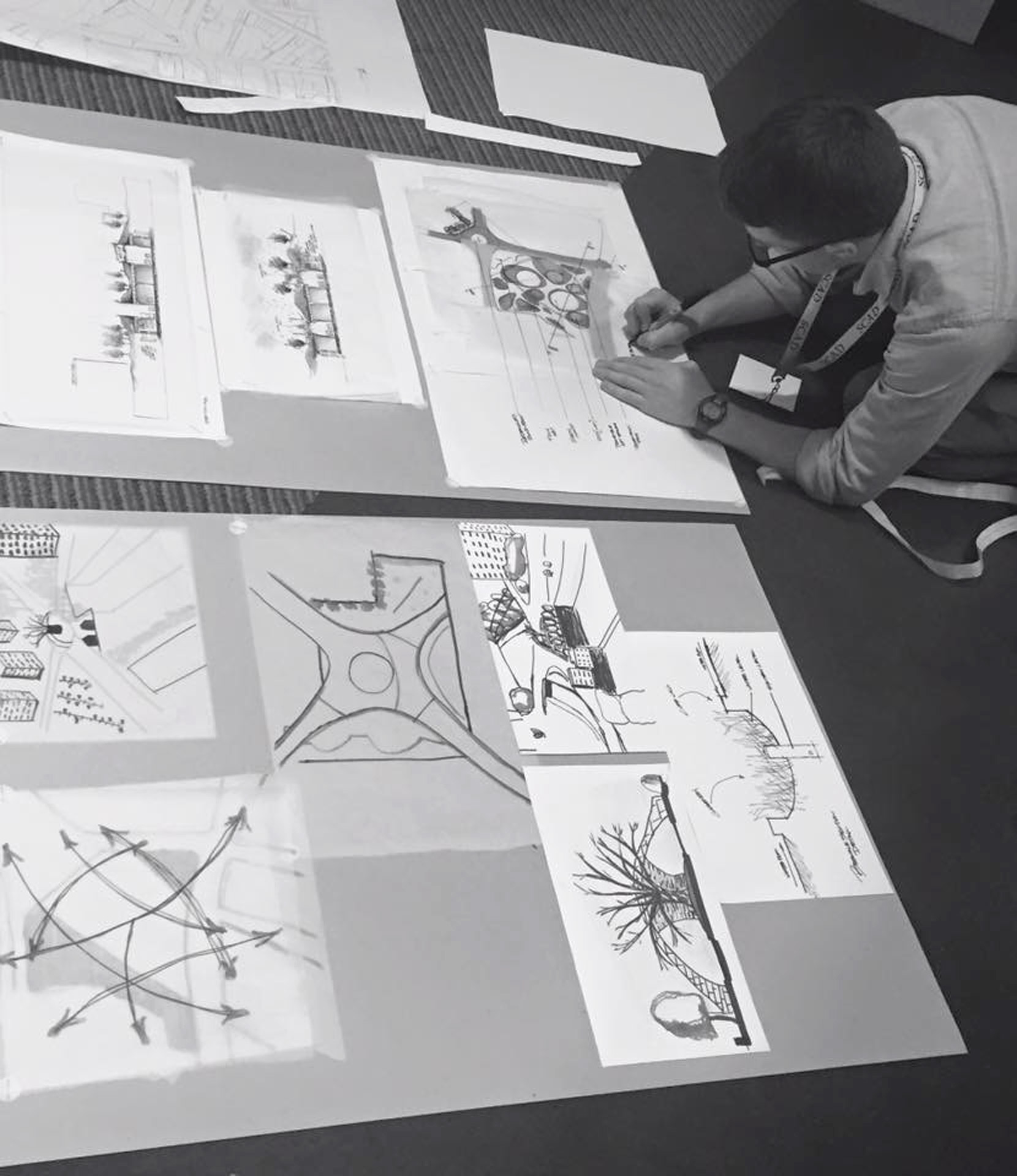
Along with landmarks like Centennial Olympic Park, Atlanta is synonymous with traffic. Long lines of vehicles — 300,000 per day — winding through Interstate 75/85 are staples in the city’s landscape. So are the concrete bridges that traverse these five miles of highway. What if these exchanges could delight and inspire drivers? What if, rather than ignoring them, commuters looked forward to passing under the structures for a momentary reprieve from their slow-moving circumstances? That is the reaction architecture students from the Savannah College of Art and Design were going for when they crafted the winning concept for the annual American Institute of Architects National Conference Student Legacy Charette design competition.

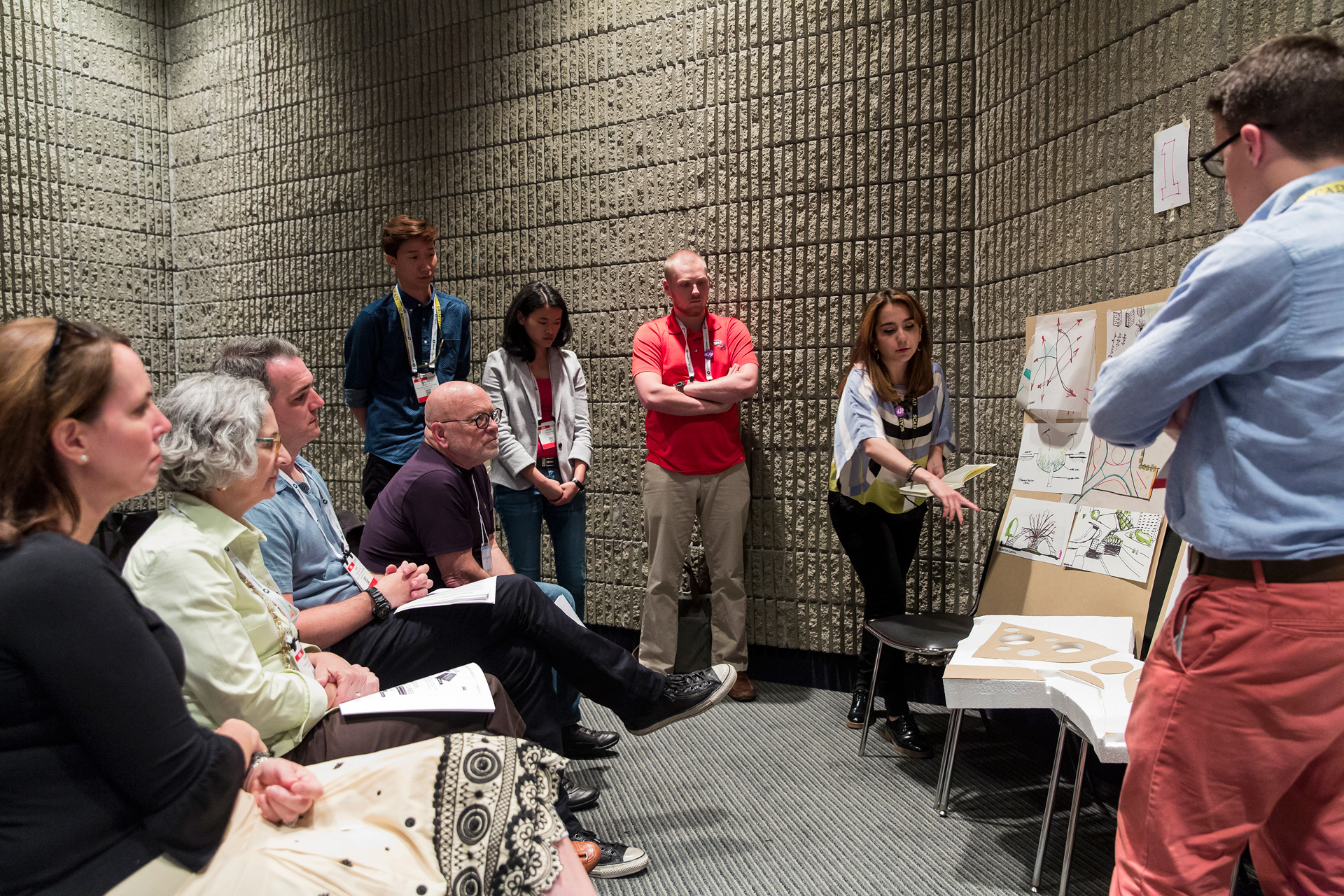
SCAD students present their work

In a nod to the host city of their 2015 convention, the AIA asked students to lend their ingenuity to the Atlanta Bridgescape Competition, the city's initiative to beautify the I-75/85 corridor, known as the Connector. Their task was to transform the area between Folk Art Park and the Peachtree Street Bridge, which passes over the Connector. The only requirement was that their “capping mechanism” engage pedestrians and drivers.

Rendering of proposed installation art

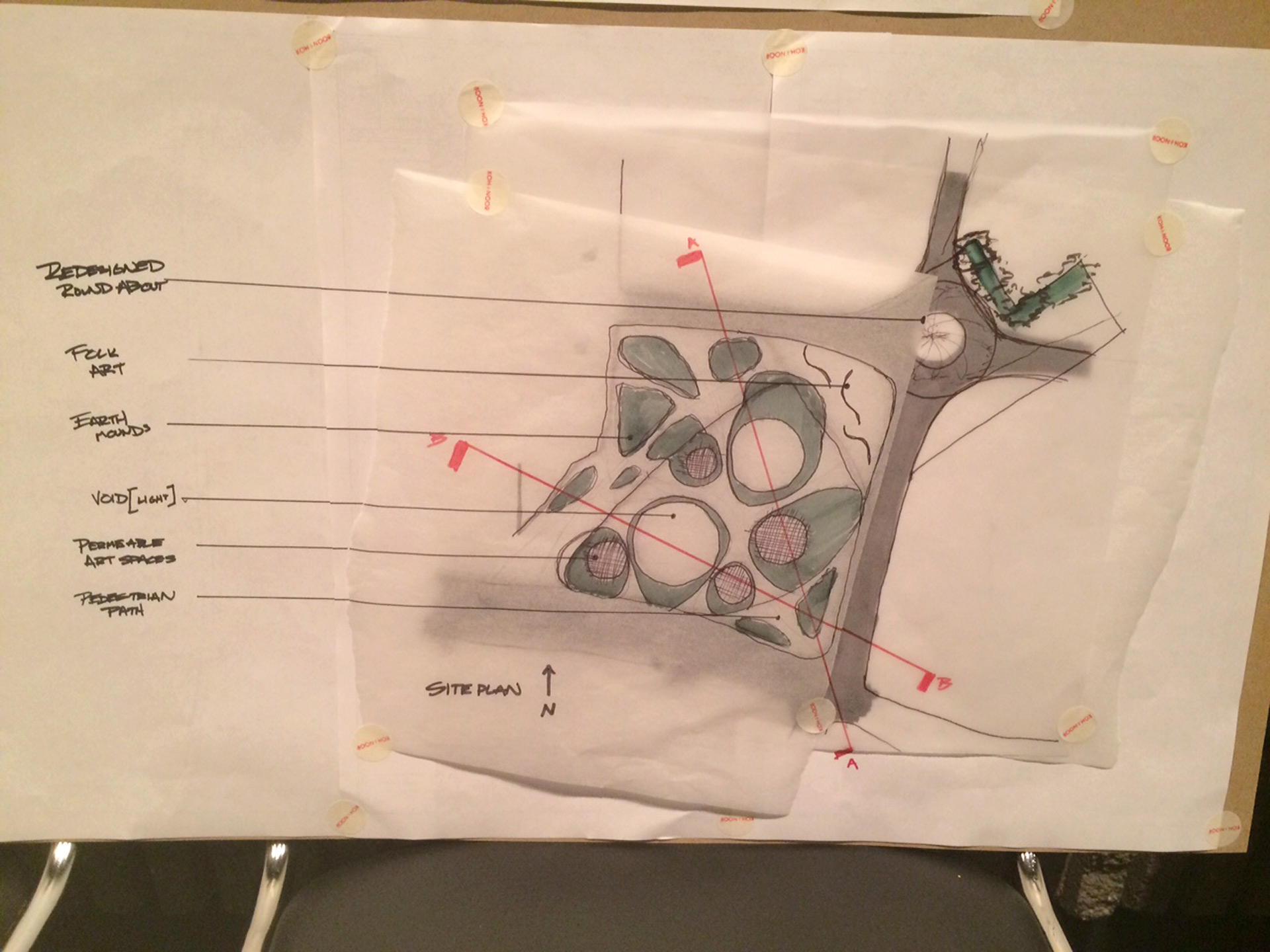
The contest's six-hour time limit left SCAD graduate Bradley Green (B.F.A., architecture, 2015) and his team just enough time to present sketches and a site plan for a cap that could be a solution for any city focused on urban renewal.

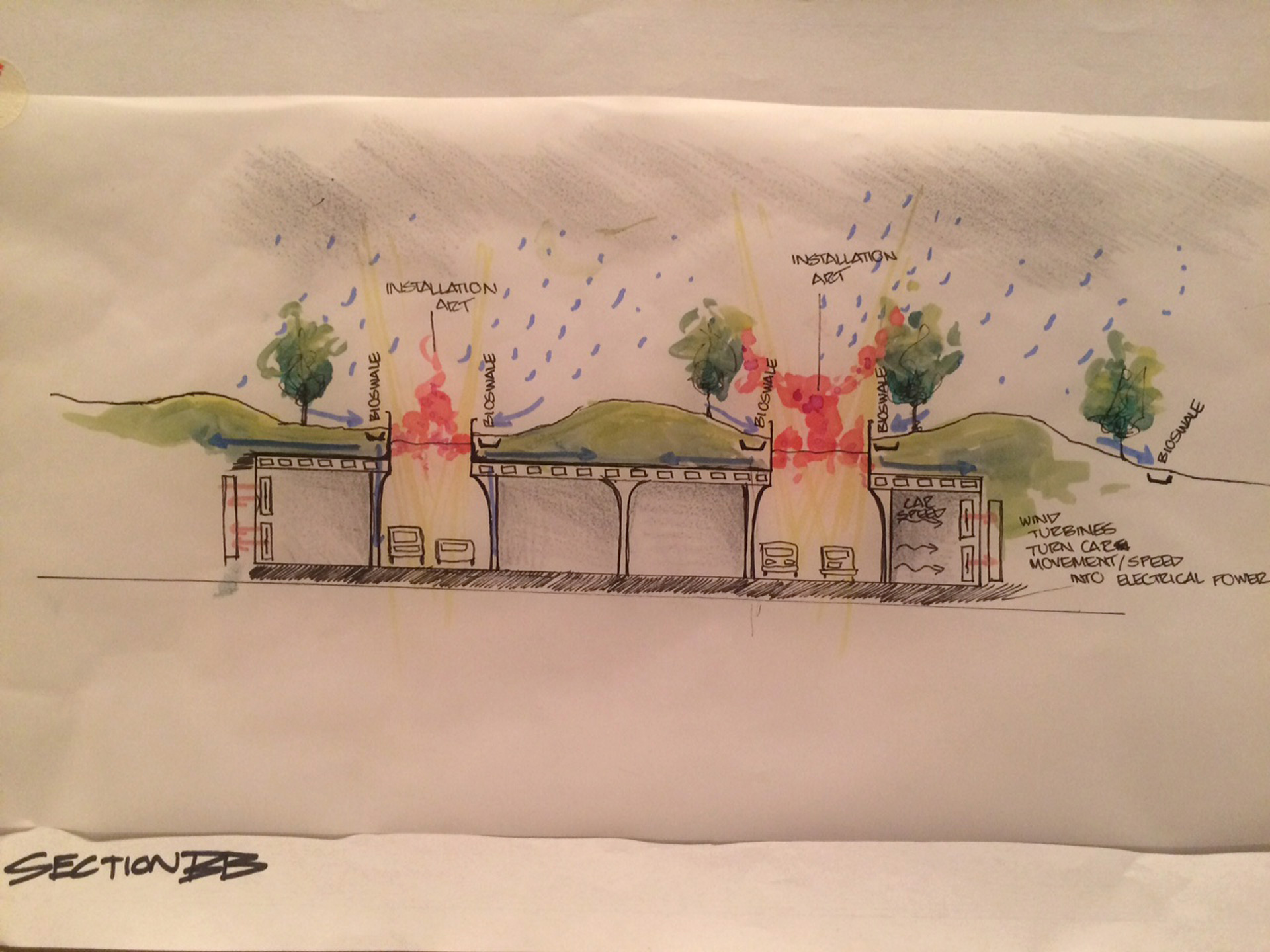
Our undulating designs allowed room for commissioned art, worked to collect rainwater in bioswales and used wind turbines to collect wind energy that would also create a visual display of light underneath the bridge. — Bradley Green

Student works on a rendering

Inspired by the roundabout in Folk Art Park, the designers envisioned a collection of earthen mounds to create greenspace for pedestrian traffic on top of the cap. Some mounds would be constructed as verticle tunnels, either hallow — to allow light to spill through onto vehicles below — or equipped to host multiple genres of artwork to be enjoyed by those passing on top of and beneath the bridge.

One layer of a multifaceted rendering

Creating a spectacle – to be constructed so as not to endanger drivers – was only one part of the SCAD team's intention. The other objective was to promote interaction with community groups who could provide the art, and even among drivers and pedestrians who could see one another through the hallow mounds. It’s Green’s way of bringing the tight-knit feel of his hometown of North Augusta, South Carolina to the big city. "As an architect, I’m doing a lot more than creating a building; I’m creating a long-standing relationship with the area I’m building in," Green said.

Thanks to the SCAD team and the finalists of the National Bridgescape Competition, traffic won’t always be the only thing by which we remember Atlanta’s roadways.

Young designers empower creative freelancers in Hong Kong

June
11
2015
By
Tags:

As in all industries, the path to entrepreneurship in art and design is full of peaks and valleys. Motivated by challenges in their freelance careers, 30 Savannah College of Art and Design students launched a collective for young designers in Hong Kong. They call themselves "22nd century designers," or XXIID, and aspire to address questions facing up-and-coming artists and designers who work in diverse creative capacities – from graphic design and marketing to illustration and photography. With SCAD professor of advertising and graphic design Gianluca Cinquepalmi advising, seven XXIID members recently convened in Causeway Bay to fine-tune the XXIID guidebook for freelancers, which covers topics like pricing structures, contracts, and client demands. We sat down with them for a preview of this sorely needed resource, which will soon go to print, and to learn about their goal to unite the next generation of creative talent in Hong Kong.

SCAD: Why did you form XXIID?

Melissa Trias: I was tired of being pushed around with freelance jobs. Associate Dean of Academics Derek Black pitched the idea of creating a junior designers’ league, and we had one meeting where everyone discussed the problems with freelance work. Then professor Gianluca Cinquepalmi got involved. He thought we needed to produce something tangible. So we started as a club and it turned into a publication and design collective.

Gianluca Cinquepalmi: The idea of XXIID was to create a platform where creatives can meet, discuss, and improve. Our job and vision is to give tangible and reliable tools based on our knowledge and industry standard. We cannot cover every single aspect of it, but at least we can give some guidelines. I can bring the perspective of a professional who has dealt with and worked in the industry while looking at the real needs of the students.

Members of the design collective collaborate inside a cafe

SCAD: What are some of the challenges that you face as young designers in Hong Kong?

Trias: There isn’t an association for designers that we could join while still being in school, but we wanted to connect with other creatives in Hong Kong. We felt like we were being misrepresented in terms of value because people would ask us to do work either for free or lower than what we deserved.

That was one of the driving forces of starting XXIID. We deserve to be compensated for the hard work we have devoted to cultivating our craft. - Melissa Trias (M.F.A., luxury and fashion management, 2015)

Shann Larsson: When I first started doing freelance design work I didn’t know about contracts and what rights I had as a designer. With this design collective, we’re outlining things that are applicable to Hong Kong in terms of payment and your responsibilities.

Adam Newbold: It’s difficult to find a single source of trusted information. We’re trying to pull this together into a more accessible space, specifically geared toward young designers in Hong Kong and Asia.

SCAD: Is this resource something that is lacking in Hong Kong?

Newbold: There is the Hong Kong Designers Association, but we feel that younger designers are not represented very well.

Trias: In the U.S., there is AIGA, the American Institute of Graphic Arts. Their standards and ethics have been so functional. We have very valuable skills that we’ve acquired learning from professors who are experts in their fields. There is no reason why we shouldn’t be pricing our work at the correct salary.

Member of design collective shares idea to group

SCAD: What artistic and design disciplines are represented in XXIID?

Cinquepalmi: I love this project because I had the opportunity to involve almost all of the departments in SCAD Hong Kong’s school of communication: graphic design, illustration, luxury and fashion marketing, advertising, video, and motion media design. It’s not only for graphic designers.

Newbold: This is the most collaborative project I’ve ever been involved with at SCAD.

Cinquepalmi: We aimed to enroll 30 students as active members of the development phase, and aim to increase by tenfold when we have the publication and the website done. We hope that with the content we have generated, we’ll engage around 300 to 400 students and have them signed up for our mailing list, so that we can tell people about the association, what’s happening, and eventually promote upcoming events.

SCAD: How will XXIID make a better tomorrow for today’s artists and designers?

Cinquepalmi: What is important for us to achieve is making the industry understand that there are talented, prepared designers who act professionally and there are not-so-prepared designers who don't act so professionally.

We need to work towards making it easily understandable to the industry the real value and worth of a graduate, different from somebody who just stumbled upon Adobe Photoshop or Illustrator. There is a difference in professional attitude, ethics, and knowledge that we can transfer. - Professor Gianluca Cinquepalmi

Trias: The purpose of the publication is to equip our graduating students so they can go out into the world and be successful freelancers.

Cinquepalmi: The idea of XXIID is amazing because the industry needs it. There is a nice video of Lee Clow from TBWA Worldwide, which states we are treated as if we are doing our clients' laundry. He is the creative director of a preeminent ad agency, working with clients like Nike and Apple. If TBWA complains, imagine what other designers have to do. [Laughs.]

SCAD: What other content will XXIID share on the website and in the publication?

Newbold: One of the tools lists locations for working throughout Hong Kong, not only co-working spaces, but also cafés—secret spots that don't mind if you stick around and have plug-ins and WiFi.

Two members of design collective look at laptop screen

Trias: Professor Cinquepalmi proposed a pricing wheel. When he pitched this idea, he said this would be the “freebie” to get people interested in the publication.

Newbold: Pricing in the U.S., in my opinion, is much higher than in Hong Kong. We want to know the average going rate so we’re not incorrectly pricing our projects, while still getting fair pay. The current plan is for the pricing wheel to be a web-based app. It’s a formula that’s been developed based on information we’ve gathered from various organizations and freelancers around Hong Kong, and the pricing standards they’ve set for their projects. You can plug in the type of project you’re working on and the hours you expect to work. It helps figure out an average going rate, so you can better price your work.

Trias: There are tools and resources that exist in the real world, such as Team Gantt, Basecamp, Behance, and BlinkBid for photographers. Knowing about these resources helps because we can learn the theories, but we need to know the industry standard. In making this publication, we not only get to use these resources, but we also get to share with our readers that they exist.

Newbold: We’re also creating descriptions on how to prepare a creative brief. And we're doing the same thing with contracting, so that you know what needs to be included.

SCAD: Do you plan to team up with students from other Hong Kong universities?

Newbold: In the future, we would love to see this grow into incorporating designers from different local universities and elsewhere.

Cinquepalmi: We believe as designers and as content creators that great content and great ideas survive. If we can create something worth reading and sharing, we can attract other universities.
‘On Creativity’ interview series debuts on Delta Studio

June
5
2015
By
Tags:

As the adage goes, a picture is worth a thousand words. And what about moving pictures? In order to harness the power of video, I decided to film conversations with distinguished Savannah College of Art and Design guests. By capturing the insights of successful professionals, these interviews further the university's reputation as the leader in creative education. Moreover, students, alumni, and the larger creative community can benefit from this trove of wisdom for years to come.

Delta Air Lines is broadcasting my all-new interviews with leaders in design, entertainment, entrepreneurship, and style on Delta Studio, the airline's in-flight entertainment system, offered on passengers' seatback screens and the FlyDelta and GoGo apps. On Creativity shares the magic of SCAD with Delta's 170 million annual passengers, taking our stellar reputation to stratospheric heights. Guests include designer Joseph Altuzarra, Spanx founder Sara Blakely, actress Mindy Kaling, philanthropist Lauren Bush Lauren, and ABC World News Tonight anchor David Muir.

Of course, this is just the beginning. The best thing about creative conversations is that they have a way of inspiring others. As you continue your lifelong quest for knowledge, please tune in to On Creativity for new episodes throughout this summer and fall, and be sure to invite others to join us at SCAD or in flight.