Skip to main content Accessibility Policy

Trish Andersen is hangin' tuft

March
5
2018
By
Tags:

Her paint-spattered overalls cuffed to show stripey socks and leopard-print kicks, Trish Andersen (B.F.A., fibers, 2005) walks through a home that belongs to an artist, unmistakably. Skeins of vivid yarn, stacked by color, indicate intent. Between two rooms a missing wall exposes plywood joists studded with carpet nails, a frame awaiting something. A compressed air tube connected to a tufting gun dangles from the ceiling.

This is where Andersen crafted her massive tapestry, heroic in scale, nearly a quarter ton and 12 feet tall ("It's a beast!"), to celebrate the launch of Coca-Cola Georgia Peach, the new flavored pop from the Atlanta-based beverage company. "I've been drinking Coke my whole life," says the native of Dalton, Georgia. Having worked with companies including Anthropologie, Mercedes-Benz and Google, Andersen is a consummate artisan and accomplished professional who knows what it takes. As the sign upon her mantelpiece says: "WORK HARD AND BE NICE TO PEOPLE."

SCAD: What directions were you heeding with the creation of this piece?

TRISH ANDERSEN: Coca-Cola were looking for artists influenced by their hometowns, whether that meant materials or process or content. This inspired me to create work inspired by Dalton. In the early-20th century Dalton was a sleepy mill town and then, through the creation of bedspreads, and hand-tufting, it became "The Carpet Capital of the World."  I knew the history of Dalton growing up there, but it's wild that my worlds have come full circle and now I've tufted this piece for Coke.

SCAD: At a glance the piece appears abstract, before revealing figurative aspects.

ANDERSEN: There's the silhouette of the state of Georgia. Red lines represent the outlines of the Coke bottle. The sub-pattern is an abstracted version of a peacock feather. Back in the day there were peacock motifs on the bedspreads made in Dalton, which inspired the name "Peacock Alley" — part of US-41, the old highway up there, where people were selling them on the sides of the road.

In its color palette, my piece is very peach heavy, there are pops of sea foam, and the case for the Coca-Cola Peach soda is a creamy grey almost like newsprint, so I brought those tones in there too.

To create the piece took a little over two weeks. I was drinking Coke! The tufting goes quickly, it's the finishing that's a lot of work. You have to latex the back and do the frames. But you can get in a groove with the tufting. The physicality of the work is crazy! I have built-up callouses from using the tufting gun.

SCAD: Where can people see your piece in person?

ANDERSEN: It's hanging in SCAD Atlanta until May, but I don't know its final destiny. We'll see where it ends up. I hope it travels to Dalton too. Short of thinking of Dalton as home, I think of SCAD as home. SCAD is a huge part of my identity as an artist.  A lot of people I've worked with, lived with, shared studio spaces over the years are SCAD people. There's a go get ‘er done work ethic we share. The community is real. I've got their back and they've got mine.

0

The unlikely trajectory of Kayo Chang

February
26
2018
By
Tags:

Kayo Chang is an intriguing global citizen. The Taiwanese-Canadian graduate student, formerly head librarian at SCAD Hong Kong, is now enrolled as an M.F.A. candidate in the SCAD writing program. She has penned essays for SCAD Manor on subjects including clothing designer Janet Wong (B.F.A. fashion, 2016), who not so coincidentally designed the dress for Chang's wedding to Derek Black, associate dean of academic services, SCAD Hong Kong. Currently studying at SCAD Savannah, Kayo will return to Hong Kong next quarter to begin an internship at ArtAsiaPacific. There's more to come from this busy Bee.

SCAD: How does your SCAD story begin?

KAYO CHANG: I started working at SCAD Hong Kong in January 2014, after the human resources director messaged me to say: "We're looking for a librarian." At that specific moment I was in Causeway Bay picking up my runner's pack for a marathon. The following Monday I went to the SCAD Hong Kong building in Sham Shui Po for an interview. I fell in love with SCAD as soon as I walked into the building oozing color and beauty. When I started working at SCAD Hong Kong as head librarian, I had two staff and four part-time employees. I loved the students and the books and my colleagues. It was ideal.

SCAD: How did you, as librarian, collaborate with professors?

CHANG: One instance is when Professor Cristina Kountiou and I developed an assignment for her class "FASM 400: Contemporary Issues in Fashion Merchandising." Instead of writing a research paper, each student would edit an existing Wikipedia page on a topic of their choice. For example, one student chose the topic "fast fashion." When we looked at the Wikipedia page it had nothing on the environmental impact of fast fashion, so the student added the whole section. The point was to teach critical thinking, improve students' writing skills, and gain insight into the bias present on Wikipedia. It was a really cool project.

SCAD: How did you go from being head librarian to becoming a student?

CHANG: I always wanted to be a writer. My husband Derek said, "You should!" So, I took my first writing class in winter 2017, "Nonfiction I" in Hong Kong, via SCAD eLearning, while I was still working full-time as the head librarian.

This quarter I'm here in Savannah taking "The Publishing Process" with the professor Lee Griffith. I'm writing a proposal for a book I want to write, part of my M.F.A. thesis. I'm using this book to explore different ideas and combined narratives. I had a secular and Canadian worldview as a young adult, so one narrative is about growing up in Vancouver. Another narrative is about going to Taiwan as an adult and learning about my family. And a third concerns Guan Yin, "The Goddess of Mercy," who my grandmother has a statue of and who has special significance to me.

The writing is a challenge, but with the support of my thesis chair, Dr. James Lough, it's going well. The SCAD curriculum is perfect for the kind of writer I want to be.

Artist Kayo Chang smiles in this black and white portrait

Cardiff and Miller's sound and sense

February
23
2018
By
Tags:

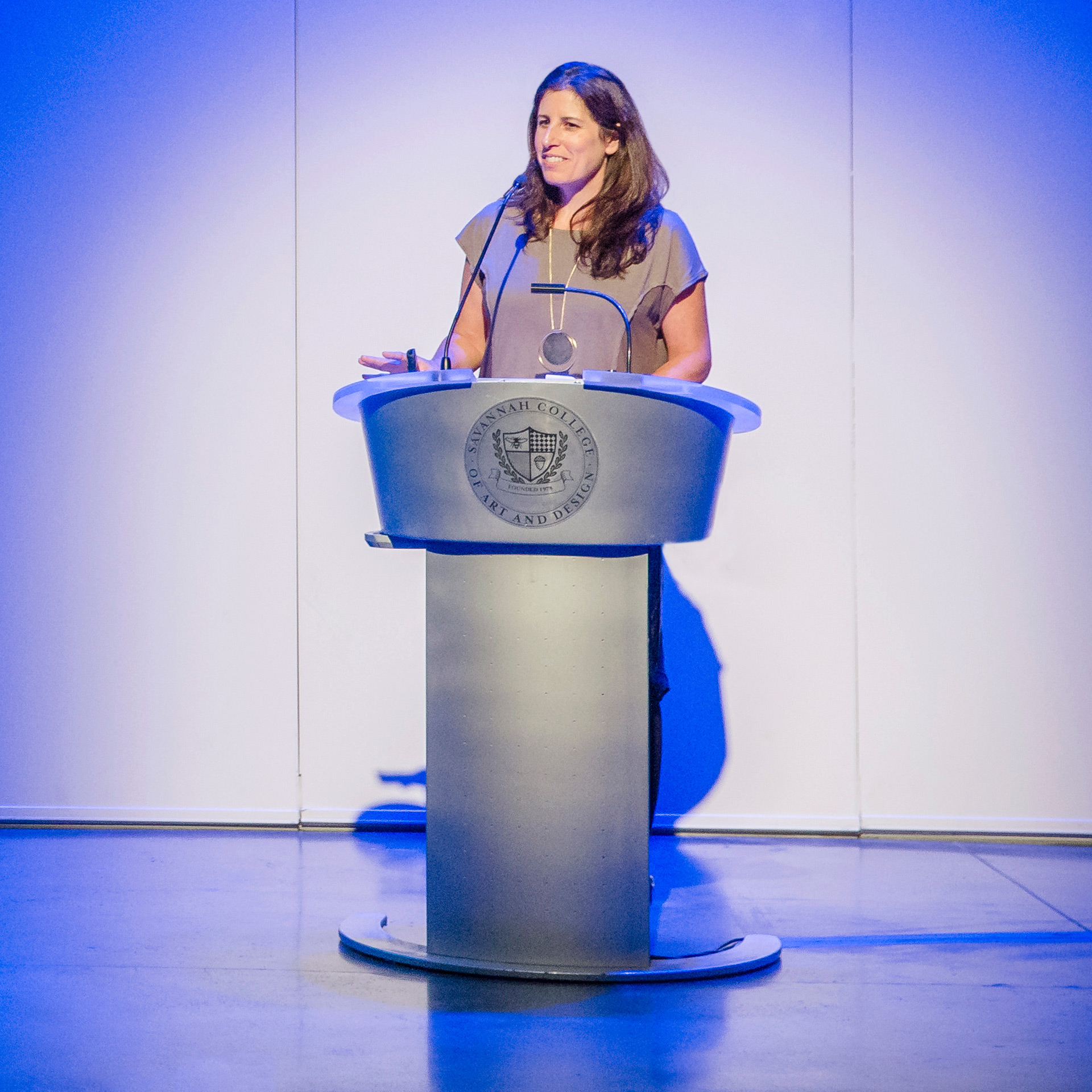
"Sound resonates through nearly every degree program at SCAD," announced SCAD president and founder Paula Wallace from the Trustees Theater stage, "and that's why our students should listen closely to tonight's honorees, two legendary artisans of sound and sense who have collaborated for over 35 years."

The honorees worth hearing were Janet Cardiff and George Bures Miller. The occasion was the SCAD deFINE ART 2018 keynote lecture. The crowd — primarily but not exclusively students — filled the venue to its thousand-plus capacity as Cardiff and Miller unspooled the secrets behind what President Wallace deemed their "transcendent aural masterpieces."

When the couple took the stage, jocular, youthful, and slightly shaggy, the fun began. Renowned for their immersive sound installations and "audio walks," Cardiff and Miller have two major installations currently at SCAD Museum of Art: "Opera for a Small Room" and "Experiment in F# Minor." Both works repanel the museum-going mindset: movements trigger sounds, while Hitchcock's "Rear Window" mis-en-scène is flipped for the DJ generation.

"We've been collaborating as artists from the first time we met," Cardiff remarked about work she called "hybrids between theater, music and the visual arts." Their talk provided an overview of their accomplishments dating to the 1990s, when they began first experimenting with the potential of listening with both ears.

"We love binaural audio," said Miller, as a duck might speak of water.

When the pair produced Cardiff's first audio walk in 1991, participants listened to pre-recorded sounds on a Walkman while walking through a forest. Some of those sounds were birds Cardiff had recorded in the forest. The effect was "an overlapping of reality…is that a fake bird or a real bird, and what about that boat going by?"

"I wasn't sure if it was art," Cardiff admitted.

The pair proceeded to create hundreds of these "audio walk" experiences in different locations around the world. After the advent of the iPhone made digital video an everyday reality, they developed "video walks" under the same reality-curving principles. Representing their native Canada at the 49th Venice Biennale in 2002, they built a 16-seat cinema simulator that turned the moviegoing experience on – and into – its head.

"We like trickery or intrigue, to bring people in to wonder, ‘How are they doing that?'," Cardiff said.

"Making art, you manipulate your senses or reality to believe in things that aren't possible," Miller added.

The energy in Trustees Theater was predicated on the enmeshed personalities of the honorees themselves. Befitting a long-time collaborating couple, they demanded clarity from each other while evincing tenderness and trust.

As the couple continued screening clips from the works, a very Cardiff and Miller thing happened: the Trustees Theater audience sat looking at a moving image of a theatergoer looking at a screen depicting an audience looking at a screen. It felt natural of course, and totally hyperreal and transporting. It felt like SCAD deFINE ART 2018.

aTVfest 2018: Content reigns supreme

February
1
2018
By
Tags:

Every February, SCAD aTVfest brings together working creative professionals and emerging student talent for three days of screenings, panels, workshops and master classes. The sixth annual SCAD aTVfest kicked off Thursday at SCAD Atlanta with packed rooms and a buzz in the air, as executive and creative writer Janet Arlotta moderated the panel on "The Evolution of Content Development."

With ever-increasing spaces to place content, networks are developing entirely new creative divisions while brands themselves deliver content directly to consumers. Opportunities are growing exponentially as television redefines itself. The panelists reflected the burgeoning diversity of this creative space.

Independent producer and director Ilyssa Goodman instructed attendees that no matter how good an idea is, it still needs a buyer. Viewers are customers, Goodman explained, and the challenges of short attention spans and content overload are leading to more short-form storytelling. FX Networks vice president of production Maureen Timpa said that while not long ago a creative pitch for a show included a full season's worth of plot and character development with three story arcs, today eight tight episodes are the norm.

The content development landscape is changing. Goodman pointed out that the company that delivers her groceries, Amazon, also wins Emmy Awards. Crowdfunding sites put creators in control of budgets and their destiny. The competition is fierce, but there has never been a more inviting playing field for content creators.

"You're fighting for time," says Jeremy Lindenmier, creative director of Denver, Colorado-based creative agency Friends of Mine. This new landscape demands a different approach to how projects are created. Brands must be elevated with distinctive content, well beyond what conventional advertising achieved. With so many messages, content must stand out and fit in to the hectic schedules of consumers.

Panelist Miguel Hernández, creative lead at smartphone protector OtterBox, stands at the forefront of branded content creation. "Content has to be insightful and connect on a level that is real,“ Hernández said. The OtterBox product line, known for its damage-resistant tablet and smartphone cases, launched its new, slimmer and more stylish line with a global short film where different local photographers capture the sights on their OtterBox-cased phones. Unscripted and produced in a few short weeks, the film informs consumers that an OtterBox can be stylish and tough. He advised, "Don't begin with an idea, begin with an insight. The idea will come."

A point all the panelists made was to always ask "Why?" Ensuring value in content requires introspection, and the final product should never seem forced. Creators must build sound business strategies that embrace the power of "Why?"

With three full days of events to come, SCAD aTVfest 2018 is poised to deliver the answers.

Darrell Naylor-Johnson on Jacob Lawrence

January
24
2018
By
Tags:

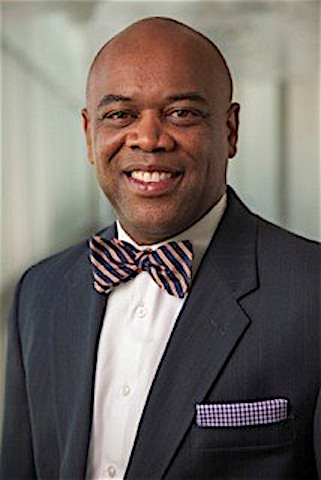
The SCAD Museum of Art exhibition "Lines of Influence" (closing Sunday, Feb. 4) commemorates the centennial celebration of the birth of Jacob Lawrence, acclaimed painter and chronicler of the African-American experience. Here, Darrell Naylor-Johnson, SCAD senior director of library services, offers insights into Lawrence's work and remembers meeting the artist and his wife Gwendolyn Knight.

DARRELL NAYLOR-JOHNSON: Jacob Lawrence is one of the most important painters of the 20th century. He has had incredible influence as an artist and researcher. With his work he turned history into visual representation. He had the ability to tell a great story and the ability to reach people creatively. That's important from the standpoint of today's artists who are fighting for recognition within an oversaturated media landscape. 

Young people and aspiring artists can learn from Jacob Lawrence's work that we have a common language. He helps his viewers understand that he's a part of a continuum. Young artists can look and say, "I'm part of what's going on and I need to draw from that, while I also need to be open and not defined by any singular aspect of who I am." Lawrence's influence makes artists realize, "My depiction has to be richer now because I have to pay homage to all the aspects of what I study and learn." It means understanding historical context while creating your artwork.

Through his work, Jacob Lawrence allows us to gain historical understanding. When you look at his "Migration Series," you feel like you're inside this great, intimate conversation and he's telling you himself. When people migrated to the North from the South, it was complicated. Folks didn't just arrive in the city and show up and check into the hotel and everything was great. It was hard. Lawrence illuminates those struggles for the viewer. The complexity that he brings to these narratives is astonishing.
 
One of my favorite series of his is "The Builders." In "The Builders" he's really going for a complexity of space and he's telling stories of his childhood in Philadelphia. You see what he saw and what he cherished in the way tools and people making things are depicted, the strength of the hands and the action of making. You see his depiction of women ironing and you have to think about the weight of an iron and how heavy it is, you see the women pressing down, their taut shoulders. Jacob Lawrence took something ordinary and made it a point of reference for a powerful image.

Years ago I studied with a painter named Richard Mayhew, and Richard knew that I was a huge fan of Jacob Lawrence. In 1993, Rick called me and said, "Are you going to be in New York? Jacob and Gwendolyn are going to be at Midtown Gallery and I will arrange for you to meet them." This was during my second year on faculty at SCAD, and I was thinking intensely about creativity and instruction, and here I was, about to meet this person whose work I'd been crazy about forever. My wife – she wasn't my wife at the time, we were dating – and I showed up at the gallery where Jacob Lawrence and his wife Gwendolyn were sitting and holding hands. We began a conversation. They were so welcoming, it really was like meeting his artwork. He spoke about his life with Gwendolyn as a couple and as a team, and he looked at my future wife and I and said, "I hope you all have what we have." Meeting him is among my favorite things I ever had the opportunity to do.

Darrell Naylor Johnson smiles in suit with bowtie

Kenneth Tryal's art of storytelling

January
18
2018
By
Tags:

"The main goal I strive for in my art is to make kids smile," says Kenneth Tryal (B.F.A., sequential art, 2018). "I hope not only to entertain, but to inspire children and those young at heart."

From Bent Mountain, Virginia (near Roanoke), Tryal is a self-professed superhero buff whose work embraces more than his Spidey-loving side. His portfolio ranges from campy monster comic "It Came for the Blue-Plate Special" to a personal strip about an emotional day on Tybee Island. He soliloquizes about the brilliant darkness of "Spawn" creator Todd McFarlane, a minute later extolling the virtues of Bob Newhart and the Three Stooges. And Tryal wants you to know, if you're ever in Roanoke, do stop in at Skate Center to see his black light paintings in the laser tag zone. Fun for all ages.

SCAD: How did you first find out about SCAD?

KENNETH TRYAL: My sophomore year of high school, I went to Heroes Convention in Charlotte with my father. SCAD had a booth there. We received a book of SCAD student work and were very impressed. My dad said, "It's where you're supposed to be." At the time, I was taking an engineering class at the local community college and thought I'd study engineering after graduating high school. Then I realized I wanted to draw superheroes. Even in high school I was the kid who was always drawing and making up stories.

When the Pixar movie "Inside Out" came out in 2015 I saw it and thought, "This story doesn't apply to one person, it applies to everyone. It's so imaginative that you can simply think, that was fun, or you can derive a lesson from it." I wanted to learn that type of storytelling, and at SCAD I have.

The first comic I made is a character I drew in class at SCAD, a fifties style cult movie star named Stella Meadows who carries a laser gun. The premise is Stella and her brother Statler are trying to make monster movies but don't have any money for special effects, so they have to go find real monsters, and inadvertently they wind up saving people. I'll definitely be drawing more of Stella in the future.

SCAD: What have been key classes in your development at SCAD?

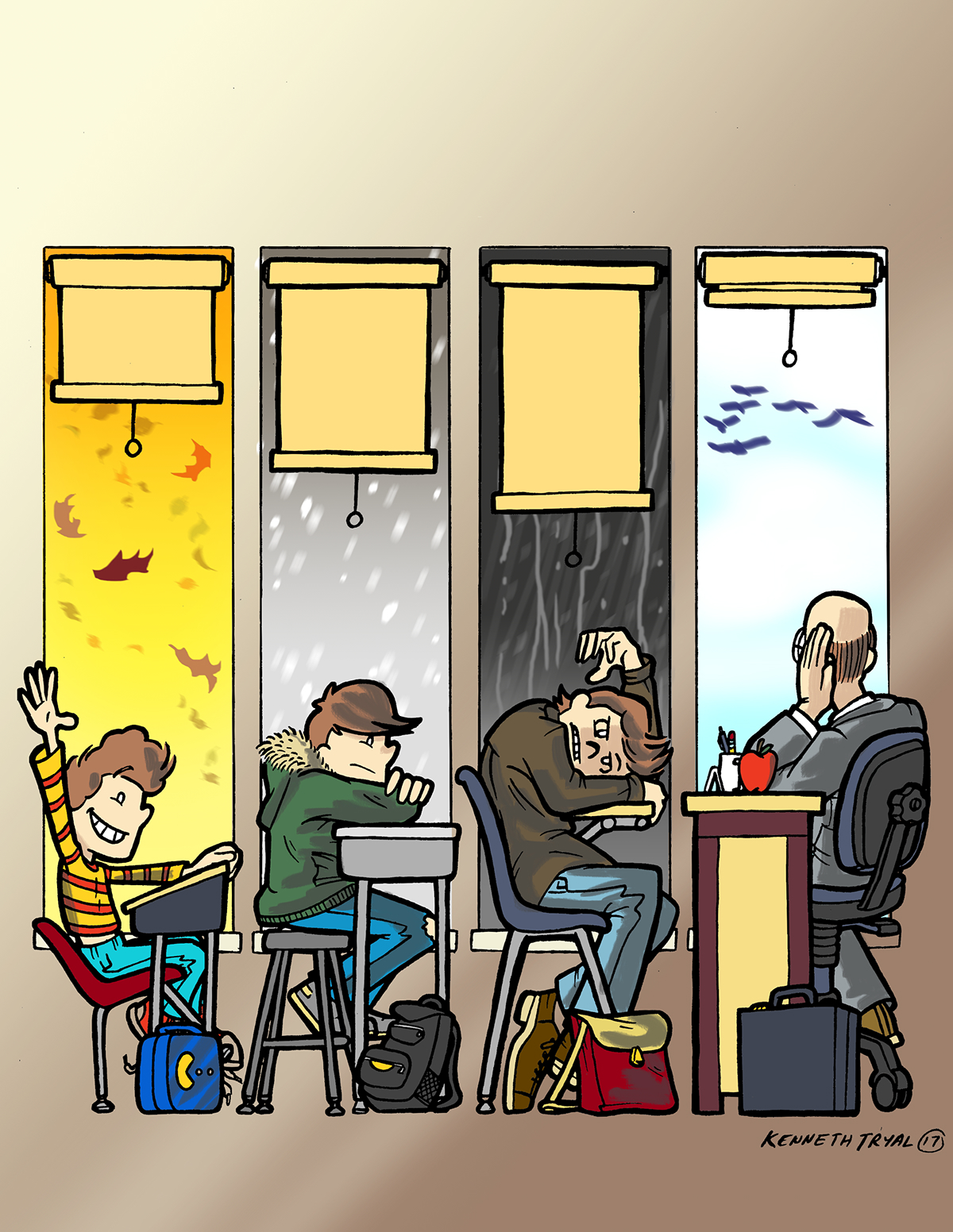
TRYAL: I've taken three classes here with the professor Brian Ralph: "Materials and Techniques," "Character Design for Storyboard Animation," and "Cartooning." Great professor, very motivating. For "Cartooning" class I drew a four-panel piece called "The Stages of Life." The assignment was to create an editorial cover for a magazine with the theme being "back to school." My piece depicts the same person, and the four seasons. I wanted to show the enthusiasm of childhood, the restlessness of being a teenager, and the fact that as an adult, you may have regrets if you didn't follow through with your passions. The man is basically me if I'd kept going with engineering and not come to SCAD.

Illustration of students lined up at desks with four windows behind them showing different scenes reflective of each characters' mood

SCAD: You also work at the SCAD Museum of Art. How have you integrated that job into your academics?

TRYAL: Working at SCAD MOA is like taking another great art history class. You're talking to people, informing them, practicing public speaking. As a job, it's fun because it challenges me to know more about art. The museum is highly diverse, and I get to speak with people from places I may never go. Being at SCAD is a very eye-opening thing. People thought I'd come home a completely different person but I'm the same guy, I just know more. It's a key to life: Know more every day.

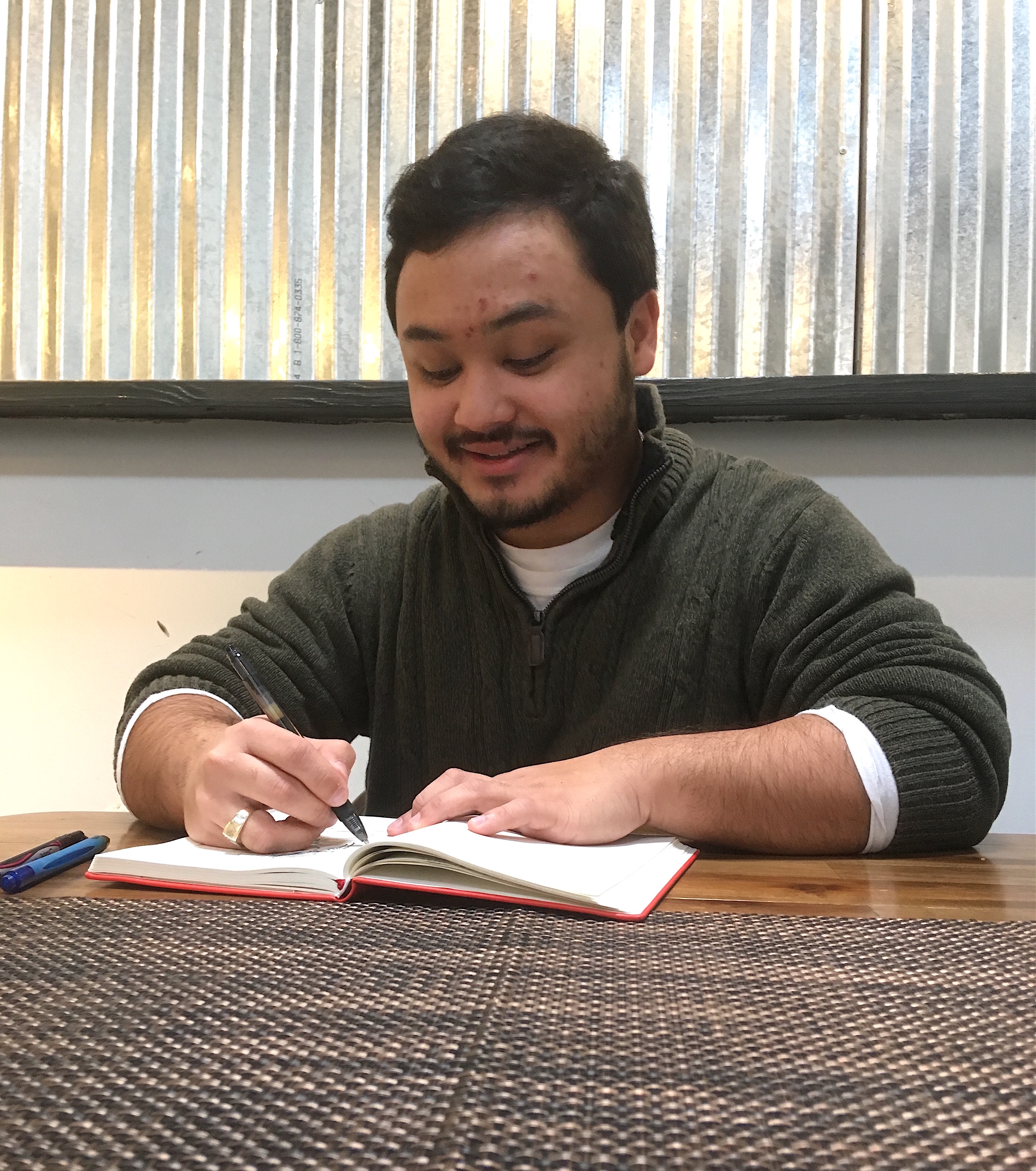
Kenneth Tryal signs book

SCAD highlights of 2017

December
27
2017
By
Tags:

As we prepare to bid adieu to 2017, we look back at the past 12 months at SCAD and all the memorable moments we shared. Here is an exemplary selection from the year gone by: the SCAD 17 of '17.

1. SCAD GamingFest premieres in Atlanta: In November, SCAD Atlanta hosted the first ever SCAD GamingFest, a two-day convocation examining the evolving world of game design and development, including appearances by experts from EA SPORTS, Ubisoft, Cartoon Network, Google Daydream Labs and Georgia Game Developers Association.

2. SCAD FASHWKND makes runway splash: The inaugural SCAD FASHWKND in May presented four days of original designs curated from the finest SCAD School of Fashion senior and graduate student collections. A runway show at SCAD Savannah and tableaux vivants at SCAD Atlanta offered glimpses into the fashionable future here and now.

3. SCAD art curation adorns new stadium: SCAD partnered with Mercedes-Benz Stadium, new home of Atlanta Falcons and Atlanta United FC, to curate all art for the stadium, featuring more than 200 works by 55 artists including 20 SCAD affiliates. Each game day, the curatorial selections of SCAD enhance the experience of the 71,000 fans in attendance.

4. Symposium for Jacob Lawrence: Amidst "Lines of Influence," the ongoing SCADMOA group exhibition celebrating the centennial of the birth of the acclaimed painter and chronicler of the African American experience, a two-day symposium of lectures, performances, screenings and panel discussions brought together scholars, artists, alumni and students to commemorate Lawrence's life and legacy.

5. Melissa Spitz named TIME's Instagram Photographer of the Year: Alumna Melissa Spitz's (M.F.A. photography, 2014) documentary photo series "You Have Nothing to Worry About" received the TIME accolade. Spitz's work will feature in an upcoming exhibition at the SCAD Museum of Art, opening January 2018.

6. DesignIntelligence recognizes SCAD interior design programs: The university's interior design undergraduate and graduate programs got the esteem treatment from DesignIntelligence, receiving the No. 1 ranking on the list of "America's Best Architecture & Design Schools 2018." Since 2008, SCAD interior design undergraduate and graduate programs have each garnered No. 1 standing six times by DesignIntelligence, the rankings body of the Design Futures Council.

7. Anna Haldewang receives European Product Design Awards: SCAD industrial design student Anna Haldewang's  (B.F.A. industrial design, 2017) project "Renascence" was named Discovery of the Year, the organization's highest honor, as well as capturing the gold medal in the transportation category. "Renascence," a cutting-edge design of a 300-foot trimaran yacht, follows Haldewang's "Plan Bee" drone project in earning the alumna international exposure.

8. Design for Social Impact recognizes Edgar Espejo: Inspired by his experiences with a deaf classmate, Edgar Espejo (B.F.A, industrial design, 2016; B.F.A., service design, 2016) created a service that allows deaf students to participate in regular classes with hearing students. Espejo's supporting service Muhimu (which means vital in Swahili) was recognized by the Core77 Design Awards as student winner in the Design for Social Impact category.

9. SCAD shines at YMA Awards: At the 2017 Young Menswear Association (YMA) Awards, 20 SCAD fashion and fashion marketing and management students each won $5,000 Fashion Scholarship Fund Awards, marking the most awards by a single university in the history of the competition.

10. SCAD alumni permeate Academy Awards: At the 89th Academy Awards, 47 SCAD alumni and students were recognized for their work on 11 of the year's best films, including best picture winner "Moonlight." SCAD alumni contributed to nominees for best picture, animated feature film, cinematography, costume design, directing, film editing, production design, sound editing, visual effects, and adapted screenplay. Eleven alumni contributed to more than one Oscar-nominated film.

11. SCAD Student Media earn top honors: At the 2017 Society for Collegiate Journalists National Contest, SCAD Atlanta's student magazine SCAN claimed first and second place in the Outstanding General Interest Magazine category. SCAD Atlanta Radio staff won first place in Internet Radio and Broadcast Overall Excellence for the second consecutive year.

12. Olivia Ray puts pedals to the medal: In a record setting year for SCAD Athletics at the state and national level, excellence was epitomized SCAD cyclist Olivia Ray, who won two national titles in track cycling at the meet in Indianapolis in September.

13. "SCAD: Architecture of a University" edifies readership: Assouline Publishing released the 360-page volume by contributing authors Paula Wallace, Margaret Russell and Chuck Chewning, highlighting the university's most inspired and inspiring spaces. Replete with 40 detailed narratives and 200 sublime photographs, the book leads readers from the university's flagship building Poetter Hall, to the panoply of SCAD architectural marvels around Savannah, and in Atlanta, Hong Kong and Lacoste.

14. SCAD Savannah Film Festival celebrates 20th anniversary: More than 50,000 film fans and industry insiders converged on Savannah for an unforgettable film festival featuring over 140 screenings amidst honorees Salma Hayek Pinault, John Boyega, Zoey Deutch, Richard Gere, Sir Patrick Stewart, Holly Hunter, Robert Pattinson, Willow Shields, Kyra Sedgwick, Aaron Sorkin and Andrea Riseborough.

15. Carlos Cruz-Diez has love, will travel: First at SCADMOA, then SCAD AT MIAMI, "Chroma," an exhibition by deFINE ART honoree Carlos Cruz-Diez, transported gallery-goers with its groundbreaking color theory in action. Designed as site-specific, "Chroma" proved as at home in Miami Beach as it was in Savannah. Bravo, maestro.

16. SCAD keeps student safe during major storm: With the September arrival of Hurricane Irma imminent, SCAD relocated more than 600 students and faculty from Savannah to its Atlanta campus. Students were given special tours of SCAD FASH Museum of Fashion + Film and attended workshops taught by industry-leading SCAD faculty, who join the university from Dreamworks, Random House, Spanx, Alexander McQueen and Walt Disney Animation.

17. SCADfit opens inside the Hive: The university's emphasis health and wellness gained added traction with the opening of its new Savannah gym, SCADfit. The 12,000-square-foot state-of-the-art facility, located within the Hive residence complex, offers fitness classes including ballet, Pilates and Zumba, and IC7 Indoor Cycles and Ciclotte monowheels. Sweat necessary, results guaranteed.

Thank you, dear SCADworks readers. See you in 2018!

Grey Clawson's reel Atlanta hustle

November
22
2017
By
Tags:

When Grey Clawson (B.F.A., film and television, 2015) was in middle school, he used a home video camera to film friends skateboarding through his Manteo, North Carolina hometown. Today, Clawson works on a much bigger scale. He is the digital dailies operator on FX's Emmy-winning comedy "Atlanta" starring Donald Glover and loader for Adult Swim's "Your Pretty Face is Going to Hell," as well as producing and directing other projects. He still makes time to film with friends on the weekend.

SCAD: What was it like to freelance after graduation?

GREY CLAWSON: Networking has been a really big part of my freelance experience. There were times when the work was spread out. I try my best to stay as busy as possible. I met a producer in Atlanta, helped him cut a feature film, and he keeps calling me for paid work today.

SCAD: How did you wind up working on "Atlanta"?

CLAWSON: Brett Bagwell, a friend from SCAD, asked if I wanted to work on a TV pilot. On my first day, while filling out hiring paperwork, I saw Donald Glover walk by. I grabbed my friend and said, "Wait, what is this show?" And he very casually replied, "Oh, it's Donald Glover's TV show. They're making a pilot for it."

We didn't know if the show was going to get picked up. They didn't have a big budget, but they had an awesome producer and crew, and they knocked it out of the park.

As a digital dailies operator, I would get a day's worth of footage every morning, sync it with sound, log all the media that was shot that day and then release what they call "dailies," so post-production teams can access clips when they need to. I didn't expect to work on a show that was going to win Emmys and Golden Globes.

SCAD: What projects are you working on now?

CLAWSON: Filming is in progress for the second season of "Atlanta." I can't say a lot about it. They seem to have more freedom this time.

I also recently cut three pieces for Motion Family, a production company run by SCAD graduates Sebastian Urrea (B.F.A., video/film, 2005) and David Kuniansky-Altman (B.F.A., graphic design, 2005). The project was for "STEP UP: High Water," a YouTube Red drama series about hip-hop dancers in Atlanta.

SCAD: Do you still make time for personal projects?

CLAWSON: Of course! Having a sense of community here really motivates me. I moved to Atlanta with four close friends, and we all work well together. When one of us has a script, we'll pass it back and forth, polish it up and film it over a weekend.

SCAD: What's the most important lesson you learned at SCAD?

CLAWSON: Be a sponge. Take all the jobs you can, and absorb everything. That lesson has really come in handy for me. Once you're in the industry, people can tell if you're "green." If you don't know something and you don't ask, you're never going to learn.

Jacob Lawrence goes to Black Mountain College

November
21
2017
By
Tags:

Jacob Lawrence had never met Josef Albers when, in the spring of 1946, the young African-American painter received an unexpected invitation from the German-born Bauhaus master to teach a painting course at a progressive liberal arts college in the mountains of Western North Carolina. Lawrence's experience that summer at Black Mountain College became a milestone for the artist, initiating him into the ranks of teacher and transforming his artistic practice.

Julie Levin-Caro, Ph.D., delivered her scholarly and spirited presentation "Jacob Lawrence at Black Mountain College, Summer 1946" during the recent symposium celebrating the exhibition "Jacob Lawrence: Lines of Influence" at SCAD Museum of Art. The lecture was enhanced by an astonishing array of visual materials Levin-Caro culled from the State Archives of North Carolina in Asheville, including Albers' original letter of invitation to Lawrence (mentioning a $25-a-week honorarium) and rare photographs by Nancy Newhall and Bacia Stepner of life at Black Mountain – a fully integrated campus in the Jim Crow South.

Levin-Caro, a professor of art history at Warren Wilson College, explained that at the time of Albers' invitation, "Lawrence had just returned to New York. He'd served two years in the Coast Guard during World War II. He'd resumed his painting career and was on a Guggenheim Fellowship and had started the 'War' series." As for Black Mountain, the college, founded in 1933 (it ceased operations in 1957) was in the summer of '46, as Levin-Caro put it, "fully under the sway of Josef Albers."

Albers and his wife Annie were in the United States as refugees of Nazi Germany. "When Albers arrived at Black Mountain, a student asked him, 'Mr. Albers, what are you going to teach us?'," Levin-Caro said. "To which Albers responded: 'To open eyes.'

"The idea was that Albers wasn't training artists, he was training people to see, to have visual perception. Another thing Jacob Lawrence got from Albers was a vocabulary and a confidence to talk about his work in formal terms. It makes us think about Jacob Lawrence as a formalist, and sometimes that gets overshadowed by the content and we lose sight that he's communicating this content through formal means."

That summer, Gwendolyn Knight Lawrence took sculpting with Leo Amino, sat in on Albers' painting classes, and taught an informal dance class to students in the dining hall, a location of no small importance, as Levin-Caro said: "Jacob Lawrence said that he was touched to notice that every day Albers would move around the dining hall and sit next to a different painting of his and look at it very closely."

Decades later, the experience at Black Mountain in the summer of 1946 continued to resonate. When interviewed in 1968 by Carroll Greene for the Archives of American Art, Jacob Lawrence said:

"Teaching has been a very good thing for me. It's led me into areas of exploration, areas of thinking which I may not have gone into it had I not had the experience of teaching. When you teach, it stimulates you. You're forced to formalize your own theories so that you may communicate them to students."

Special thanks to Dr. Julie Levin-Caro and all the presenters and attendees of the "Jacob-Lawrence: Lines of Influence" public symposium. SCAD Museum of Art will be closed Nov. 23-24 but reopens for normal hours on Saturday, Nov. 25, 2017. "Lines of Influence" is on view through Sunday, Feb. 4, 2018.


GamingFest racks up high score

November
13
2017
By
Tags:

In its very first year, SCAD GamingFest attracted experts from Cartoon Network, EA Sports, Google Daydream and many more for a two-day exploration of the creative development of today's most popular games.

Held at SCAD's 13,300-square-foot SCADshow theater in the heart of Midtown Atlanta, SCAD GamingFest was the newest example of the university's prestigious leadership in the gaming industry. Students attendees represented a wide swathe of carefully curated SCAD degree programs including animation, branded entertainment, film and television, graphic design, illustration, motion media design, sequential art, sound design, television producing, visual effects and writing.

SCAD is home to the nation's largest academic degree program for interactive design and game development, with nearly 5,500 SCAD alumni of gaming and related programs working for industry leaders including Electronic Arts, Blizzard Entertainment and Nintendo. Notable alumni have launched also their own studios and titles, including Tiny Monsters and Ker-Chunk Games.

SCAD GamingFest schedule highlights included:

The Art of Voiceover: Dave Fennoy and Brian Bremer, voice actors for the "The Walking Dead" game and the creative team behind the voices, discussed how the best voice actors bring a game to life. 

In The Huddle: An Evolution of Story in "Madden NFL": Some of the creators behind the longest-running sports video game in history, "Madden NFL," explored how story has advanced in EA SPORTS and how those advancements helped create the game's first ever story mode, "Longshot." 

Google Daydream – AR Lessons Learned for Success: Designers at Google's Daydream Labs figure out the who, what, why and how of successful augmented reality applications. As the Apple and Android platforms widen to allow more augmented reality, the Google Daydream experts explained how they make important discoveries to help developers succeed.

Gaming in Atlanta: Top professionals from Nektr, at American Gaming Systems, and the Georgia Game Developers Association talked shop about the business and culture of producing hit games. 

Special Screening of "The Wizard": An enthusiastic Friday night audience enjoyed this 1989 cult classic about two brothers (Luke Edwards and Fred Savage) who run away from home, meet a girl (Jenny Lewis), and hitchhike across the country to compete in a video game tournament. A conversation on the film's cultural significance and renewed relevance in the world of gaming followed the film. 

Another crucial component of GamingFest was a presentation of SCAD+, the groundbreaking university program designed to assist alumni in developing commercially viable digital products. From hundreds of applications, nine participants were selected by the SCAD+ advisory board, placed on teams, provided a living and work space and access to resources to develop their original product ideas. As presented to an engaged and eager GamingFest audience, the three projects – focussing on gaming, virtual reality, augmented reality and mobile experiences – will be ready for presentation to potential investors at the end of the year.

SCAD GamingFest is the newest professional engagement program through SCADFILM and highlights SCAD's support of Atlanta's growing gaming industry, responsible for 3,200 jobs in Georgia. Next year's GamingFest is already in the works, so be sure to level up for the next installment of this memorable, enlightening, game-tastic SCAD tradition.