Skip to main content Accessibility Policy

Luxury and fashion management students visit Shanghai

November
7
2018
By
Tags:

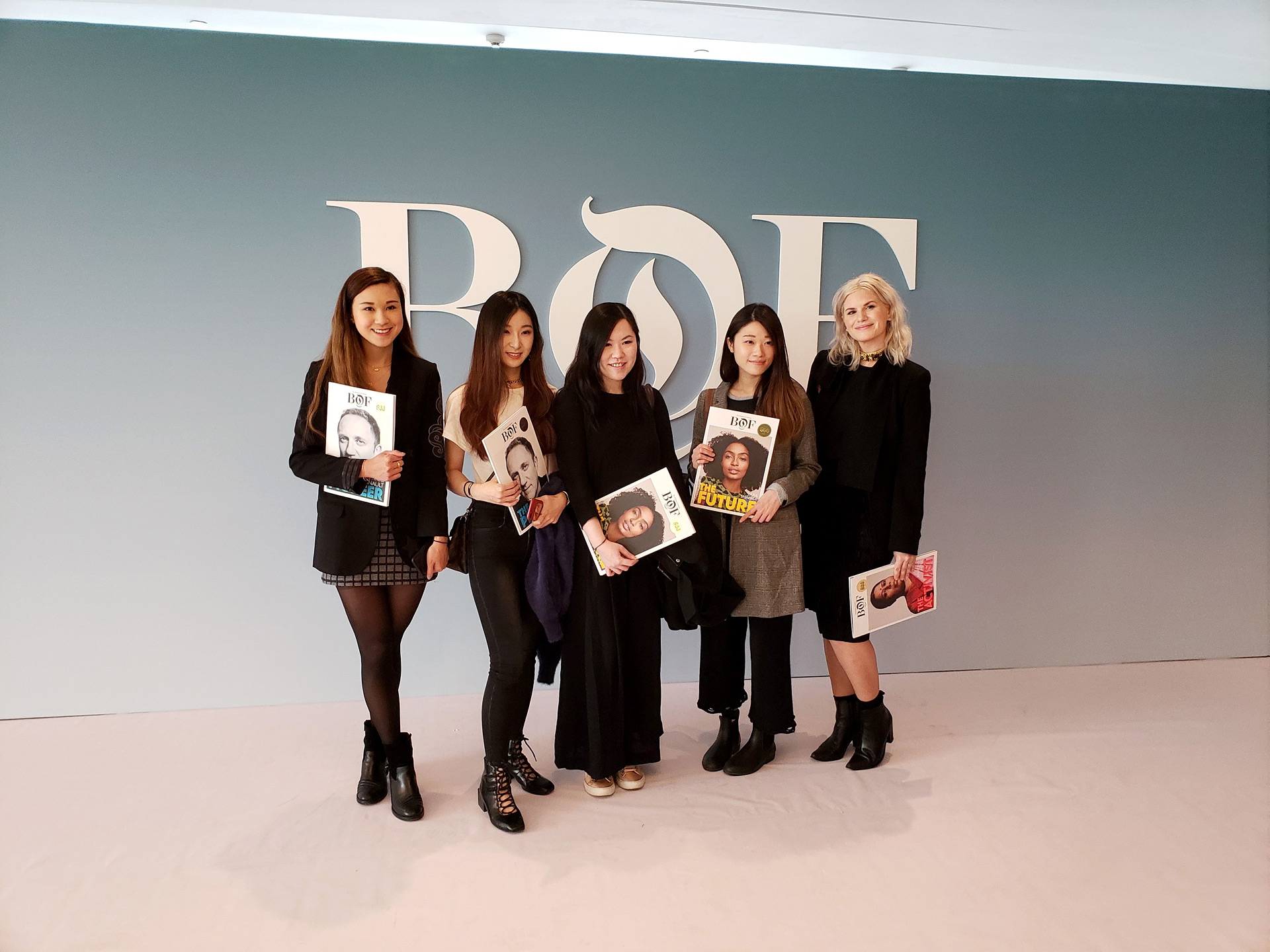
Shanghai is a city of expansive spaces and opportunities for growth. This quarter, five luxury and fashion management (LXFM) students from SCAD Hong Kong spent an insightful week in China's biggest city, accompanied by SCAD professor of fashion and fashion marketing and management Cristina Kountiou and SCAD associate chair of building arts, fashion and language studio Robert Meeder.

The group visited multiple events, including the Inaugural Summit on Sustainability initiated by yehyehyeh, the Business of Fashion (BoF) Summit, and Shanghai Fashion Week, part of Shanghai International Fashion Culture Festival. Along the way, SCAD students met and interviewed industry professionals, influencers and entrepreneurs, all of whom spoke with enthusiasm about the rapid evolution of society and industry in China.

At SCAD, students are exposed to circular design thinking, which means thinking of the "death" of an item during its conception. As the Chinese luxury fashion marketplace matures and the meaning of "Made in China" is redefined, the need for a conversation surrounding sustainability grows.

During the Inaugural Fashion Sustainability Forum, held at the Edition Hotel in the Bund, Nike senior director of sustainable business and innovation Virginia Rustique-Pettini spoke about the company's innovative sustainability efforts in developing the Flyknit and Air sneakers. Event host Shaway Yeh, yehyehyeh founder and co-creative director for NOWNESS China, is a leading force behind the push for sustainable thinking in China. The subject remains at the forefront of concern for all those in fashion.

The BoF Summit, the primary catalyst for the SCAD visit to Shanghai, was an eye-opening experience. The summit began with a fashion principal smashing the proverbial bottle of champagne on the BoF China Summit yacht. The dazzling presence of the glitterati of China's fashion scene made the event a style watcher's delight. 

The keynote conversation between Gucci CEO Marco Bizzarri and BoF founder Imran Amed focused on how Shanghai's "fashion industry is gaining global credibility" and the future of Gucci. Bizzari spoke about how his management style fosters innovative thinking and the importance of letting his team be creative without controlling them. He stressed Gucci's continuing growth in Asian markets, specifically China. 

The SCAD students in attendance were privileged to have met the professionals at the conference, who spoke freely about their international work experiences. The summit demonstrated how motivated China is for the luxury fashion industry to grow and admit innovation into the sphere of the spending superpower.

Shanghai Fashion Week was infused with nostalgic references to 1920s Shanghai. Once regarded as the "Paris of the East," it's only fitting that the city, with its rich heritage, is the setting for new designers and artistic creativity.

Fashion Week in Shanghai is like a contact sport: the coolest shoes, most watched stories and best parties win. Balenciaga sneakers, tight plaid suiting, two phones (one for China and one for Hong Kong), WeChat, Weibo, and Douyin were all in. Attendees were fast and fierce with scanning each other's contact info. Shanghai continues to open itself to artists and creators alike—making it the ideal location for SCAD students to have this unique learning experience.

Five students smile while holding Business of Fashion magazines

Participating SCAD Hong Kong students: Vivien So, Lynn Serulla, Nikita Mitla, Jeng Yiu Chan and Odelia Wong.

Film Fest: Talley returns

November
5
2018
By
Tags:

"Do you know how sophisticated it is to marry navy blue and black?" exclaims legendary fashion journalist André Leon Talley amidst the riotous whirl of a runway show in director Kate Novack's new documentary "The Gospel According to André." In a film bursting with lush color, the statement feels shaded with metaphor. Talley, a Diana Vreeland acolyte, Anna Wintour ally, former correspondent for Women's Wear Daily in Paris and longtime Vogue editor-at-large, was raised by his fastidious grandmother in the Jim Crow South. His journey was, and is, astonishing. As he says in Novack's film: "I made it look effortless sitting on the front row all those years. But...."

"The Gospel According to André" screened at this year's SCAD Savannah Film Festival in the Lucas Theater, one of Savannah's finest historical and cultural landmarks. The gorgeous setting was only proper: Talley, who holds an honorary doctorate of humanities from SCAD, has mentored students at the university for over a decade, and his name adorns the eponymous André Leon Talley Gallery at the SCAD Museum of Art. In September of this year, he visited SCAD Atlanta for a screening of "The Gospel According to André" at SCADshow, including a discussion of the film and its production.

The return of Talley to SCAD Savannah during film festival was heralded by SCAD a cappella group HoneyBees performing Aretha Franklin classics "Respect" and "Think," arranged by American Idol winner and current SCAD student Candice Glover (B.F.A., dramatic writing). "President Wallace has treated me like a prodigal son," remarked the esteemed guest.

After the screening, Talley appeared to a standing ovation. Resplendent in a silk caftan atop an opulent ottoman, he was joined on-stage by author Julia Reed. Together the pair regaled attendees with outrageous stories from their days working together at Vogue. "I don't live for fashion, I live for beauty and style," Talley said, con brio. SCAD has not seen the last of this legendary figure.

Savannah Film Festival logo

Film Fest: innovative 'Docs to Watch'

October
29
2018
By
Tags:

One dividend from screening multiple movies in close sequence is the revelatory flash when they reflect each other unexpectedly. This experience was in brilliant supply during the opening days of the SCAD Savannah Film Festival, including its essential "Docs to Watch" programming.

So, what could the upbringings of superstar athletes Wayne Gretzky, Jerry Rice, and Serena Williams—all analyzed by director Gabe Polsky in his sports documentary "In Search of Greatness"—possibly have in common with an aloha shirt-loving, academically underperforming high school student named Robbie in Cristina Costantini and Darren Foster’s "Science Fair"?

The answers seem both obvious and counterintuitive: an emphasis on unstructured creative play, a parenting style that makes room for discovering passions on one’s own terms, and the encouragement to pursue interests beyond the core curriculum. Gretzky, Rice and Williams are all-time great champions. Robbie is an impish kid salvaging computer parts from garbage dumps and experimenting with artificial intelligence. Yet they have these factors in common.

Robbie’s programming project leads him to travel to Los Angeles to compete along with some 1700 high school students in the 2017 International Science and Engineering Fair (ISEF). In Costantini and Foster’s feature, we meet other teens on their way to the fair, including an outspoken prodigy from Kentucky named Anjali; Kashfia, a Muslim introvert at a football-obsessed high school in South Dakota; Myllena and Gabriel, two students from a poor village in Brazil decimated by the Zika virus; and Ivo, a German aeronautics devotee revisiting a concept that industry dismissed decades ago.

"Science Fair" radiates inspiration. During the Q&A following the packed screening in Trustees Theater, co-director Costantini said: "People tell us, ‘Your cast is so diverse!’ The fact is, that’s what the world of Science Fair looks like. If we didn’t have girls, if we didn’t have immigrants and the children of immigrants, it wouldn’t be reflective of what this world looks like. There are tons of kids, not just in science, but in many fields, who need to be encouraged to follow their curiosity. They should be our focus."

Costantini’s comment reconnects to "In Search of Greatness," where Gretzky, the least physically naturally gifted of Polsky’s subjects, delivers a quote handed down from his father: "Skate to where the puck is going to be, not where it has been." In a sense, and with the planet’s future at stake, the kids of "Science Fair" are heeding that call.

The SCAD Savannah Film Festival continues through Nov. 3, 2018. View a full schedule of screenings and events at the official festival website.

Savannah Film Festival logo

Architecture students rev up with CityEngine

October
25
2018
By
Tags:

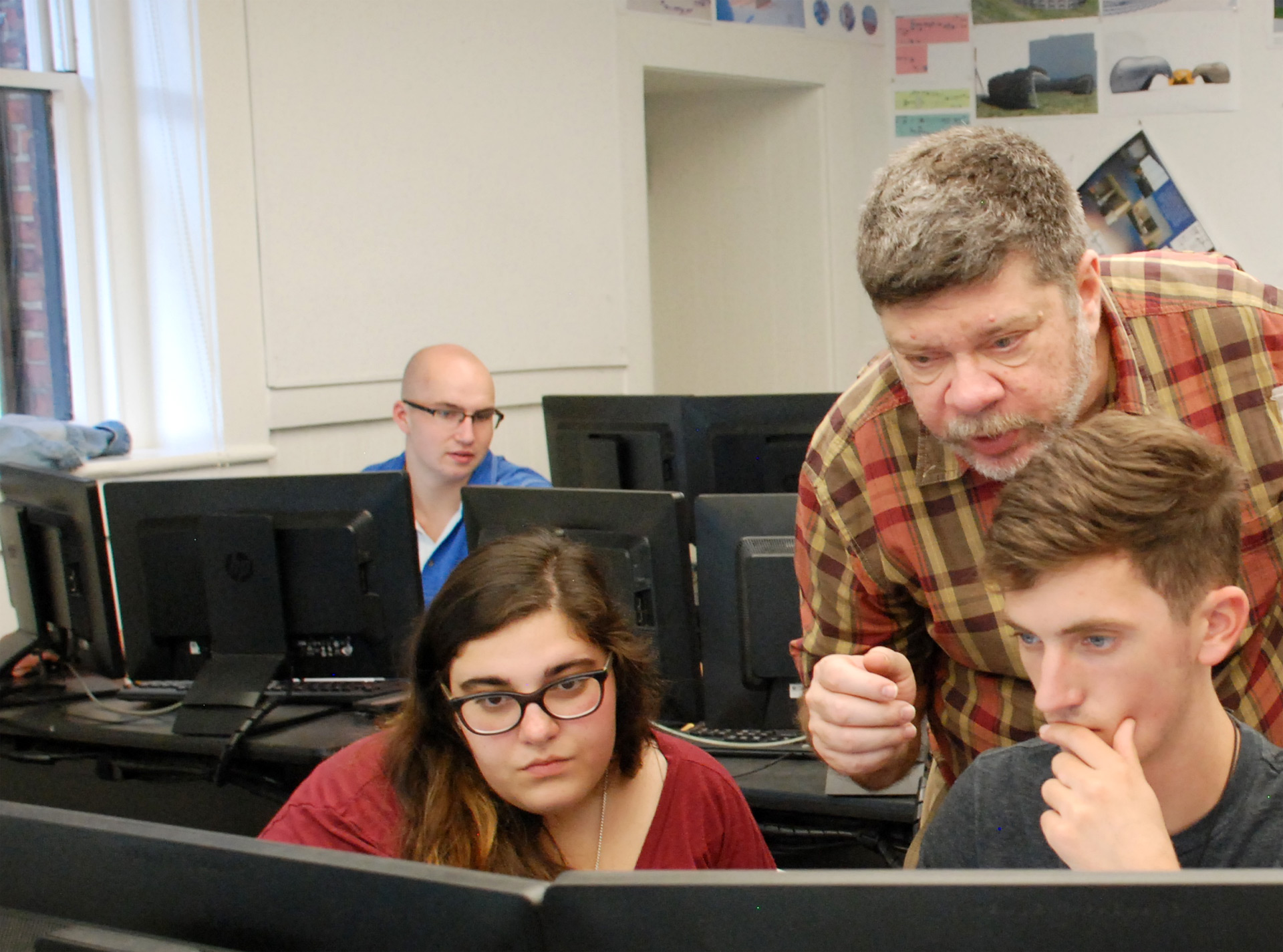
This quarter, architecture professors Christine Wacta and Alice Guess brought two classes together for a guest workshop by visionary city planning consultant Jeff Herzer, focused on geodesign software program CityEngine.

Herzer, who holds a master's degree in geographic information systems (GIS), and whose consultancy Jeffcity.io works under the banner "Geo + Media + Design," met Wacta at the Esri Geodesign Summit in Redlands, California in January of this year.

"I watched her presentation and we clicked and she invited me to SCAD," said Herzer, whose work includes public outreach projects and media for large transportation projects. "I recognize the value of the geodesign process and the need for CityEngine training. It's a valuable tool, one I'm impressed is already being used by SCAD students."

As defined by mapping tech company Esri, CityEngine is a three-dimensional modeling application for generating 3D urban environments, supporting the creation of large-scale city models. A key tenet of CityEngine is treating a city as an interconnected, holistic system—precisely the approach Guess and Wacta instill in their students.

As Wacta explained: "CityEngine is a procedural, meaning it taps right into the data of the city. In CityEngine, we can place a building in Savannah at a specific location and conduct solar calculation to see what the shadows and light will be like each day of the year. As architects we design and measure buildings. CityEngine is a tool to help us make the right decisions."

This quarter, Wacta is teaching ARCH 404 (Architecture Design Studio IV: Urban Context), a class of fourth year undergraduates, while Guess's class ARCH 717 (Graduate Architecture Studio I: Urban Design and Development) is comprised of first year graduate students.

"For my graduate students, knowing how to use CityEngine gives them a highly competitive skill," professor Guess said. "Learning how to use this program prepares them for their professional careers, and in the immediate sense sets them up for their independently driven thesis. It's another tool in the tool box in terms of how students understand the data that they research and how they represent their data to others."

CityEngine, part of the architecture curriculum at SCAD for the past four years, allows users to take authorship of their designs by coding, as Herzer emphasized during his workshop. "He showed our students the power of coding in CityEngine," said Guess, "and how it can have demonstrable effect on their work."

Wacta, whose students are designing sustainable plans for Savannah in the year 2050, observed how Herzer's workshop had a direct effect of broadening her students' visions for their creative careers: "One student told me, ‘I'm now looking at government jobs where I can affect policy changes'—something beyond the type of job you might expect an architecture student to consider."

"Seeing these SCAD students work directly speaks to the multidisciplinary nature of geodesign as a whole and why it's important," concluded Herzer. "I'm impressed by SCAD, and I look forward to coming back."

Herzer looks over the shoulder of two students on computers

Above: Jeff Herzer working with SCAD architecture students.


Demi Waldron: 'Cinematographer'

October
18
2018
By
Tags:

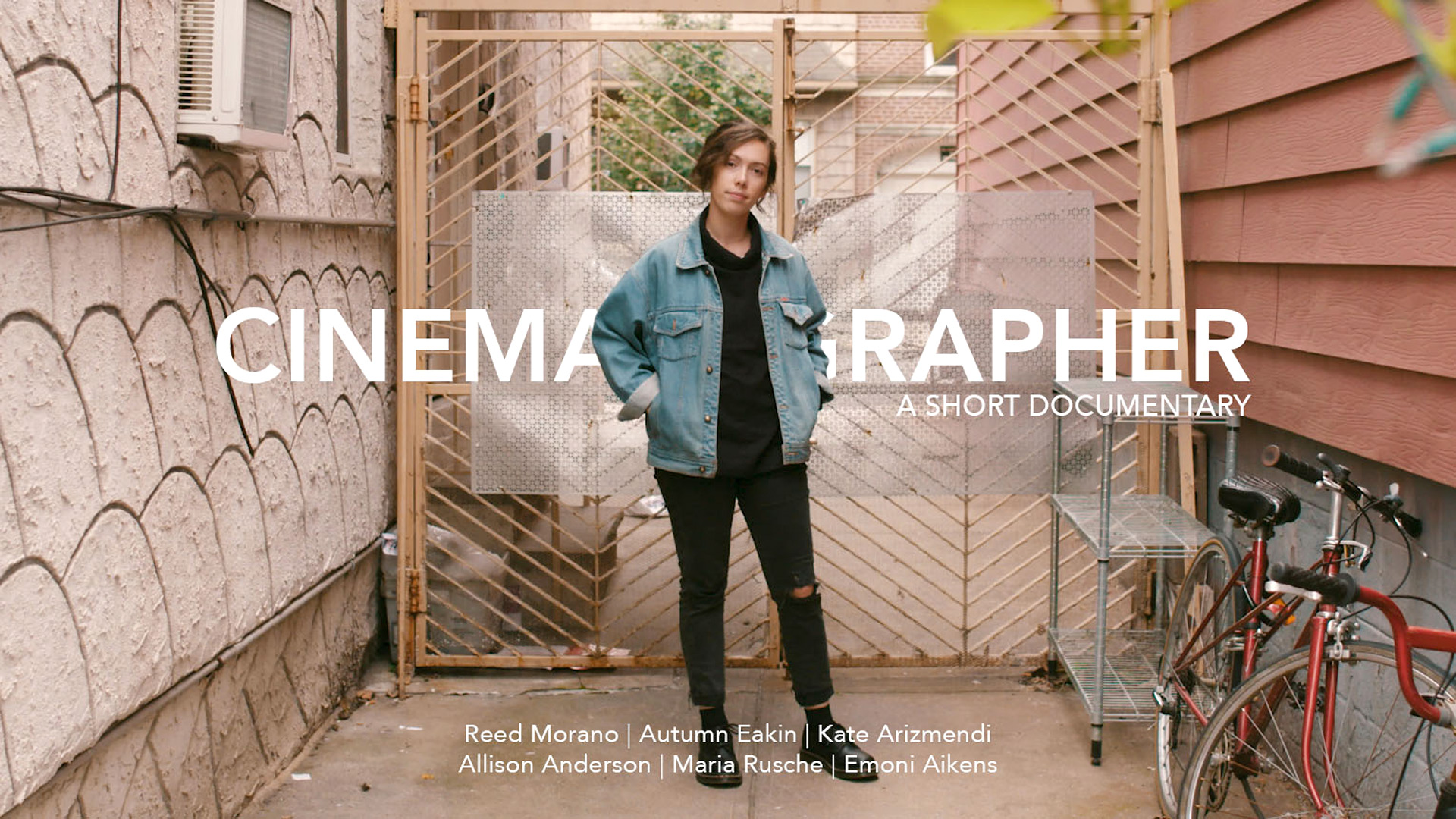
It's not a spoiler to call "Cinematographer" timely. The new, 11-minute documentary by Demi Waldron (B.F.A., film and television, 2018), an Official Selection of the 2018 SCAD Savannah Film Festival, features six women—Reed Morano, Autumn Eakin, Kate Arizmendi, Maria Rusche, Allison Anderson and Emoni Aikens—discussing their lives as cinematographers in an industry undergoing overdue changes.

This year, director of photography (DP) Rachel Morrison was nominated for the Academy Award for Best Cinematography for feature film "Mudbound"—the first female nominee in that category in the 90-year history of the Oscars. This prompted Waldron to insert two key archival clips from Academy ceremonies past at the beginning of "Cinematographer." Slight reveal: One clip features a young Elizabeth Taylor, the other a not-so-young John Wayne.

Waldron and collaborator Claudia Burgi (B.F.A., film and television, 2018) will be at both screenings of "Cinematographer" at this year's SCAD Savannah Film Festival. Come see the film, and meet the young women behind it.

Postcard with woman standing in front of the word Cinematographer

Demi Waldron:

We wanted to make our film's perspective as accurate as possible, and highlight different age groups and experience levels. Each woman in "Cinematographer" came to the film industry in a different way and they represent a variety of styles. I cut the film to create a sense of them having a conversation, like they were talking back and forth to each other, which worked really well. Professor Alex Newton guided me throughout the editing process and gave great advice.

One wonderful thing about SCAD is I was able to shoot, shoot, shoot. As a student, every weekend I'd get on a project and shoot it and learn. Being a DP is challenging. There are a lot of different aspects of being a DP beyond shooting, like managing the set. Claudia and I had been talking for a long time about making a film about women in film. We decided to focus it on DPs, since that's what we are and have the most experience with.

With Reed Morano, I've followed her work longer than any other DP. I saw Reed speak at the Savannah Film Festival in 2015. Then I went to one of her screenings in New York and got to hear her talk about her new film "I Think We're Alone Now." She had recently won her Emmy for directing "The Handmaid's Tale." She's one of my biggest inspirations and role models.

The Emmys and Academy Awards are trying to become more inclusive. The thought occurred to me that it hasn't always been this way, so I went back and watched every single Academy Award Best Cinematography presentation I could find. I think I watched fifty or sixty of them on YouTube. I found two where I thought, if I open my film with these clips, without saying anything else, that sets the mood: It starts then and ends now. Having that historical context is important.

I'm excited to come back to Savannah with "Cinematographer." Showing the film at the festival is like showing it at home.

A graduate of Woodruff High School in Woodruff, South Carolina, Demi Waldron currently resides in Park Slope, Brooklyn, where she works as a freelance cinematographer. She recently shot the music video "Rude Boy" for electro-pop band Salt Cathedral, directed by fellow alumna Susan O'Brien (B.F.A., film and television, 2014). See Demi's work at www.demiwaldron.com.

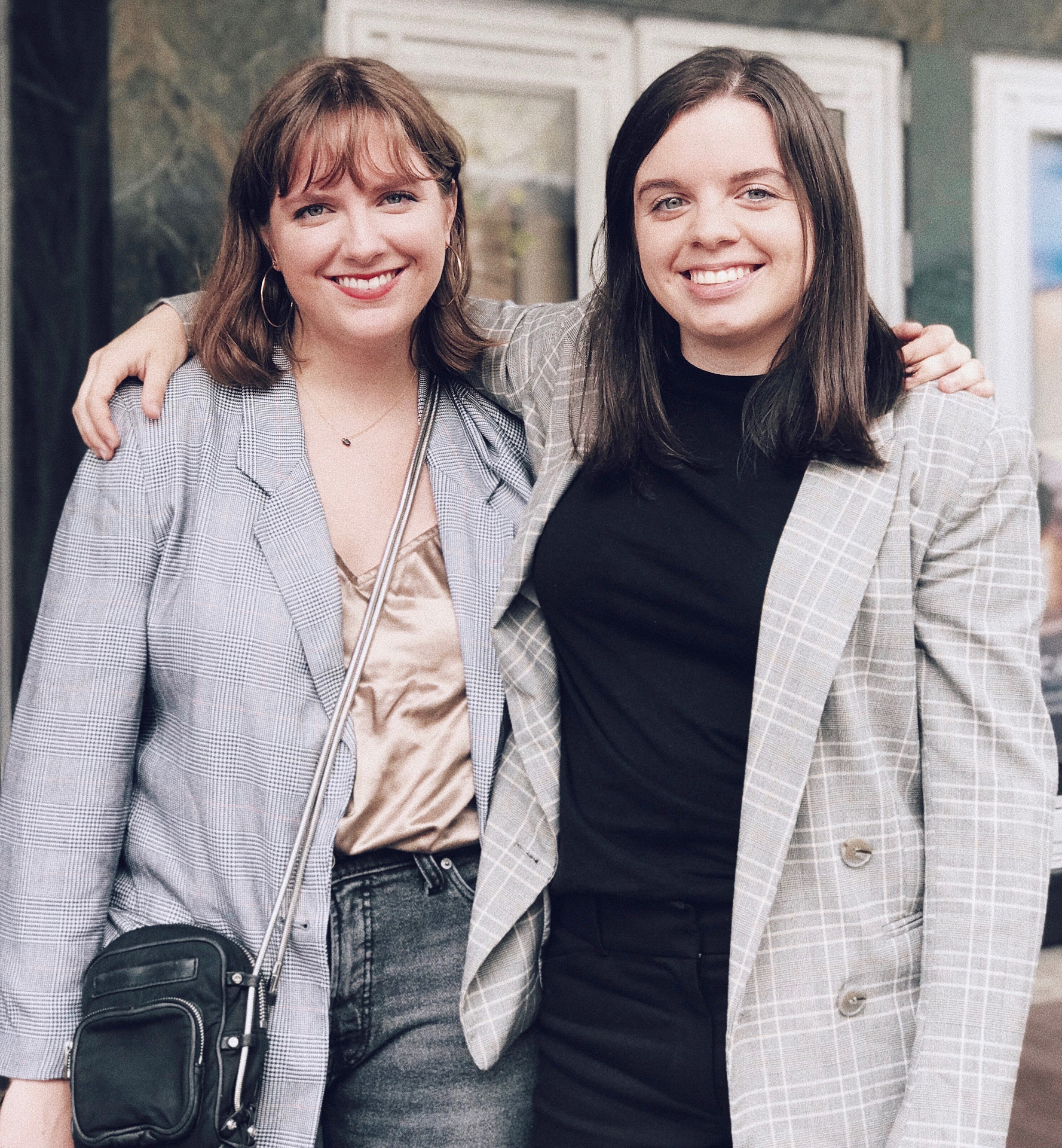
Waldron and Burgi smile to camera with arms around each other

Above: Waldron (right) and “Cinematographer” executive producer and director of photography Claudia Burgi.

"Cinematographer" screens at SCAD Savannah Film Festival during "Student Shorts Block B – Heavy Hitters" at Lucas Theatre for the Arts: Tues. Oct. 30, noon; Sat. Nov. 3, 10:30 a.m.

Savannah Film Festival logo

For ticket information visit the festival website.


The passion and vision of Calvin Bellas

October
10
2018
By
Tags:

A native of Trinidad and Tobago, Calvin Bellas (B.F.A., film and television, 2018) grew up in the decidedly non-tropical clime of Michigan's capital city, Lansing. While attending Lansing Community College, he heard about SCAD from a digital media professor. “I'd never been to Savannah before," Bellas says. “I visited SCAD online, and was immediately captivated." Awarded the prestigious May and Paul Poetter Scholarship, Bellas arrived at SCAD in September, 2016 to study film and television.

As a SCAD student, Bellas worked on a wide variety of film and television projects. He color-corrected a music video for NYC-based Colombian band Salt Cathedral (directed by SCAD alumna Susan O'Brien); conducted cinematography for Vivian Griefhan's senior thesis film “Locked-In"; and volunteered as engineer for the College Television Emmy Award-winning SCAD sitcom “The Buzz."

For his own senior project, Bellas created “Meraki," a compound profile of multiple SCAD artist-athletes that is less traditional documentary and more akin to artful, acclaimed sports films like “Zidane: A 21st Century Portrait" and “The Art of Flight."

In fall 2018, Bellas began working full-time at SCAD as post-production support technician.

Calvin Bellas:

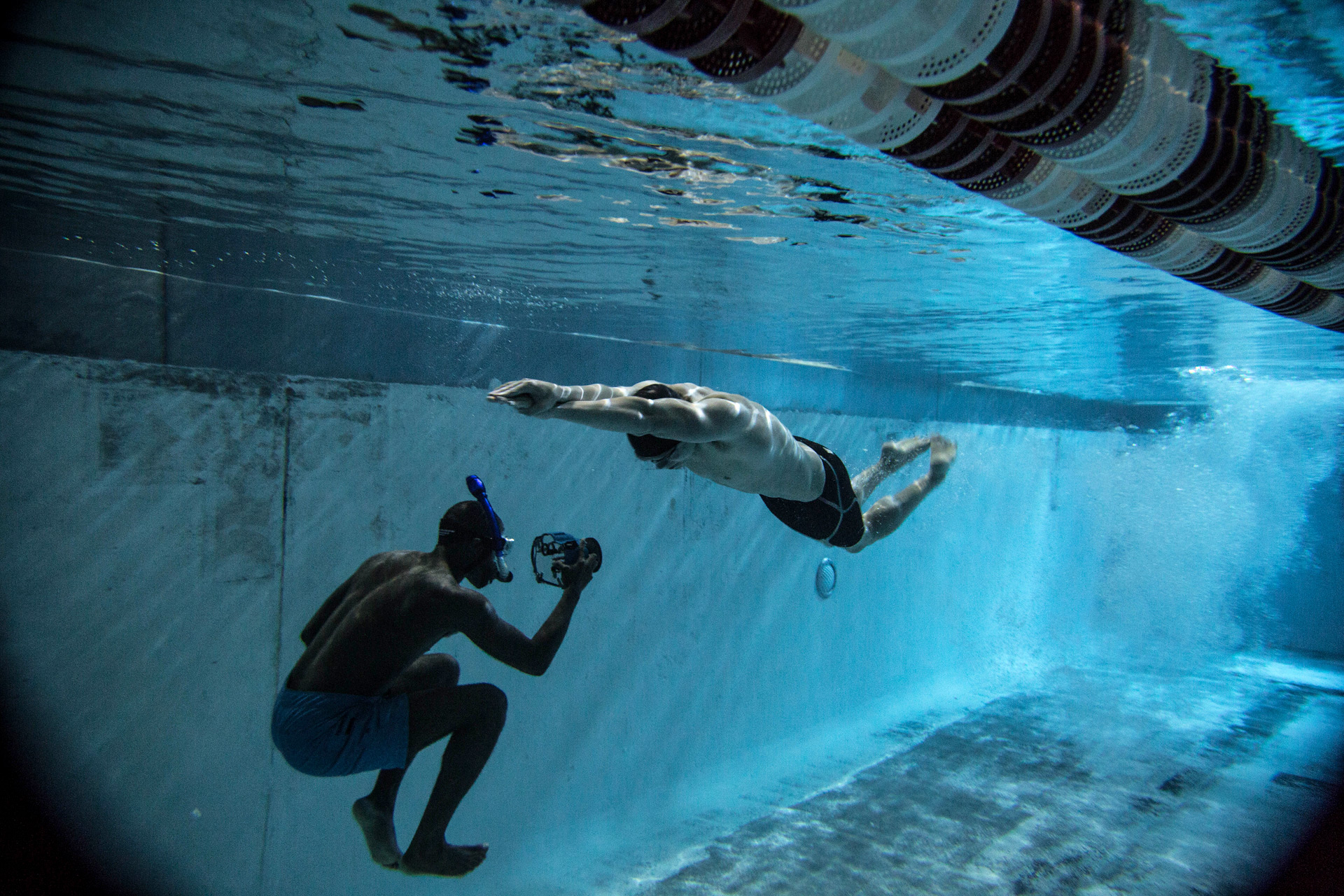
My passion has always been athletes and the outdoors. For my senior capstone project, I wanted to push my boundaries. I wrote and directed and shot “Meraki," a documentary about the SCAD artist-athlete student experience.

Bellas films swimmer underwater

The title “Meraki" is a Greek word that relates to the soul, creativity, and love that someone puts into their work. I wanted to explore the connection between SCAD students' athleticism and their artistry.

SCAD doesn't have a football, basketball, or baseball team. We have other interesting sports, like fishing and cycling. I wanted to combine lesser-known sports with better-known sports, like swimming, and make a film that shows the breadth of the SCAD artist-athlete experience. Through word of mouth, and by talking with our athletic director Doug Wollenburg, I found the students featured in “Meraki." I'm really thankful for all the athletes who participated.

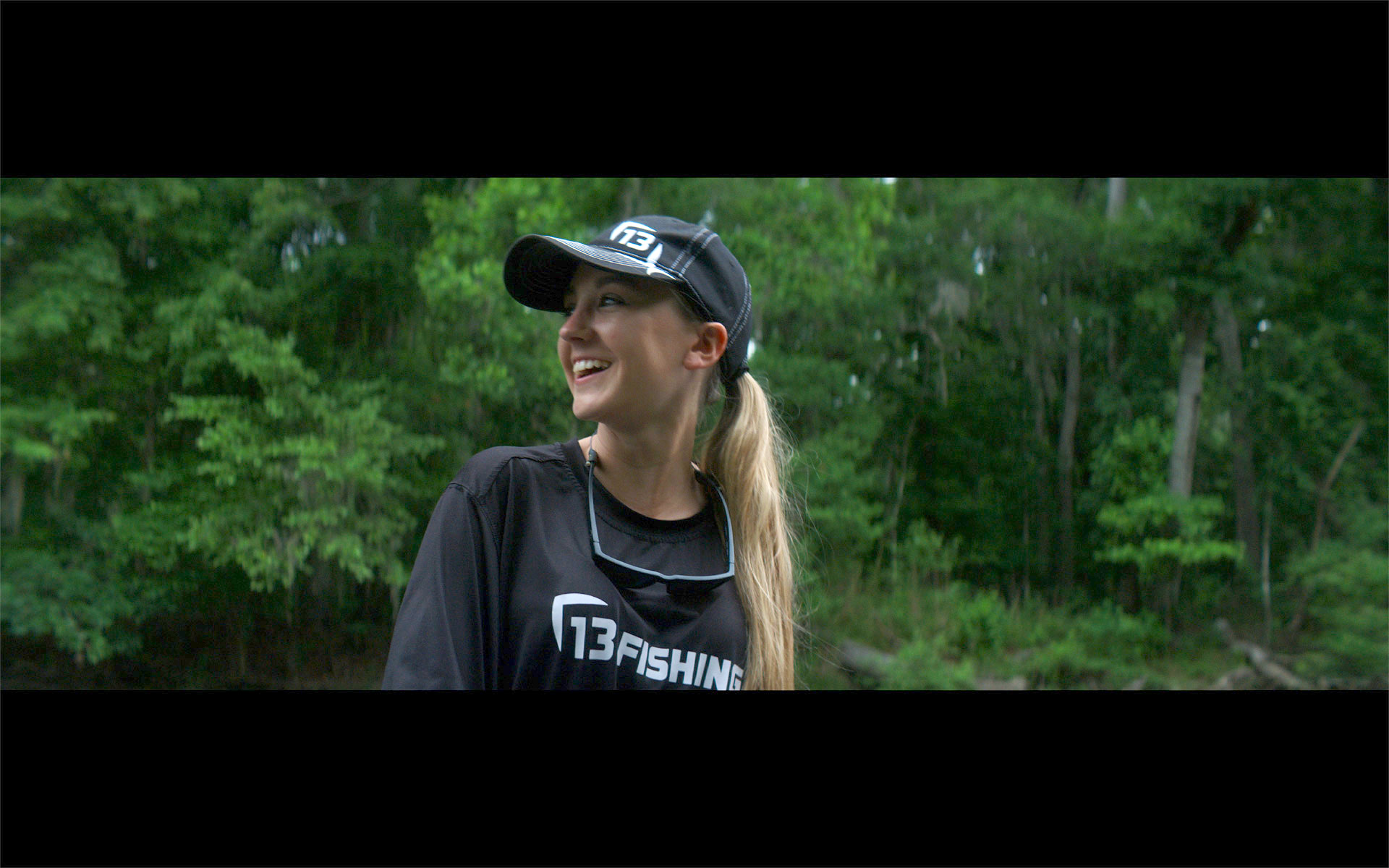
Ryleigh Tyson is a young woman who's at SCAD studying industrial design, she's on the SCAD fishing team, and she's sponsored by a fishing company called 13 Fishing. Ryleigh is extremely passionate about tournament fishing. I filmed her on her favorite river in South Carolina, on a boat with the wind blowing, to show her calculated casting and release and concentration.

Still of woman wearing a fishing shirt

We shot “Meraki" in its entirety all in four consecutive days. Those four days of shooting were embedded within thirty weeks of work across three academic quarters, from pre-production and planning through to post-production and editing, under the guidance of professor Alexander Newton (M.F.A., film and television, 2009). My two producers, Dany Ramirez and Grey Gowder, were essential.

I took all the things I learned at SCAD to make “Meraki" as cinematic a documentary as possible. “Meraki" is, in a sense, a spec piece for branded content. I wanted it to be in the realm of a Nike or Adidas ad, quality-wise. I'm really interested in creating branded short films that show the connection between brand and customer.

I'm always trying to connect with the audience. As a cinematographer I strive to convey a story visually to an audience in the most effective way possible. Regardless of whether the audience has ever been in the situation they're watching on-screen, they can connect on a human level. Studying film at SCAD, my two areas of focus were cinematography and color correction. I love back-end technical work. That's what led me to my new job at SCAD as post-production support technician.

Now I have the opportunity to help incoming students via my job. To start my professional career here at SCAD is part of an incredible continuum of opportunities for growth. I'm grateful.

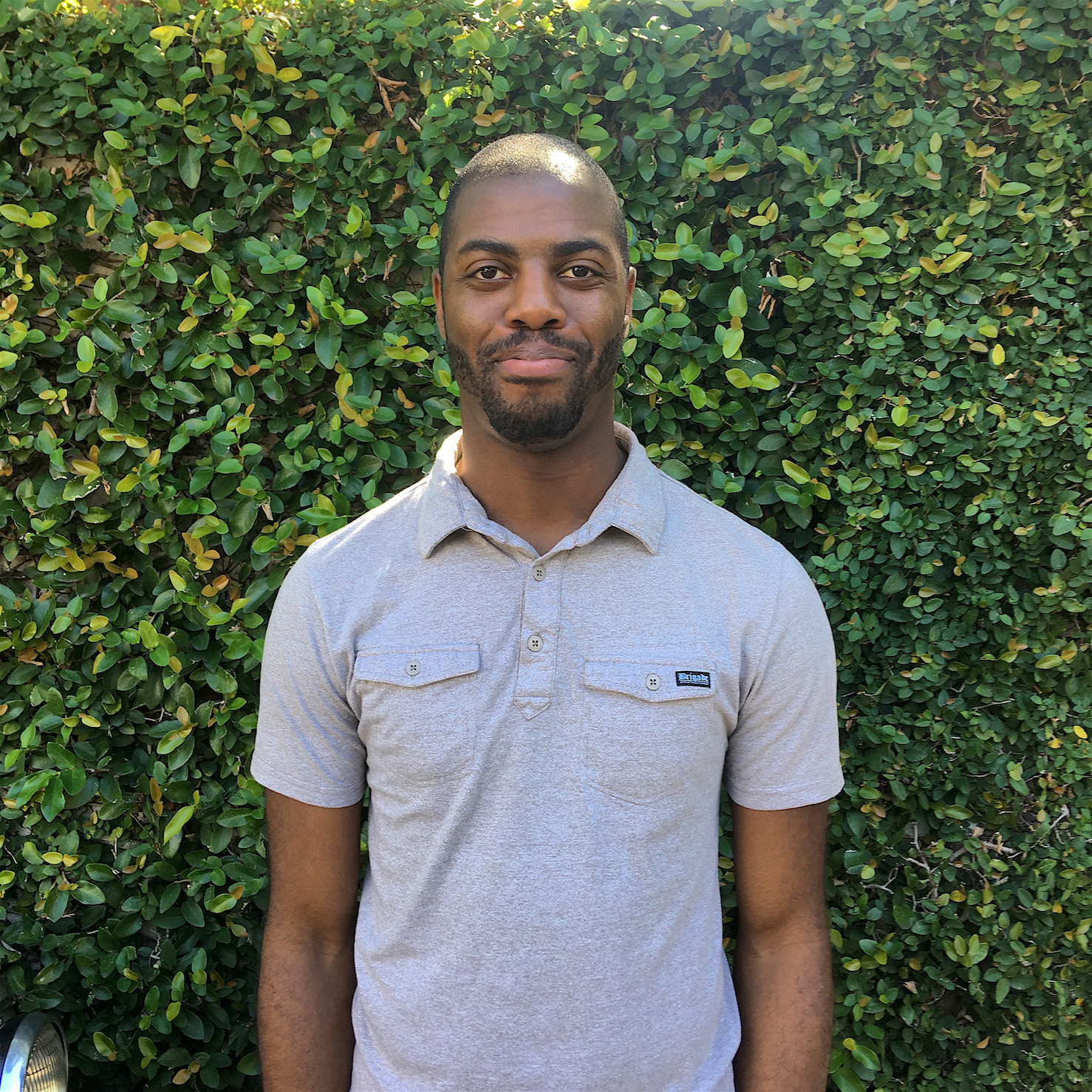
Portrait of Bellas in front of wall covered in green ivy

See more of Calvin's work at his official website www.calvinbellas.com.

And be on the lookout for "Meraki" on the film festival circuit...coming soon.


'In the Present': Elaine Mayes

October
9
2018
By
Tags:

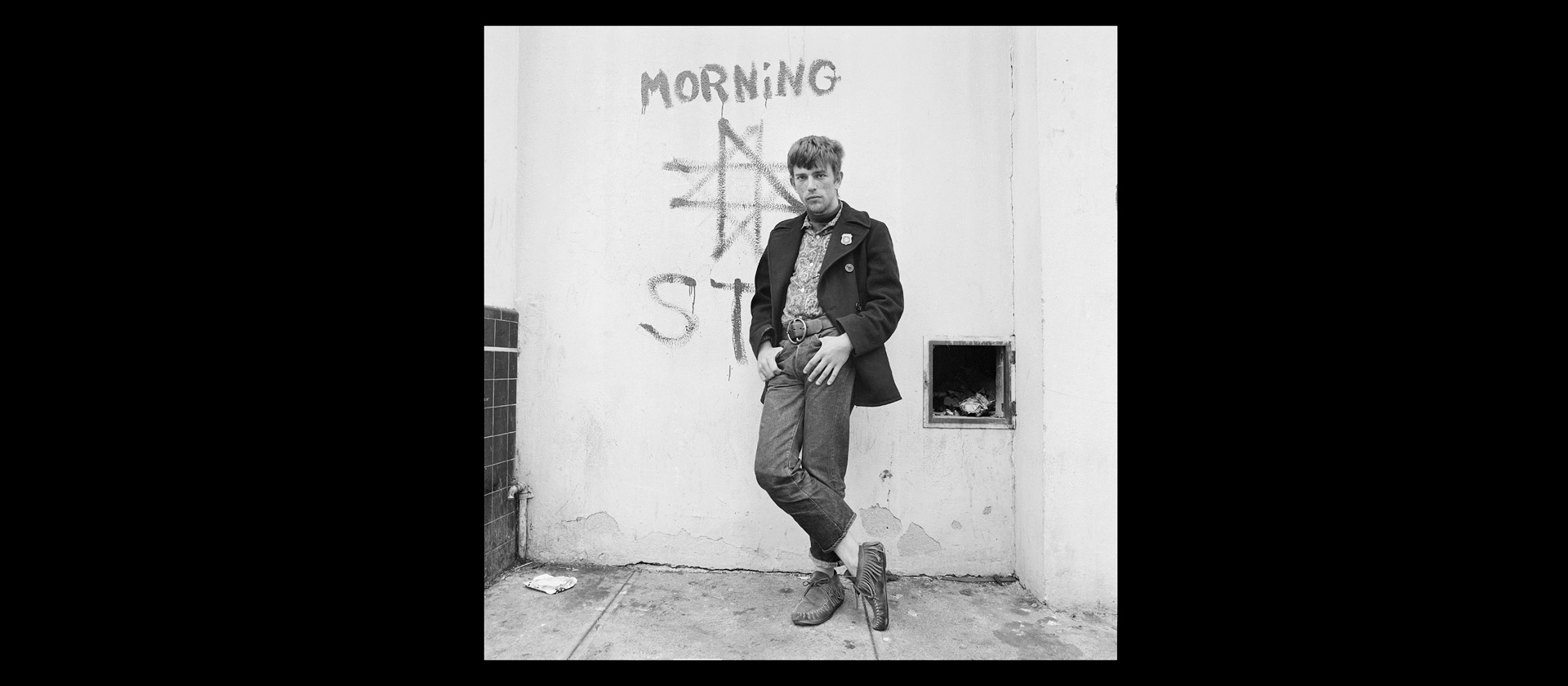
Pea coat, buckskin boots, thumbs jammed in front pockets, a haircut no professional barber could possibly countenance, his weary face still open to possibility: this is "Russell in Front of Morning Star Graffiti" (1968), one of thirteen photographs from Elaine Mayes' "Haight Ashbury Portraits," displayed at SCAD MOA as part of the new exhibition "In the Present: Five Decades."

"In the Present" includes more than 90 examples of Mayes' photographic explorations of travel, movement, and the everyday. The first woman to teach film and photography in an American university, Mayes has been an active visual artist since 1960, and worked as a photojournalist, filmmaker and educator during her singular career.

The SCAD MOA exhibition includes landscape images from Mayes' black-and-white series "Autolandscapes," photographed from a moving car, and features her lesser-known color photography, including key examples from her "Long Island Survey Project" documenting families hanging out on Jones Beach in the late 1970s. 

In 1967, Berkeley native Mayes photographed the Monterey Pop Festival, the subject of her book, "It Happened in Monterey" (Brittania Press, 2002). By the time of her Haight Ashbury series, the Summer of Love was over. Yet there is an innate sympathy in the faces of her subjects, even the hard-edged ones: Mayes, in her early thirties when she took the photos, was a fellow traveler, able to capture her subjects as equals.

Her "Haight Ashbury Portraits" seem more like Civil War-era daguerreotypes than the average fashion-conscious image of today. Part of it is process; Mayes' use of silver gelatin resembled the daguerreotype in sharpness and detail. There is a sense, too, that Mayes' souls come from the old world. They are children of a counterculture whose commodification has only accelerated in the subsequent decades, subsuming what is was meant to represent. It is hard to imagine her subjects wearing advertising.

In the spacious, well-lit environ of SCAD MOA, thirteen digital prints of Mayes' Haight photos are displayed on a single wall. Stepping back and looking at more than one photo at once creates a composite of the artist's vision. A similar effect happens with the "Autolandscapes" in the adjacent room.

Mayes' 1973 photograph "Bay Street West Mall, Window with Mannequin and People on Sidewalk, Springfield, Massachusetts" depicts a bearded young man eating a banana and a cigar-smoking older bald man wearing a suit and fat necktie. They stand only a few feet away from each other, but could not be further apart. The mannequin in the window appears to possess the most charged potential for movement.

"Recording my life has become second nature," Mayes says in her newly-completed film "Summers with Helen," which screened at the SCAD MOA theater to celebrate the opening of her exhibition, with Mayes in attendance. The film, a document of the decade she spent sharing summer vacations in the Catskills with photographer and documentary filmmaker Helen Levitt, is a minor key masterpiece, revealing something of the inner lives of these two important artists though their mundane interactions.

During the Q&A following the film, Mayes was asked what she thinks about first when she wants to take a photograph. Her response: "I don't think ahead of time. I see it. I go back later and make a value judgement. The world inspires me. My work comes out of what I see."

Photographed in black and white, man stands with legs crossed in front of graffitied wall

“In the Present: Five Decades” is on view through Jan. 13, 2019. The exhibition is supported by a grant from Mrs. Robert O. Levitt. The exhibition is curated by Storm Janse van Rensburg, head curator of SCAD Exhibitions and Susan Laney (B.F.A, photography, 1998), guest curator.

The exhibition is free for all museum members, and SCAD students, faculty and staff with a valid SCAD Card. Open to the public with the cost of museum admission.

Pull up a chair: Joaquin Roesch

October
5
2018
By
Tags:

"My goal as department chair is to promote the essence of professional practice and business acumen," says Joaquin Roesch, SCAD chair of architecture and urban design. "I want our students to know the business of architecture."

Roesch, a native of Guatemala City, Guatemala, brings to SCAD a wealth of international experience, including work at Phoenix, Arizona firm Will Bruder + Partners, the Florida-based Oppenheim Architecture + Design, and most recently in London at the world-renowned Foster + Partners, where he collaborated across a vast cultural context on global projects as both architect and project manager. He is a full member of the American Institute of Architects and the Royal Institute of British Architects.

Roesch's tenure as SCAD chair has coincided with significant student accolades. In April of this year, four SCAD architecture students traveled to San Juan, Puerto Rico to attend American Institute of Architecture Students (AIAS) South Quad Conference: Ashley Joos, Alexia Lund, Markus Russell and Kennard Taylor penned an article about their experience, which appears as a multi-page feature in "Citizen Architect: A Publication of AIA Georgia" 2018 Resource Guide. That same month, SCAD students swept all six student categories in the 2018 AIA Georgia Design and Honor Awards. Roesch continues to build upon these successes.

Joaquin Roesch:

I started at SCAD the second week of October, 2017. When asked why I wanted to teach, I said: "I wish somebody had told me what I know now back when I was a student." It's that simple. I love the profession of architecture and I believe there are things that we can do to improve the profession. Among them is teaching our students project management and how to talk to clients. As chair of the department, I work with my fellow faculty to optimize our students' academic experience.

This fall, our architecture program has expanded to SCAD Atlanta. We have ten second-year graduate students taking an architectural studio class, Graduate Architecture Studio IV: Interdisciplinary Focus (ARCH 747), with professor Hsu-Jen Huang. Professor Huang has set up visits to prominent architecture firms in Atlanta so that students can gain first hand exposure at the professional level.

Professor Huang also leads our Hong Kong immersion program in architecture, which takes place winter break, before the start of winter quarter. Both undergraduate and graduate students travel to SCAD Hong Kong and visit professional architecture firms in Hong Kong. Last year that included a visit to the Hong Kong office of my former employer, Foster + Partners. They toured the firm, met with a partner, and gained professional insights beyond the classroom.

I'm currently teaching a second-year graduate studio class here in Savannah, emphasizing business principles including financial forecasting and analysis. Our graduate students take that architecture studio along with a focused elective, and develop a project around that focused elective. The elective my students are taking is Finance and Accounting for Creative Industries (SDES 507).

I relate what I've learned in 15 years of professional practice with my students. I share stories, like the instance when my firm was two weeks from a project deadline and the client said, "I want to change the shape of the building"—and how we responded. In academia we talk about context in a perfect system. Actual practice is imperfect. You can't control every variable. But you can apply the mechanics of academia to professional practice, and vice versa. Counterpoint is crucial.

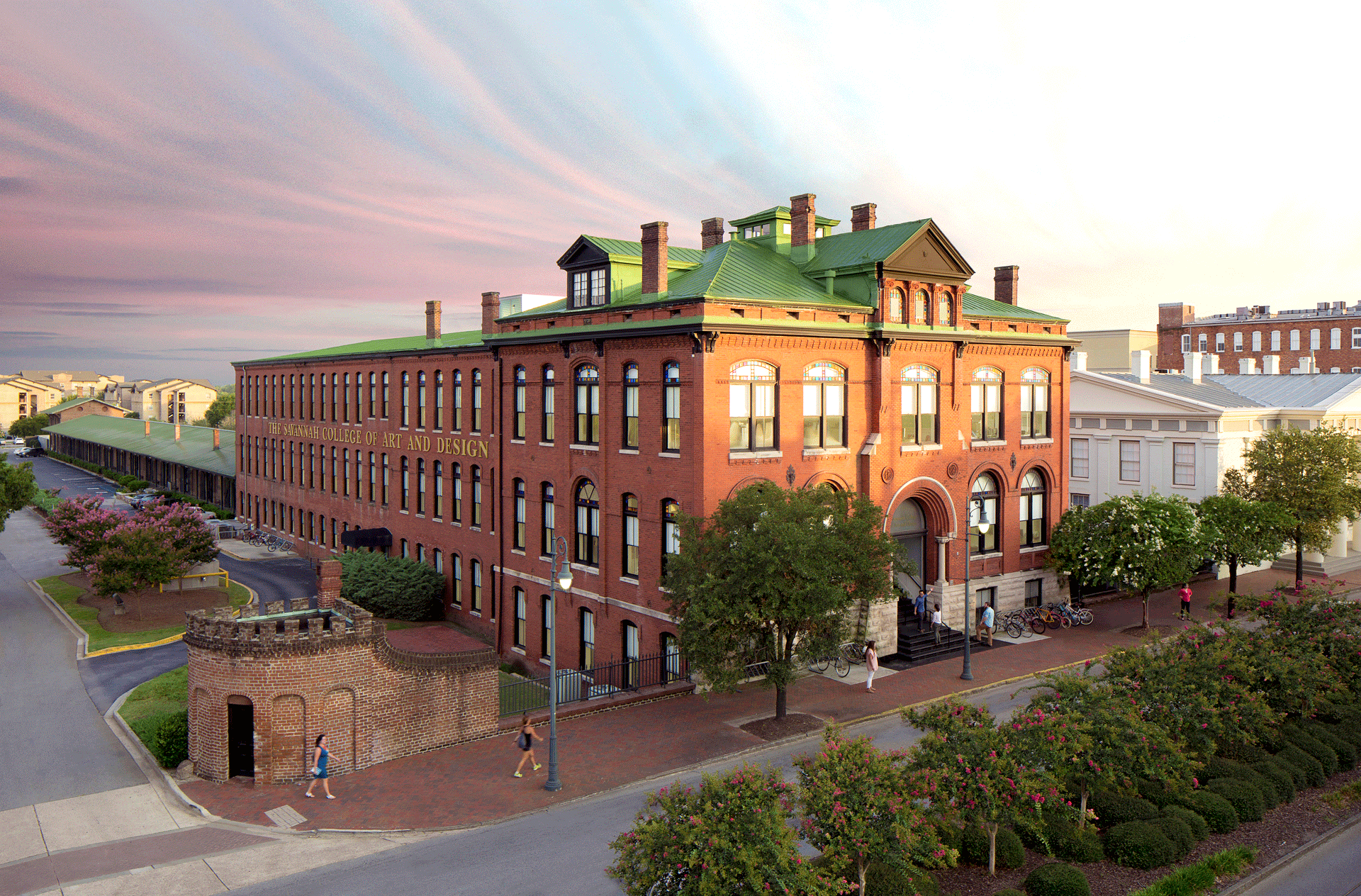
Exterior of Eichberg building

Learn more about SCAD architecture here.

Read about the 2018 AIA Design in Georgia award-winning SCAD students here.


Sean Fahie's 'Chocolate Covered Honey Buns'

October
2
2018
By
Tags:

Sean Fahie's laugh—an exuberant boom—is tantamount to a worldview. When the author of new poetry collection "Chocolate Covered Honey Buns" (Over The Edge Books, 2018) and two-time SCAD alumnus (B.F.A., graphic design, 2005; M.A., illustration, 2007) lets loose, life gets brighter.

"Sean has charisma," says Vek Neal (B.F.A., illustration, 2004). "A lot of charisma." Neal, designer of "Chocolate Covered Honey Buns"' iconic book cover, has known Fahie since high school, when the pair both attended Davidson Fine Arts Magnet School in Augusta. "Going to Davidson and then SCAD conditioned Sean to explore different outlets for his creativity. You know that person who can go out into the world and speak with anyone? That's Sean. He's fluent in his artistry, and fluid with his art."

The St. Croix-born, Georgia-raised Fahie is synonymous with Atlanta's creative community. Co-host of long-running podcast "The Influencers Present," Fahie was named "Best Local Renaissance Man" by Creative Loafing in 2014. He currently works as a designer at virtual creative studio Straight To Tell.

SCAD: "Chocolate Covered Honey Buns" is an illuminated manuscript. It contains poetry and prose, and mixed media pieces that are corollaries to the writing. Why also include multiple photos of the author?

Sean Fahie: I put myself in there because it allows you to read the poems and get a feel for who the writer is at the same time. The book deals with overcoming heartbreak and moving towards your dreams. I remember the day my ex was moving out. There were boxes all around the house. Anthony Gary, the photographer who took some of the pictures in the book, called me up and said, "Sean, I know this might be hurtful but I want to come over and photograph how you're feeling right now." So, he came over and took photos, and also took photos of me sitting on the bench outside Little's Food Store in Cabbagetown. Those images are in the book.

SCAD: "You" and "I" are the recurring characters in the book. Why take that approach?

Fahie: To create a connection with the reader, so readers can imagine themselves as part of the story. I've had people say, "This poem is about your ex, huh?" And the truth is, not really. Inspiration from relationships, yes, but not directly about one person. I abstract from personal experience to make the book universal.

SCAD: The poem "I am faithful" utilizes its title as a refrain. In "Still Working" the word "working" appears four times in four lines. When did you realize repetition was an effective literary technique?

Fahie: I can't help take some of the lessons I learned as a rapper, and apply them to my writing. I remember listening to Juelz Santana's song "Dipset (Santana's Town)" and thinking, "How dare they! You can't rhyme the same word twice!" Then I realized hey, that works. Basquiat, in his paintings, wrote and repeated words and crossed them out, all in ways that make you look more closely.

SCAD: "Being Liked" is about what being Black is like. It's a sensational poem, but it's not sensationalized. Was there a moment that made you want to get those thoughts down?

Fahie: It was a culmination of what's going on in the world. The title is a double entendre. It refers to wanting to be liked, and the fact that we've been in America for so long and America just does not seem to care. And then it's also, This is what it's like, being like this.

I got my undergrad in graphic design at SCAD, but I had a strong desire to gain mastery of illustration, so I went back for my master's. I utilize my abilities to earn a living. If you look at The Most Influential Designers of All Time list online, there are barely any people of color. But I know they're out there. I want a 12-year-old version of me to look at me now and say: "You can do that? I didn't know that was a choice."

SCAD: Your book contains the epigram: "It's always been there waiting for you not to be afraid of it waiting for you." What is "it"?

Fahie: The thing you may be dreaming of, the thing you are most afraid to do, but it's waiting for you to accomplish. The "it" is universal. We all have one.

Chocolate Covered Honey Buns yellow book cover

Order a copy of “Chocolate Covered Honey Buns” here, or ask for it at your local bookseller.

Author photo by @luchero.
Architecture graduate students tour WestEdge

September
27
2018
By
Tags:

"One thing I tell my class," says SCAD architecture professor Alice Guess, "is to anticipate the future needs of a city in the design that you create today."

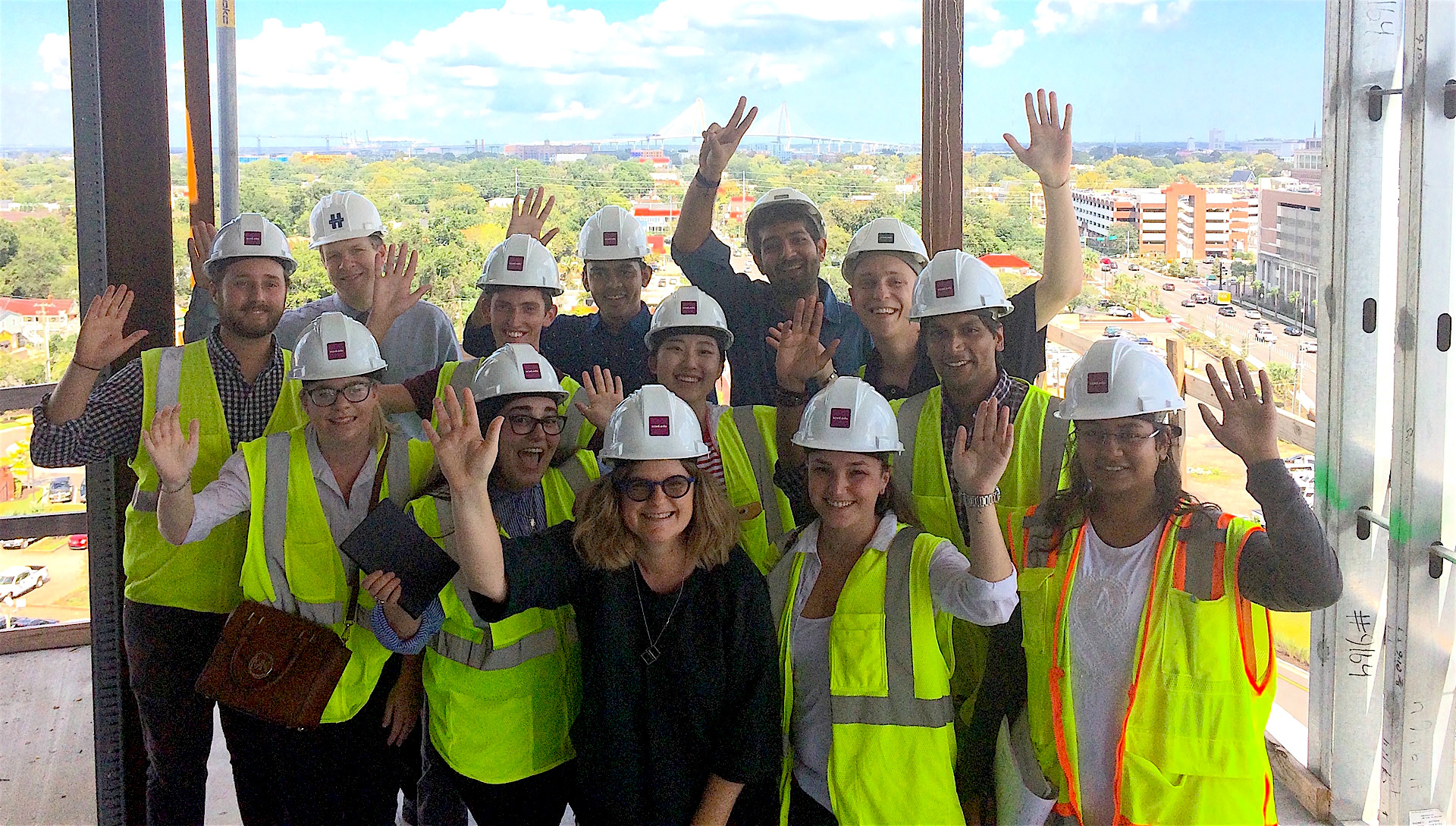
Last week, students in Guess' class "Graduate Architecture Studio I: Urban Design and Development" (ARCH 717) visited the under-construction WestEdge center in Charleston, South Carolina. An expansive iteration of the ubiquitous urban mixed-use development, WestEdge bills itself as Charleston's new "Discovery District," a hub for research, collaboration, and innovation – as well as a place to work, shop, and live.

Guess' students were given an exclusive "hard hat" tour by WestEdge CEO Michael Maher, whose insights bridged the theoretical, technical and practical.

Professor Alice Guess:

This visit to WestEdge was a good match for this particular studio class, because we are an urban design studio, and the class project this quarter is concepting redesigns for the Savannah Civic Center site.

The concepting for WestEdge started 13 years ago, and anticipated an industry that would need a place like this. WestEdge is unlike your typical mixed-use development, because it has components for biotech and lab facilities for the Medical University of South Carolina. That relates to what I tell my students: Anticipate the future needs of the city.

We toured a number of structures within the WestEdge hub, including the structure called 10 WestEdge, which has a Publix grocery store as the anchor retail on the ground level. The mid-level has beautiful views across the Ashley River, and from the other corner you can see Ravenel Bridge and all of Charleston.

Michael Maher, WestEdge CEO, worked for the Charleston Civic Design Center when this project first germinated. I was formerly a partner in an architecture firm in Charleston, so he and I have been colleagues for some time, and that's how I was able to arrange the visit.

It's interesting for my students to see the development at this stage. We were standing on the seventh floor of a building under construction, wearing vests and hard hats. It was the second week of class, and we were in the middle of the exact sort of development that the students are studying.

At SCAD, and in this class, we have students from all over the world. My students from India who have more experience in construction were very interested in the structural systems WestEdge are using. The apartment areas are steel framed and they were asking, why not concrete? It began a conversation about what drives these types of decisions, and how the answers are different for different regions.

The CEO spoke about designing the WestEdge streetscape, and explained the ratio between the height of the buildings and the width of the street and how that's optimized. He also talked about the review process with the Board of Architectural Review and what it means for building heights, earthquake-proofing and hurricane resistance. He explained how the mechanical systems for the ground floor grocery store affected the construction process. The students gained tools and insights they can use in their own work.

My class came back with focused ideas for a mixed-use site that can speak to both the present and future condition of Savannah. Fall quarter is off to a great start. I'm enthusiastic about what my students are going to create.

Group of students in construction vests and hard hats wave to camera

ARCH 717 student participants:
Hamilton R. Brindley, Hemantsingh Choudhary, Sunny Samir Desai, Joshua L. Hall, Taylor L. Hankinson, Saloni Jaiswal, Xiaoyue Jin, Analis M. Ramos, Divy Timbadiya, Olivia G. Vargas, Austin K. Young.