Skip to main content Accessibility Policy

Kassidy Laxdal’s patterns of excellence

June
25
2019
By
Tags:

“Why do people wear exotic animal prints,” wonders Kassidy Laxdal (B.F.A., fibers, 2019), “when they could be wearing a pattern of their own animal’s fur?”

The brain teaser is not rhetorical. “Animal Farm,” the current group exhibition at Gutstein Gallery, features Laxdal’s eight-paneled “Dog and Cat Fur Pattern.” At close range, these finely dappled weavings could be peculiar geological formations seen from deep space. Yet the patterns, created on the Jacquard loom in Pepe Hall, are close-ups based on the coats of actual animals.

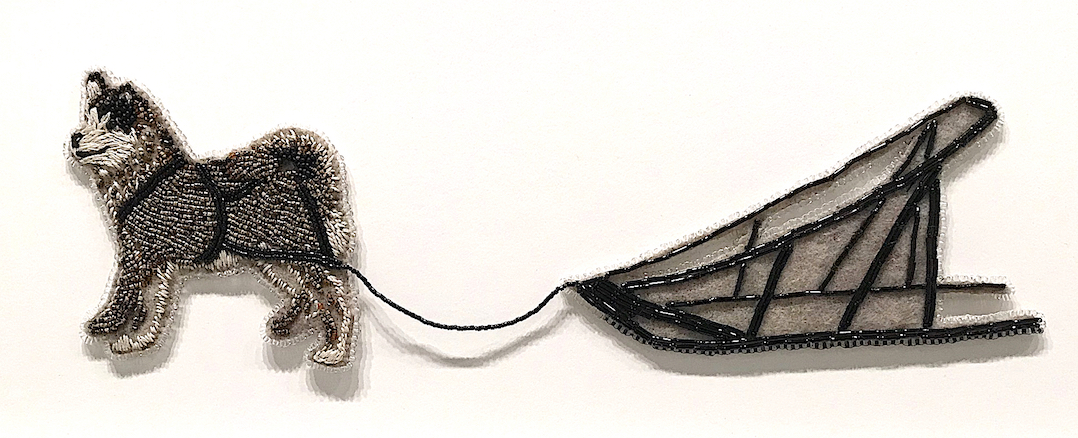
“Dog and Cat Fur Pattern” reveals key aspects of Laxdal’s personality: animal-loving, technically accomplished, artistically inquisitive, clever. That “Animal Farm” features a second work by the new alumna—the impeccably beaded “Sled Dog”—demonstrates she is an artist of impressive versatility.

an embroidered sled dog and sled

Kassidy Laxdal:

I’m from Zimmerman, Minnesota, population 5000. My entire life I’ve traveled through the Savannah airport, because my family also has a house in Hilton Head. When I was in 3rd grade, 8 or 9 years old, there was a SCAD pamphlet in the airport and I picked it up and said, “Mom, I want to go here.” And she said: “Make it your goal.” So I did.

I came to SCAD to study interior design, but when I signed up for my first fibers class, Surface Design: Drawing for Print and Pattern (FIBR 160), I found my calling.

I made a lot of animal-inspired products in my major. I made small backpacks for dogs, so they can carry their own weight in a relationship. When I had a concept for a person to wear a shirt with the pattern of their own’s animal fur, I started making linocuts to create fur patterns, but wasn’t achieving the amount of detail I wanted to translate animal fur into a pattern.

I took Weaving I, and then I had an internship with Alexandra Forby (B.F.A., painting, 2013), who owns Daughter Handwovens, a small business here in Savannah. From April to December 2018, I was in her studio two to three times a week helping her by making warps and setting up looms. I loved it.

Winter quarter senior year I took Complex Woven Structures: Jacquard Technology (FIBR 415) with an incredible professor named Deborah First. That’s when I learned to use the Jacquard loom. Finally, I knew I could get the level of detail I wanted. The Jacquard is computerized and uses WeavePoint, a weaving design software, so you can weave images that are hyperrealistic. I made a swatch collection of patterns of different animal furs, including a blue heeler, a calico cat, a tabby, a Bengal cat and a German shepherd. These are the pieces up now in Gutstein Gallery.

My sled dog I created in beading class with professor Sam Norgard, a world-renowned beader and embroidery artist. I planned my entire schedule my senior year around taking her class. I used bugle and baguette beads to create the contours of the sled. I also added embroidery into the piece, to capture the fur around the face of the dog. Now that I’ve graduated, having my work up in Gutstein is part of my ongoing connection to SCAD.

Kassidy Laxdal

Fun fact! Kassidy was the makeup artist on the SCAD student film that won grand prize in the Coca-Cola Regal Films Program 2019.

See Kassidy Laxdal’s work in “Animal Farm” at Gutstein Gallery through July 14, 2019.


Radical urban ecology with Ryan Madson

June
4
2019
By
Tags:

A roost of wood storks commands the oak grove in Ledbetter Pond, as SCAD students standing at the railing at Oatland Island Wildlife Center marvel at the natural world. "What do other species see?" asks student Mark Lawrence (M.Arch, 2020), eastern box turtles swimming beneath his feet. "What do other organisms experience in these places we've designed?"

Lawrence's question is but one of the paradigm-shifting issues addressed in professor Ryan Madson's Urban Ecology (URBA 725). The morning field trip comes near the midpoint of the ten-week class. (Other field trips on other days include a walk in Forsyth Park with landscape architect and native plant specialist Thomas Angel, and a venture into a liminal zone outside the Savannah historic district unkept by humans.)

By lunchtime at Oatland, students will have communed with wolves and seen bison rumbling towards shade. What may sound like a low-country safari has a deeper purpose: to create a radical shift in thinking, leading to what Madson calls "speculative urban post-human design" focused on "the world without us."

"The course is geared towards architects and urban designers," explains Madson, "but students from other majors, including design for sustainability and themed entertainment design, bring their own disciplinary attitudes and interests. It's about multiple disciplines being creative at the highest level of urban resilience. It means thinking beyond the Anthropocene and considering non-human species and their role in cities."

Rigorous coursework includes reading Gilles Clément's "Third Landscape Manifesto" and studying the Ile Derborence rock mass in Lille's Parc Matisse. As Madson explains: "I want students not to think about cities in a human-centric way. It's a philosophical and conceptual leap to design really robust ecosystems for everything but people." 

This prompt culminates in each student's final project: take an iconic urban environment and rethink how it could look when all the humans are gone. Exemplary work includes Alex Fogleman recasting the Las Vegas Strip as a wetland, Samantha Doherty's prism forest for Red Square, and a pastoral reimagining of Tuileries Garden at the Louvre by Yue Xiao as a "moo-scape" for cows and sheep.

Sam Doherty: "This class has opened my eyes to be more extreme in the amount of effort that can be put into making ecology work in the city. If we look at what the post-human world could be, that informs how we should actually be making our cities now."

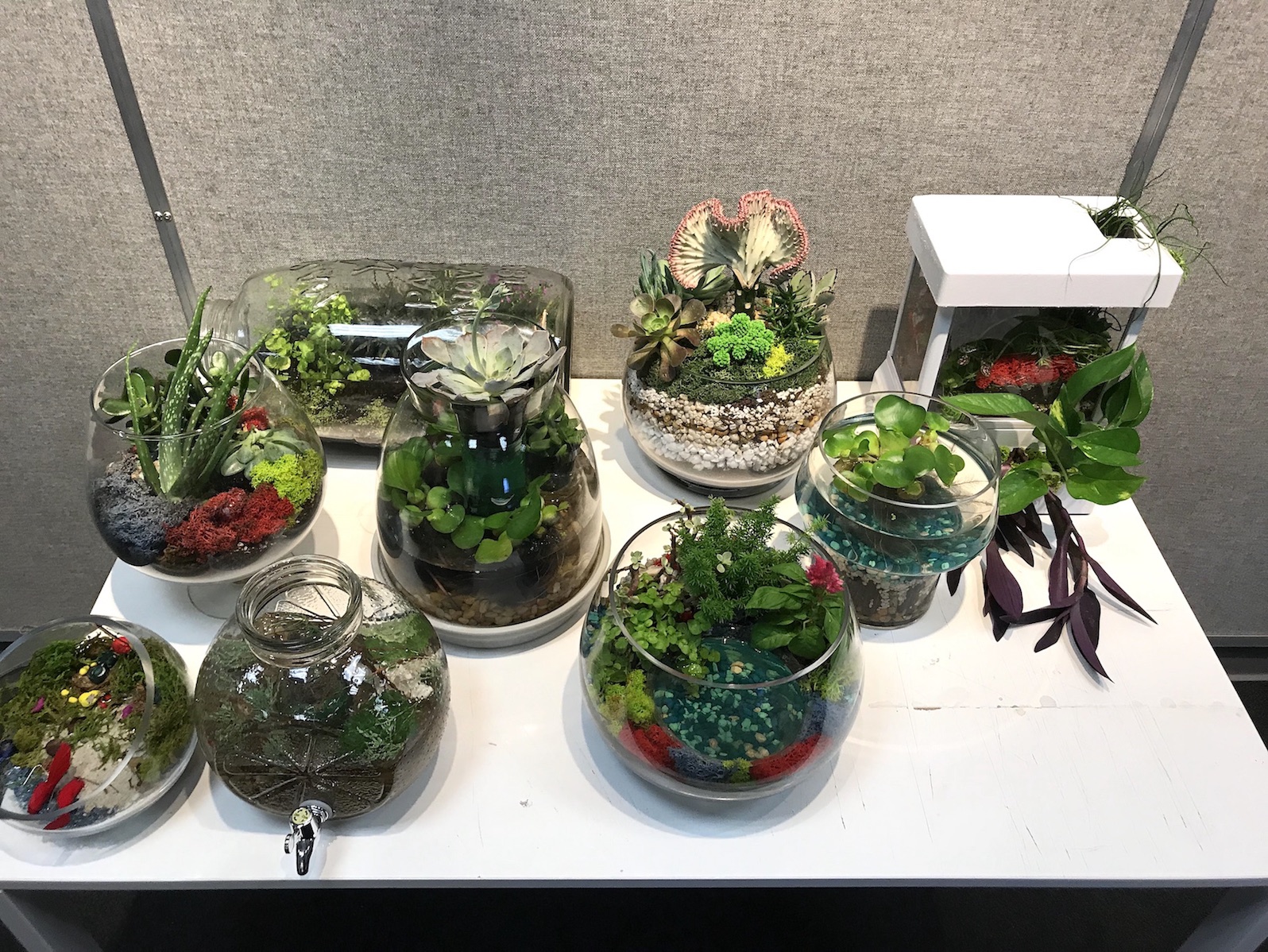
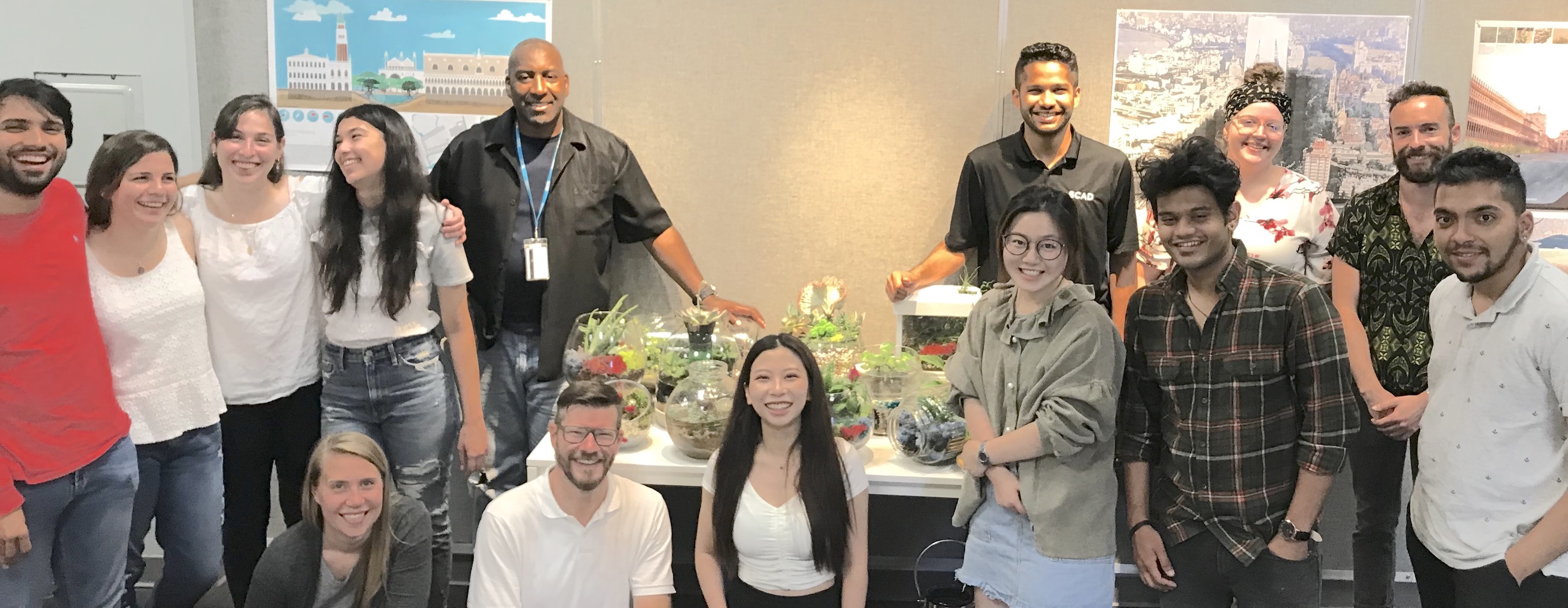
In Clark Hall on the final day of class, students present fully-realized design boards alongside terrariums they've built as organic analogies for their city concepts. Over the course of the quarter, they have all made conceptual breakthroughs that, paired with their technical expertise, they will carry forth to create new possibilities for Planet Earth.

As Akhil Hemanth (M.Arch, 2019), a native of Bangalore, India, puts it: "A radical proposition is the start of change."

urban design plantings

photo: Meg Van Over


Thank you to the SCAD students of Urban Design 725:

Jessyka Colon Penton
Elira Conde Rodriguez
Samantha Doherty
Alex Fogelman
Akhil Hemanth
Mark Lawrence
Aniket Anil Madkaiker
Aakash Mani
Ana Susi Martinez Trujillo
Meg Van Over
Daniel Jose Velez Cabrera
Yue Xiao
Ling Zeng

SCAD students of Urban Design 725

Ankita Gandhi's architectural excellence

May
29
2019
By
Tags:

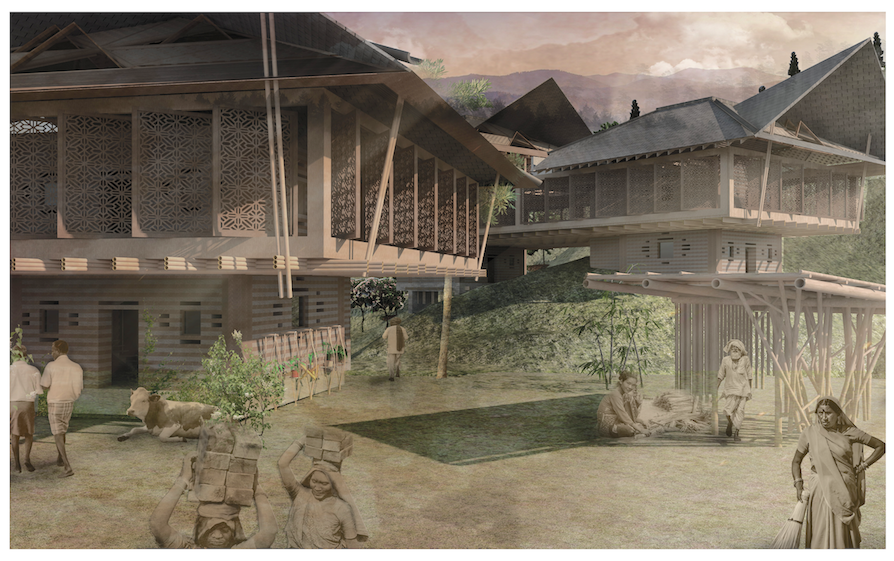
Currently on display in Clark Hall, the graduate thesis project of Ankita Gandhi (M. Arch, 2019) is a simple, beautiful home intended to be built by the very people who will live in it. Constructed from natural building materials, with function indivisible from aesthetic pleasures, the structure exemplifies the "thematic unity of material practice."

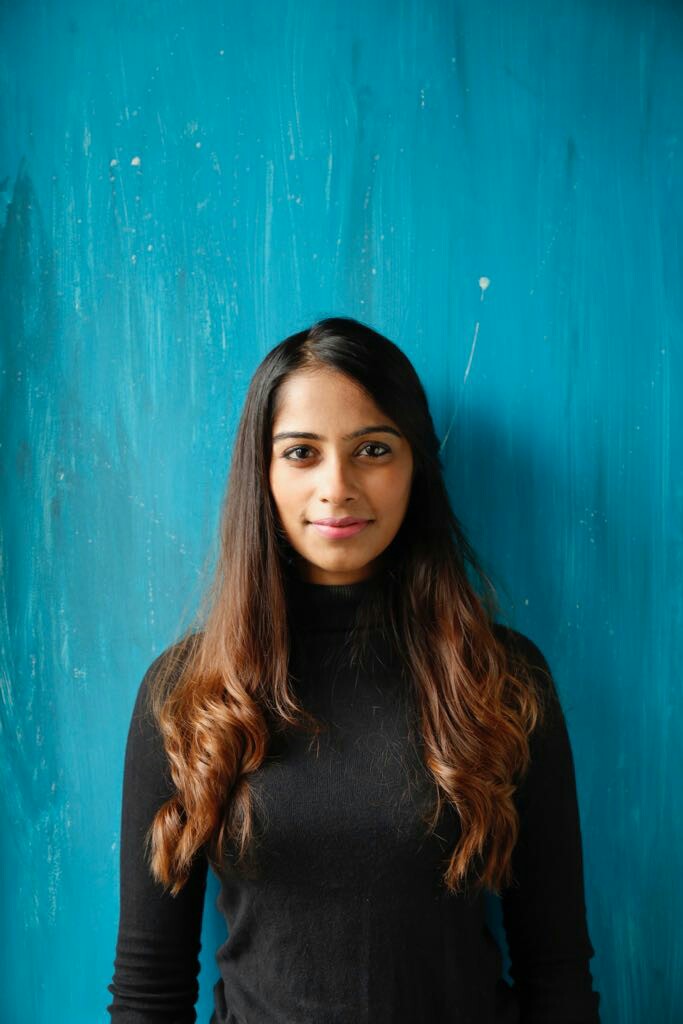
A native of Mumbai, India, Gandhi will graduate from SCAD this Friday. She represents the future of ethical architecture in an evolving world.

architectural rendering

Ankita Gandhi:

After completing my undergraduate studies in India, I volunteered at an institute called Dharmalaya in northern India. Dharmalaya helps the local community build their own homes using natural materials. I stayed for two months, and learned to builds adobes. The village, Bir, is in an earthquake-prone state called Himachal Pradesh. I studied the vernacular forms of wooden Buddhist temples that have stood there for 200 years. My time at Dharmalaya led directly to my master's thesis at SCAD.

My thesis is called The Renaissance of the Vernacular of Eco-Architecture. I designed a home that can be made by families living in Bir. Everything is modular, with adobe bricks that don't require mortar. The corners of the house are made of wood, and the joinery overlaps and moves easily, allowing for seismic activity. The structure reflects the centrality of agriculture and animal husbandry in the rural community.

My module works in all seasons. A manual heating system is the core of the house. When it's cold, the family can attach to the core, but when it's nice, they have the option to experience the sunlight. You want to sit on a veranda and watch your kids play. You want to see the sunlight across the floor, and read a book in a cozy nook. I incorporate all these emotional pleasures into how I designed my structure. The housing module has operable windows. The window design is known as jali, with carvings like apertures that provide options for light and privacy.

architectural rendering

During summer break last year, I went to Michigan to work in a natural building institute called Strawbale Studio run by a woman named Deanne Bednar. The social, cultural and economic aspects there are all tied together. We grew our own foods. We cooked with a rocket stove. We worked with local timber. Our clay mix was horse dung and rich topsoil, fine sand and chopped straw. We stacked straw bales fastened with wooden dowels and plastered them with clay mix to create structures. It was an important learning experience.

My thesis committee has been very important to my project. Professor Madson is an urban planner who helped me envision how my module will fit on a site. Professor Varland informed the emotional heart of the project: How do I connect what I design to the people who are going to live there? My third committee member, Scott Jackson (B.A., architecture, 2007; M.Arch., 2009), is a SCAD alumnus who runs GoDesign, an NGO devoted to building schools in developing countries. He helped with the logistics of my project and understanding the site-specific challenges.

SCAD is an extremely diverse and encouraging learning environment. The extraordinary quality of what your classmates are doing makes you want to achieve your best. I'm going to miss it.

portrait of ankita gandhi

Learn more about SCAD architecture degree programs.


Linden Colby's denim sensations

May
16
2019
By
Tags:

Witnessed at SCAD FASHION 2019's debut Atlanta Runway Show, Linden Colby's senior collection "The Art of Imperfection" caused a sleight-of-sight sensation. Dominated by denim, underpinned with poly pongee, Colby's garments exemplified the creativity, technicality and craftsmanship of SCAD School of Fashion students.

A graduate of Marshwood High School in South Berwick, Maine, Colby (B.F.A., fashion) begins her creative career as associate apparel designer at Abercrombie & Fitch in fall, 2019. First, her collection hits the runway again, this time in Savannah on Saturday, May 18.

Linden Colby:

My collection is my commentary on living in a perfectionist society. Six designs tell a whole story. I call my muse the inner warrior. She's pulling apart oversized denim pieces and bursts of color come out. She represents mental strength, as well as physical strength. She takes experience and expectation on her shoulders and walks with confidence in the world.

fashion illustrations

fashion illustrations

Being meticulous about every detail in our lifestyles and appearances, we have to be reminded that leaving things to chance and being instinctive can be gorgeous. That's something I recognized in the work of Michelle Morin (B.F.A., graphic design). I fell in love with the way Michelle pours high-fluidity paint onto canvas. I reached out to her and she was immediately interested in collaborating.

For the active wear pieces, I sent a Photoshop file of Michelle's paintings to a company in New York City called Design2Print, and they printed it onto spandex material using dye sublimation. Rather than water or chemical-based dyes, it's more like a heat transfer. It eliminates waste from the process.

The SCAD fashion department has a diverse faculty, who all have incredible experience as professionals working for top companies. One of our professors, Mitchell Vassie, told me about the Japanese idea of Mottainai, and I took that idea of salvaging things too good to waste as I was creating my collection.

fashion models

I find an ease in working with denim because it's a sturdy fabric, it's not silky or slippery. The stitching on denim is supposed to be visible, so you're not doing tiny hand-stitches to hide the sewing. But as you're adding layers of denim together it becomes challenging.

In fall 2018, a representative from the denim brand Isko came speak to SCAD fashion students about the I-Skool design competition. I asked about a sponsorship, he said yes, and I visited their NYC showroom over winter break and selected my denim. Everything denim in my collection is from Isko. I used a herringbone weave, and a selvedge denim, and one that feels and looks like a wool blend.

I used pleats as a functional visual detail. I had to measure, for every inch of denim I'm going to need another inch of the print to fold under, then another inch to fold the other way. You know when they tell you in high school you're going to use math for the rest of your life? They meant it.

Seeing the garments in an actual fashion show is a different experience. When the pleats open, you see the whole pattern underneath. That changes as the model walks and moves. Her leg kicks out and the colors pop. It's so exciting to watch ideas come to life.

Linden Colby with fashion models

Collection photography: David Dong (B.F.A., photography).

See more of the work of Linden Grace Colby.

Learn more about SCAD FASHION 2019.


SCAD FASHION 2019!

May
15
2019
By
Tags:

SCAD Atlanta debuted its first ever runway show the evening of Friday, May 10, presenting original designs curated from the finest SCAD School of Fashion senior and graduate student collections. The event will have its Savannah corollary this Saturday, May 18, 5 p.m., outside the Hive. Both featured events are part of the shimmering fabric of SCAD FASHION 2019.

As the most anticipated sartorial event of the year, SCAD FASHION redefines the runway. Programming the Static Showcase, Jewelry Showcase, and SCAD: In Conversation.

"SCAD's nearly 4,000 fashion graduates are now design leaders at Anthropologie, Marc Jacob, Kenneth Cole, Kate Spade, Abercrombie, Chanel, Lily Pulitzer, and just about every other major brand,” said SCAD president and founder Paula Wallace. “SCAD grads also create new brands like Argent and AUDRA, and I'm just in the A's! Now Atlanta's fashionistas can say they experienced all this luminosity for themselves at SCAD Atlanta's first-ever runway show."

Each year, graduating SCAD School of Fashion students in Atlanta, Hong Kong and Savannah are given the opportunity to have their work expertly critiqued by fashion industry leaders, and the university's Style Lab mentor program connects them directly with established designers as they complete their final collections. This year's SCAD Style Lab mentors are Shirley Kurata, Los Angeles-based stylist; SCAD alumna and SCAD40 Prize winner Eleanor Turner (B.F.A., fashion, 2008), fashion designer; Mesrop Megrabyan, innovator designer at Nike; Robert Verdi, celebrity stylist, entrepreneur and television personality; and Frederic Tremblay, accomplished design professional.

SCAD honored CFDA award-winning fashion designer Cynthia Rowley in Atlanta and will honor Phillip Lim in Savannah. Rowley appeared in conversation with Kimberly Rabanal, SCAD professor of fashion marketing and management. Lim will be in conversation with journalist Michelle Lee, editor in chief of ALLURE. The SCAD Étoile honors icons of style and design, Rowley and Lim join previous SCAD Étoile honorees including Derek Lam, Jonathan Adler, Pierre Cardin, Graydon Carter, Linda Fargo, Jason Wu, Carolina Herrera, Margaret Russell, and David Yurman.

SCAD School of Fashion is comprised of degree programs including accessory design, business of beauty and fragrance, fashion, fashion marketing and management, fibers, and jewelry—all disciplines working together to produce all-encompassing creations, reflecting an industry where synergy is key.

SCAD has long been a destination for luminaries across disciplines to connect with emerging talent. Famed fashion designers have attended SCAD fashion events to extend their valuable insights and provide students with real-world critiques. The university provides these visits as opportunities to celebrate remarkable work and unprecedented careers. To date, SCAD has honored fashion industry titans Manolo Blahnik, Derek Lam, Reese Witherspoon, Stephen Burrows, Tom Ford, Diane von Furstenberg, John Galliano, Marc Jacobs, Zac Posen, Miuccia Prada, Oscar de la Renta, Ralph Rucci, Isabel and Ruben Toledo, Vera Wang and Vivienne Westwood.

Thank you to everyone who attend the SCAD FASHION 2019 events in Atlanta.

The schedule of events for SCAD FASHION 2019 in Savannah is:

Thurs., May 16–Fri., May 17
, SCAD Jewelry Trunk Show
Jen Library, 201 E. Broughton St.

Thurs., May 16, 5 p.m., 
SCAD Savannah Fashion Static Show Opening Reception
Gutstein Gallery, 201 E. Broughton St.

Sat., May 18, 2 p.m., 
In Conversation with Phillip Lim
SCAD Étoile honoree
SCAD Museum of Art, 601 Turner Blvd.

Sat. May 18, 5 P.M.
, SCAD Savannah Runway Show
The Hive, 207 W. Boundary St.
Tickets available at savannahboxoffice.com

Sat., May 18–Sun. May 19, 
SCAD Savannah Fashion Static Show
Gutstein Gallery, 201 E. Broughton St.

Events are free and open to the public unless otherwise noted. For gallery hours and more information, visit scad.edu/fashion-show-2019.

Follow @SCADdotedu and use #SCADFASHION to join the conversation via Facebook, Twitter and Instagram.

SCAD FASHION 2019

Liberal arts uses the Force for good

May
6
2019
By
Tags:

In honor of Star Wars Day, the SCAD Savannah department of liberal arts hosted Liberal Arts at Lightspeed, a two-day event May 3-4 featuring exhibits, lectures, and demonstrations inspired by the Star Wars universe. This year's event, the fifth annual Liberal Arts at Lightspeed (or, as the department dubbed it, Episode V), focused on the series' droids.

Festivities kicked off in Arnold Hall with Gordon Tarpley, a Los Angeles-based designer, prop builder, and C-3PO cosplayer, joining Allison Steinweg, associate chair, liberal arts, on Friday afternoon for a Q&A session. Tarpley spoke about his multifaceted work, from building props for a Star Wars-themed episode of "Jimmy Kimmel Live!" to playing C3PO at Disney-sponsored events, and reflected on the galaxy-wide Star Wars fanbase he has encountered as a result of playing C-3PO.

That fanbase was evident on Saturday, as Tarpley donned the C-3PO costume and meandered through the exhibitions in Arnold Hall with R2-D2 at his side. In one exhibition, professor Samuel Gross displayed dozens of Star Wars neckties, which he showed off to the two droids. "These ties have become a point of connection with students," said Gross. "Students who I've never met before will approach me to talk about a character on my tie."

Lauren Arnold (B.F.A., production design) echoed the sentiment: "I think everyone can find something to connect with in the various characters." Arnold, who hopes to pursue costume design, said that she particularly appreciated the work of fellow production design student Journey Olson (B.F.A., production design), whose costume designs were on display.

The day's events highlighted the work of SCAD students and faculty in an array of disciplines, from industrial design to writing to sequential art. The department presented lectures by liberal arts professors Stephanie Weaver and David Steinweg examining storytelling and friendship through the lens of the Star Wars narrative. Student Alex Coajou (B.F.A., industrial design) presented on his work with the R2D2 Building Club, which has built droids for Lucasfilm, Disney, and commercial events. This year marked the fourth time that Coajou has participated in Liberal Arts at Lightspeed.

As the afternoon drew to a close, attendees were invited to mark their calendars for Liberal Arts at Lightspeed Episode VI on May 4th, 2020. "And of course," associate chair Steinweg said in conclusion, "may the force be with you."

R2-D2 and C-3PO with student Journey Olson.

R2-D2 and C-3PO with student Journey Olson.


Jordan Wannemacher has books covered

May
1
2019
By
Tags:

Check your shelves, booklovers: You may already own some of her work. Jordan Wannemacher (B.F.A., graphic design, 2012) is the proprietor of Studio Jordan Wannemacher, a boutique book design studio based in Montclair, New Jersey. Her recent striking designs include a repackaging of "The Everyday I Ching" (St. Martin's Press, 2019) and Oprah Winfrey's new bestseller "The Path Made Clear" (Flatiron Books, 2019). A magna cum laude Bee who minored in creative writing, Wannemacher is a bibliophile with inimitable style.

A selection of book covers by Jordan Wannemacher

Jordan Wannemacher:

When I talk to other book designers, I realize many of us have the same origin story: Did you read alone at lunch as a kid? Growing in Greer, South Carolina, I had an influential AP art history teacher, Mr. Patrick Grills at Riverside High. He was the first person to mention SCAD to me. I would listen to SCAD Radio online, fascinated by the idea of a place where alternative kids went to study art. My first time in Savannah was orientation weekend. It was a fantasy come to life.

Taking creative writing and literature classes at SCAD was fantastic. Dr. James Lough was an inspiration as a professor. When I came to him for career guidance, he recommended looking into working for a university press and gave me vital industry knowledge as I was navigating where to apply for jobs after graduation.

When I applied to work for Columbia University Press, they responded quickly: "We had a designer who attended SCAD, and we loved him." It was a direct path from SCAD to getting that job, because they'd already had a great experience employing a SCAD alumnus.

After working at Columbia, I worked at Rodale Press, a traditional progression from designer to senior designer. Shortly after, Rodale got bought by Hearst and I was laid off. Fortunately, I'd been freelancing on the side for a few years already. My clients said, "if you have more time, we have more projects." So I took the leap and started my own design studio. It's funny how something that felt scary at first has become the best thing for my career.

Designing the cover for the Margaret Drabble novel "The Dark Flood Rises" (Farrar, Strauss & Giroux, 2016) was a dream-come-true experience. Not only is it an amazing novel by a legendary author, the book was art directed by Rodrigo Corral, one of the top book designers and creative directors practicing right now. FSG has also published so many of my favorite authors, including Denis Johnson, Joan Didion and Flannery O'Connor.

I used to say, "I haven't made it until I've designed a book for Dr. Lough." Two years ago, I designed the cover of "Short Circuits: Aphorisms, Fragments, and Literary Anomalies" (Schaffner Press, 2018). Thanks to Dr. Lough's introduction, I've now created seven book designs with Schaffner, including Sylvia Torti's novel "Cages" (Schaffner Press, 2018). "Cages" is about people in a lab studying bird song and memory, as well as a love story. The cage is not only what the birds are living in, but a symbol for the cages the characters put themselves in. The cover I designed has an intentionally controlled, lab-like look.

The cover of the book Cages

One of my favorite parts about book design is the production aspect. I love picking papers, lamination, foil effects or spot gloss. You become not only the cover designer but a packaging designer.

When people ask me what I do, and I tell them I design book covers they say "That's so cool!" and I can't help but say "I know!" It feels so good to create something people pay attention to, and form deep, meaningful connections with.

Portrait photo of Jordan Wannemacher

Visit Studio Jordan Wannemacher


Kicking it with Gabbie Garbe

April
29
2019
By
Tags:

Playing soccer and studying design at SCAD has proved a potent combo in the professional life of Gabrielle Garbe (B.F.A., motion media design, 2017). Today, Garbe works at the Manhattan office of Futbol Club Barcelona (FCB), perhaps the best-known soccer team in the world. Those fortunate to have seen Garbe play at SCAD witnessed her focus and ferocity. The 2016 Sun Conference All-Academic team selection is also a friendly and funny pro.

Gabbie Garbe:

My position with FC Barcelona is commercial designer with our business development team, working on partnerships and sponsorships. My responsibilities include creating pitch decks for potential clients. I'm always in contact with our designers in our offices in Barcelona and Hong Kong. My knowledge of sports marketing and the sports sponsorship world has grown so much since I've been here.

My first year at the job, I went to Barcelona for an event. Javier Mascherano was leaving after more than seven years at the club. I was in the auditorium with all the first team players and the president. Technically the players are my colleagues so I can't go up and be a fan. I'm pretty sure my smile said it all.

Last summer we signed a deal with Stanley to be the first main sponsor for our women's team, FCB Femeni. Our office led that whole partnership. I traveled to L.A. where we made the official announcement. The women's team was there, and I got to participate. It's wonderful to see our Barcelona women's team have a main sponsorship partner, and see them doing so well.

I attended Shattuck-St. Mary's boarding school in Minnesota. My high school coach knew of SCAD, and I scheduled a visit. My first day in Savannah I was like, “I love it! I have to get in to SCAD!” I went to a weeklong SCAD summer seminar, and a soccer camp, and was offered a scholarship.

SCAD has so many incredible specialized degree programs. Motion media encompasses all the things I like: design, motion, film, photography. Taking part in the SCADpro project with BMW was an important learning experience. I worked with industrial design majors and interactive design majors and it opened my mind to different opportunities where motion media can play a role. Professor John Colette was so passionate about motion media design, I knew I couldn't go wrong with my major. And I haven't, because I love my job!

I miss everything about SCAD soccer. Coach Becky Gunn is an incredibly caring coach. She comes from a competitive soccer background, and worked with us throughout training. Senior year I played center back in the back line with my two closest friends, Meghan Grable and Thorhanna Omarsdottir. The experience of being an athlete at SCAD and managing my academic workload definitely plays a role in my current job, as I strive to create work-life balance.

I must say, working for Barca has its perks. Occasionally during the summer, we'll have a mini soccer-tennis tournament in the office. And this week Barcelona play Liverpool for a place in the Champion's League final. We'll be watching at the office. I can't complain!

Prospective collegiate soccer players interested in attending a SCAD Savannah women's soccer ID clinic this Friday, May 3 can learn more about the opportunity here.

Learn more about the SCADpro innovation studio here.

Gabrielle Garbe (B.F.A., motion media design, 2017) Força Barça!

Gabrielle Garbe (B.F.A., motion media design, 2017) Força Barça!


SCAD Faculty Sabbatical Awards: Kristie Bruzenak

April
24
2019
By
Tags:

Kristie Bruzenak, professor of foundation studies, SCAD Savannah, received a 2017-2018 sabbatical award for her project "Illustrated Surface Design as Modeled by William Morris." During her sabbatical, professor Bruzenak traveled to London for two weeks to research the floral surface illustrations of 19th century artist William Morris. Her goal was to understand Morris' process and translate it to fit the digital technologies of current practices. Professor Bruzenak has developed a paper on William Morris' design process to be published by the William Morris Society. She posts her work on Instagram.

Due to the similar interests and topics present in professor Bruzenak and professor Linda Warner Constantino's projects, the sabbatical award committee recommended the two professors offer collaborative workshops. As a result of these workshops, SCAD students participated in the Deep South Orchid show, hosted by the Deep South Orchid Society, winning several awards, including first, second, and third place in watercolor; best of orchid art; and awards in graphite and color pencil.

In the second installment of "A Tale of Two Sabbaticals," Kristie Bruzenak speaks insightfully about her sabbatical experience.

Kristie Bruzenak

SCAD:  How did you choose the subject of your sabbatical?

Professor Kristie Bruzenak: I teach the elective courses that make up our scientific illustration minor. As a branch of scientific illustration, botanical illustration is a field of great interest to me. My studies in botanical illustration led to my interest in pattern design, especially the designs of William Morris.

Morris' patterns are fluid and elegant, and speak about the nature of his subject, flowers. His designs belie a practice of careful observation that imparts a richness to his work. Many of Morris' designs have a puzzling structure with roots in Middle Eastern Arabesque grids. There is nothing written about his process, so I wanted to take a look at what museums hold in their non-public archives to help me better understand how his designs were created.

The SCAD illustration B.F.A. program of study offers a concentration in illustration for surface design. I was motivated to satisfy my curiosity for my own sake, and for what I might be able to share with illustration students. I was hoping to discover helpful insights, and I did. What I didn't expect was meeting the many remarkable individuals I encountered during my sabbatical, and receiving an invitation to publish my research through the William Morris Society.

Cyclamen, pencil on paper, 10" x 14".

Cyclamen, pencil on paper, 10" x 14".


SCAD: How will the sabbatical influence your work as an educator at SCAD?

Bruzenak: Having the opportunity to deepen my expertise by looking into the "back room" holdings of large museums like the Victoria and Albert, and sitting in a smaller room of the William Morris Society, lifting original drawings out of archival boxes and seeing the pencil and paint marks of a master was impressive. Knowing that my white-gloved hands were holding the secrets of a century old process that influences design to this day was humbling. The sheer number of pages, the quality of the work and the indications of exploration and resolution was an experience I will use to inspire students. SCAD students can see the sparkle in your eyes as you relate what you have learned with enthusiasm, and it is heartening to see it reflected back.

While in England, I took advantage of an opportunity to study with Rosie Sanders, an international painter of large botanical watercolors. I joined five other artists living and working in her home and studio for four days. Rosie has a lovely garden and also brought in specimens to explore. We sat around a large dining table in her charming cottage each evening discussing art. It was a joy to participate and see how she manages her work and her business. Rosie would spend time each day in her office posting on social network, communicating with her gallery and managing her exhibitions, her schedule and her finances. This experience is another story to share with students and help them understand the importance of having business expertise and management skills. Even highly successful artists need to keep their business lives going on a daily basis.

SCAD: How will SCAD students benefit from your sabbatical experience?

Bruzenak: Professor Linda Warner Constantino and I took our sabbaticals at the same time. Since we have closely related interests, we were asked to collaborate on tangible outcomes. We planned "The Orchid Project" and gave illustration students a pair of workshops designed to help them prepare submissions to the Deep South Orchid Show. I taught a workshop on drawing orchids while Linda taught one on painting orchids. I also asked my scientific illustration students to use orchids as a subject for their botanical illustrations. The results of the workshops and the course work were submitted to the show and our SCAD students earned seven awards. My students won first, second and third in colored pencil and second in black and white drawing. Linda's students were very successful as well. Next year, Linda and I plan to continue the project and submit student work to the Atlanta Orchid Show. We expect great results!

This spring I will be offering a full-day workshop in pattern design organized on Arabesque grids. This workshop will be the first in a series of three that will help SCAD students participate in Le Grand Prix du Carré Hermès, an international scarf design competition. Additional workshops in the fall will support the second and third stages of the process. I hope sharing my growing knowledge of pattern design will help SCAD students to excel in the competition.

I will be creating four sets of pieces for an exhibition to be held winter 2020, with my colleague Linda Warner Constantino. Each set I create will consist of a botanical painting, a page of motifs developed from the painting and a final pattern design. The pattern design will reflect William Morris' practice of organizing motifs using Arabesque geometry. Linda and I will be holding the show locally so students can learn from the process shown, as well as from the final pieces.

Vitis rotunidfolia, Scuppernog, watercolor on paper, 10" x 14".

Vitis rotunidfolia, Scuppernog, watercolor on paper, 10" x 14".


Levi's: riveting history

April
16
2019
By
Tags:

"This year is the 50th anniversary of Woodstock. Guess what Jimi Hendrix was wearing when he was playing 'The Star-Spangled Banner'? Yes, bell-bottom jeans!"

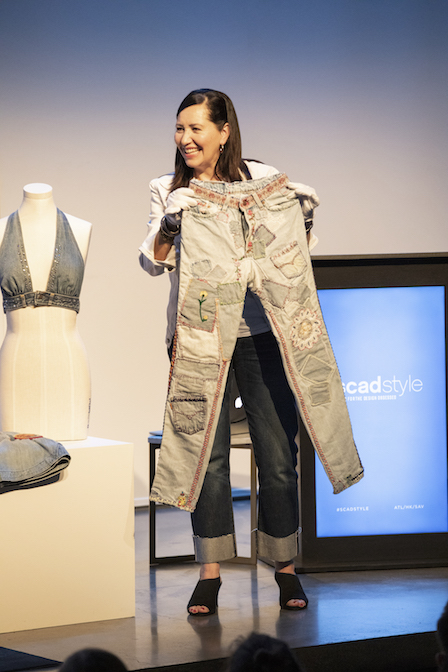
The person asking the question knows her denim. Fitted in a clean tee with iconic red logo, white jean jacket and dark denim jeans, Tracey Panek, Levi Strauss & Co. official brand historian, appeared at the SCAD MOA theater during SCADstyle 2019.

Across locations in Savannah, Atlanta and Hong Kong, SCADstyle 2019's esteemed speakers included Ariel Foxman, Mary Katrantzou, Steve Madden, Phillip Picardi, and Sally Singer. Panek's presentation, moderated by Mobolaji Dawodu, fashion director, GQStyle, focused on brand history and the customization of cool.

"I refer to Levi's as the 166-year-old startup," Panek said. "It's San Francisco-born, a stone's throw from Silicon Valley. A start-up, just with a longer history than the Lyfts of the world."

At Levi's, Panek manages the company's archive, facilitating work requiring historical materials. Embroidered, sequined, patched, painted—Panek explained how the company embraces customization, to the point that tailoring stations now feature inside Levi's stores.

The start-up's story: Bavarian immigrant Levi Strauss arrived in San Francisco in 1853 to sell working men's pants during the gold rush. "They weren't called blue jeans, they were called waist overalls. You'd pull them up over your long underwear and get to work."

In 1872, Levi received a letter from a tailor in Reno named Jacob Davis with an unusual idea: add tiny copper rivets in the pockets. "When you do that," Panek said, "they won't tear and will last longer. The patent for the rivet was granted on May 20, 1873, the day we refer to at the company as the birth of blue jeans."

Early customizations were practical: a hand-sewn tool pocket or a patch where a cowboy's reins had worn a thigh thin. Panek showed an image of a pair of wizened 501s from 1917 worn by a hard rock miner from Wickenburg, Arizona. Of a photo of WWII-era jean jacket, she observed: "That plaid lining was added for extra weight and warmth. What's unique about this one—and a favorite of our designers—is the heart stitched onto the back. That's not about practicality, that's about style."

History continued as customization exploded. "In 1967, a young woman named Melody Sabatasso came to San Francisco. When she was invited to a wedding all she had to wear were jeans, so she cut them up into a dress. She got such rave reviews on her outfit that Lauren Bacall commissioned her to do a piece, which kickstarted her career. She still creates pieces with Levi's today."

Panek stitched together surf culture, Hell's Angels' knife-cut vests, punk rock, bum flaps, Beavis and Butthead, military patches, Elton John, and a pair of bedazzled chaps once worn by N'Sync's Lance Bass. Then she took questions.

Linden Grace Colby (B.F.A., fashion) asked: "How do these historical pieces inspire future designs? How do you navigate the balance between history and innovative design?"

"The main users of the collections are designers," Panek said. "They take anything from a button design to a pocket shape and use it for inspiration for a new piece. We have a line called Levi's Vintage Clothing that reproduces pieces from the archives so you can buy an 1890 pair of Levi's, or WWII-era jeans.

"We introduced an innovation a year ago for finishing jeans using lasers, the FLX process. Google came to us and we created a jacket with copper threads added to the sleeve and cuff that connect to your Bluetooth and mobile device. We mix heritage with innovation pretty well at Levi Strauss."

Woman holding a pair of Levi's jeans

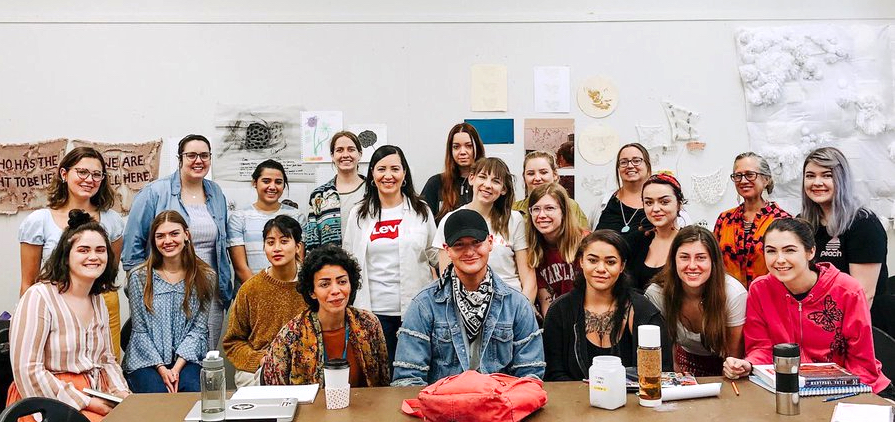
During her SCADstyle visit, Panek also spent time at Pepe Hall visiting with two SCAD fibers classes, Senior Studio I (FIBR 440) taught by professor Jessica Smith, and Business Practices for Fibers (FIBR 337) taught by professor Katie Buchanan.

"Tracey was generous with students, insightful into the way research and history play into contemporary design, specifically Levis Strauss," professor Smith said. "She spent an hour speaking with the students about her career, the role of a historian in a brand, and how the archives support designers today. It was a fun discussion with high student engagement."

Tracey Panek, Mobolaji Dawodu, and attendees of SCADstyle 2019.

Thanks to Tracey Panek, Mobolaji Dawodu, and all attendees of SCADstyle 2019.