Skip to main content Accessibility Policy

Charlie Vazquez: Cook to the Future

November
15
2019
By
Tags:

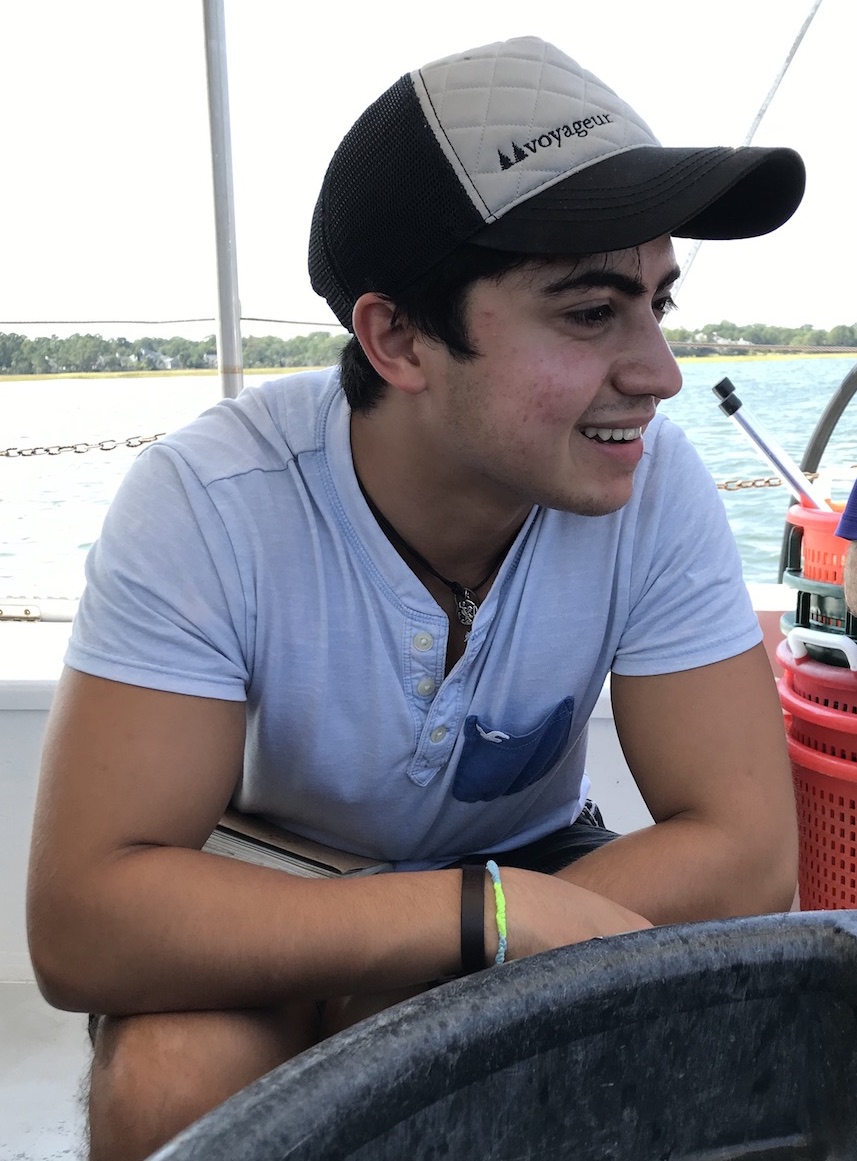
As a torrent of sea life sloshes into a black plastic tub, Charlie Vazquez (B.F.A., industrial design) stoops on the deck of the Sea Dawg and sifts through striped anchovies, banded drum, harvestfish, and a prodigious pile of shrimp. SCAD campus executive chef Dusty Grove and marine biologist John "Crawfish" Crawford look on.

This afternoon trip up the Savannah River is part of Vazquez's research into the future of food. His findings will contribute to "Cook to the Future" — a project created with five fellow classmates for Contextual Research Methods (IDUS 215) with professor Louis Baker.

An Austin, Texas native who sings in SCAD Performing Arts Ensemble and works as a resident advisor in Victory Village, Vazquez exceeds expectations. As a squid passes through his hands aboard the boat, Charlie grins: "I love getting out of my comfort zone!"

Charlie Vazquez:

On board the Sea Dawg, John Crawford walked me through the procedures of catching shrimp, from lowering the net to counting the catch. The crew sorts the catch based on species to make sure that one species isn't being overfished. The catch goes into a cooler until arrival back at the marina, where there's a kitchen where a chef cooks the seafood, adds nutrients, and feeds it to the fish in the Georgia Marine Education Aquarium.

The trip was fascinating, and highly useful as it applies to my Contextual Research class. Contextual research means researching environments and people to develop form and design going forward. I was part of a six-student team focusing on the future of cooking. What will cooking look like in the year 2050? How will we eat?

The key to my research was making a connection with Dusty Grove, head chef at SCAD student dining. Dusty's been an important part of the Savannah food scene for decades. He let me observe the kitchen at Hive Café at SCAD, and introduced me to Jason Restivo at Savannah restaurant Atlantic, who allowed me to visit his kitchen.

Interviewing Dusty and Jason and visiting their kitchens gave me helpful information: how kitchens are organized and what influences palate and taste. The information connects directly to what cooking is now and will become.

As a team, my classmates and I took hundreds of data points and consolidated them into core ideas. We completed our cultural probes and created an online process book. I published my research and findings online. We determined that in the future, people will still want to cook, but it will be more about adding elements to precooked dishes. Cooking will be increasingly about customization.

I've learned so much so quickly at SCAD. This quarter I took Foundation of Sustainable Materials (SUST 308) with professor John Schaffeld, and participated in a SCADpro project. Next quarter I'll be on-stage performing in "Little Women," directed by performing arts professor Jay Jaski. I'm going to SCAD Lacoste in the spring. For summer 2020 I've been accepted to an internship at Plastipak, in Plymouth, Michigan. That's a lot to look forward to!

portrait of charlie vazquez

Learn more about industrial design at SCAD!

Special thanks to John "Crawfish" Crawford and the staff of the UGA Marine Education Center and Aquarium.

SCAD Savannah Film Festival: Samantha Morton

November
5
2019
By
Tags:

"I still remember that feeling of being a kid and playing so much that you believe everything you're playing," said Samantha Morton, recipient of the Virtuoso Award at the 22nd SCAD Savannah Film Festival. "That's the thing I bring on set and into character."

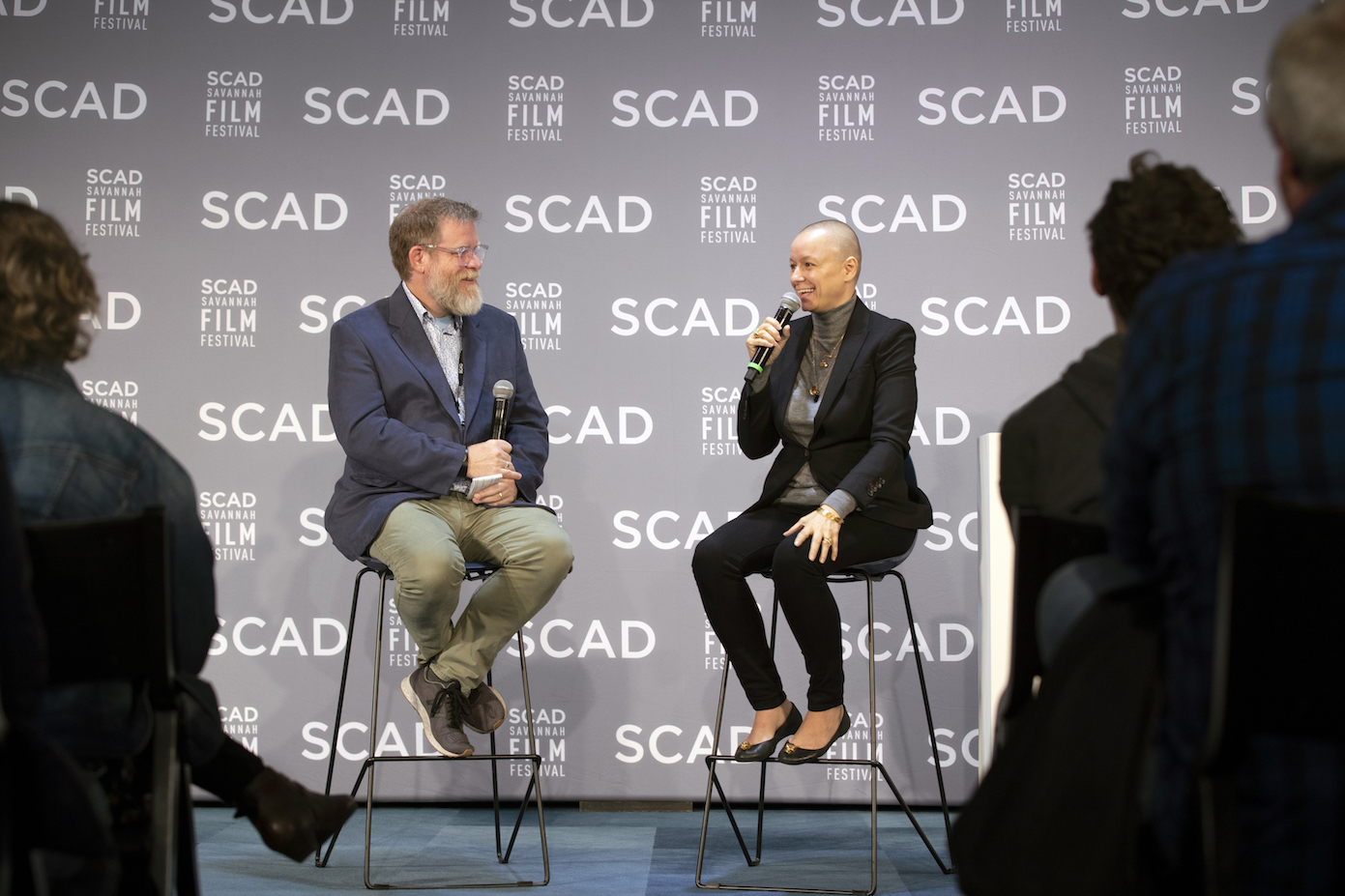
Morton's excellence spans all cinematic metrics. From big screen to hand-held, art house through blockbuster, the Nottingham, England native spoke about notable roles in Woody Allen's "Sweet and Lowdown" (1999), Steven Spielberg's "Minority Report" (2002), and Carine Adler's "Under the Skin" (1997) during her "In Conversation" appearance at Gutstein Gallery with SCAD professor Michael Chaney.

Spontaneous ovations greeted the mere mention of her work on television shows "The Walking Dead" and "Harlots." "If the great role happens to be in a great TV show, you're going to do that," Morton said. "It's not always about film."

Samantha Morton:

"When I was younger and lots of scripts were coming in the door, [the choices I made were] about what I thought had a message, a political message, a feminist message, or tackled mental health issues. I always had to have conscious reason for that role. When I got older, I still turn things down if I think it's written for the wrong reasons or is exploitative. I can't just make tea. I've never been the pretty girlfriend role. When they offered me Alpha [in ‘The Walking Dead'], I thought wow, what an iconic role! I was so proud the opportunity came my way and I could get my hands on it.

"Recently I've been working on a show called 'Harlots.' 'Harlots' is produced by Debra Hayward and Alison Owen, women I really admired in the film industry who decided to make their own television production company, Monumental Productions. 'Harlots' is produced by women, directed by a woman, written by a woman, starring women. I'm not saying we're kicking the geezers out. But this particular show was about the sex industry in Georgian London. It was kind of a female perspective on something we always have a male perspective on. When the opportunity came my way, I cried.

"It brings me right back to 'Under the Skin.' Carine Adler made 'Under the Skin' when she was 50-years-old. This was a film written by a woman, produced by a woman, about a woman. At the same time, Lars von Trier was making ‘Breaking the Waves.' [The films] came out at the same time. It would be very interesting for you as film students to watch both of them and ask yourselves questions about what the films were about, why these two films were made at the same time, what was the female director saying, what was the male director saying.

"With the ‘Walking Dead' I'd not done American television before, and it was very important for me to understand from Angela Kang the show runner what her vision was from beginning to end of a season. The episodes come in weekly, so you don't know what's happening. You can say anything as a character as long as you know the character. You can pick that person up and drop them in any environment.

"Do all the work yourself, so when you turn up you're not asking, ‘What do you want from me? What do I do now?' You can answer all of those questions by instinct. You just be. It's like the zen of acting. You're present and you get on with it."

Samantha Morton at the 22nd SCAD Savannah Film Festival

Thanks to Samantha Morton and all the attendees of the 22nd SCAD Savannah Film Festival.


SCAD Savannah Film Festival: toil in soil

November
4
2019
By
Tags:

"The Biggest Little Farm" is a documentary about dirt. Writer/director John Chester and his wife Molly quit their cramped city apartment to go back to the country; specifically, to try to revitalize 200 acres of arid farmland in Moorpark, California. "It all circles back to the health of the soil," Chester says, sifting earth in his hands.

The Edenic epic unfolds over eight years. The classic "human versus nature" trope is dispensed for something more micro: chicken vs. maggot, owl vs. gopher, and duck vs. snail are all subplots that rage as husband and wife and their team introduce purpose-driven organisms into their ecosystem in search of awesome harmony, what their biodynamic farm guru Alan York calls "tapping into a power you can ride without extraordinary effort." As Chester says: "Observation followed by creativity is becoming our biggest ally."

An Emmy-winning filmmaker, Chester came to this year's SCAD Savannah Film Festival to screen and speak about "The Biggest Little Farm." At the same time, across the country, wildfires in southern California were flickering within a few hundred yards of his Apricot Lane Farms gate. The precarious nature of existence, underlined.

"For the first five years of filming I was not admitting to anyone else, or really myself, that I was making a film," Chester said from the Lucas Theatre for the Arts stage. "I was just documenting things that were inspiring to me. In year five, I realized I'd been inadvertently filming and photographing the keystone players in the reawakening ecosystem, and how that was going to reintegrate into our problem solving. In year five I took the footage and put it together, then spent the next three years filming and finishing the film."

The ultimate success of farm itself, Chester explained to the film festival audience, "was really about building the immunology of the land. The soil system, the biodiversity, that is the immune system of our farm, and it happens to also be the ecosystem of our planet. The next layer of immunology is how we communicate to each other on the farm. That has to start with Molly and I and how we handle tough situations, and how we pass that on to our team.

"We never evangelized [to neighboring farmers] about why you should farm the way that we do. Nor do I look at them as the problem. They're a symptom of a voting mechanism that is voting for the cheapest food possible. Industrialized agriculture has responded to the same vote.

"Now I'm watching some of our neighbors use cover crop, which is the single most important thing any farm can do when it comes to the restorative methods of soil and biodiversity and the health of the food you eat. It's starting to happen, but it needs to happen through the lens of example, and it can't be polarizing. Innovation happens in a bipartisan environment."

The "lens of example" is key: "The Biggest Little Farm" is a portrait indivisible from its subject, itself a metaphor for filmmaking. As Chester told the Lucas Theatre audience: "My excitement for storytelling has been reawakened through my deep experience with the ecosystem. I thought I was out, but realized I have a lot more to tell."

SCAD Savannah Film Festival 2019

Thanks to John Chester and everyone who attended the 22nd SCAD Savannah Film Festival.


SCAD Savannah Film Festival: Wonder Women

October
31
2019
By
Tags:

For the third consecutive year, the SCAD Savannah Film Festival featured the popular Wonder Women panel series, celebrating the cinematic achievements of women in film and television. Separate panels on producers, directors, and writers featured industry professionals examining their careers and answering questions from an eager student audience.

At the Wonder Women: Below the Line panel, moderator Dana Shockley, SCAD professor of film and television, welcomed seven top professionals from diverse backgrounds and skill sets:

Natasha Braier, cinematographer ("Honey Boy"; "Neon Demon")
Latoya Henderson, makeup department head ("Welcome Home Roscoe Jenkins")
Molly Hughes, art director ("Hillbilly Elegy"; "I Am Thinking of Ending Things")
Aiesha Li, costume designer ("Tully"; "Birth of the Dragon")
Nancy Richardson, editor ("Twilight"; "Divergent"; "Selena"; "Stand and Deliver")
Amy Roth, costume designer ("Motherless Brooklyn"; "Madame Secretary"; "The Looming Tower")
Heather Taylor, VFX editor (Crafty Apes)

The panelists regaled the Gutstein Gallery audience with stories of their entry into the film industry and how to create a break. Here are edited highlights from their insights.

Aiesha Li: "I was not destined for film. I was going to become a surgeon. But I always liked fabrics. I was sewing as a hobby, then one day a film came to town that needed people who could sew. So, I interned for a small fee. They taught me how to break down fabrics, how to make clothes look old and how to make them look dirty. When I finished university, the production company called and said would you like a full-time job? I stared at the bottom and worked my way up in production design."

Molly Hughes: "I came to Savannah to work on a film called ‘The Legend of Bagger Vance.' I flew myself here and the production designer was Stuart Craig, who worked on the Harry Potter films. He said, ‘If you figure out how to get to London you can always work for me…' I was young, and when you're that age, when you love something, you believe you can do it. I moved to London and worked there for the next nine years."

Natasha Braier: "When I was in film school, I wasn't sure why I wanted to be a filmmaker. But I think it's really important to go on that inward journey. Why are you so eager to be a filmmaker and tell stories? We have so much responsibility, especially now at this particular moment in history. Every frame that reaches the screen is a political act. We can continue to have the world we have, or make a better world."

Nancy Richardson: "We're all storytellers. People have a tendency to think the writer/director is the storyteller. Every single one of the people on this panel has a really sophisticated sense of story and character. That's not to be underestimated. If you graduate wanting to be a writer and director, be flexible. There are a lot of areas in film that you might be happy working in."

Heather Taylor: "As females in the industry, we're conditioned to think we're not worth the same as a man we're working alongside. When I was starting out as an assistant editor, when the editor came in to look at a scene, it took a while for me to give my opinion, even when I was asked for it. When someone asks for your opinion, if you have a valuable contribution to make, give it. That's when people see your worth."

Latoya Henderson: "Learn about every department. Don't just stay in your lane. If you're going to be a director, learn about makeup, costumes. It's going to make your job easier. I know a lot of directors who started off as production assistants. Learn as much as you possibly can before you decide what you're going to do in the industry."

Amy Roth: "You have a voice, you have a vision. Get out there and do it. It doesn’t matter if you get fame or recognition in order to shine."
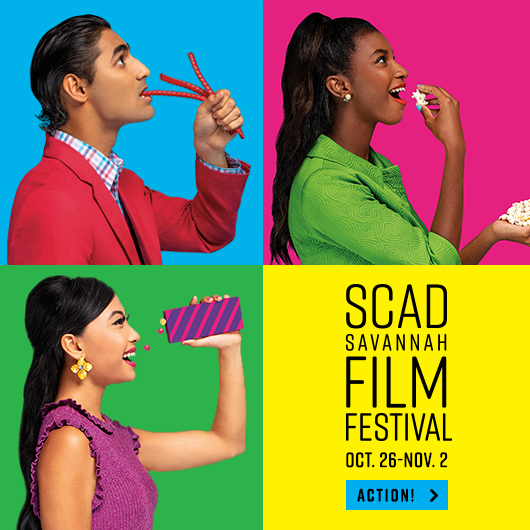
The 2019 SCAD Savannah Film Festival promotional graphic

The 2019 SCAD Savannah Film Festival continues through Saturday, Nov. 2.

For a full list of programming, visit the dedicated site.
 

SCAD Savannah Film Festival: skate free

October
30
2019
By
Tags:

"If my marriage had gone well, I would have kept Kamali locked away at home like I was," says Suganthi, 32-year old mother of the daring skateboarder at the heart of director Sasha Rainbow's 24-minute film "Kamali" (UK, 2019). As an Indian girl growing up in the coastal town of Mahabalipuram, nine-year-old Kamali Murthy doesn't heed the words of observers as she whizzes past: "Who will marry her if she breaks?"

Whether framing her upper body with skateboard out of sight to create the sensation of Kamali flying, or showing her skating an oceanside concrete half pipe through the barred window of her home, the visual poetry of "Kamali" does what great documentary film does. The stakes of the situation are defined as we feel what the subject is feeling. As Kamali's mother says: "It's like I'm looking at myself when I look at Kamali."

"Kamali" screened at this year's SCAD Savannah Film Festival as part of "Shorts Spotlight: Living on the Edge," a program dedicated to the stories of people under pressure, fighting the odds.

Director Carol Dysinger's "Learning to Skateboard in a Warzone (if you're a girl)" (UK, 2019), while complementary to "Kamali," screened on a different day, providing necessary breathing room.

Dysinger's 40-minute portrait follows Afghani girls learning to read, write and skateboard through a program called Skateistan as the city of Kabul explodes around them. Equal time is devoted to showing the girls in the classroom (eager to learn and mischievous; they're kids) and in their homes, where amidst mundane daily tasks mothers hope for better lives for their daughters. The window of opportunity these girls are skating through could shatter at any moment.

Both "Kamali" and "Learning to Skateboard in a Warzone (if you're a girl)" illuminate a key truth: As a literal vehicle for personal expression, a skateboard can be a tool against oppression. So can film.

The 2019 SCAD Savannah Film Festival promotional graphic

The 2019 SCAD Savannah Film Festival continues through Saturday, Nov. 2.

For a full list of programming, visit the dedicated site.
 

Welcome to the 22nd annual SCAD Savannah Film Festival

October
24
2019
By
Tags:

Come celebrate the 22nd SCAD Savannah Film Festival, an acclamation of cinematic excellence, Oct. 26 – Nov. 2, 2019. The largest university-run film festival in the country honors professional and emerging student filmmakers during an eight-day film celebration, welcoming more than 63,000 attendees from around the world, including directors, writers, filmmakers and actors from the big screen.
 
The festival kicks off Saturday, Oct. 26, with the Opening Night Gala Screening of "The Aeronauts" directed by Tom Harper. The festival closes on Saturday, Nov. 2 with the Closing Gala Screening of "A Beautiful Day in the Neighborhood" directed by Marielle Heller. A key stop on the Oscar festival circuit, SCAD Savannah Film Festival will screen a total of 159 films, including 35 narrative films, 15 documentary films and 109 shorts, more than any previous year.
 
"SCAD alumni and students alike will join in the festivities at the 22nd annual SCAD Savannah Film Festival. With so many SCAD grads living in Georgia, they don't have far to come!" said SCAD President and Founder Paula Wallace. "SCAD is a global leader in entertainment arts, and it's our pleasure to host the best film festival anywhere."
 
"This year's festival is one of our best and most exciting film line-ups we've put together," said SCAD Savannah Film Festival Executive Director Christina Routhier.  "We are thrilled to present eight days of premiere screenings, panels, workshops, and a one-of-a-kind Immersive VR experience to SCAD, our students, and the City of Savannah. One of the highlights of this year's festival is our annual Wonder Women series which includes award winning and rising directors, producers, writers, and below the line artists. I am even more proud that the festival will be screening films from over 50 female filmmakers making us one of the few festivals that are celebrating the work of female artists from around the world."

SCAD's preeminent School of Entertainment Arts is creating world-class, industry-ready talent that fills needs in Georgia, and in the industry globally. More than 10,000 SCAD alumni have graduated from the schools of digital media and entertainment arts, and nearly 5,000 students are currently enrolled in majors that cover fields of animation, entertainment, motion pictures, media production, writing, editing, broadcast media and performing arts.

Celebrating its 22nd year, the festival and the competition provide SCAD students with opportunities as unique as the selected films. This year, the SCAD Savannah Film Festival received over 1,800 submissions for the competition film series. During the festival, students from every academic discipline connect with leaders from the entertainment industry through master classes, coffee talks, lectures, workshops and panel discussions. Savannah, a premier film hub in the Southeast, promotes quality movies produced by independent and studio filmmakers.
 
Tickets and passes are available for purchase online at savannahboxoffice.com, by telephone at 912.525.5050, or in person at the Trustees Theater, located at 216 E. Broughton St., Savannah.

Festival logo

View the festival schedule for a complete list of films and screening locations.


Kravet Design Challenge: a pattern emerges

October
22
2019
By
Tags:

The annual Kravet Design Challenge epitomizes the brilliance of cross-disciplinary collaboration at SCAD. The challenge brings together students from two SCAD clubs: Fibers Force, and Interior Design Organization, to have their work judged by representatives from Kravet, the global leader in to-the-trade fabric and home furnishings, in a festive event in Pepe Hall.

This year's prompt — design a collection drawing inspiration from a film made in Savannah — resulted in a lively raft of student creations. Sixteen teams, each comprised of one SCAD fibers student and one SCAD interior design student, displayed mock-ups inspired by movies including "X-Men: First Class," "Forrest Gump," "The Peanut Butter Falcon," and "Midnight in the Garden of Good and Evil."

"That you chose to enter this competition in addition to your classwork shows your incredible commitment to work with people at SCAD outside your discipline," interior design professor Christina Gonano told students. "We're all really happy with how everything looks. Congratulations on doing amazing work!"

Ellen Kravet, co-principal and executive vice president, and Scott Kravet, chief creative director, Kravet, Inc., were equally effusive in their praise.

"Your depth and detail are exceptional," Scott Kravet said, addressing all entrants. "To choose a winner, we looked for designs that would be applicable to the ease and use of what we do at Kravet. I looked for a design of a space I would personally like to live in."

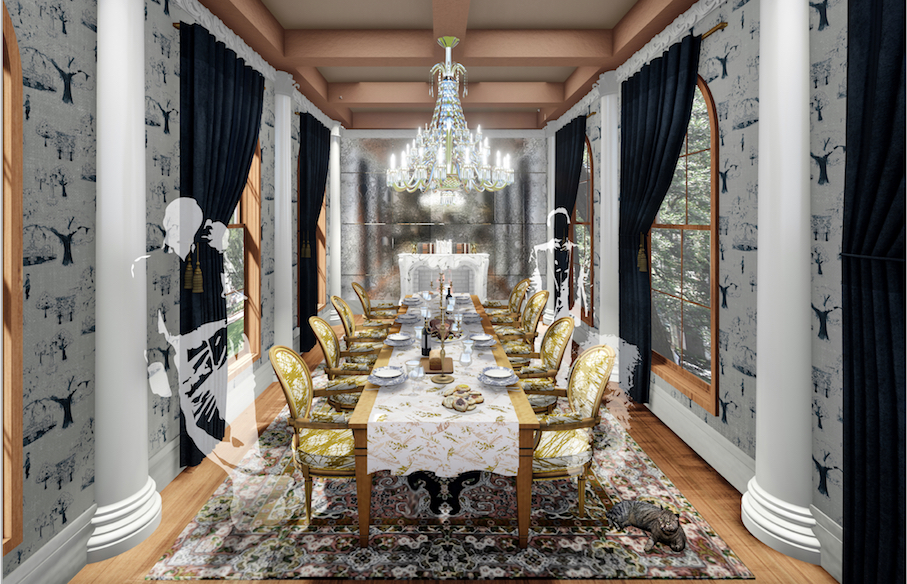
The collection receiving the highest accolade, "Accentuating Eccentricities"

The collection receiving the highest accolade was "Accentuating Eccentricities" by Sheridan Markham (M.F.A., interior design) and Shelby Pogue (B.F.A., fibers), notable for what Scott Kravet deemed its "spectacular detail and layering, including the ghost. As a buyer of art and textile design, I would buy the feather design today as an indoor print or outdoor print. Well done."

Having won the competition last year, Markham and Pogue were delighted to repeat their top honors. Their collection contains coded, idiosyncratic nods to Clint Eastwood's adaptation of John Berendt's best-selling novel, demonstrating a profound commitment to design excellence.

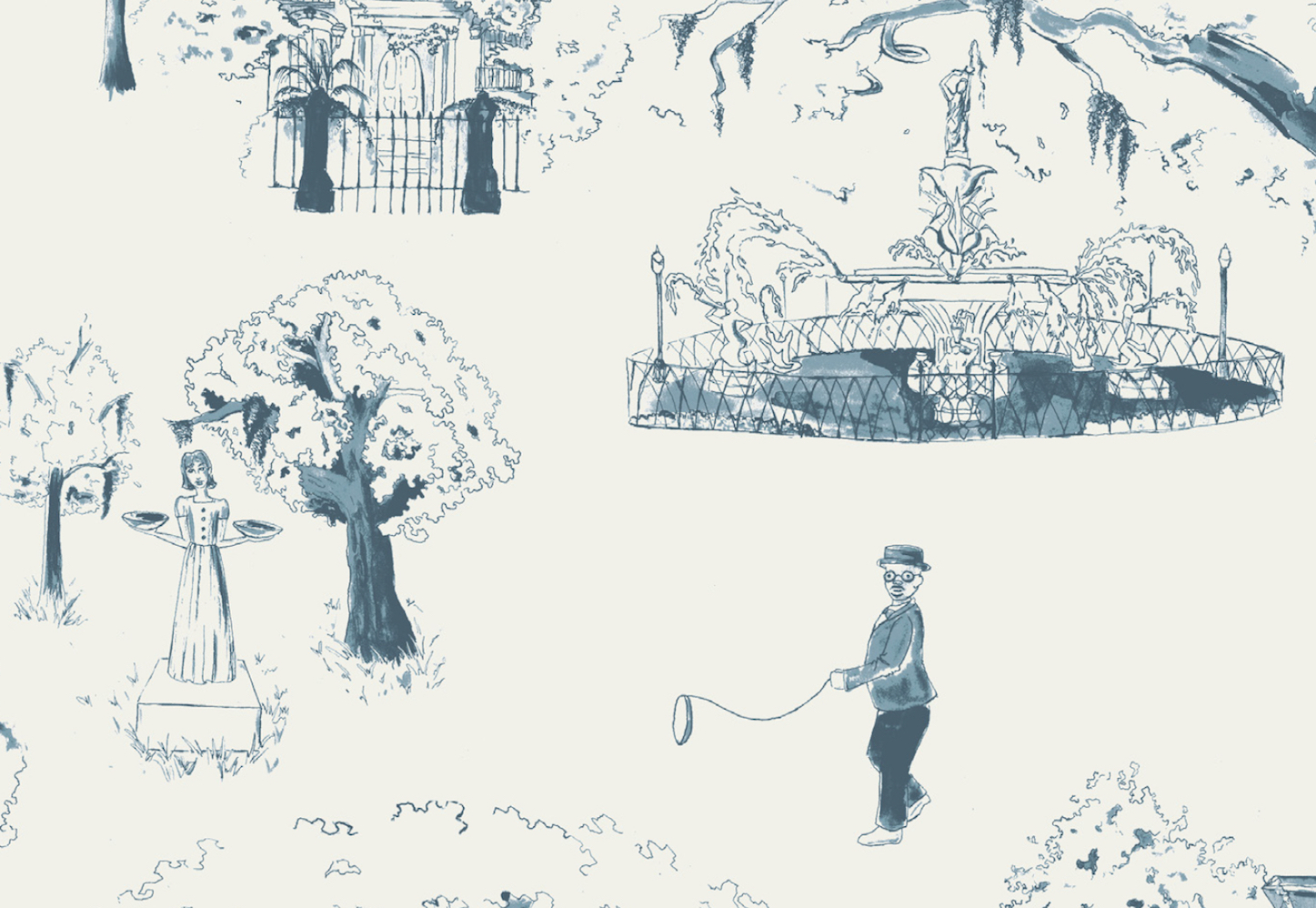
close up detail of "Accentuating Eccentricities"

"As part of our research, we visited the Mercer House, where part of ‘Midnight in the Garden of Good and Evil' was filmed," Markham said. "We learned there are certain colors unique to the home: wild herring peach, Indian bluff blue, and Jim's taupe. We incorporated elements of the ornate, historic space and the characters who inhabited it into our collection."

"To create the feather print, I dipped real a feather in ink and dropped it on the paper," explained Pogue. "Then I scanned it into Photoshop and played with layers and opacity and color replacement. The inspiration came from the movie character Serena, who is always wearing dramatic feathered ensembles."

As Markham and Pogue were congratulated by their peers and professors, all participants received a certificate of commendation from Kravet, a valuable accolade to have in a student portfolio.

"Kravet is consistently supportive of what our students do," professor Gonanao added. "They encourage these collaborative opportunities, which are really gateways to professional success. We look forward to doing it again next year."

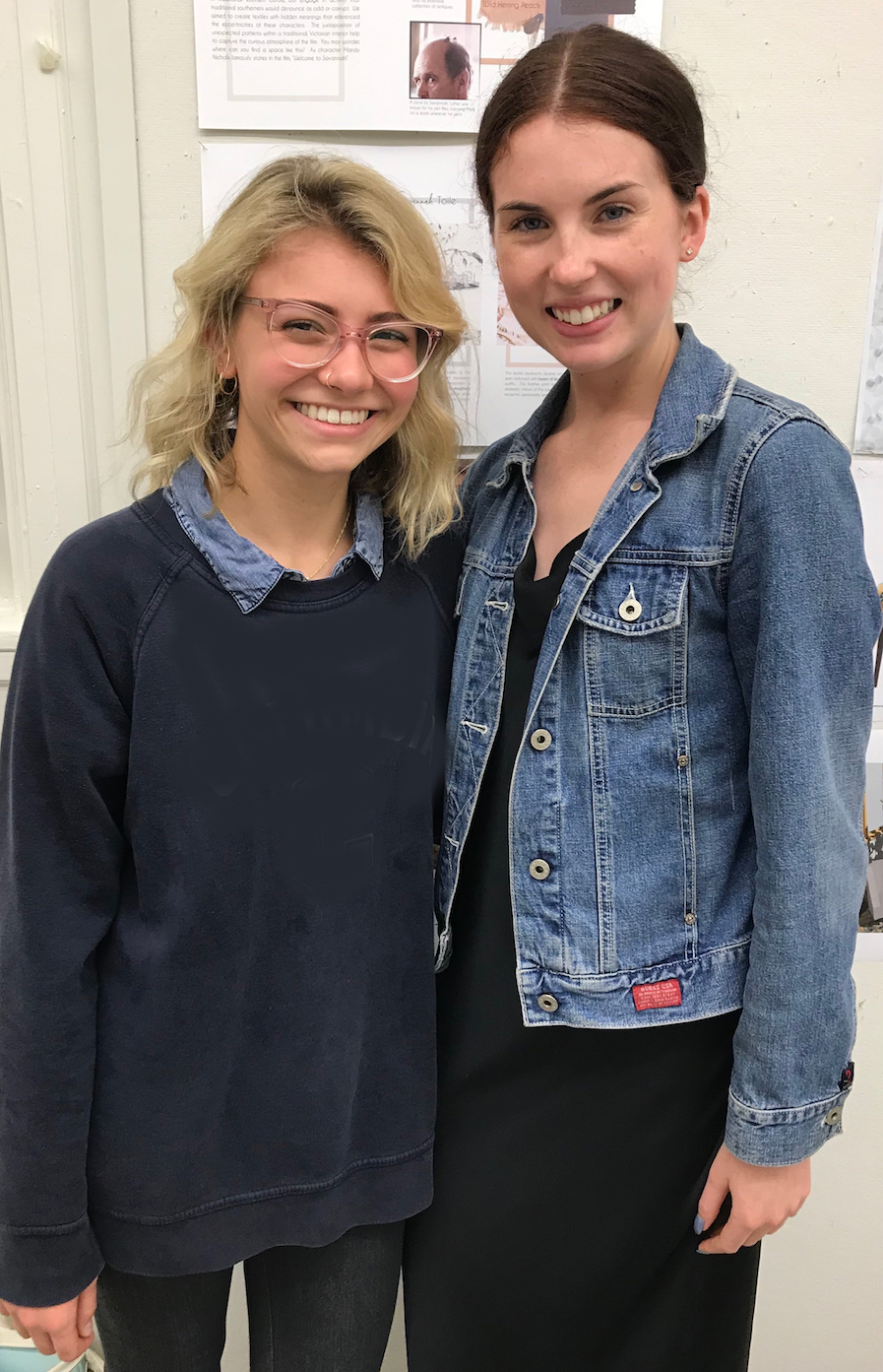
 Shelby (left) and Sheridan

Congratulations Shelby (left) and Sheridan!


Emilie Kefalas' "Replay"

October
10
2019
By
Tags:

"I'm inspired by the women announcers I found through this project," says Emilie Kefalas (B.F.A., writing, 2018). "Writing ‘Replay' introduced me to a whole new facet of sports."

A new one-act play about a rookie sports announcer calling her first collegiate football game, "Replay" premieres at Theatre 54 in New York City, Fri., Oct. 18. Produced with the support of the Manhattan Repertory Theatre, "Replay" is but the latest of Kefalas's diverse writing credits. Formerly editor-in-chief of SCAD District, she is the author/illustrator of children's book "A Capitol Dream" (Palmetto Publishing, 2019), and currently works as external communications coordinator with Disney Parks, Experiences and Products. In a pinch she can also kick an extra point.

Emilie Kefalas:

I had the idea to write a play about rookie female sports announcer after I read a Chicago Tribune article in 2016 by the wonderful journalist Heidi Stevens, about Julie DiCaro, a host of a sports commentary radio show in the Metro Chicago area. Heidi wrote about how Julie received these abhorrent comments from men about her voice and her opinions on sports.

It was the first time I'd considered how women play a role in sports commentary. Women's voices in sports announcing are relatively rare. When you hear a woman's voice commentating on a football or baseball game, you take notice.

When I watch college football on TV, the women I see are all sideline reporters. But the idea of hearing the woman's voice I found fascinating. I researched how people react to women reporting from the broadcast booth.

Reading about their experiences and listening to their announcing on-line was really helpful. It's an art form and a craft. You have to call quickly and assess a tackle, a move. I had to train my brain to follow how they called players names and numbers and the plays themselves.

I thought, I have to write a play about this. I knew it would be a great medium to explore how people react to this concept of a woman announcer, while bringing awareness to the women in sports announcing. I dedicate the play to them and the trailblazing they have done.

As a writing major at SCAD, I took Introduction to Dramatic Writing (DWRI 101) as an elective. Due to the robust curriculum of the SCAD writing program, I graduated with a portfolio of unrivaled diversity. My SCAD experience empowered me to try all different forms of writing, including playwriting.

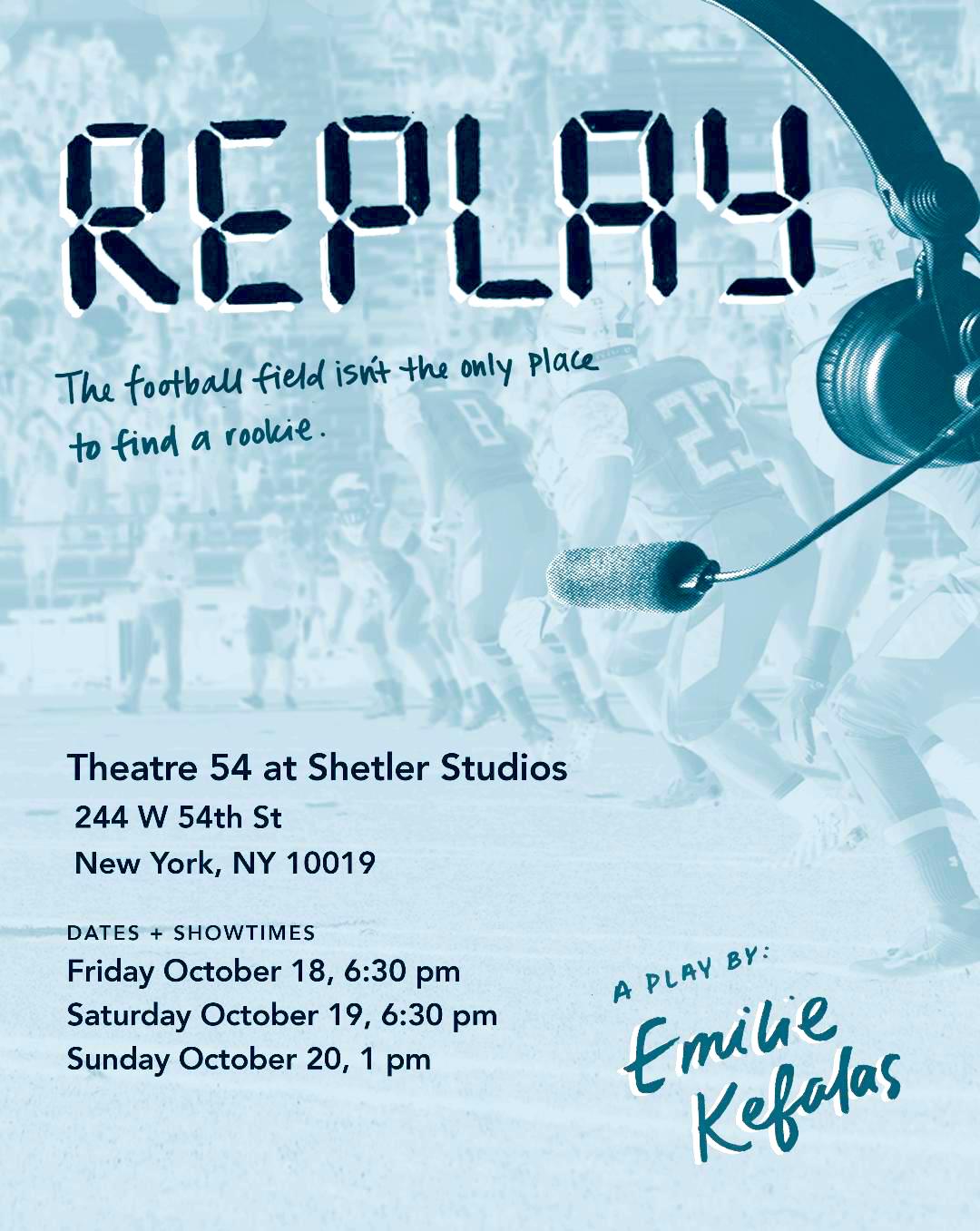
Having my play produced in New York feels like scoring a touchdown. It's called "Replay" because the story is told in reverse. It starts at what appears to be the end. We first see "Mags" after she's called her first collegiate football game by herself. She was supposed to be in the booth with someone, but we find out everything via a replay of what happened. I love the idea of pulling back layers of a story and making an audience think.

promo poster for Replay

Purchase "Replay" tickets here.

Photo: Angie Stong (B.F.A., photography, 2018)
Poster design: Sarah Funk

Visit www.emiliekefalas.com!


Voiceover wisdom with Lucas Grabeel

October
8
2019
By
Tags:

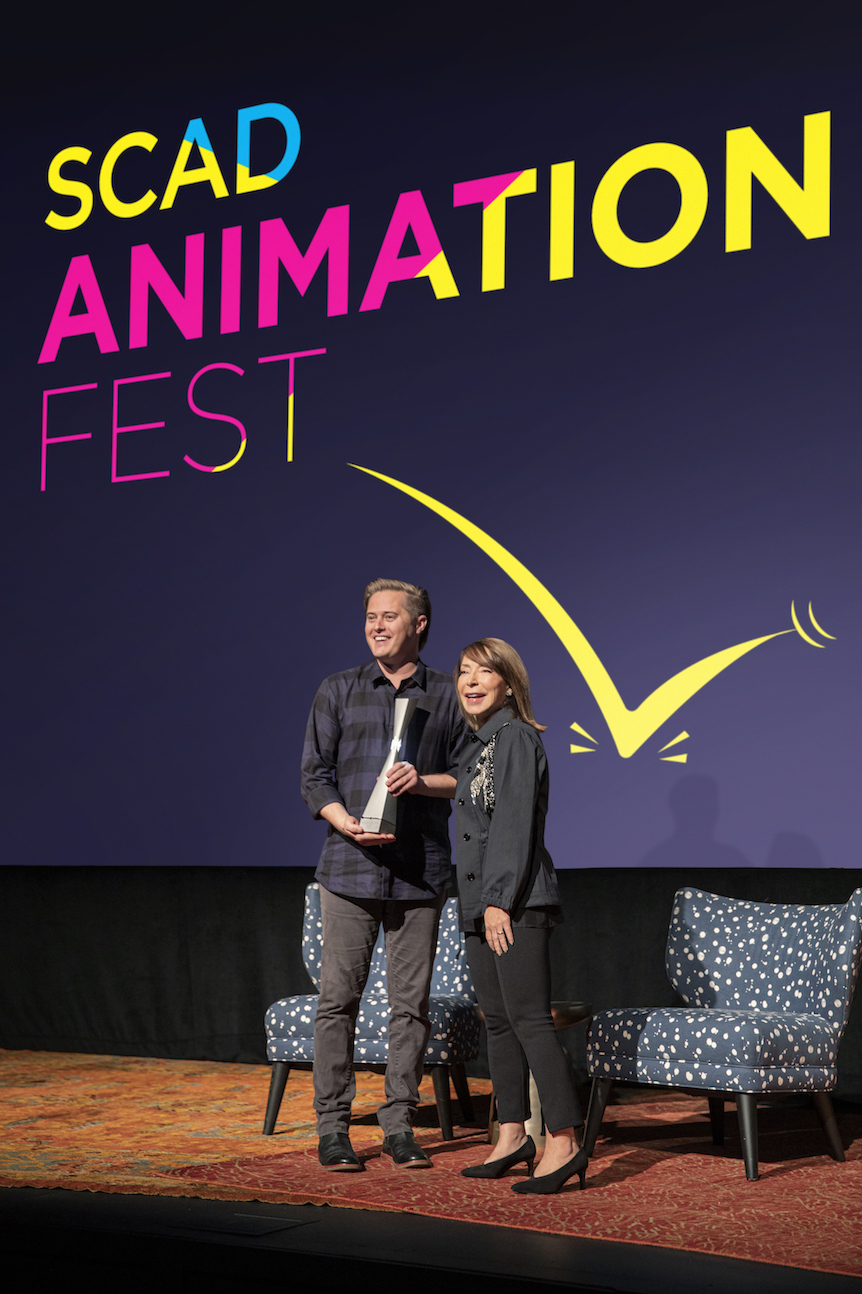
Last week, actor, singer, dancer and songwriter Lucas Grabeel received the SCAD AnimationFest Achievement Award at the third annual SCAD AnimationFest in Atlanta. Grabeel, beloved for voicing animated characters for "Family Guy" and "Pinky Malinky" as well as his live action roles in "Switched at Birth" and the "High School Musical" films, hosted a masterclass for SCAD students, appeared at a public screening of "Pinky Malinky" featuring a Q&A moderated by D.W. Moffett, Chair of Film and Television, SCAD Savannah, and was widlly cheered at a special presentation where he received the SCAD AnimationFest Achievement Award from President Wallace.

The following are edited and condensed remarks by Grabeel at SCAD AnimationFest 2019.

Lucas Grabeel:

After a couple years in L.A., I got the "High School Musical" job that changed my life. At the time my sister was an assistant to another actor doing a voiceover gig with one of the top animation casting directors in L.A. The casting director said, "Would your brother want to do animation?" She said, "Of course, he's been doing silly voices and annoying me his whole life."

I did bit parts on "Glenn Martin, DDS" and "Family Guy," then I auditioned 250 times before I booked a job: "Sherriff Callie's Wild West" for Disney Junior. That's when I started sitting next to the great Jessica DiCicco week after week in the studio, singing and learning mic technique and how to take a voice and create a whole character. That was my voiceover education.

When you're on camera, the camera is picking up your body language, so it's more subtle. When you're doing voiceover work in animation, you have to put yourself in your mind where you are, like if you're having a conversation. When you're reading the script, you need to visualize. It's heightened and uses more of your imagination.

Once you book the job, they'll have a description of what they want the character to feel like. Sometimes there'll be a drawing of the character as well. I look at the page then go off in my head and do different emotions for the character: excited, scared, sad, super-happy. Just like with a character on screen, you develop a story, then start to know the character. Then you go to the studio and they say, "Oh no, we want something completely different!" Which has happened to me many times. You have to roll with the punches and that's when it gets exciting. It adds good pressure to be creative.

If you want to work in animation after graduation, there are amazing internships in L.A. There is so much animation that's being made right now. Knock on every door: Nickelodeon, DreamWorks, Fox, Disney. Nickelodeon has an incredible program. They really want young people to come and create and bring new ideas to the table. Many people high up at Nickelodeon started off in that program. One thing about the animation world is there's a sense of family and camaraderie and support. The people in animation love animation.

There are a lot of voiceover workshops. Get used to the sound of your voice, learn to control your voice. Workshops also teach you how to warm up vocally, how to cool down, and how to show up ready to go whenever the job starts.

The resources and facilities you have at SCAD are incredible. Getting in a recording studio is the best thing you can do. Look to your colleagues and record a demo reel. Do a couple characters and cut it together. It's all about getting in front of the microphone, hearing yourself, testing yourself, listening back, and learning.

Event photo

Thanks to everyone who attended SCAD AnimationFest 2019!


Faculty Sabbatical Award: Jill Kinnear

October
1
2019
By
Tags:

Jill Kinnear, professor of fibers, SCAD Savannah, received a 2018-2019 Sabbatical Award for her project "Exploring Pre-Columbian Textiles in Peru: Lima, Cuzco and the Sacred Valley."  Professor Kinnear spent three weeks in Peru traveling and researching textile traditions from pre-Columbian societies through the present day.

She acquired beautiful textiles and hats direct from the artisans who make and wear them. These acquisitions comprise an extraordinary exhibition currently on display of the first floor of Pepe Hall. Her detailed account of her trip appears on the SCAD Fibers blog.

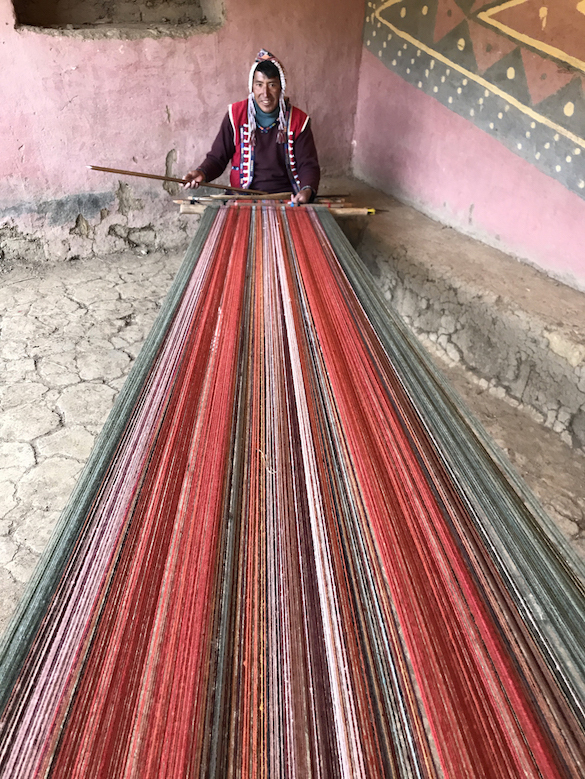
peruvian weaver working on loom

Jill Kinnear:

Peru has one of the longest, most complex and highly developed histories of textiles in the world. Textiles were crucial to every economic and political objective of pre-Columbian society. There was no hard currency, and textiles were used instead as barter, as diplomatic gifts, for ceremonies and to appease newly conquered peoples. Some of the textile techniques are unique to Peru, and are not practiced anywhere else in the world. It was amazing to witness artisans making these beautiful fabrics still using pre-Columbian techniques. I also visited a number of world-renowned museums in Lima before travelling to Cusco, a city in the Andes that was once the capital of the Inca Empire.

In Cusco, I met with Nilda Callañaupa Alvarez, founder of the Centro de Textiles Tradicionales del Cusco. Nilda is originally from Chinchero, a weaving community between Cusco and the Sacred Valley. Her organization works with ten different weaving communities to preserve traditional spinning, dyeing and weaving techniques, and to ensure that weavers make a living from their weaving. The CTTC has become increasingly successful, and she and the weavers deserve enormous credit. I visited three of these communities and collected textiles from each one.

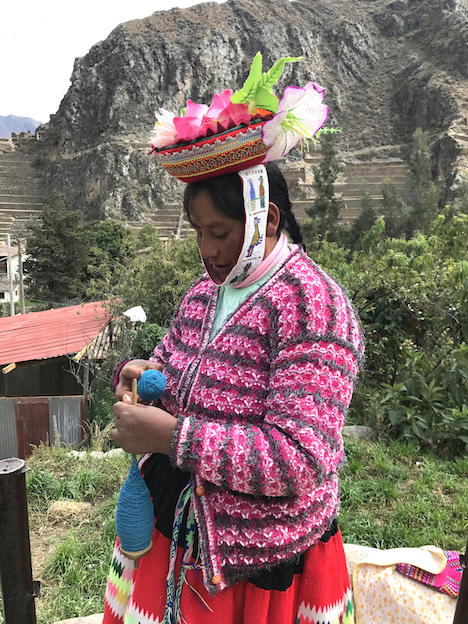
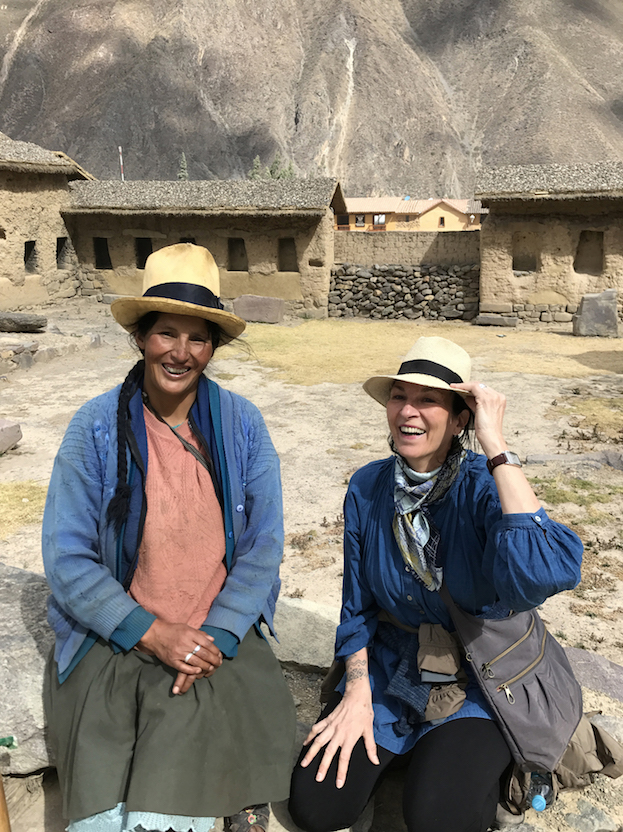
In the highlands and regional areas, aspects of traditional life have remained unchanged for centuries. Traditional dress retains its importance for people; they're not dressing for tourists but for themselves. Hats are an essential part of the outfits as symbols of status and identity, especially for women. 

portrait of peruvian textile craftswoman

If you go to a market in the Sacred Valley, people come from as far away as the Amazon to sell their produce, and consequently you'll see many different types of hats there. The beautiful red felt hats the women wear, monteras, look almost like fruit bowls. Women put flowers in them and add white beaded patterned straps.

I knew I intended to install an exhibition when I returned to SCAD, so I started collecting hats as well as textiles while in the highlands. People do bring back woven textiles but don't often bring back hats; they're not the easiest thing to transport! I managed to collect nine hats, both men's and women's. I wanted hats that had been worn, so they retained the character of the wearer.

There's a beautiful hat in the exhibition that's made of straw, woven in Chimbote and painted with a mixture of glue and chalk that's turned it hard and white. The pearl buttons were added by the owner. If you look you can see that she stored matches in the band. I bought it from a woman who was herding sheep.

I teach Survey of Textiles: Origins and Evolution (FIBR 221) here in the SCAD fibers department. While the class is about the textile history and techniques of each culture, I also try to give students a sense of the region and the time, of what it might have been like to live in a place in a particular era. Short of taking the students there myself, the next best thing I can do is bring back artifacts, notes, photographs, videos, samples, books, catalogues, contacts – and my wonderful experiences. I hope the exhibition in Pepe Hall allows our students to gain a greater understanding of these extraordinary textile techniques, the people and the country.

I applied for my sabbatical and SCAD provided financial support for me to travel to Peru.  The amount of funding ensured that I could travel comfortably and I did not need to stint on acquiring textiles. SCAD was extremely supportive and I'm very grateful for this award. The experience of this journey is invaluable; it's contributed to my own professional development and to my teaching.

Jill Kinnear in Peru

SCAD Sabbatical Awards provide eligible professors with opportunities to pursue professional growth and achievement through study, research and practice.

Learn more about the SCAD fibers program.