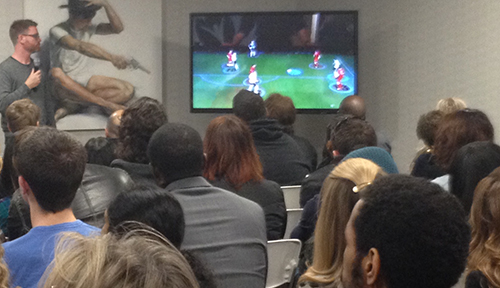
The Virtual and Augmented Reality panel at aTVfest, with Janet Arlotta and John Howell from North Carolina-based (n+1) designstudio, opened my eyes to how 3D and motion media are giving producers on live TV sets unlimited possibilities.
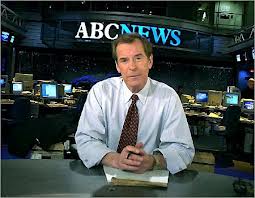
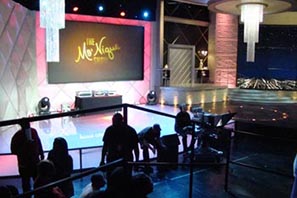
For a producer, a physical set is like home base. You block segments around the set. You visualize how the host will engage the audience and cameras. You know exactly where to perch to make eye contact with your talent while the make-up artist touches up their foundation.
A few of the sets I became cozy with over the years:
From that reference point, I assumed that a virtual set would be totally disorienting and cold. (Could an audience really relate to augmented reality over the cushiness of Oprah’s coach?) But the case studies Janet and John presented demonstrate that these increasingly used and essential methods for engaging an audience create storytelling opportunities that vastly outweigh the temporary discomfort of operating outside of a traditional set.
With clients like Inside Edition, Food Network and Tennis Channel, some of the best work with virtual and augmented reality isn’t happening in sci-fi, as I erroneously believed, but in nonfiction television, especially sports. And it’s all done in real-time, not post-production.
Virtual sets like, UFC’s for example, have smaller space requirements but posses more specialized features, like ‘baked-in’ lighting and shadows, which mean less man hours needed for live broadcasts. For Tennis Channel, a virtual set offered a two-in-one for US Open coverage: one set for "US Open Tonight" and one for "Breakfast at the Open." That’s two shows built around one desk, sitting on one green screen.
Probably the best known use of augmented reality in TV is the neon first down line, now ubiquitous in NFL games, along with the line of scrimmage and the world record marker that you’ve seen hovering above Olympic swimmers. John Howell shows how ESPN diagrams a soccer play using augmented reality.
But AR also means ESPN can diagram plays using animated 3D players, and that CNBC’s hosts can walk in and around the financial data they’re reporting using corresponding infrared dots on their hands and Steadicam.
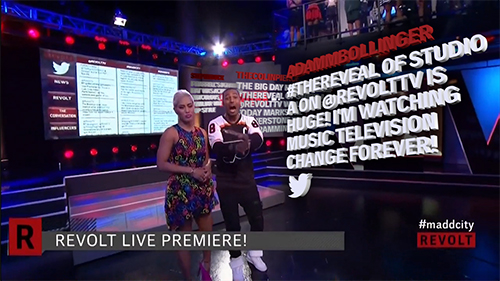
Then there’s social media. No, not the kind that sits in a screen beside the talent on a set. That’s so 2010. Sean “Diddy” Combs approached (n+1) designstudio for help with the set for his new music network REVOLT. With social media interaction being a major player in REVOLT’s mission, (n+1) took that traffic out of the screen and literally made live Tweets float in the air around the talent. Instead of a Twitter wall built into the set, AR enables those screens to move and fly around the hosts.
The Bowerbags 2011 Kickstarter campaign was my first foray into crowdfunding.
You know the feeling you get when you empty your pockets on laundry day only to find a five or ten dollar bill that you had completely forgotten about? There is arguably nothing more satisfying than when you find free money, especially if it’s for your growing business.
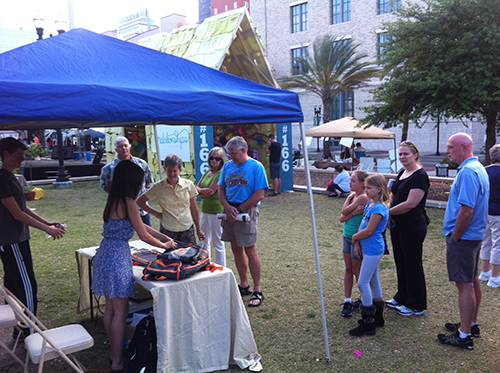
It was precisely that feeling that moved me to load up my car and spend five days sharing my project in downtown Jacksonville last year at the inaugural One Spark festival, slated this year for April 9-13.
One Spark, dubbed the ‘world’s crowdfunding festival,’ is a creative safe haven of music, art, and technology, designed to help creators showcase their talents and score some cash for it. Whether you’re a musician, a maker, mural painter, printmaker, hacker, or even an organic farmer, the sky is the limit at this event.
Imagine the scene: creators displaying and demoing their projects, which span every imaginable genre, while festival goers vote for as many projects as they like through a mobile app. Every vote my company, Bowerbags, took in last year wound up being worth somewhere around five dollars. (Not too bad for spending the days with my girlfriend and brothers strolling downtown Jacksonville, and far more interesting than anything I do on laundry day.)
Outside of the money, it was a great way to validate the product line with face-to-face consumer feedback. We also gained some great industry contacts and further press coverage just from people stopping by the booth.
Woody Allen said, “90% of success is just showing up.” I definitely found this to be the case with last year’s One Spark. Based on that turn out of 130,000 people, I’d say it’s a fair wager that this year’s festival will be even bigger, and more profitable.
If five days of art, music, and technology sounds fun, but you’d rather not do any work, then get down to Jacksonville anyway. The One Spark events go all day and all night and, even if you don’t have a business yet, the festival is a great way to network and meet project supporters.
To read some festival success stories and register your project for One Spark, go to http://www.beonespark.com/participate-creator. Students with a .edu email address can register for free until January 31, which is the deadline for Creator applications.
Jamie Bowerman (B.F.A., Graphic Design, 2004) is a SCAD graduate student (M.A., Industrial Design) and founder of Bowerbags. Jamie enjoys all things innovative and spends most of his time thinking of new ways for people to carry things. Follow Jamie on Twitter @bowerbags.
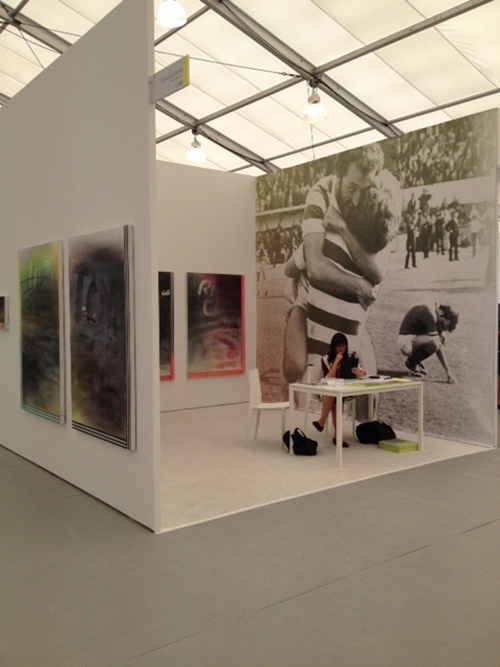
Donning her signature shoes, whose iconic stripes are prominently referenced along the borders of her work, Wendy White (B.F.A., Fibers) took visitors through the logic of CURVA. The exhibit opened this week at the M Building in Miami with a VIP preview that was attended by hundreds of connoisseurs of contemporary art, Art Basel attendees, and Wendy’s fellow alumni from Savannah College of Art and Design. CURVA will remain on display through Dec. 20.
The five pieces that compose CURVA seamlessly blend the boundaries between art and sport, between fine and urban art. Here, Wendy describes why sport, and soccer in particular, served as the impetus for collection.
Wendy on why she incorporates the Adidas stripe as a frame.
A soccer ball conspicuously hangs from the edge of Tietz. Wendy uses the structural element to connote pace and movement.
Using Green Brigade, which evokes the atmosphere created by the fierce rivalry between Scottish teams the Rangers and the Celtics, as an example, Wendy explains her use of photography.
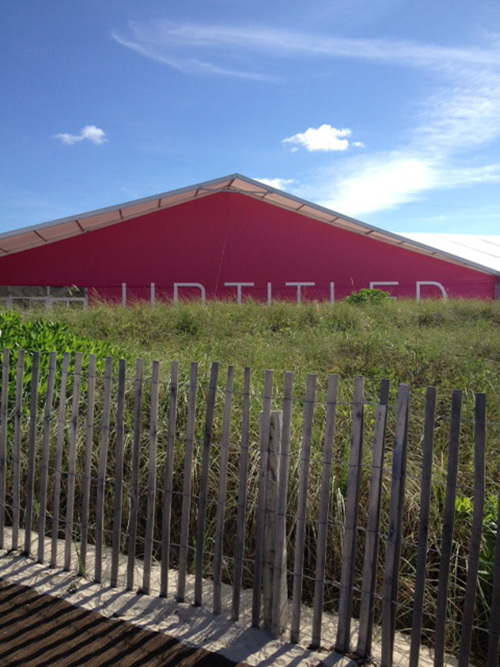
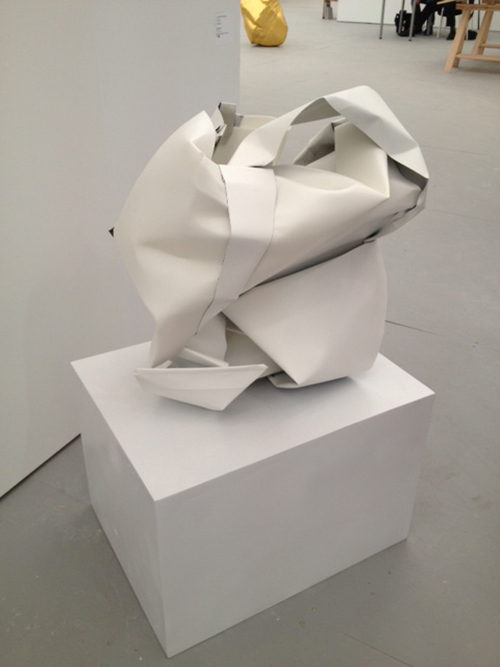
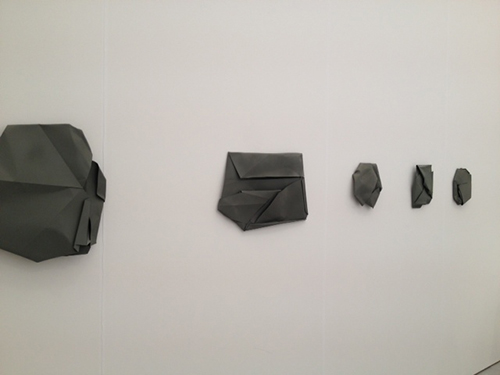
Wandering through UNTITLED’s airy pop-up tent on Miami Beach, I bumped into Savannah College of Art and Design curator Alex Sachs in the booth of Andrew Rafacz Gallery, which represents Wendy White (B.F.A., Fibers) in Chicago. Always curious about the works that catch a curator’s eye, I asked Alex to tell me what has her attention at the fair. In this case, it was the geometrical forms, beguilingly folded aluminum, by artist Robert Burnier that drew Alex in.
What followed, after Andrew approached us in the booth, was an enlightening and organic conversation about Robert and why UNTITLED is the best fair in Miami Beach.
Andrew Rafacz: Robert is Chicago-based and studied at the art institute but he is in his 40s and started as a software engineer years ago and decided to go back to school for art, because it was his first love. And that kind of informs his work because these start as designs in the computer and some of the lines are very precise and then he’s manipulating them by hand in his studio. So they have that hand-involved quality, but they straddle different lines. For me they’re about drawing. They look like folded paper, they’re sculptural and they have this mystery of materiality that I think is really epiphanic.
Alex Sachs: When you walk up to the booth you have no idea what they are. You really need to approach them to see what the materials are and to see the intricacy of the folding. The discovery is also why they’re really intriguing.
AR: This piece, you know, I stared at it in the studio and then we had it in the gallery, but having it in here, I was walking up to it and there are so many crazy folds inside this thing and it’s revealing itself even further.
Tarana Mayes: Andrew, have you exhibited at UNTITLED before?
AR: This is my second time exhibiting here. These guys are doing something really special. It’s a curated fair. I feel like some art fairs have said they are curated, but nobody curates a fair like Omar Lopez-Chahoud, who curates this. Because he is hands-on from day one all the way through this fair. He has been on site every day.
AS: Did he make any changes to your presentation?
AR: He didn’t. I feel like – last year he loved it, too. I had Wendy’s work here last year. I’ve watched him make changes here and there, which is an amazing thing, actually, to have somebody that dedicated, because sometimes you do art fairs and the person across from you, maybe the booth’s over hung or things don’t visually line-up. I mean a fair is always about a multiplicity of artistic voices, so it’s never going to be seamless.
AS: Yeah, the diversity.
AR: But you also want it to be like, we’re here as exhibitors for seven days. You want it to be visually arresting and not oppressive. So the combination of a really well curated fair with a tent bathed in natural light during the day makes it a joy to be in.
AS: The other thing I’ll say about this fair is that there’s a lot of restraint. A lot of times at art fairs there are a lot of people taking photos. I think it’s so overwhelming.
AR: Yes, they’re over-stimulated.
AS: Often times at fairs people are just taking photos and they’re like, “I’ll think about it later, I’ll look at it later.” But here it’s open and bright, and there’s plenty of wall space so that you really see each work individually, the way that you’d want to see them in a gallery. So it’s proximate to an ideal situation for showing art. Lots of natural light, lots of white space between the walls, and plenty of room between the booths, so it’s really open.
AR: And what’s amazing is that all of the things you said…having a fair take those things back, which we know worked in the first place, that is radical. It’s radical in what it’s not, actually.
TM: Having a fair remove the things that weren’t working?
AR: Remove the things that work for the big fair, I guess, or work for selling a lot of product, but they don’t work for taking in art in any sort of substantial way. I’d even go a step further and say the art fairs are starting to eclipse what happens in the gallery. So many galleries are struggling to stay open because they only sell art at an art fair. Well, that is truly problematic in the long run, because if you don’t have a space for an artist like Robert Burnier or Wendy White to develop and articulate a solo idea or exhibition in a space like that, what do we have left? We don’t have artists who can evolve like they need to. My point is that [UNTITLED] is taking it back by not reinventing the wheel.
So many galleries are struggling to stay open because they only sell art at an art fair. Well, that is truly problematic in the long run, because if you don’t have a space for an artist like Robert Burnier or Wendy White to develop and articulate a solo idea or exhibition in a space like that, what do we have left?
AS: Again, I’ll just say restraint. It just feels elegant and shows great restraint, which enables the viewer to see the work in it’s best light.
Yesterday, Academy Award-winning director and producer Lee Daniels delivered the commencement address at SCAD's very first fall commencement ceremony in Savannah. Lee told graduates and their families, “I couldn’t afford to go to college and I was angry about that for a long time. This would have been the college that I went to because it’s pretty badass.” SCAD awarded Lee the Honorary Doctor of Humane Letters.
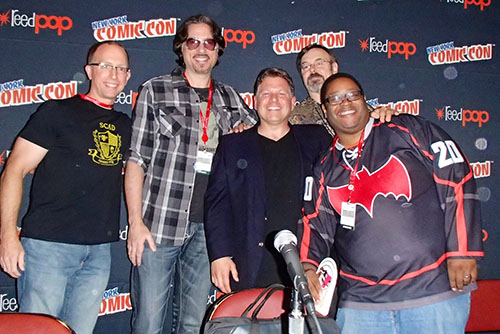
That’s what I had to keep reminding myself as I sat on a panel at New York Comic Con 2013 listening to the other panelists speak. I couldn’t help but get lost in what they had to say since, just like the audience, I’m a fan of their work. I love comics, always have, always will. So to be a panelist at the conference was thrilling.
One of the panels I participated in was called “Page 1 – Panel 1,” a discussion about the process of making comics. As a professor of sequential art, I do this every day in one way or another, so I should have been able to handle this, right?
Comics writer Buddy Scalera moderated and told me in advance what the panel was about and who else would be there. Of course, once I sat there with comic industry super stars like Marc Silvestri, Jamal Igle and Jerry Ordway, it became a completely different thing. I was star struck.
Photo courtesy of Buddy Scalera
Worry not, dear reader, my brain kicked in to gear and I was able to contribute to the discussion and break process down to basics for the crowd, whose goal was to grasp a better understanding of how comics are made. Whew.
I feel lucky to be in a position where I get to talk about the medium that I love and to find myself in situations like this. I get a charge from the “who” and the “what” of comics, and especially from knowing that the people I shared the stage with feel the exact same way.
That’s the beauty of going to a comic convention: immersing yourself in the community and culture. Like hearing Professor Shawn Crystal speak on Marvel’s “Breaking into Comics” panel, or seeing Professor Tom Lyle talk to alumni while drawing for fans. Picking up an advanced copy of student Luigi Anderson’s first coloring job for Oni Press was another highlight, as was catching up with dozens of successful alumni, like Nick Dragotta and Andrew Robinson.
I’m sure next year’s convention will be just as exciting. Hopefully, I won’t be as star struck on the panel but, then again, I kinda hope that I will be.
Pat Quinn is an associate dean of Academic Services at Savannah College of Art and Design in Atlanta. His work has appeared in Marvel Comics and DC comics, among others. You can see Pat’s art on his blog, Deviant Art page and on Twitter.
What if I told you that you could use your vacation to Disney or LEGOLAND to build notions of career planning in your child’s little noggin?
Here’s how. Take Johnny’s favorite attraction and point out all of the things that make it work. Notice the queue and how it’s engineered to entertain while moving hundreds of bodies efficiently. Call his attention to the overall story being told and how that tale made him want to buy a hotdog at the seamlessly integrated snack kiosk.
These bells and whistles are not just the result of someone’s imagination. (Walt Disney’s Imagineers didn’t throw fun and color into a pot, chant bibbidi-boppidi-boo, and pull out Pirates of the Caribbean.) Theme park attractions require intricate planning and design.
Enter SCAD’s M.F.A in themed entertainment. The first in the U.S., this program gives students the fuel with which to design the experiences we plunk cash down for at zoos, parks, resorts, restaurants, museums, you name it.
There are two reasons why this expertise is in demand. One, with Imagineers retiring in droves, the theme park industry is facing a sea change in its workforce and, two, it’s experiencing unprecedented growth.
Consider: DreamWorks’ 3.1 billion dollar Dream Center in Shanghai, opening 2016; Universal’s Wizardry World of Harry Potter in Japan, opening 2014; Disney Shanghai, opening in 2015.
Sprinkled worldwide among the big studios are smaller companies, like Tribe, Inc., which keep the industry humming with major jobs like producing the Super Bowl half-time show, the Democratic National Convention, and more. All told, the theme park and attraction business is a multi-billion dollar industry with 350 million people visiting the world’s top ten parks in 2012, alone.
The professionals who engineer these spectacles want to make room for more. That’s why the Themed Entertainment Association will bring the SATE Conference all the way to Savannah this week, so participants can see what SCAD’s academic program is all about, and recruit fresh talent.
So there’s some food for thought while you sweat it out in the long amusement park lines or tour a museum. All hope is not lost if your 16-year-old wants to major in drawing. Your starving artist might end up feeding the fantasies of a generation addicted to ceaseless entertainment and in so doing feed himself, too.