Skip to main content Accessibility Policy

New faculty spotlight: Fatemeh Hosseini

February
15
2022
By
Tags:

"SCAD is a family, especially for students from abroad," says foundation studies professor Fatemeh Hosseini (M.A., motion media design, 2019). "Think about leaving your culture and country, not knowing what will happen. I made that decision when I came to SCAD as a student. Now when I tell students that I'm sharing the journey they're going through, it resonates."

On a rainy Friday afternoon, Hosseini is sitting upstairs in Foxy Loxy after class at Arnold Hall. As she resets her coffee cup in its saucer, she is not intentionally being gestural, but there is an inherent sense of emphasis in her action. For this artist-educator, life is not a rehearsal.

When Fatemeh came to SCAD as a graduate student in 2015, she already held a master's degree in painting from Alzahra University in Tehran, Iran; had taught drawing, painting, and sculpting classes at Moon Gallery in Karaj; and worked as a commissioned artist in municipal beautification projects in major Iranian cities including Mashhad and Tehran.

"I grew up in Iran in a supportive family of artists, where much of my drive and inspiration was formed," she says. "That life experience now helps me. I'm teaching from my heart."

"Fatemeh is an artist who is dedicated and diligent, and I admire her passion for study and eagerness for aesthetic expression," says SCAD motion media professor Minho Shin, who taught Hosseini in Motion Media Design Techniques II (MOME 206), where she created a stunning promotional film for the VGIK International Film Festival.

While pursuing her master's at SCAD, Fatemeh also earned two College Reading and Learning Association (CRLA) certifications, enabling her to work as a mentor and tutor for SCAD students, and setting the stage for her joining SCAD faculty in Fall 2021.

This academic year, Professor Hosseini is teaching Drawing for Storyboarding (DRAW 206) and Storyboarding Essentials (DSGN 208). These foundation studies courses are primarily for students who will go on to major in film and television and animation—disciplines where Hosseini herself has achieved award-winning excellence.

"Being a SCAD professor is wonderful. When I am teaching, it's an ongoing conversation about film, filmmaking, storytelling, and shot design. In a class of 20 students, these are 20 individuals with 20 different ways of storytelling creating 20 different storyboards. I design my syllabus in a way that covers everything that they need to know. In every classroom session I teach, I demonstrate, I give students time to work on their assignment, and I give them feedback, one-on-one.

"In the time that I've been here, I've seen the consciousness of SCAD students grow. That's because of how hardworking the faculty is—professors helping students any way they can."

As her coffee cools, Fatemeh continues to exude warmth. "I tell my students, the purpose is not to be famous, it's to express life itself and speak of the truth. That's the true definition of happiness. Happiness is there for the artist as long as they're involved in creation, to make the world a better place."

Art piece by Fatemeh Hosseini

See more at fatemehosseini.com.

View her "Blind Drawing, Bold Imagination" workshop, designed while a gradute student at SCAD. 


New faculty spotlight: Kwame Nyong'o

February
3
2022
By
Tags:

"What techniques can you use to elevate your own storytelling?" asks Kwame Nyong'o, professor of animation. "How can you subvert traditional tropes, alter structure, and get deeper into your characters' personalities to make them more interesting and complex?"

Recognizable around Montgomery Hall for his radiant dashikis and quick smile, Professor Nyong'o joined SCAD faculty in Fall 2021, after two decades living and creating in Nairobi, Kenya. There, he worked on projects ranging from UNESCO's Africa Animated! Program to the beloved Disney Channel series Tinga Tinga Tales. Last year, he directed the UN Environment-sponsored film "The Wonderful Story of Aisha, Ali and Flipflopi the Multicoloured Dhow Boat"—the first-ever Kenyan short to be selected for Annecy International Animated Film Festival.

This acclaimed storyteller could have remained in East Africa's cosmopolitan capital, but as he says, "My wife and I thought it would be interesting for our children to live in the States if the opportunity arose." A message in early 2020 from SCAD senior faculty recruiter Nick Oji (who Nyong'o calls "an amazing dynamic fellow") led to Zoom conversations with SCAD chair of animation Chris Gallagher and associate chair John Webber.

"From those initial discussions, I felt the positive sense that everyone here is on the same team," Nyong'o says. "My colleagues went out of their way to talk to me, and as I heard and read about the philosophy and culture of SCAD, I understood the university as a place that embodies the values I believe in." Finally, Nyong'o says, "My wife, Wanzilu, who is open-minded and super intelligent, is the one who actually said, ‘Let's move to Savannah.'"

SCAD chair of animation Chris Gallagher is delighted by the department's new addition: "Kwame is an outstanding professor who adds a unique style and perspective to enrich our students' lives. He has worked extensively across almost every role in animation, which means he is equipped to push our students to create art to their highest potential—the level they need to reach to be truly successful."

In his inaugural SCAD academic year, Nyong'o is teaching a gamut of courses including Core Principles of Animated Storytelling and Concept Development (ANIM 275), Collaborative Experiences: 2D Production Pipeline (ANIM 372), and Animation Aesthetics and Practice (ANIM 705). "One of the things I emphasize is how to take something from your own experience, your own cultural background, and infuse that into your storytelling," he says.

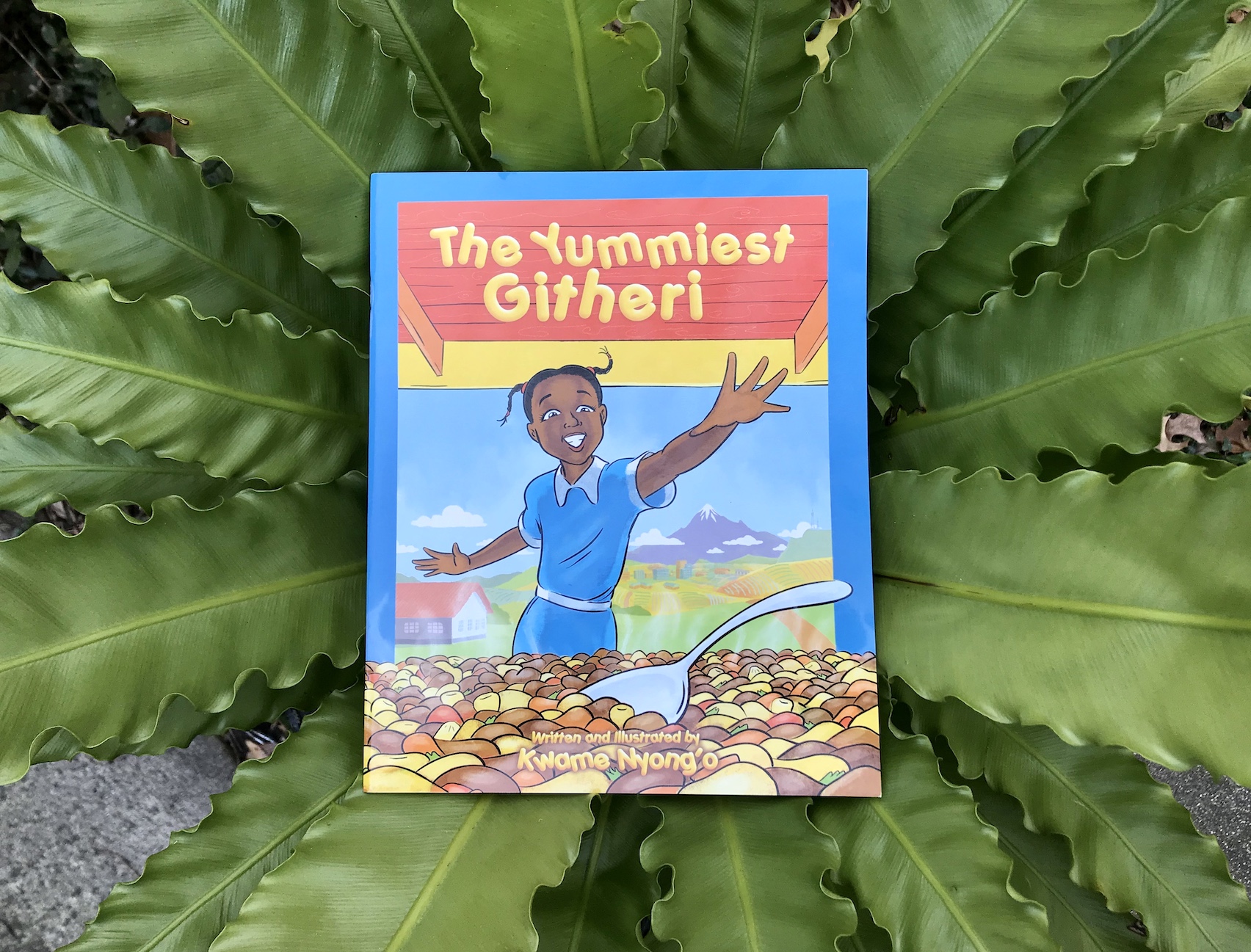
An author of note, Nyong'o has written and illustrated an acclaimed series of children's books "showcasing the positive side of life in Kenya, with regular kids with normal challenges. My intention is for kids outside Kenya to see people in Kenya living their lives. It's nice that the books have been popular in Kenya too."

Should his surname seem familiar, it's not a coincidence. Professor Nyong'o is cousins with Oscar-winning actor Lupita Nyong'o. (Kwame: "I don't think my students at SCAD know we're related. Maybe I'll ask her pop up sometime via Zoom to say hello!") Kwame also mentions his brother Tavia ("a big-time professor at Yale") as nudging him towards the fruits of academic life.

"My teaching instinct goes back to my grandfather, Canon Hesbon Nyong'o," Kwame says. "Originally from the western Kenya, he was one of the first English-speaking people from his part of the country. His value was that education is important and teaching is the best thing you can do. I'm happy to be doing that here now at SCAD."

"The Yummiest Gith4ri" by Kwame Nyong'o

Visit Kwame Nyong'o.


New faculty spotlight: Dr. Gayatri Devi

February
2
2022
By
Tags:

"Part of education is the ability to inculcate a sense of social and political agency," says Dr. Gayatri Devi, professor of liberal arts. "This means students have total freedom to articulate their sense of who they are, and the critical attention they pay to issues outside of their own lives is amazing."

Dr. Devi joined the SCAD faculty in Fall 2021, intent on recontextualizing her expertise and beliefs after nearly three decades in higher education. "I've never taught at a university like SCAD," she says. "The fact that SCAD caters exclusively to the arts and humanities and design and performing arts is incredibly affirming to me."

SCAD Chair of Liberal Arts, Dr. Rebecca Cantor shares this enthusiasm: "Dr. Devi is a pro in every sense of the word. A seasoned writer, scholar, and educator, she brings all her experience into the classroom every day. I am thrilled to have Dr. Devi join the department, and I'm excited for every student who will get to take a class with her at SCAD."

This quarter, Dr. Devi is teaching From Ink to Ideas (ENGL 123). "One of the assignments is an ecopoetics assignment, where students identify an environmental issue that they care about. The first part of the assignment is a creative response to the environmental issue they've chosen. The second part is like an artist statement, explaining their thinking and why they picked this issue. I receive incredible essays from students with paintings and drawings and comics as part of the work."

Dr. Devi also teaches Foundations of Story (ENGL 142) "where we look at narrative theory, and how to construct stories in different traditions in different genres" and, at Dr. Cantor's behest, Cinema in Context: From the Fairground to the French New Wave (CINE 705).

"In my graduate seminar, I have students from the U.S., China, Taiwan, Turkmenistan, Nepal, India, South Korea, and different parts of South America and Central America," Dr. Devi explains. "They all have frames of reference to film traditions from their own country."

A proponent of what she terms "transnational curiosity," Dr. Devi was born in Travancore, in the state of Kerala, India, and came to the U.S. in 1990 to earn her Ph.D. at University of North Dakota. (She retains ties to the institution as contributing editor to North Dakota Quarterly.) Devi speaks Malayam ("my mother tongue"), Hindi, and English, and studied Sanskrit to facilitate reading the classical poet and playwright Kalidasa. She co-edited the book Humor in Middle Eastern Cinema (Wayne State University Press, 2014), available at the Jen Library, and her next book, on indigenous cinema worldwide, is forthcoming later this year.

It is something of a sweet surprise then, when Dr. Devi reveals that she has "always wanted to be a torch singer" and that being a "big fan of Johnny Mercer" contributed to her interest in living in Savannah. Perhaps this fun fact shouldn't be unexpected, and actually reflects a pedagogically pertinent worldview.

As Dr. Devi says: "Deep cultural contact, deep love and respect for other people and their cultural products—to me, those things matter."

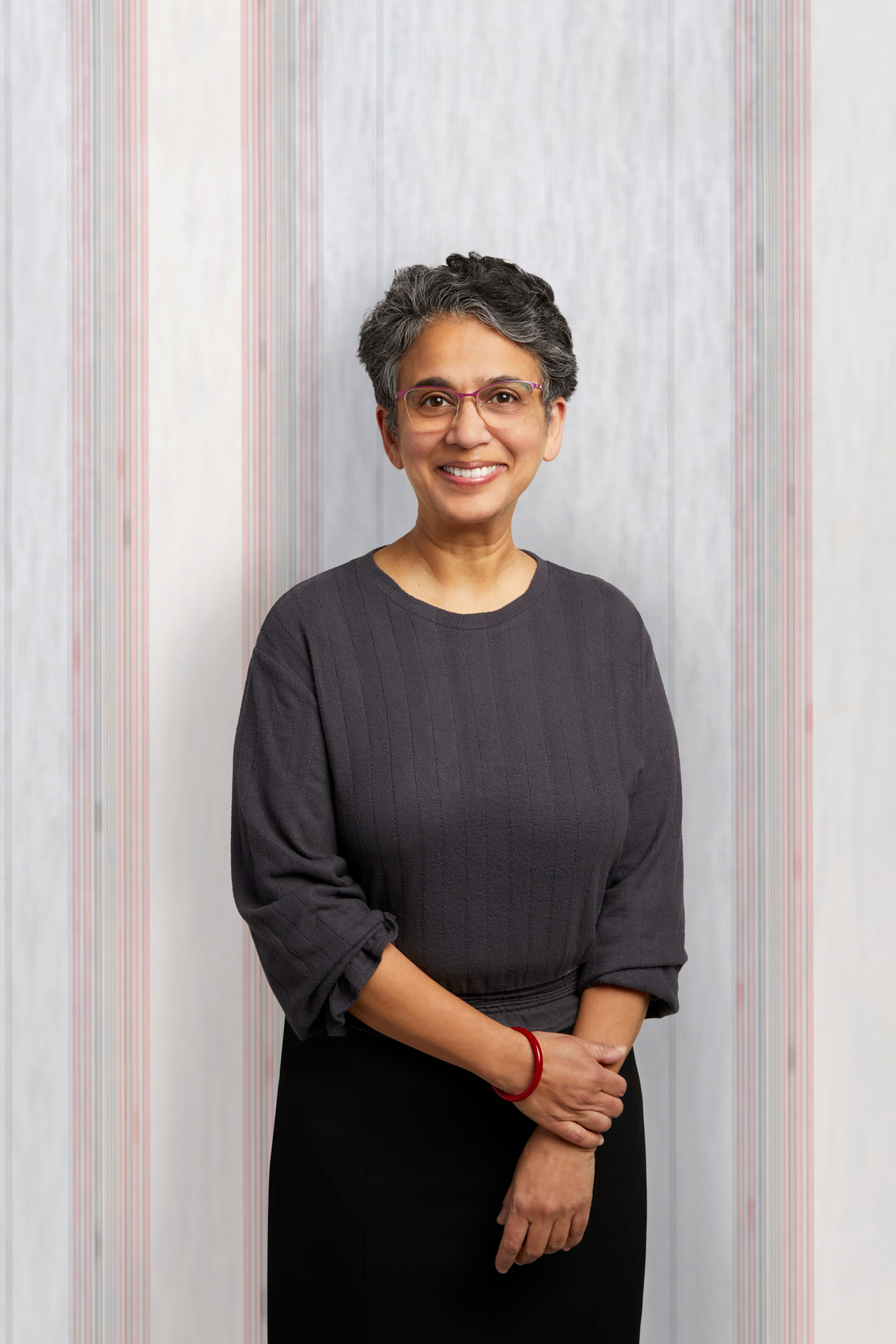
Dr. Gayatri Devi

Learn more about the diverse degree programs at SCAD.


SCAD FASH offers exclusive curator-led tour

January
12
2022
By
Tags:

Enjoy an intimate look at two new SCAD Museum of Fashion + Film exhibitions at a curator-led, members-only tour, this Thursday, January 13, 2022, 6 p.m. in Atlanta.

SCAD FASH director of fashion exhibitions Rafael Gomes will give a behind-the-scenes tour of some of fashion history's greatest runway moments as he guides museumgoers through an exhibition of the photography of Robert Fairer. Robert Fairer Backstage Pass: Dior, Galliano, Jacobs, and McQueen features intimate portraits of supermodels, designers, and creatives capture the zeitgeist of fashion at the turn of the 21st-century.

The exclusive SCAD FASH also invites guests to witness the future of fashion with Robert Wun: Between Reality and Fantasy. The exhibition offers the opportunity to discover the bold work of emerging fashion designer Wun, a rising star in the fashion world who has dressed fashion mavens Billy Porter, Solange Knowles, Lady Gaga, Céline Dion, Issa Rae, and Tessa Thompson.

This tour is open to SCAD FASH members only. Space is limited, with admission through a first-come, first-serviced basis. Members may RSVP to [email protected].

About the exhibitions:

Robert Fairer Backstage Pass: Dior, Galliano, Jacobs, and McQueen
Before instantaneous access to fashion shows via livestreaming and social media, London-based artist Robert Fairer was backstage photographing the designers, models, hair and makeup artists, and stylists working in crowded spaces at a frenetic pace, moments before the final looks were presented. His intuitive ability to frame the beauty, drama, and energy backstage resulted in stunning images—found in the pages of British Elle, Harper’s Bazaar, and American Vogue—that celebrate the creative talents who contribute to the magic of the runway. A captivating record of a bygone era, the exhibition features behind-the-scenes photographs from the house of Dior, John Galliano, Marc Jacobs, and Alexander McQueen.

Robert Wun: Between Reality and Fantasy
Robert Wun favors a narrative approach to fashion design, embracing a global perspective that honors his heritage yet refuses preconceived notions of Asian identity. He often looks to nature to inform his work, relating the asymmetry of organic forms to the complexity of being human. Energized by the potential of design to function as a universal language, Wun translates bold conceptual ideas into technically rigorous yet accessible garments that empower the wearer.

Rafael Gomes is the director of SCAD fashion exhibitions for the Savannah College of Art and Design. Before joining SCAD, Gomes was an archivist and exhibition coordinator at Vivienne Westwood, where he oversaw the coordination and styling of global fashion shoots, videos and fashion shows. Gomes also designed, planned and executed large-scale exhibitions at numerous world-renowned museums and galleries, including the Victoria and Albert Museum, the Palace of Versailles, the New York Metropolitan Museum of Art and the SCAD Museum of Art.

SCAD FASH building exterior

Learn more about SCAD FASH, and become a member today.

Take the curator-led, members-only tour, Thurs., Jan, 13, 2022, 6 p.m.


Sauda Mitchell: the star is significant

January
5
2022
By
Tags:

Who better to do this work? Sauda Mitchell (B.A., visual communication, 2013) is an archivist, artist, and educator—indivisible facets of a unified identity, all on display in her solo exhibition Re-Cor-Dare, at the Jepson Center in Savannah.

"Having attended SCAD, having worked at the Georgia Historical Society, having archived and processed the W.W. Law Collection—all those experiences have shaped my view of history," Mitchell says. "It's my responsibility to share what I have had the privilege to engage with."

Re-Cor-Dare—impeccably installed in a light-filled upper wing of the Telfair's flagship museum—comprises a series of works in an array of tactile media: prints, paintings, artist books, textiles. The exhibition's title is an etymological extension of the act of recording, incorporating the Latin roots "cor" (heart) and "dare" (to give).

The formal evolution of Re-Cor-Dare dates to 2017 and Mitchell's SCAD Alumni Atelier residency when, she explains, "I met board members from Friends of the African American Arts, which led to crossing paths with Erin [Dunn, Telfair associate curator], who scheduled a visit to my studio. I showed her my sketches for Voyage, and she asked if I'd be the next #art912 artist"—the Telfair initiative dedicated to exhibiting artists living and working in Savannah.

Displayed in the gallery's hull-like big room, Voyage Windsails No. 1-5 are hand-painted acrylic, cotton fabric, and hand-dyed indigo textile pieces depicting a journey in the Atlantic slave trade. The sails— mounted in windows, not on walls—render the gallery pelagic. Iconography reappears. "The star is significant because it references the journey enslaved people made," Mitchell says. Speakers in a half-baffled corner swell with Robert Glasper's 2004 rendition of Herbie Hancock's 1965 composition Maiden Voyage. The immersive presentation suits the work.
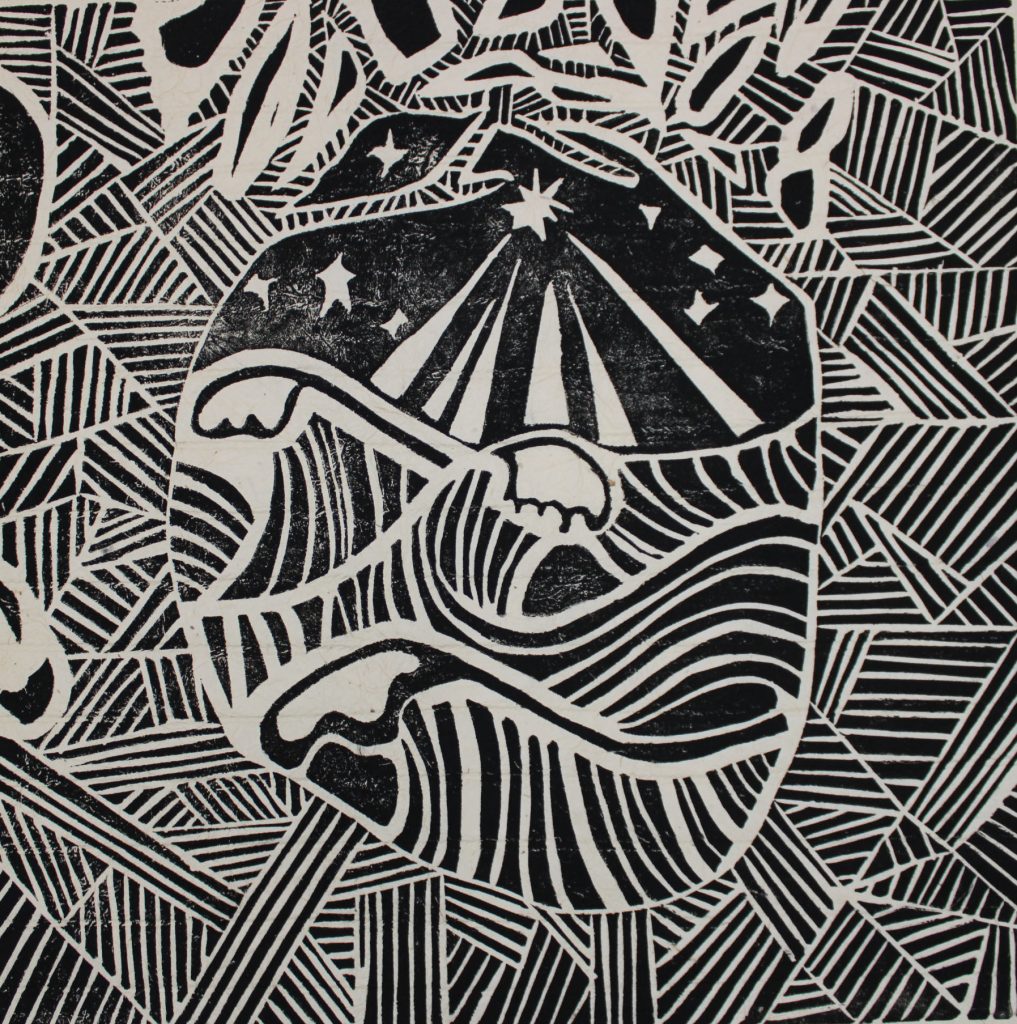
Sauda Mitchell (American, b. 1981); Voyage No. 3, 2020; linoleum on paper; courtesy of the artist.

Sauda Mitchell (American, b. 1981); Voyage No. 3, 2020; linoleum on paper; courtesy of the artist.


"Inspiration came from a poem I wrote as a SCAD student, titled Voyage, about the Middle Passage," Mitchell explains. "The poem had been tucked away for years. Then, when I heard Glasper's Maiden Voyage, it was as if I was transported into a ship in the Middle Passage, I could hear moans, bees buzzing, water—all elements that were very much part of my poem. I revisited my sketchbook and reread that poem, and it was timed perfectly to the music. From that experience I decide to create a series called Voyage."

On an adjacent wall, sense memories manifest in a lively collaboration between the artist and her father, wood carver Alfonzo Mitchell.

"As a child, I'd go downtown and smell the tobacco and see it going out of the silos," says Sauda, a Winston-Salem, NC native. Finding Grandma Judie comprise two pieces whose flue-cured whole tobacco leaves hang from walking sticks carved by the elder Mitchell. Viewers peer through the long leaves to see portraits of ancestors.

"I'd conducted genealogy for other patrons at the Georgia Historical Society, but never provided myself that service," Mitchell says. "When I started digging, I discovered that my grandmother's maiden name was Hairston. That's how I made the connection to the Hairston family, and found the book by Henry Wiencek." As documented in The Hairstons: An American Family in Black and White (St. Martin's Press, 1999), the Hairstons owned several plantations and thousands of people—including Mitchell's great-great grandmother. "This is the first time that I am incorporating my own family history and how it unveiled itself into my work."

Re-Cor-Dare exemplifies Mitchell's mastery at using archival research to facilitate creation in the resonant present, an ability that makes her invaluable as the much-beloved archives and special collections librarian at SCAD. "It's an energetic collaboration with SCAD faculty, always," Mitchell says, of connecting students to proper collection items, and supporting their ideal learning outcomes. "In order to curate and bring together a collection of resources for students to engage with, you have to understand what they're learning, and what is going to propel them and inspire them." And who better to do that work?
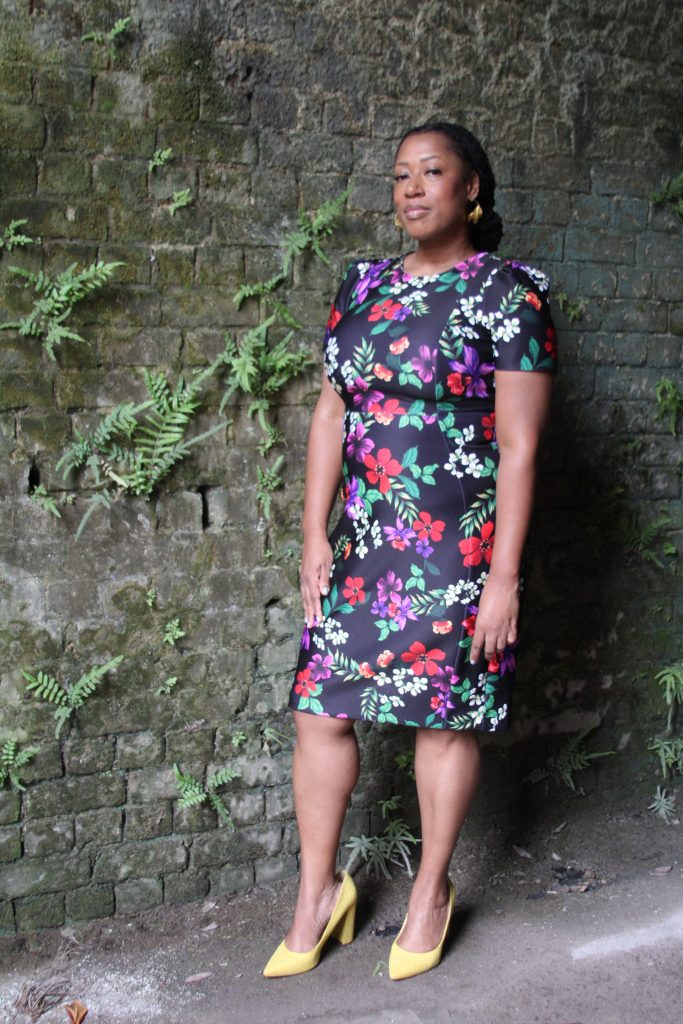
Portrait of Sauda Mitchell by Labeeb Abdullah

Portrait of Sauda Mitchell by Labeeb Abdullah (B.F.A., motion media, 2004).

Re-Cor-Dare is on view at the Jepson Center in Savannah through Feb. 27, 2022.
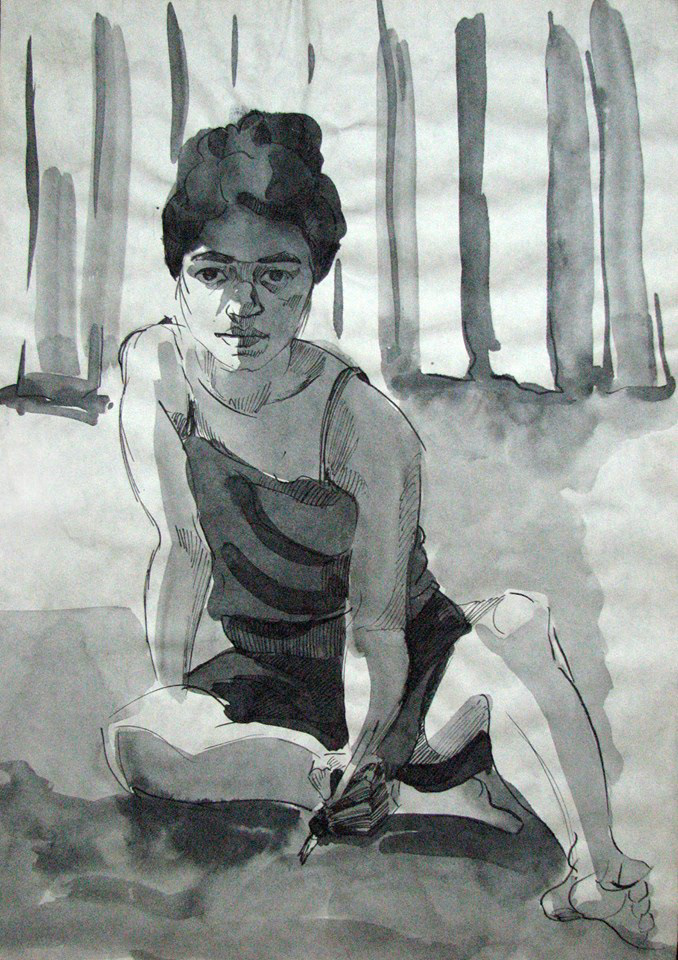
 

Service design sensation Shreya Dhawan

December
20
2021
By
Tags:

As a graduate student, Shreya Dhawan (M.F.A., service design, 2018) contributed to two transformational SCADpro projects: Delta Air Lines’ "Envisioning the Future of Air Travel," and Philips Healthcare’s "Redefining Patient Care Services." Solving significant challenges for major corporate clients was an experience she achieved before graduation.

"Our students learn how to make sense of complex business systems and design effective solutions to enhance the value at the heart of rendering and using a service," says service design professor Xenia Viladas.

As Shreya puts it: "To be able to learn what clients are looking for was a valuable experience."

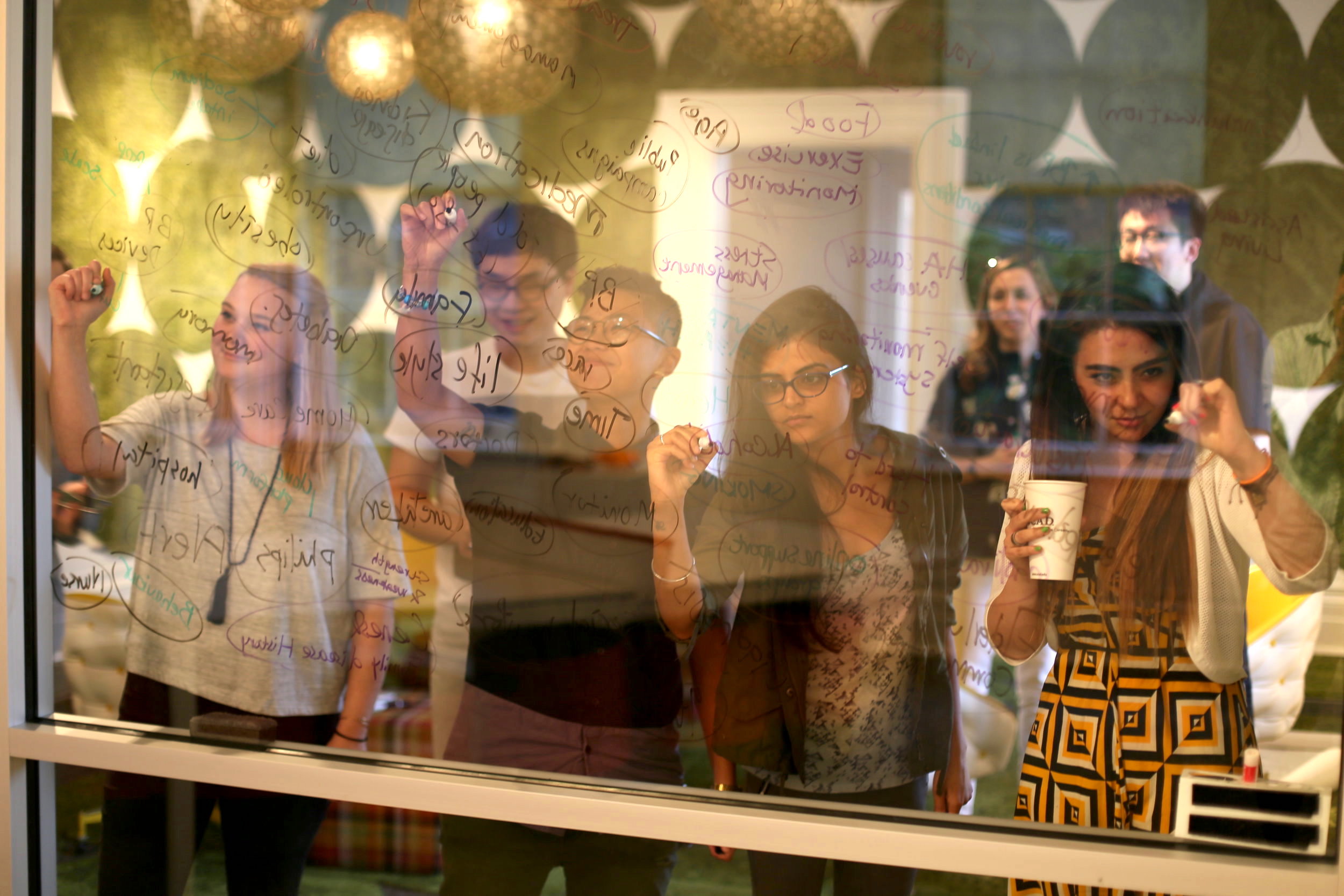
Student map design solutions on clear dry erase board

Shreya (center) maps design solutions for Philips during a 2016 SCADpro project.

Shreya Dhawan:

My journey to SCAD began in India. I had earned my bachelor's degree in industrial and product design, was working for a company called Tata Elxsi, and went to work with a medical startup designing hand sanitizers for the hospital environment. It felt like we were missing something by not talking to the actors in that setting. I wasn't even sure what that research approach was called. I went online and saw that SCAD offered a degree in service design. I reached out to a student from Delhi named Jagriti Kumar (M.F.A., service design, 2016) and asked about the program. She had only positive things to say: "You should definitely give it a shot!"

Being able to participate in two SCADpro projects was a significant part of my professional development. It's important to understand the ecosystem of the client. You might be working on a single piece, but how does that piece affect the entire system? Professor Viladas taught us how to see a system as a whole. I learned how to work at a concept level, then zoom out and work at a strategy level. Learning how different concepts tie together in a bigger strategy is fascinating.

I currently live in Atlanta and work as a service designer at Harmonic Design. Our CEO Patrick Quattlebaum co-wrote the book Orchestrating Experiences: Collaborative Design for Complexity (Rosenfeld Media, 2018). Patrick was interested in my SCADpro projects—that meant I already had experience working with clients in real time. He understood how that fit into what Harmonic does.

At Harmonic, we have clients in industries including telecommunications, retail, insurance, and banking. I worked on a project with a major public library system, mapping the digital fluency of different citizens who are coming into the library, so that assistance can be more effectively provided to them, while designing a superior physical space for a better service environment.

There are very few opportunities for a student to be a service design intern and really learn on a real client project. I wanted to push for students to get those opportunities. At Harmonic, I’ve been able to create our internship program. Our first year, 2019, we had a student intern from SCAD, Matias Rey (B.F.A., service design, 2019), who is now a full-time associate service designer at Harmonic. In the third year of our internship program, we received almost 100 applications.

I have seen tremendous growth in people's understanding of what service designers do. With our client base, it's about showing our many beneficial skill sets. As we keep evolving our practice of service design, our value proposition increases. We are focused more than ever on figuring out how we are contributing to sustainability, and how can we bring it into our practice, and bring it to our clients. It’s not just an industry trend—it's important for us as humans.

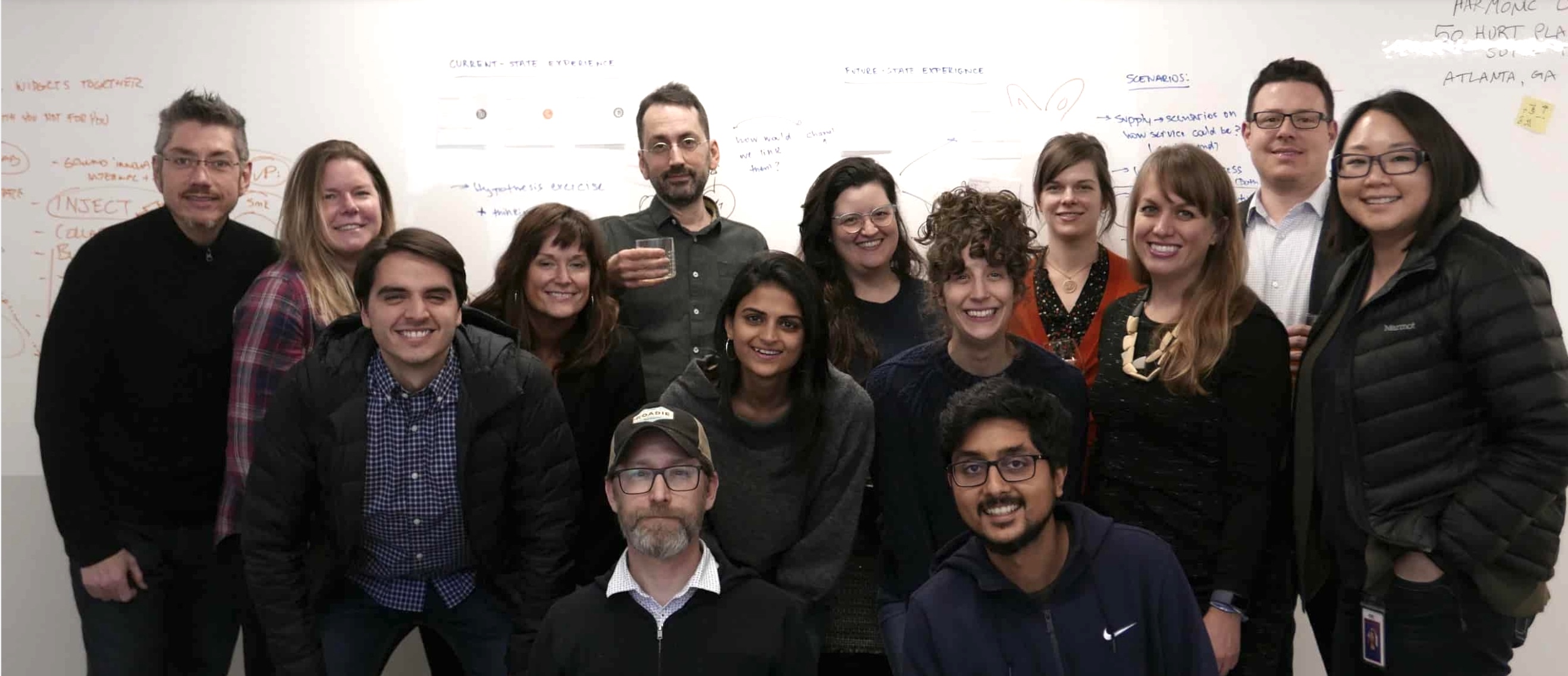
Group photo

All smiles: Shreya Dhawan and her colleagues at Harmonic Design.


Sterling Jones: double major, twice as nice

December
16
2021
By
Tags:

Sterling Jones (B.F.A., art history, 2021; B.F.A., business of beauty and fragrance, 2021) double-majored in degree programs that, at first, may not seem complementary.

In 2018, Jones was an art history major studying at SCAD Lacoste, developing her focus on French language and cultural studies when "I saw on Instagram that SCAD announced a new major, business of beauty and fragrance." She returned to Savannah the following quarter and added BEAU as her second major.

While completing her BEAU capstone—a luxury body care line for men called Peak—she concurrently composed her art history thesis on the cultural conversations of artist Barbara Kruger. As Jones says: "SCAD inspired my creativity to new levels."

Sterling Jones:

My SCAD experience was eye-opening, magnetic, and immersive. I began at SCAD in 2016 as an art history major. By my second quarter, I immersed myself in different projects and groups outside of art history. I did it by going to student conferences, being a student ambassador, and becoming a student model for fashion, photography, and beauty projects.

In professor Meloney Moore's course Beauty and Fragrance New Product Launch (BEAU 330), I co-created a project with my team members, Brittany Heath (B.F.A., business of beauty and fragrance, 2021) and Iris Kang (B.F.A., business of beauty and fragrance). Our project was developing a new 360 brand campaign and extension focused on the Korean brand, CosRX.

The whole idea of creating a new skincare line for men was utterly foreign to me. The project challenged me to step out of my comfort zone as an art history major—it's still one of my favorite projects I've ever worked on. I was asked to present it in front of Estée Lauder Companies when they visited SCAD for the first time. That gave me my jump start at ELC as a summer intern and then a full-time associate.

In 2017, I started my blog, and it grew to an amazing beauty media platform called The Beauté Study. During the pandemic, I began to teach about the power of fragrance online to over 100 students from six different countries worldwide live. Now, the classes are available as a permanent option to watch at any time in The Beauté Study's Beauté Vault.

The creativity of my blog gave me a fantastic experience working with brands like Merit Beauty, Cocokind Skincare, Follian, and Mejuri. In 2019, I spoke at The Beauté Culture Conference on my experience as an influencer and digital marketer in the beauty space.

rendering

When it came to Peak—the capstone project for my BEAU major—my goal was to build a product experience for men that soothes and hydrates the skin with premium ingredients, while personalizing it with a unique, desirable fragrance. I was inspired to create custom technology to allow my customers to add a customized scent to their product. To create the proper packaging fit for the vision for Peak, I collaborated with Charlie Vazquez (B.F.A., industrial design, 2021).

Currently, I work as a CEO Global Presidential Associate at Estee Lauder Companies. The Presidential Associate Program is an 18-month rotational program offering three consecutive assignments specially designed for undergraduates. It's a fast-paced program, where I change roles every six months. Right now, I am working with the makeup brand Bobbi Brown Cosmetics on the Global Go To Market team. I call it the mothership—I work with product marketing, country regional teams, online, and creative to make products come to life for our customers and their beauty rituals.

I'm grateful SCAD allowed me to cultivate the creative, public speaking, and marketing skills that I use today!

Student work

Follow Sterling J. at The Beauté Study on IG!

photo of Sterling Jones: Keno Y (Kevlar Rose Agency)


Akshay Manjunath: designing solutions

November
17
2021
By
Tags:

For Akshay Manjunath, "pressure cooker" is not a pejorative.

At SCAD, Akshay (M.A., industrial design, 2019; M.A., design management, 2019) pursued two master's degrees simultaneously. Among his crucial collaborations, he worked on a SCADpro project, conducting research and data analysis, and providing recommendations for the design of a low-cost modular firepit for Walmart.

"As I observed the excellence of my fellow students, I came to understand that intense challenges are part of life, and you can deal with them instead of getting stressed," he says.

The Walmart connection was key. Akshay is currently a design researcher for the global giant ("When they hired me, they saw the SCADpro project on my resume"), part of a team responsible for creating a better work experience for Walmart's 2.3 million employees.

A native of Bangalore, India, who also holds a bachelor's degree from Sri Venkateswara College of Engineering, Akshay currently works from his home office near Logan Square in Chicago.

Akshay Manjunath:

I joined Walmart in August of this year. My role as design researcher is to work with other researchers to identify challenges in the system, so that employees have a better work experience from point of hiring to retaining their talent. This also means creating a standardized approach for all Walmart employees globally. We use both quantitative and qualitative analysis to help build refined data sets to better understand the experience of the people who work at Walmart. It's been a wonderful experience so far.

I came to SCAD in 2017 with the intention of doing an M.F.A. in industrial design. My first research project in industrial design was The Avocado, a self-tracking device prototype that improves your life by helping you manage your mood. It does this using chromotherapy, aromatherapy, and music therapy, all by recognizing your mood via touch and facial recognition technology. Through that project, we explored what research can do in design, and I realized I wanted to pursue another mastsers, in design management, at SCAD.

In simple terms, design management is the management of the design process through well-informed decisions that define the direction of the outcome. I saw the potential in design management for how it can be used to develop strategies in problem-solving.

The power of SCAD and the importance of its emphasis on collaboration means that as a design management student, I worked with textile designers, themed entertainment designers, actorsUX designers, and animators all together on a single project. To reflect on my projects at SCAD says a lot about the work I do professionally today.

All my SCAD professors were phenomenal. Eduardo Milrud was, at the time, the chair of industrial design, and wonderful to work with. Professor Kwela Sabine Hermanns taught me the basics of research, while professor Hari Nair, who took me deeper to show me the real-world impact made by quality research.

I also had the opportunity at SCAD to meet a number of living legends of design. In 2018, SCAD hosted an event called Crosswalks, featuring Don Norman, considered the founder of UX design; Vijay Kumar, the author of 101 Design Methods; Phil Gilbert, general manager of design at IBM, and others. They came for a panel discussion, and afterwards, I spoke with Don Norman, who told me, "It's good to have empathy, but you as a designer need to control your emotions so you can create solutions." That's always stuck with me.

For students from India who are considering SCAD, I would say: Whether you are new to design or an experienced designer, if you get an opportunity to attend SCAD, go for it. As long as you put in the effort, there is every opportunity to shine. SCAD offers all the resources you need. Even after graduation when you enter the job market, SCAD offers essential assistance and support. SCAD is more like a family — always there to help.

portrait of akshay manjunath

Visit Akshay.


Catalog alchemist Alaina Colleen

November
8
2021
By
Tags:

Whether she's antiquing, embroidering, or listening to Peggy Lee, Alaina Colleen (B.F.A., fashion, 2019) brings classic inspirations into the present. A freelance graphic designer based in Kansas City, Alaina created the vivid visual identity for the 2021-2022 SCAD course catalog. In the process, she supplied a set of symbols seen across an array of digital and physical materials — from SCAD admissions brochures and artist notebooks to the Volkswagen Bug “art car” often seen zipping precious cargo safely around Savannah.

Alaina Colleen scad catalog design displayed on ipad

Alaina Colleen:

SCAD has such a giant network of talented alumni, and I'm honored to be approached to create artwork for the catalog so early in my career. I was given creative freedom and asked to represent SCAD in a beautiful light, which is easy to do. I wanted to communicate the way SCAD felt to me with prospective students.

In previous years with the catalog, the alumni artist has always created a finished artwork for the front and back covers. I wanted to provide SCAD's creative team with assets they could mix and match. I landed on developing different symbols that can be set to different backgrounds. The deliverables were patterns, textures, borders, a color palette, and a clutch of symbols they could use however they wanted.

Wings are uplifting, and a key represents knowledge, a way of unlocking and discovering yourself and your value. Even if you don't contemplate the meaning of the symbols, you innately understand what they signify.

I'm drawn to warm, sun-kissed colors. There's something that feels really right about primary colors, they're strong and beautiful and in some way nostalgic, I like pairing them with jewel tones and pastels to balance things out. I love small accents of neon around edges of things. I favor metallic color in my work too, because of its talismanic resonance. All this went into what I created for the catalog.

At SCAD, I realized I was and am passionate about many things. I'm happy that I ended up in the fashion program because there are many skillsets folded into it — textiles, sculpture, graphic design, and learning to make gifs and videos too. Coming up with concepts, conducting research, and mood boarding — that all carries over into any medium, and I've been able to transition seamlessly into my work as a graphic designer.

As a fashion major, I took all my apparel classes with professor Sachiko Honda. She's a hawk with an eagle eye. I drew a portrait of her in fashion illustration class. She emphasized attention to detail, and she zoomed in on technique and manipulating fabric and thread in a beautiful way. Her expectations were always very high, and when you get high expectations from a professor you respect, you come to have high expectations of yourself in a healthy way.

In the modern world with all these screens around us, we're exposed to so much input, it's amazing and overwhelming. Working as a graphic designer, I work digitally to get ideas out quickly. I crave working with my hands, and want to make physical things that fill a space and can last longer. Creating embroidery feels meaningful and powerful. To focus on thread going in and out, to make a big picture with tiny threads, there's really nothing like it. When you embroider a garment, it feels special.

I am a multi-disciplinary artist and designer. I struggle with titling myself. It changes. And that's good, right? I mean, how do you apply your skills to the real world? I never want to close the door on different mediums.

portrait of alaina colleen

Alaina and Louie, gloriously. (Photo: Kendall Eager, B.F.A., photography, 2018)


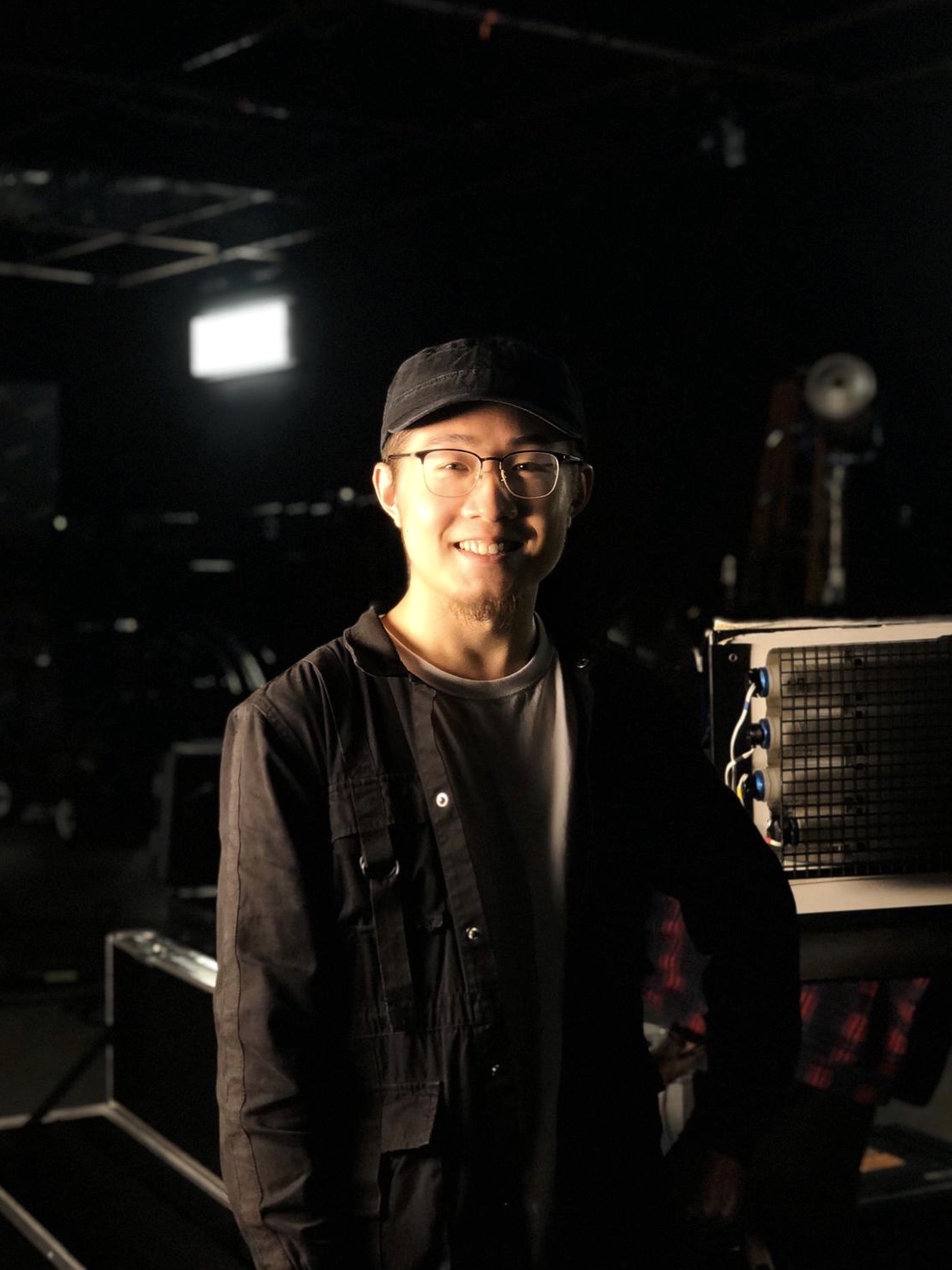
Zikun "Tim" Teng: filmmaker in progress

October
8
2021
By
Tags:

Zikun "Tim" Teng (M.F.A., film and television) defines himself with one word: "filmmaker." Then he pushes that definition in every available direction.

Motion picture editing, production management, post-production workflow, cinematography, sound recording, photography, and screenwriting are all part of Teng's integrated skill set. His software expertise includes an official Avid certification, alongside aptitude in Adobe Suite, DaVinci Resolve, and Nuke. Impressively industrious, the graduate student can also routinely be found enjoying an artisanal grilled cheese during lunch at the Hive.

"Working in film, my concentration is post-production," Teng says between bites of gooey fontina. "I'm primarily an editor. I'm also responsible for transcoding files. I send the timeline to the departments who are doing sound, color, and visual effects. It's important to know something of all those disciplines as well, otherwise I won't be able to communicate effectively."

Insight into Teng's process comes from professor Lubomir Kocka, who taught Tim in Directing for Film and Television (FILM 729). "Tim is diligent, always prepared, always paying attention during lectures," Kocka says via email. "His dedication is evident in his academic accomplishments. He grasps the tools and techniques of the craft of directing, and continually upgrades his skills."

In winter quarter 2021, Teng edited the short film "Evergreen," directed by Yiwei Yao (M.F.A., film and television). His editing is indivisible from the narrative itself, about two childhood friends in love with the same person. Teng's rhythmic decisions chart the story's stormy emotions.

"Professor Kocka taught us how to design a shot, which is what makes a film a film," Teng says. "He taught us how to get the audience to be empathetic with the character. He also taught us the concept of laterality, how to use the left and right sides of the screen, and why where you position characters on the screen affects how the audience thinks about them."

This is where Tim thrives: using the technical to achieve the emotional. As he says: "The core of art is to provoke emotion." 


Originally from Tianjin, China ("Not as humid as Savannah," he says), Teng came to the United States for the first time in 2017 for a business management summer program at Sacred Heart University in Fairfield, Connecticut. When he returned to China to complete his B.A. in Business English at Tianjin Foreign Studies University, he knew he wanted to return to the U.S., and began researching top film schools.

Since arriving at SCAD in 2019, Tim has left Savannah only during his for-credit internship with the iHeartRadio podcast CT101 in summer, 2021 in Stanton, California. "As an intern, I worked on set, and in live event settings, and in post-production. I gained a deeper understand of the entertainment industry, and improved my verbal communication skills. It was a fulfilling eight weeks."

Now beginning his final year at SCAD, Teng continues to take classes that expand his prowess. He was the only non-visual effects major in professor Gray Marshall's course Cinematography for Visual Effects (VSFX). This quarter he is taking Thesis Production, where he and fellow student Yiwei Yao (M.F.A., film and television) are working on "Daughter," the film that will complete their graduate studies. Meanwhile, another short Teng worked on, "Denial," directed by Morgan Davies (M.F.A., film production, 2021), is heading for the festival circuit.

As he wraps up lunch, Tim's phone begins buzzing. It's an alert from SCAD Editors Club, a group that connects students specializing in post-production with producers and directors. Tim makes note of the possibility, then looks up with a grin: "I find opportunities everywhere."

Connect with Zikun "Tim" Teng on LinkedIn.