Skip to main content Accessibility Policy

Virtual Open Studio returns for fall

November
6
2020
By
Tags:

SCAD returns for fall with Open Studio, offering art collectors and enthusiasts exclusive access to work by the university's community of talented artists. The three-day all-virtual event takes place Friday through Sunday, Nov. 13-15.

Open Studio will showcase more than 700 jury-selected works by students, alumni, and faculty across all SCAD degree programs, including illustration, painting, photography, printmaking, and sculpture. Featured artists include Diego Cardenas aka "lé dieguê" (M.F.A., painting), Olivia Lovito (B.F.A., photography), Ayana Ross (M.F.A., printmaking), Andrew Munoz (M.A., advertising), Ashna Malik (B.F.A., painting, 2020), and Thomas Flynn II (B.F.A., painting, 2016). Open Studio is an exceptional opportunity to obtain leading works by star and future star artists from the SCAD universe.

A portion of proceeds from Open Studio will benefit the SCAD Student Relief Fund, helping students with financial hardships complete their degrees. This follows a successful initial virtual iteration of Open Studio night held in June of this year.

"Open Studio is an event that represents our continuing commitment to supporting and elevating the creative voices in our communities," said Victoria Gildersleeve, associate director, SCAD Art Sales. "The virtual event enables patrons around the world to shop for original SCAD artwork by talented artists among our students, alumni, and faculty. SCAD continues to provide an education of unparalleled excellence for fine artists, and Open Studio remains an important part of that mission."

SCAD Art Sales, a premier curatorial platform launched in 2016, will offer guests access to its artist network through the work on display. A "view-in-room" will be available during Open Studio on the mobile platform via the ArtCloud app, making it possible for shoppers to preview works in their home before placing an order.

Stay tuned next week as SCADworks features interviews with Open Studio artists.

Banner image: Diego Cardenas aka lé dieguê (M.F.A. painting), "Angular Perception 13," oil on canvas, 48" x 48".

Pitchford preaches prioritization

October
29
2020
By
Tags:

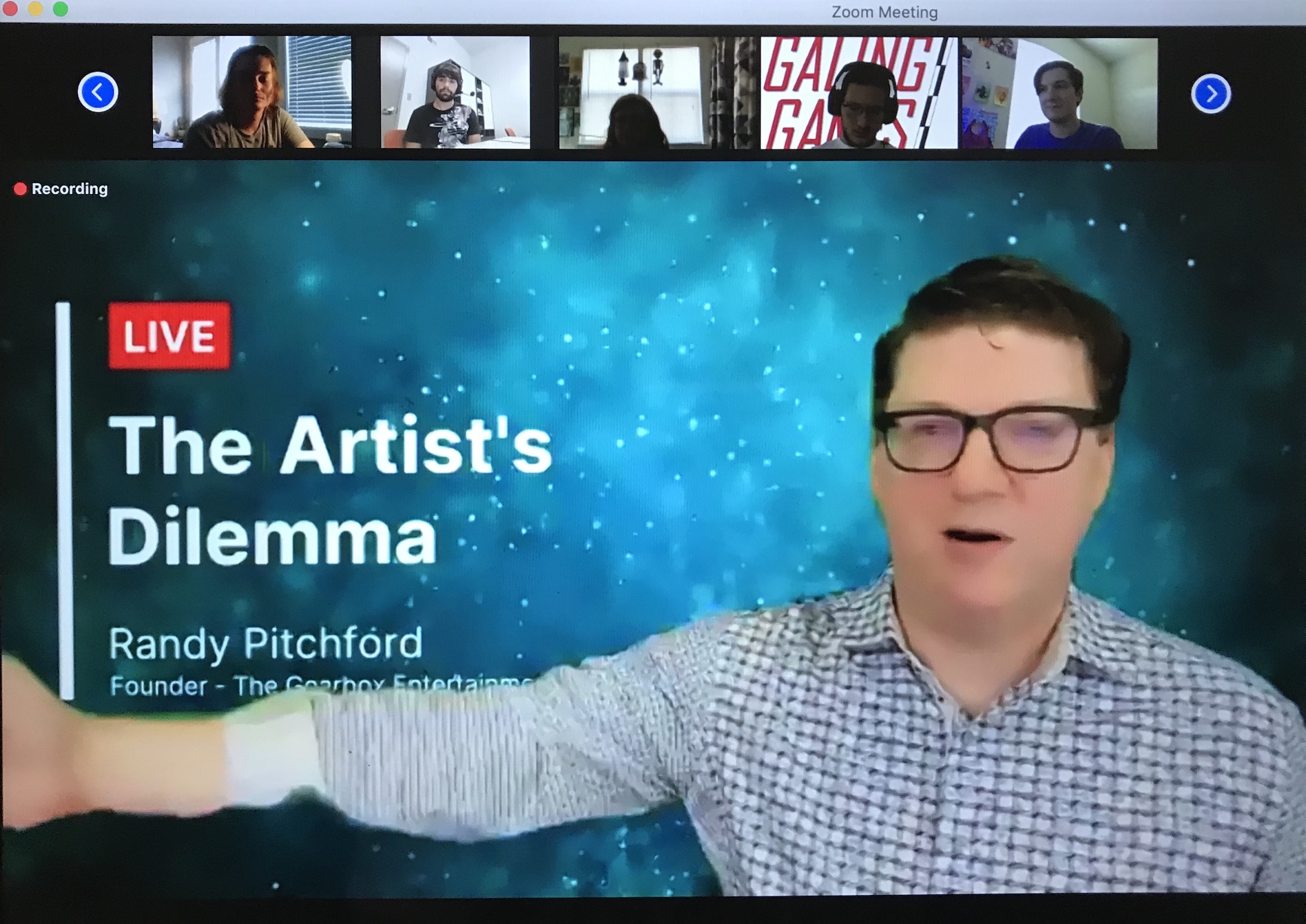
"I firmly believe that the best game developers in ten years are people who are not yet in the industry today," said Randy Pitchford, "and that's going to be you."

As founder of Gearbox Software, Pitchford is an industry icon. His company has created some of the most successful video game franchises of all time, including Borderlands and Brothers in Arms. He spearheaded the initiative Borderlands Science, a mini-game within Borderlands 3 that enables players to contribute to medical research by helping map the human gut microbiome. With his youthful cowlick and unbridled enthusiasm, Pitchford has cred to boot, having grown up with the earliest gaming systems to become an architect of a billion-dollar global industry.

Pitchford's guest lecture, "The Artist's Dilemma," delivered via Zoom to undergraduate and graduate students in the SCAD School of Digital Media, addressed those who play Pitchford's popular games and will work in his industry. During his talk, the Zoom chat boomed with animation, motion media design, visual effects, and interactive design and game development students asking questions in real time, testament to this connection.

"While we are artists, we're commercial artists," Pitchford said. "Our livelihoods, and the livelihoods of the people we work with, depend on making commercial art. The fact that we can make commercial art means that we as a species have figured out a way to commoditize entertainment, so that some of us can dedicate our lives to creating experiences and joy for other people."

Pitchford's talk was structured with compelling narrative reveals and mind-fizzing koans, suiting someone who attacks his craft and his business from both wildly philosophical and rigorously practical perspectives. Ultimately, he spoke directly to the task at hand: doing the work.

Here are five key points from his talk:

1. "When I got started programming computers and designing games back in the early days, there were no schools to go to and learn the craft, we were teaching ourselves as we went. Now you have the opportunity to go to a university where experts can teach you how to get to a point where you can pave the way for what's next. I'm so grateful you guys exist."

2. "I make video games because I love video games. I'm a lot like you: When we feel that engagement interacting with our entertainment, we want to see if we can do that too, and create something that gives those feelings to other people. That instinct is rooted in empathy. I call it having the heart of an entertainer."

3. "You need to eat. If we're going to commit to this, we have to make money. As an artist there's a balance that we have to think about. There's a spectrum with expression on one side and commercialism on the other. There is a place in the middle where we can value expression but accept the reality of earning a living. Hunting for that sweet spot is the artist's dilemma."

4. "I've been in the industry for 30 years, and worked on a lot of projects and made a lot of things. There's the same problem every time: not enough. Not enough time, not enough money, not enough people, not enough memory. Of all the skills you develop, the most important may be figuring out what's important and attending to what's higher in the importance ranking. That's prioritization."

5. "It can be daunting thinking about entering the job market. If you're really good at something that we're already in need of, we're going to want to employ you. Then show us something we've never seen before. If you can do both, you're going to be wanted and loved, you're a unicorn. In aggregate, show a high degree of specialized skill. Another way to be successful is to be awesome and great, so that people love working with you."

Pitchford's guest lecture, "The Artist's Dilemma," delivered via Zoom

Thanks to SuAnne Fu, chair of interactive design and game development, and Nye Warburton, associate chair of interactive design and game development.

Find Randy Pitchford on Twitter @DuvalMagic.


SCAD welcomes Joël Díaz to new role

October
21
2020
By
Tags:

SCAD is proud to announce the appointment of Joël Díaz as the director of the Walter O. Evans Center for African American Studies. Díaz is an experienced leader and community builder within education and the arts.

As director of the Evans Center, Díaz will work closely with students, faculty, and staff to develop programming that enhances public knowledge, understanding, and appreciation of Black art and culture. His essential guidance will enrich SCAD's long history of engagement with renowned Black artists and cultural leaders and bring new horizons to the university's preeminent educational experience.

"Since its founding a decade ago, the Walter O. Evans Center has shined a brilliant, prismatic light on the story of contemporary Black culture," stated SCAD President and Founder Paula Wallace. "The hiring of Joël Díaz, a gifted storyteller and educator, ensures that SCAD reaches and engages more students and SCAD Museum of Art visitors than ever before. The future of the Evans Center is bright!"

In 2011, SCAD established the Walter O. Evans Center for African American Studies within the historic SCAD Museum of Art. Through the generous gift of Ruskin Society member Dr. Walter Evans and his wife Linda, the SCAD Museum of Art is home to more than 60 important works of art by renowned African American artists such as Romare Bearden, Elizabeth Catlett, Robert S. Duncanson, Richard Hunt, and Jacob Lawrence. The collection forms the foundation of a multidisciplinary center for the study, understanding and appreciation of African American art and culture.

"Art reveals to us the possibilities of life lived and life imagined, I am grateful to continue the work that SCAD,  Dr. Evans, and Linda Evans began many years ago by celebrating, interrogating, interpreting, and expanding our understanding of what has been deemed possible for Black life through the lens of African American art and culture," said Joël Díaz regarding his new role.

In addition to the donated historic works in the center, a permanent gallery space in SCAD Museum of Art is dedicated to exhibiting the work of contemporary African American  artists. In the decade since its founding, the Evans Center and SCAD MOA have continually exhibited and celebrated Black artists, including internationally heralded exhibitions focused on the legacies of Jacob Lawrence and Frederick Douglass, as well as contemporary exhibitions by Lorraine O'Grady,  Hank Willis Thomas, Carrie Mae Weems, Fred Wilson, Toyin Ojih Odutola, Kenturah Davis, and many others.

Prior to joining SCAD, Díaz worked with many leading arts and advocacy organizations and institutions, including the Schomburg Center for Research in Black Culture, and the nonprofit New York cultural center Pioneer Works. More recently, Díaz led a museum education immersion program for nontraditional students and created curriculum for historical research and interpreting material culture at the Museum of the City of New York.

For more information, please visit scadmoa.org.


September Park delivers

October
9
2020
By
Tags:

It's one thing to design a great collection. It's another to present it effectively. Out of 4482 entrants to the i-D x ARTSTHREAD Global Design Graduate Show 2020, the work of alumna September Park (B.F.A., fashion, 2020) stands out.

The garments in her collection PS² (Park September Postal Service), inspired by postal workers and packaging materials, sport shipping labels linking to her digital portfolio: "It shows I'm ready for new opportunities."

Sponsored by Gucci, the international competition was open to all art and design students graduating in 2019-20. From the judge’s curated shortlist, Park’s collection received the most public support in the Sports & Denim category.
 
The Seoul, Korea native is currently interning in New York for Victor Li. When Park Zoom’d with SCADworks, she’d just finished a call with Alex Brownless, co-founder of ARTSTHREAD, to discuss next steps in her c
areer.

Student work

September Park:

When I heard about ARTSTHREAD competition, my senior collection was finished, but I went back to work on how I presented the collection on the digital platform, to make sure it best represented my concept and style.

My initial idea for PS² was a concept design based on "delivery," where I’m delivering stories through a fashion collection. At the same time, part of my concept was, How do I deliver myself to a potential employer?

I thought about the postal service, where a mail carrier comes to your door and delivers presents and joy, and also important mail, like voting information. I interviewed a person who works in the mailbox store next to Eckburg Hall. He said the work is very sensitive regarding time and quality, and means working every day, locally and internationally. I want to be that kind of person, who you can trust to deliver, and get a job done right and done fast. And technically, I am shipped from my home in Korea to study in the United States.

I chose to take my inspiration from the postal service. The postal service is for everyone. I wanted to make sure my collection is for everyone too. That's why I used elastic waistbands and adjustable straps, to fit the clothing to your body. I wanted to make sure this collection is for all sizes and all genders. When I shop for clothes, I shop in women’s wear and in the men’s section too. It’s important to mix genders in my collection because I personally wear clothing that way.

Fashion professor Mitchell Vassie helped me develop my concepts and portfolio, and another incredible fashion professor, Sachiko Honda helped me with the pattern making process. I was inspired by the torn edges of packaging, and created a pattern, then used glossy ink to print it on the jumpsuit with flatbed printing.

I’ve been friends with Regina La Ò (B.F.A., graphic design, 2019) since freshman year at SCAD. Her style matches my aesthetic, and I asked her to design some shipping labels for me. She designed my fantastic logo, and the QR code on the label links to my portfolio. It all connects to the inspiration for the collection itself: packaging, shipping, and delivery.

My journey really began when I was attending North Jakarta International School, and a representative from SCAD came in. At the time I was just discovering my love of art, and the SCAD representative said she saw potential in my work. I applied to SCAD and was offered a scholarship. That was a magical moment for me. SCAD gave me true friendships, love, and proof that if I keep pushing myself, there is always something good that can happen.


Visit September Park and view her winning portfolio.


The lines tell the story

October
8
2020
By
Tags:

"Don't let fear creep into your mind when you set out to paint," says the man with the brush in his hand.

SCAD painting professor Kent Knowles (B.F.A., painting, 1997) is in a studio at SCADpad West in Atlanta, teaching students from Statesboro to Mexico City to Brooklyn and Jakarta. Knowles is conducting "Drawing with Paint," an online workshop exploring methods for establishing a focal point within a composition using a single color.

A small mound of burnt sienna oil paint sits next to him, along with mineral spirits and several well-worn brushes. A blank 24x30 canvas stands before him, soon to become an image of a young woman in a winter coat with a large button weighing down her right side. Kent's camera is positioned close to his canvas, allowing students to see how his arm, wrist, and fingers hold and guide his brush.

"I am not afraid to let the painting come to me," Knowles says. "I don't start with an idea. I don't know what this will become. I let the lines guide me."

Using his brush to mix a small amount of paint with the mineral spirits, Knowles makes his first vertical stroke. The paint runs in small drips as he makes a second and third stoke. As the drips run together, Knowles scrubs the paint into the canvas, creating earthy brown pockets of color.

A figure slowly emerges from the overlapping lines as Knowles works at extracting the form revealed to him. "This looks like a shoulder, and this an arm," Knowles observes. "You can see the light must be coming from the right." He angles his brush as though it were a sun ray beaming onto the figure.

Knowles is himself an acclaimed artist, best known for capturing female subjects in fraught situations. His paintings "High Seas," "Break Up," and "Parabola" highlight the strength of women in the face of immediate danger. Snakes, broken ice sheets, and gale force winds are backdrops his subjects stand out against.

The son of an Air Force chaplain, Knowles began painting in Germany as a young man and acknowledges Stanley Spencer, Paula Rego and Thomas Hart Benton as major influences. He credits his intuitive process with giving his paintings depth of emotion and capturing the energy of the work.

"The subject will come to life as I refine the lines and see the shapes I have been given."

Knowles encourages his students to allow their paintings to develop naturally from their point of view: "Your world view is going to help you see what you have in front of you. Don't be afraid to go for it."

Throughout the class, Knowles picks up the camera and brings it within inches of the painting. He demonstrates how the mineral spirits help create contrast in face, hair, and coat. He uses a rag to pull color of the canvas and answers questions posted in the "chat."

The virtual learning environment has facilitated Knowles' ability to demonstrate the techniques he has honed over decades. His students know this, and eagerly await the next time they are able to see him, singing to himself, sleeves rolled up, wearing a protective mask, an apron, and brandishing his brush with precision as the lines tell him a new story.
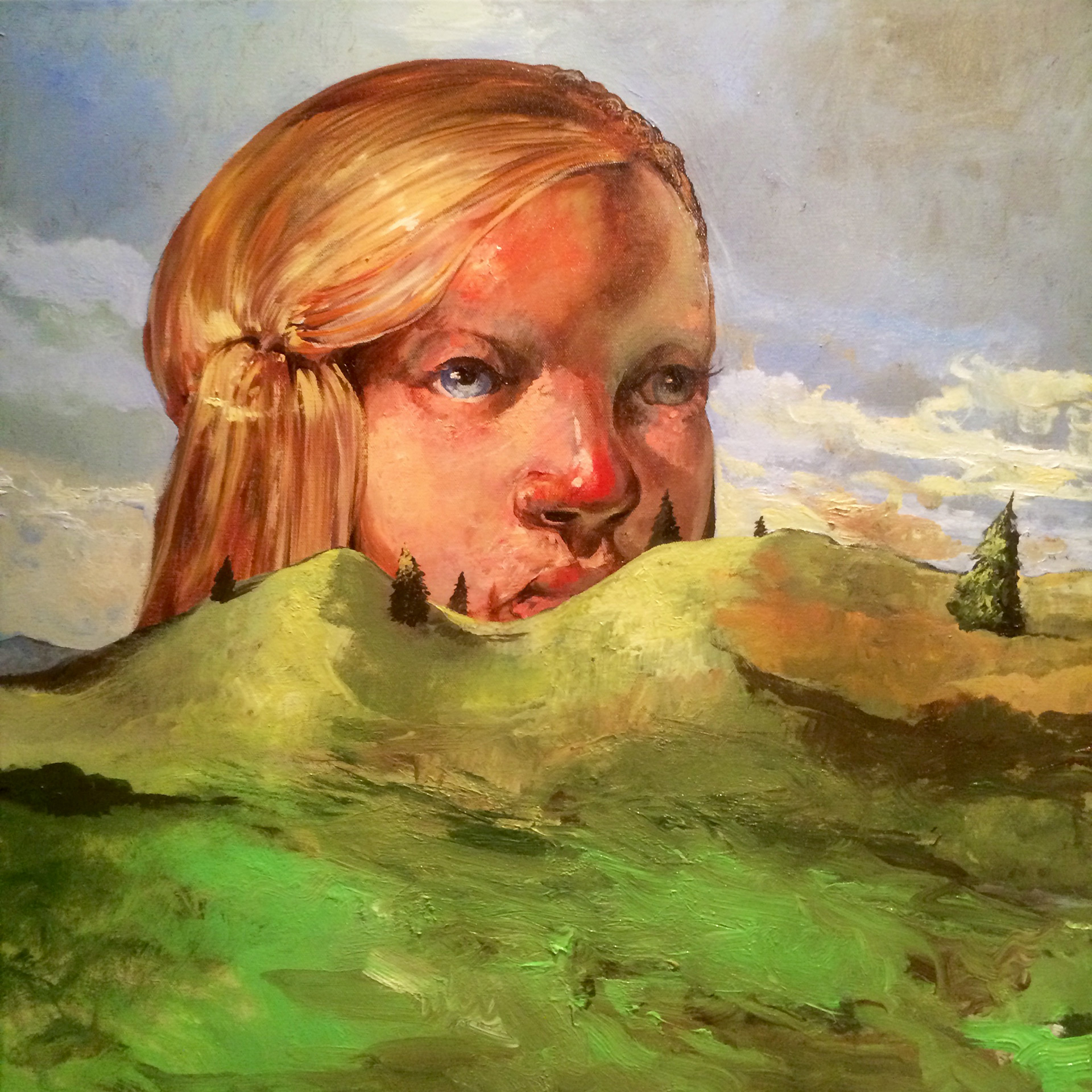
Kent Knowles, “Wayward,” detail, acrylic on canvas, 24” x 24”, 2015. Image courtesy of the artist.

Kent Knowles, “Wayward,” detail, acrylic on canvas, 24” x 24”, 2015. Image courtesy of the artist.
 

Jackie Dunn: Reading Creatively

October
6
2020
By
Tags:

As the collection strategy librarian at the Jen Library, SCAD Savannah, Jackie Dunn knows books. She estimates the Jen Library added 2700 new print titles in the past year, as the award-winning facility reopened for fall quarter with new safety precautions, enabling students to continue to check out materials, and to use computers, scanners, and study areas.

A concerted focus on e-book titles is facilitating an enriched experience for students learning remotely and via eLearning. "We also acquired over 300 new e-book titles this past spring and summer," Dunn says. "The trend of collecting larger volumes of digital materials will continue."

Dunn's personal reading habits are inextricable from her professional dedication. Here are a few books Jackie loves, all of them in the SCAD Libraries holdings.

Robin Wall Kimmerer, Braiding Sweetgrass: Indigenous Wisdom, Scientific Knowledge and the Teachings of Plants (Milkweed Editions, 2013): "Authored by an indigenous woman who is also a botanist, this book offers profound insights into the natural world. Spirit and science unite, inspiring gratitude and offering essential lessons on ecology at a time when sorely needed."

Paul Koudounaris, Heavenly Bodies: Cult Treasures & Spectacular Saints from the Catacombs (Thames & Hudson, 2013): "The word ‘relic' brings to mind a timeworn, dusty object; not so with the relics captured in these photos. Bejeweled and adorned in intricate textiles, the bodies of the catacomb saints challenge our ideas of corporeality, death, and holiness. Gaining access to these treasures was no small feat for Koudounaris, and the stories accompanying the photos are often surprisingly humorous."

Kate Atkinson, Life After Life (Back Bay Books, 2013): "This novel ponders the question: What if we could live our lives again and again, until we finally got it "right?" Set against the dramatic backdrop of World War II in England, the reader follows the life (lives, rather) of Ursula Todd, as she tinkers with her destiny and challenges fate time and again. " 

Christopher Marley, Pheromone: The Insect Artwork of Christopher Marley (Pomegranate Communications, 2008): "Marley's images of jewel-like insects captivate and inspire. His photography is unaltered; colors have not been adjusted or saturated for visual affect. Many of the photos have been printed with fifth-color metallic ink and are accompanied by essays on insects, color, and design. If you are looking for visual stimulation, let this book be your muse."

Madeline Miller, The Song of Achilles (Ecco, 2012): "The story of Achilles has been told countless times, but never in quite so intense or gut-wrenching a fashion. This unique homage to The Iliad is a story of war, but also of love and sacrifice. Miller brings the heroes and heroines of ancient Greece back to life, with unforgettable dimensionality."

Sabrina Scott, Witchbody: A Graphic Novel (Weiser Books, 2019): "One of the unfortunate aspects of adulthood is that we often become disenchanted with our world. The sense of wonder that accompanied childhood is replaced by the stresses of everyday life. Witchbody reignites feelings of wonder and mystery through unique stream-of-consciousness text and beguiling illustrations, reminding us that the magic of our universe is always within reach."

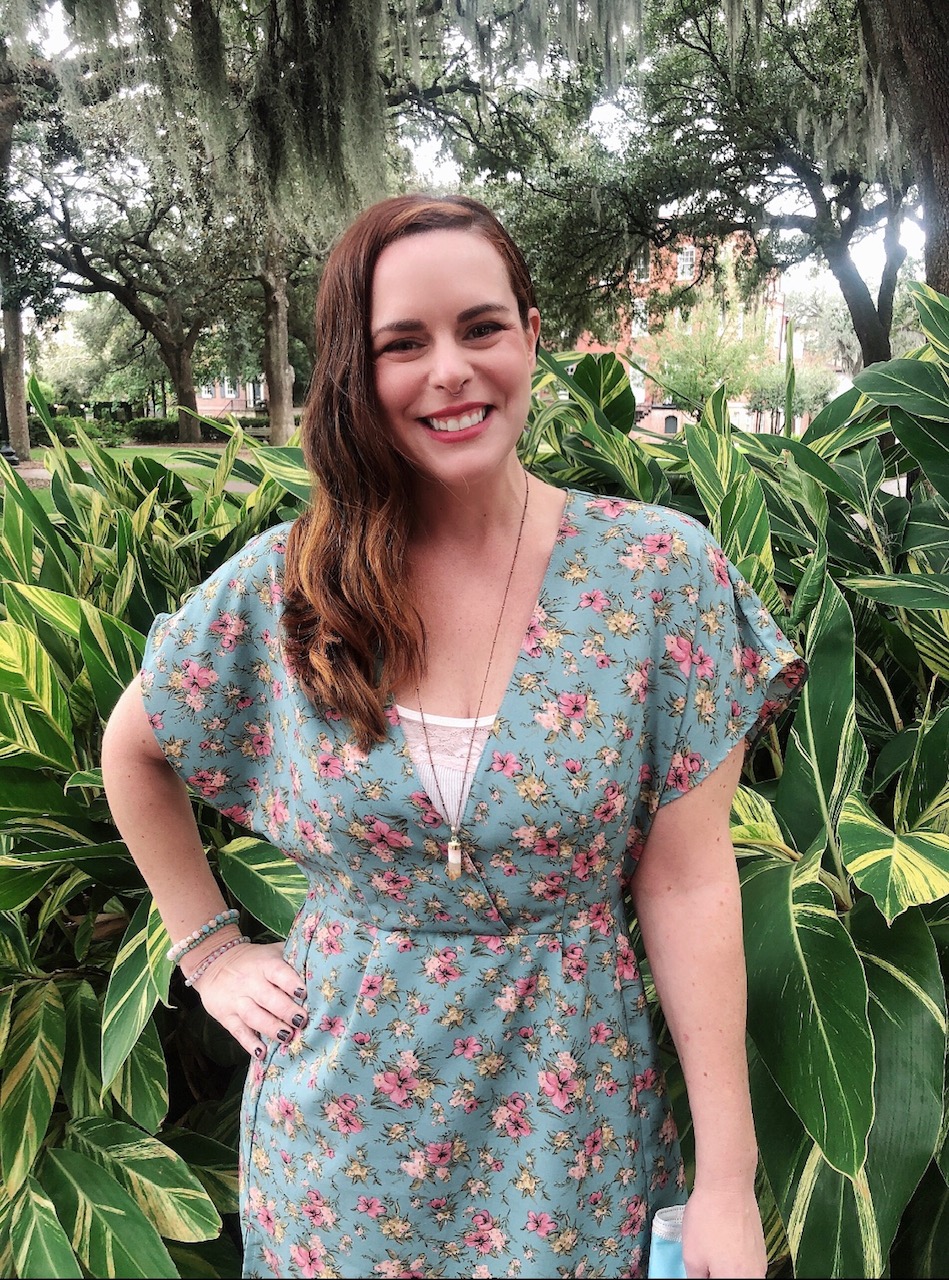
portrait of Jackie Dunn

Jackie invites you to search the SCAD Libraries catalog and databases and use the online feature "Ask A Librarian"!


AnimationFest spotlight on 'Bearly'

September
18
2020
By
Tags:

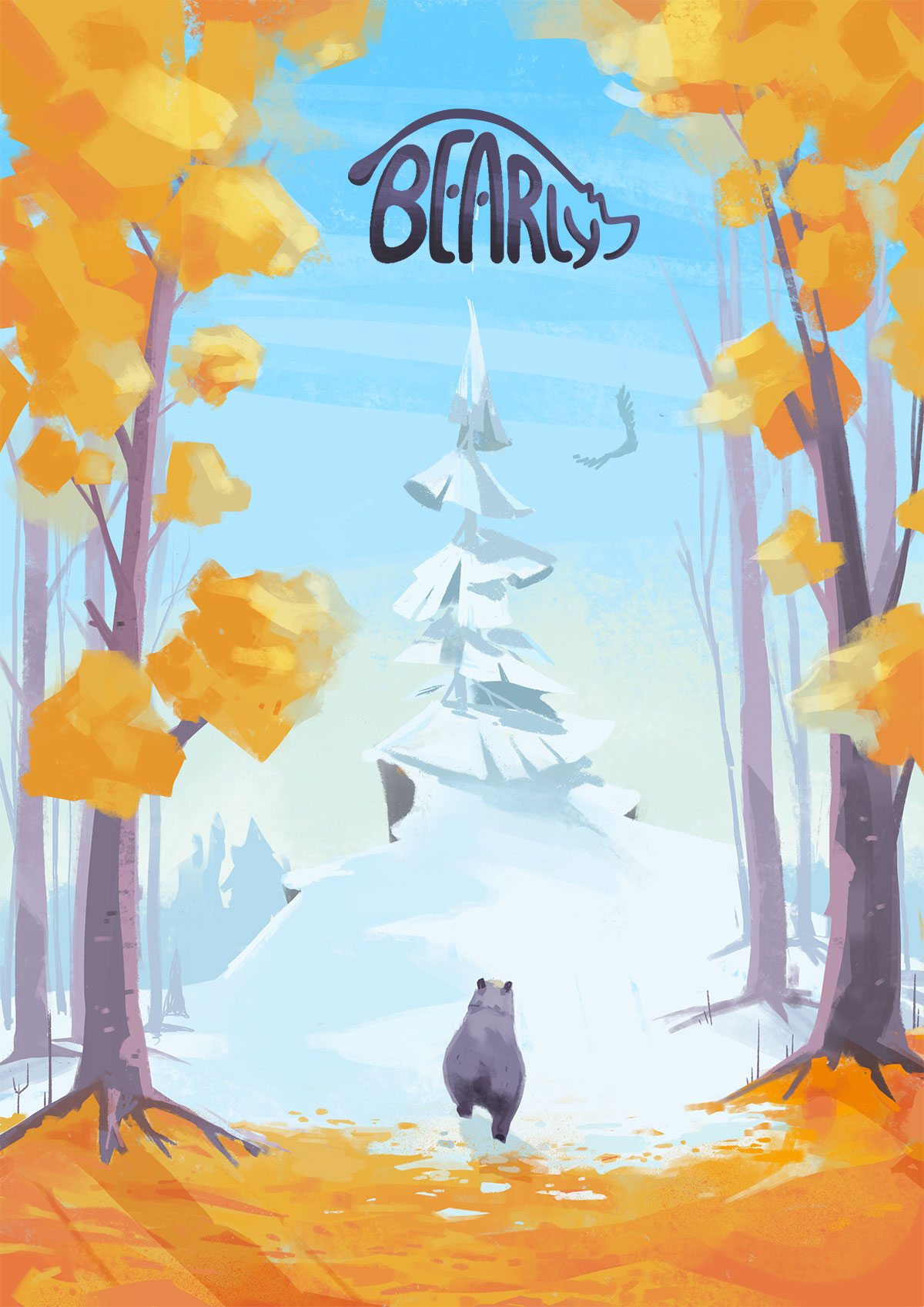
What happens when a bear full of FOMO refuses to hibernate? Bearly, the new animated musical film and the first production of SCAD Animation Studios, tells the story of an adorable mammal who denies natural instincts to discover the beauty of the changing seasons. The project was written, developed, and realized by students in the university's top-ranked animation, dramatic writing, and sound design degree programs. Bearly will premiere during SCAD AnimationFest, Friday and Saturday, Sept. 25-26.

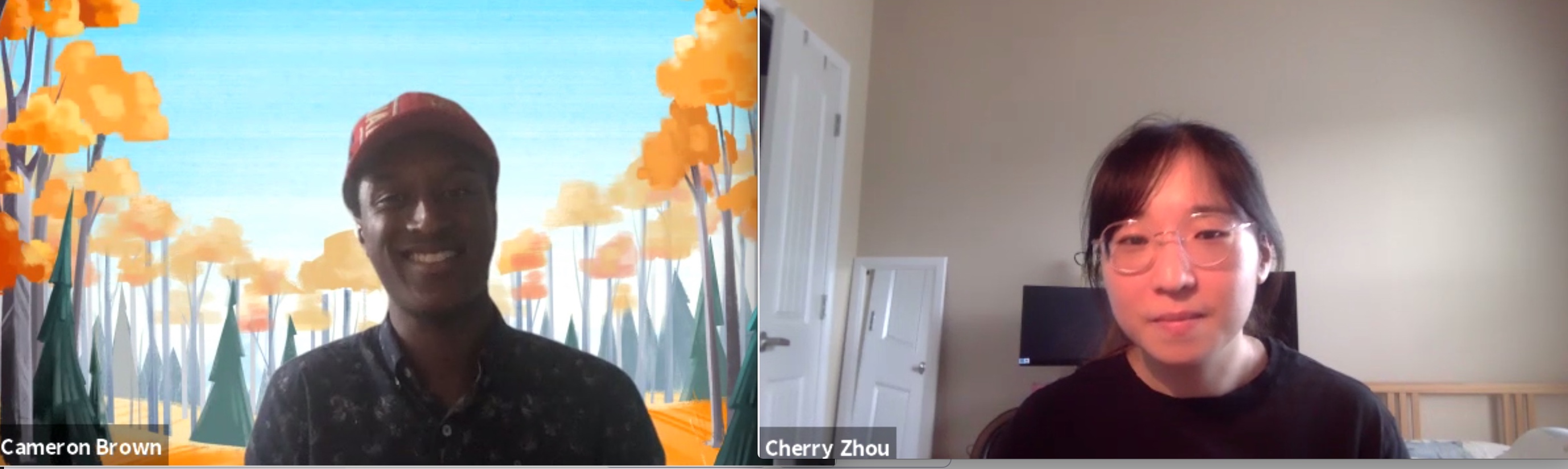
Producer Cameron Brown (B.F.A., animation) and director Cherry Zhou (M.F.A., animation) Zoom'd into SCADworks to discuss the film.

screen shot of zoom session

Cameron Brown: The initial processes began in summer 2019, when Colin Rhoades (B.F.A., dramatic writing) came up with the story of a bear who tries to see what winter is like and fight the urge to hibernate. Colin began writing the music, and once Fall 2019 quarter began, the project went into pre-production, which is when Cherry and I came aboard.

Cherry Zhou: During pre-production, we began storyboarding the film based on Colin's idea. The entire pre-production team met and discussed possible minor changes that could enhance the storyline. Because the song was the first thing we had, it finalized the timing of every single shot, whereas usually a production creates all the animation first, and then the music. All those story beats are very cohesive and quick in Bearly, and you can always read it very clearly.

Cameron Brown: Once we went into production, we started automation lighting tests and brought on a team of student animators. We already had the storyboards done, so it was simply a matter of communicating to the animators how to follow the follow the storyboard and interpret the story into the 3D space. On our art team, Natalya Gaida (M.F.A., animation) and Nicholas Piña (M.F.A., animation) worked to create the look in the style of a children's book. Their work was then handed over to our lighting team, who were working in Katana.

Cherry Zhou: I want to explain Katana a little bit more. In the animation department, most students have been using Autodesk Maya. We got the note to use a newer software called Katana that runs faster on lighting and rendering. It was a big plus, but in March 2020 we went into quarantine and the university was shut down for the spring quarter. Fortunately, SCAD got a system called Virtual Lab that allowed students remote access to our render farm.

Cameron Brown: One of the best things about an animation production is that everyone's got to work with everybody else. Bearly was an incredible team effort that involved the work of over 60 students. At AnimationFest, we're going to have a Bearly panel, including SCAD chair of animation Chris Gallagher, our executive producer Professor Bernardo Warman, along with myself, Cherry, our 3D animation lead Peter Kerkvliet (B.F.A., animation), and our lighting and compositing lead Taylor Saunders (B.F.A., animation). We're going to walk through our steps during production, and we're going to show the film. It's going to be awesome.

promo image for Bearly

For a full list of students who worked on Bearly, and to watch the trailer, visit the designated page.

Register for SCAD Animation Fest here.

AnimationFest 2020 coming soon!

September
10
2020
By
Tags:

This year SCAD will host the acclaimed AnimationFest virtually this September 25-26. The SCADFILM festival programming will provide innovative and insightful content every hour on the hour throughout the two-day virtual festival, using leading streaming technology and event management platforms. The virtual festival will feature exclusive screenings, panel discussions, visual presentations and top talent and alumni from Netflix, Epic Games, Pixar, Nickelodeon, Dreamworks, Amazon, and more.

"The profession of animation is one of the creative winners of 2020, because virtual collaboration has long been a practice in the industry, where teams work together from across the world to write, produce, score, and give voice to these films," said President Paula Wallace. "Animation films and shows have actually increased production during the pandemic! SCAD AnimationFest finds the industry riding high, and invites our SCAD students into the very heart of it, to connect with our Bees in the industry and other filmmakers elevating animation to become the leading form in world entertainment."

Dynamic AnimationFest programming will represent many of the university's top ranked degree programs, including animation, visual effects, motion media design, film & television, and interactive design and game development. The festival will showcase many SCAD alumni who have become leaders in their creative careers, as well as standout student work.

Programming highlights for AnimationFest 2020 include: The Making of Amazon Studios' Undone with co-creators Raphael Bob-Waksberg & Kate Purdy; A Conversation with Avatar: The Last Airbender creator Bryan Konietzko; Framestore presents: Behind the FX of HBO's Lovecraft Country; and Behind the Scenes Conversation: CBS All Access' Star Trek: Lower Decks with creator Mike McMahan.

An additional feature, SCAD Animation Studio Presents: The Making of Bearly, will celebrate the recently launched SCAD Animation Studios with department chair Chris Gallagher. The first film created by the SCAD Animation Studios, Bearly was created and produced in a year-long collaborative with students in professional roles including lead animator, producer, visual development artist, story artists, 2D and 3D animators, lighters, compositors and more.

Passes for the two-day festival will be available for purchase on September 15, 2020. SCAD AnimationFest attendees will be able to register and purchase festival passes through a single gateway that will give them unified access across multiple devices to all sessions in the festival. Every hour of programming will also have a dedicated internal producer to ensure top-quality streaming execution and interaction. Passholders will have the opportunity to experience the festival across multiple devices and choose where and how to enjoy the content.

For more information visit the SCAD AnimationFest 2020 site.

advertisement for scad animationfest

Van Duyn dines safely

August
19
2020
By
Tags:

Interior design professor Christine Van Duyn knows what it takes to accomplish world-class work. Before joining the faculty at SCAD, she worked as an architect specializing in award-winning restaurants, bars, and lounges, including marquee projects like the Columbia Room, named "The Best American Cocktail Bar" (Tales of the Cocktail, 2017) and The Dabney, both in Washington D.C.

A SCAD alumna, Prof. Van Duyn (B.F.A., photography, 2004) is challenging her students this quarter to examine the future of the restaurant industry as they design spaces that will function in a post COVID-19 landscape.

Christine E. Van Duyn:

Restaurants have unique obstacles in our world today. Social distancing guidelines, capacity limits, and mask requirements are all impacting businesses in ways that restauranters are still trying to figure out. Here in Savannah a few places have developed to-go menus, begun taking reservations, and changed their hours of operation.

Industry professionals learned numerous lessons over the summer, and those learnings are months if not years away from fully being implemented to ensure the struggles and shutdowns we've experienced will never happen again.

With that understanding, I am working closely with my interior design students this quarter to re-think, re-imagine, and re-understand what a restaurant experience will be going forward. The conversations have been fun to lead and I am excited to see how the students develop their projects over the course of the semester. Here are some of the original ideas that have really sparked our imaginations:

Outdoor Dining: We are seeing our downtown sidewalks and streets turn into funky pop-up patios. While these are fun and needed adjustments, they are not long-term solutions. Outdoor dining will be necessary in the world going forward. We must look to design designated outdoor spaces from the beginning rather than the end.

Back to Booths: We have all been to an old-school Italian restaurant where the lighting is dark, the décor is dated, and the waiters served your parents butter and noodles when they were young. The one thing that those restaurants did right was booths. Booths provide a barrier from other parties and will slow the spread of germs and air born pathogens. Booths will make a comeback, and we need to ensure the spaces we design allow for easy flow of movement and safety of staff.

To-Go Windows: Food delivery systems will only be more important to the success of our community as we move forward. Today, your delivery driver physically walks into a restaurant and often times interacts face to face with individuals in order to ensure they are walking out with your food. We can already see the inherent risks in this system. While that was fine 12 months ago, it will not be the norm going forward. Restaurants will design specific windows and locations for food pick-up, limiting risks for both the staff, delivery drivers, and patrons.

Safety has always been paramount when it comes to design, and these shifts will be seen as exciting new challenges throughout the industry. The fact that they will play out in real time, across the entire world, will be entirely brand new — and I can guarantee you that SCAD students will be right there as it happens.

Visit Christine Van Duyn at her wonderful website.


Park perks with Emily Schmidt

August
14
2020
By
Tags:

SCAD Atlanta foundation studies professor Emily Schmidt emphasizes the importance of storytelling through design. Before joining the SCAD faculty in 2015, she worked as a production artist at Marvel Entertainment and Image Comics. Professor Schmidt knows superheroes – and what it takes to be an everyday hero too.

As the necessities of public life are reassessed, professor Schmidt is challenging her students to reimagine city park systems through conceptual thinking and graphic design, making public social spaces safe and enjoyable for everyone.

Emily Schmidt:

Public parks are extremely important to our communities right now, not only for our overall health and mental well-being, but also the greater social benefits.

Parks provide a space where we can responsibly meet people while practicing safe social-distancing measures. Parks are the new home to yoga studios looking to survive current quarantine mandates. Parks are places where children can play outside of the home at a time when "home" often combines a virtual school, mom's office, and the screen-time capital of the world.

And yet, our parks, layouts, and capacity numbers have not yet adapted to our new COVID-19 world. In Atlanta, many people are not adhering to national safety regulations. Entrances and exits are not clearly marked, and citizens with pre-existing conditions are unable to fully feel safe in what is one of the only "safe-spaces" left.

I am working with my students to design and educate our fellow Atlantans on how we can keep our parks safe in our new normal, while challenging their problem-solving and design skills.

Three key ideas:

  1.  New way finding measures: Indicate where the entrances to the park are. Indicate where the exits are. Rather than having bottlenecks and people brushing past each other face to face, have consistent traffic flows to decrease the possible spread of the virus.
  2. Geolocation gamification: Adapt the popular principles of Pokemon GO. Everyone loves winning, regardless of the game itself. Gamifying social distancing at all times will slowly and positively train and re-shape our behaviors. People will look for ways to maintain the necessary six feet in the hopes that they will continue to climb the leaderboard. In turn, we all rise in the rankings.
  3. Social distancing lifeguard: Would a lifeguard look a little weird 300 miles away from the ocean, or 1,000 feet away from a pool? Perhaps. But lifeguards are here to help protect lives. Having health and safety experts on-hand to help educate, clarify, and at times enforce proper behavior would be an enormous help to the fighting of COVID-19.

My students will continue ideating, refining, and presenting their ideas to our community. Through a series of infographics and graphic design presentations, we will look to educate each other on the steps we can, and must, take to ensure the safety of everyone around us. It will take new ideas and a dedicated commitment from all of us to make sure we once again can return to the parks, restaurants, and lives we loved before this outbreak occurred. Together we will defeat COVID-19.

SCAD university logo

Read more think pieces by SCAD professors at the new SCAD Medium page.