"This year is the 50th anniversary of Woodstock. Guess what Jimi Hendrix was wearing when he was playing 'The Star-Spangled Banner'? Yes, bell-bottom jeans!"
The person asking the question knows her denim. Fitted in a clean tee with iconic red logo, white jean jacket and dark denim jeans, Tracey Panek, Levi Strauss & Co. official brand historian, appeared at the SCAD MOA theater during SCADstyle 2019.
Across locations in Savannah, Atlanta and Hong Kong, SCADstyle 2019's esteemed speakers included Ariel Foxman, Mary Katrantzou, Steve Madden, Phillip Picardi, and Sally Singer. Panek's presentation, moderated by Mobolaji Dawodu, fashion director, GQStyle, focused on brand history and the customization of cool.
"I refer to Levi's as the 166-year-old startup," Panek said. "It's San Francisco-born, a stone's throw from Silicon Valley. A start-up, just with a longer history than the Lyfts of the world."
At Levi's, Panek manages the company's archive, facilitating work requiring historical materials. Embroidered, sequined, patched, painted—Panek explained how the company embraces customization, to the point that tailoring stations now feature inside Levi's stores.
The start-up's story: Bavarian immigrant Levi Strauss arrived in San Francisco in 1853 to sell working men's pants during the gold rush. "They weren't called blue jeans, they were called waist overalls. You'd pull them up over your long underwear and get to work."
In 1872, Levi received a letter from a tailor in Reno named Jacob Davis with an unusual idea: add tiny copper rivets in the pockets. "When you do that," Panek said, "they won't tear and will last longer. The patent for the rivet was granted on May 20, 1873, the day we refer to at the company as the birth of blue jeans."
Early customizations were practical: a hand-sewn tool pocket or a patch where a cowboy's reins had worn a thigh thin. Panek showed an image of a pair of wizened 501s from 1917 worn by a hard rock miner from Wickenburg, Arizona. Of a photo of WWII-era jean jacket, she observed: "That plaid lining was added for extra weight and warmth. What's unique about this one—and a favorite of our designers—is the heart stitched onto the back. That's not about practicality, that's about style."
History continued as customization exploded. "In 1967, a young woman named Melody Sabatasso came to San Francisco. When she was invited to a wedding all she had to wear were jeans, so she cut them up into a dress. She got such rave reviews on her outfit that Lauren Bacall commissioned her to do a piece, which kickstarted her career. She still creates pieces with Levi's today."
Panek stitched together surf culture, Hell's Angels' knife-cut vests, punk rock, bum flaps, Beavis and Butthead, military patches, Elton John, and a pair of bedazzled chaps once worn by N'Sync's Lance Bass. Then she took questions.
Linden Grace Colby (B.F.A., fashion) asked: "How do these historical pieces inspire future designs? How do you navigate the balance between history and innovative design?"
"The main users of the collections are designers," Panek said. "They take anything from a button design to a pocket shape and use it for inspiration for a new piece. We have a line called Levi's Vintage Clothing that reproduces pieces from the archives so you can buy an 1890 pair of Levi's, or WWII-era jeans.
"We introduced an innovation a year ago for finishing jeans using lasers, the FLX process. Google came to us and we created a jacket with copper threads added to the sleeve and cuff that connect to your Bluetooth and mobile device. We mix heritage with innovation pretty well at Levi Strauss."

During her SCADstyle visit, Panek also spent time at Pepe Hall visiting with two SCAD fibers classes, Senior Studio I (FIBR 440) taught by professor Jessica Smith, and Business Practices for Fibers (FIBR 337) taught by professor Katie Buchanan.
"Tracey was generous with students, insightful into the way research and history play into contemporary design, specifically Levis Strauss," professor Smith said. "She spent an hour speaking with the students about her career, the role of a historian in a brand, and how the archives support designers today. It was a fun discussion with high student engagement."
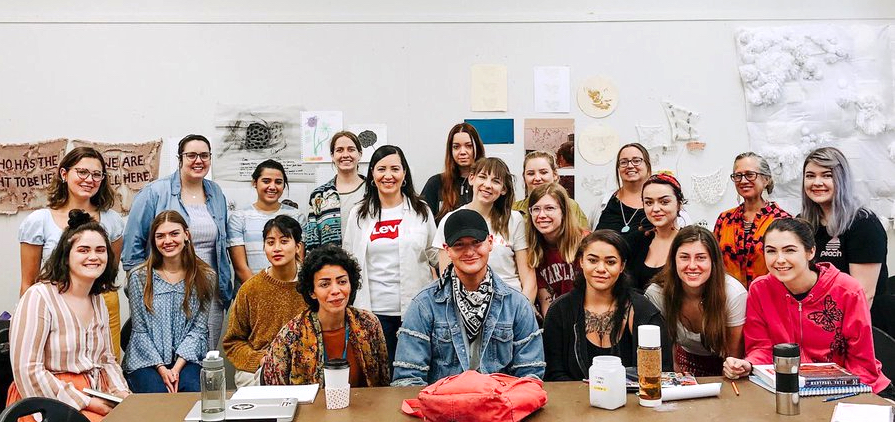
Thanks to Tracey Panek, Mobolaji Dawodu, and all attendees of SCADstyle 2019.