Skip to main content Accessibility Policy

Parking garage as host for micro housing model

January
7
2014
By
Tags:

There was a time during my freelance television production days when I would have gone anywhere for work. In fact, being able to uproot from Atlanta and moonlight in a new city for six to ten weeks of production sounded like the ultimate adventure. Where to live? No matter. I would apply to the job first and answer this question second, knowing there had to be some college friend or distant relative in said city who would welcome a carpetbagger.

Thanks to Savannah College of Art and Design, however, college friends and distant relatives alike may never have to receive another call from a roaming creative professional looking for an available couch.

SCAD's answer to temporary urban digs, or permanent urban digs sans the extra square footage, lies in the micro-housing experiment opening at SCAD Atlanta this spring called SCADPad®. Yes, parking included, but that's not the only thing that distigushes this project from its brothers and sisters in the micro housing movement, like San Francisco's SmartSpace or the "Making Room" exhibit at the Museum of the City of New York.

If you're a SCAD student in Savannah or Atlanta, email [email protected] a chance to live in this one-of-a-kind space. Artists and designers, to take a gander at leaving your imprint on SCADPad's interiors and exteriors, email [email protected] for information on the RFP, submission deadline Jan. 20.

Model of micro housing


Three prototype dwellings are currently underconstruction. In April, these three versions of SCADPad will host three rotations of students who will live in the units for two-week cycles. As an extension of the work that School of Building Arts students began this summer and fall, this quarter students from additional programs have been assigned the task of making the SCADPad prototypes functional and even fun.


Model of micro housing

Industrial Design students will create modular wall systems for the bathroom, kitchen, and exteriors, as well as ceilings and floors. Interactive Design students will work on the dwelling systems, like water management, while Sustainable Design students will address solid waste, energy waste, and water collection.


Model of micro housing

Last but not least, Interactive Design and Game Development students will create video games to promote social interaction between SCADPad residents, while also exploring how technology can contribute to a sense of community in this experimental neighborhood. Furniture Design students will outfit the common areas with tables and chairs where residents can lounge.

Stay tuned for details on how the prototypes are progressing.

Working Class Studio debuts Spring 2014 collection

January
6
2014
By
Tags:

Emerging from Working Class Studios' prolific design laboratory this week is the Spring 2014 collection of products for the home. Check out the catalog that’s fresh off the presses. Or see these items in person, before they land in stores like Nordstrom, Uncommon Goods, or Smithsonian Gift Shops, at the Atlanta International Gift & Home Furnishings Market (Jan. 7-14), Chicago Market: Living and Giving (Jan. 16-22), Seattle Market Week (Jan. 18-21), or NY Now (Feb. 2-6).

The result of Savannah College of Art and Design artists’ grit and genius, the Working Class Studio collections hold more meaning than most trinkets of a similar function. Here’s a peek at the process and inspiration that contributed to these items coming to kitchen counters, coffee tables, and nightstands throughout the U.S. and abroad soon.

Industrial Design student Katherine Mirabito

The Katherine Collection Lantern

Katherine Mirabito (B.F.A., Industrial Design)

“I really enjoy knowing that what I design may one day make someone’s day just a little brighter, even if it’s just for an instant.”


Prototype from The Katherine Collection Lantern by Katherine Mirabito

 The Katherine Collection Lantern by Katherine Mirabito

Furniture Design student Yan Zhao

The Yan Collection Lamp

Yan Zhao (M.A., Furniture Design)

“My inspiration came from furniture joints, nature flowers and the golden section shape, which is the shape of the lamp.

MUJI Art Director Kenya Hara’s design philosophy called ‘Emptiness’ also inspires me a lot.”

Sketch of The Yan Collection Lamp

Prototype of The Yan Collection Lamp

Fibers student Danielle Hansen

The Danielle Collection

Danielle Hansen (B.F.A., Fibers)

“While designing my collection, I was focused on Peru, specifically the mountains and plant life. I wanted to take these natural elements and transition them into modern textiles.”

Sketch of The Danielle Collection

Matching blanket and pillow from The Danielle Collection

Graphic design student Eda Sy

The Eda Collection, Little Red Riding Hood, and Three Little Pigs Placemats

Eda Sy (B.F.A., Graphic Design)

"The Eda Collection is inspired by springtime blooms and the harvest season, where everything is starting to come alive. The Three Little Pigs series is inspired by the popular children's tale. I wanted to tell the story in a new light, but still make it familiar and relatable to people. I broke it down to different characters and materials for the houses, and used these as motifs to create the overall design."

Sketches of patterns by Eda Sy Matching rug and pillow designed by Eda Sy

Placemats designed by Eda Sy

Sketch of wolf and pigs by Eda Sy
Pig and wolf placemats by Eda Sy

Fibers student Lauryn Reiners

The Lauryn Collection

Lauryn Reiners (B.F.A., Fibers)

“I am a board game fanatic. When we were asked to design a collection of items that would be an ‘impulse buy,’ games immediately came to mind. They're perfect for all ages and you can never have too many. Even better, by screen printing them they become super easy to store, easy to carry, and they have that unique twist WCS is known for.”


Prototype by Lauryn Reiners

Screenprinted games by Lauryn Reiners


Immersion Hong Kong: a tour of the city's architectural gems

December
16
2013
By
Tags:

In case you’re stuck somewhere cold, snowy, uninspired, or all of the above, here’s some eye candy that’ll whisk you away on a virtual, albeit momentary, adventure.

The images come from 18 graduate and undergraduate students from Savannah College of Art and Design's School of Building Arts who are traversing Hong Kong in search of the neighborhoods, architecture, and urban design that make it one of the world’s great cities.

Hong Kong's historic and modern culture provides students with rich perspectives of Chinese architecture, social and political influences in its urban design and architecture. - Hsu-Jen Huang, Professor of Architecture

These postcards and excerpts from the travel-study itinerary document the field trips and assignments the students have participated in since arriving in Hong Kong. SCAD Hong Kong's location in the North Kowloon Magistracy Building has not only provided a welcoming home base, but a context for understanding development and preservation in Asia at large.

Day 1: Arrival in Hong Kong.

Day 2: Orientation and first class meeting at SCAD Hong Kong, then dinner with SCAD architecture alumni representing Handel Architects, Marc & Chantal Design, Aedas and Pleasanthouse Architects.

Students give peace sign while they sit in small auditorium

Students eating at restaurant

Day 3: Chungking Mansions site visit followed by a walking tour of the Tsim Sha Tsui Promenade and the Hong Kong Museum of Art.

View of Hong Kong from a boat

Day 4: Fa Yuen Street Market, Ladies Market and Jade Market.

Students in Hong Kong street

Student sketches boats

Day 5: Field trip to Macau and the Ruins of St. Paul's Cathedral.

Students pose in decorated Hong Kong street

Students pose next to large, ornate building facade

Day 8: Firm visit at Foster + Partners. Meetings with local residents, preservationists and firms give students a taste of what it’s like to be engaged in a global practice. Then a stop at Kowloon Walled City and a discussion of the Kai Tak Airport redevelopment site.

Students in conference room

Student sketching

Day 10: The pier at Cheung Chau Island.

Students sit in front of building

Day 13: At the Hong Kong Maritime Museum, students pitch in and help the American Institute of Architects teach architectural sketching for the Draw Together Hong Kong event, which teaches participants how cities develop through observation and the resulting drawings.

Row of students sketchingStudents sit and sketch

Day 11: A field trip to Tian Tan Buddha.

Students pose while holding umbrellas

For more photos follow SCAD Architecture on Instagram, #immersionhongkong.

Holiday shopping with Kickstarter

December
13
2013
By
Tags:

If the season of giving and holiday movies has you under its spell, head on over to the Kickstarter page for student film, Sea Odyssey, where you can indulge your appetite for both. Sea Odyssey won’t be out in time for Christmas, more like May 2014. But by pledging to support the short film, you'll score an inventive and charitable gift for someone special, and put into motion a project that has grabbed the attention and participation of award-winning visual effects company Fugo Studios.

The internship for high school students in Sea Odyssey's art department (donation $150) has my sister’s name written all over it. The DVD of the father-son themed flick (donation $25) are perfect for dad and brother. You have until Dec. 17 to nab these gifts and bragging rights to launching an inspiring indie film.

Learn more about Sea Odyssey and writer-director Adam Nelson (candidate for a B.F.A. in Film and Television) below. The Atlanta Film Festival (March 28-April 6) is touting Adam as a model for emerging filmmakers on its own Kickstarter page, which features more great gift ideas. Um, honey, that tour of Atlanta movie sets (donation $150) is right up my alley.

Get on the bus: shuttle from Wynwood to Art Basel Miami Beach

November
29
2013
By
Tags:

Here’s a peek from concept through production of the bus Savannah College of Art and Design is exporting to Art Basel Miami Beach. The complimentary shuttle will run Dec. 4-8 from 10 a.m. to 7 p.m. and transport riders from UNTITLED. Miami Beach (bus stop located at 10th Street and Ocean Drive) and The M Building (194 NW 30th Street), home to Wendy White: CURVA, in the Wynwood Art District.

Sketches of SCAD Art Basel busSketches of SCAD Art Basel bus

SCAD Art Basel bus in progress

It took three days to wrap the vehicle in the vibrant paintings of Xiaolu Zhang (M.F.A., Painting) and the bright magenta that’s sure to catch a few stares along the 6-mile loop between Wynwood and Ocean Drive.

SCAD Art Basel bus in progress

Every inch of the shuttle was covered, even the roof, where one last portrait will give airborne enthusiasts, and the many helicopters that are sure to be circling, a focal point.

Detail of SCAD Art Basel bus

Let’s just call this an Art Basel debut for Xiaolu’s ‘Little Evils’ series, which harkens back to a time before life became too serious. The perfect tenor, I'd say, for ABMB.

Detail of SCAD Art Basel bus

SCAD teams with Hewlett Packard to create field trip of the future

November
20
2013
By
Tags:

In a world of devices and screens of every variety, it’s easy to wonder, do we really need paper? Hewlett Packard recently turned to students and the Collaborative Learning Center at Savannah College of Art and Design to help them answer that question in the affirmative.

On the first day of fall quarter, Hewlett Packard came to Savannah to invite the help of the very demographic that’s using less and less paper in their every day lives. Rather than fear these millennials, HP asked students from SCAD’s advertising, graphic design and illustration programs, among others, to help them bring paper to life using their free augmented reality app, Aurasma.

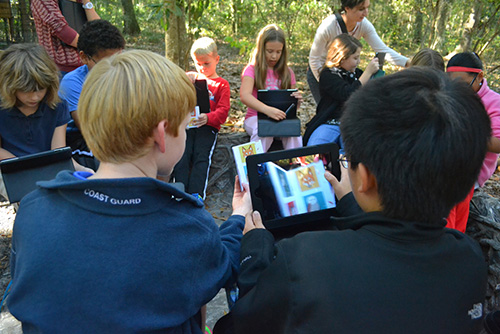
In turn, the SCAD students enlisted a generation even younger than they - third and fifth graders from May Howard Elementary School - to test whether paper, spruced up with digital qualities, can win over young attention spans.

Student explores booklet full of stickers Students scan their stickers

Using the Aurasma app, the SCAD students created the interactive Passport to Nature tour of animal exhibits at Oatland Island Wildlife Center. At each stop, the elementary students collected a stamp created by scientific illustrator and graphic designer Grace Washko (B.F.A., illustration) to put in a passport conceived and designed especially for this purpose by Shaun Oppedisano (B.A., advertising) and Brenna Kaplan (B.F.A., graphic design).

Once inside their passport, the students could scan the sticker with an iPad or other smart device to yield a digital experience called an Aura. Complete with videos, produced by Andrew Lainhart (B.F.A., film and television) and statistics about the animal’s diet and habits, for example, the Aura contained information that the students might not have been able to gather from the exhibit itself.

What was the verdict?

Suffice it to say that the experience managed to impress the group, many of whom probably mastered a screen swipe before they could walk. According to one third grader, Aurasma made the trip to Oatland Island Wildlife Center, “more funner.” Doesn't get more honest than that. They’ll probably never look at a field trip the same way again. If only homework could be this cool.

Oatland Island Wildlife Center is researching how to implement the Passport to Nature Program permanently.

DesignIntelligence’s 2014 rankings name SCAD interior design #1

November
12
2013
By
Tags:

For the third year in a row, DesignIntelligence has ranked Savannah College of Art and Design's graduate and undergraduate interior design programs number one in the nation.

Leading professionals and educators determine “America’s Best Architecture & Design Schools.” SCAD’s close relationship to industry and unique interdisciplinary environment are two factors that keep its programs at the top of the list.

Interior design students who study at SCAD benefit from exposure to more than 40 degree programs and the Collaborative Learning Center, through which they solve real-world design challenges for major corporations and brands.

In one of the first such partnerships between SCAD and industry, for example, interior design students worked directly with Benetton and their North American staff to design a new flagship store for the retailer. The students tapped the university's graphic design, advertising, fashion and marketing management, architecture, furniture design, and service design programs to present Benetton with plans for a retail store of the future.

In an increasingly competitive economy where the demand for skilled talent is high, these projects give students an edge, especially within a multi-disciplinary profession like interior design. The result is a success story for higher education and employment for a new generation of designers.

Ninety percent of students who graduated from SCAD’s interior design program in Spring 2012 reported that they were employed or pursuing further education within nine months of graduating.

A few recent projects by SCAD faculty and the 1,500 alumni of SCAD’s interior design program:

Interior of Gritti Palace in Venice

Restoration of Gritti Palace in Venice, Italy by Chuck Chewning.

Interior of New Balance Experience Store in Boston, Massachusetts

New Balance Experience Store in Boston, Massachusetts by Nikole Nelson.

Interior of Nectar Skin Bar in Washington, D.C.

Nectar Skin Bar in Washington, D.C. by William McGovern.

Interior of Celebrity Cruise's Sky Observation Lounge

Celebrity Cruise's Sky Observation Lounge by Professor Charles Boggs for RTKL.

Interior of sales and design center in Dallas, Texas

Gulfstream's 9,300 square-foot sales and design center in Dallas, Texas by Tray Crow.

SCAD will celebrate its number one ranking tomorrow with events in Savannah and Atlanta.

FOX Sports taps students to create show open for Super Bowl XLVIII

November
11
2013
By
Tags:

Updated Jan. 31: Get a peek at the final Super Bowl project here.

What does art have to do with football and football have to do with art?

NFL Network’s documentary on the late Steve Sabol, filmmaker and president of NFL Films, answers this question eloquently. The film enlightened me on how the seemingly disparate worlds of art and football complement one another. After all, Steve, who is largely responsible for how we experience the modern era of football, got his start as an art student. Throughout his career, he spent as much time on the gridiron and in testosterone-laden locker rooms as he did in his studio creating his trademark collages. That blend of art and sport, which Steve embodied, resulted in dozens of Emmy Awards and acclaim for days.

That context makes it easy to understand why FOX Sports has enlisted a team of art students to help it pull off its coverage of the Super Bowl in February.

As football season got under way, FOX Sports visited Savannah College of Art and Design to ask motion media, illustration and animation students to design the introduction to the Super Bowl. The project is a partnership between SCAD's Collaborative Learning Center, which gives students course credit for real world assignments, and FOX’s Creative University Program. Inside the kickoff presentation, the mood wasn’t all business, though. Laughter erupted when FOX Sports creative director Gary Hartley told the students,

“You want to impress the old grizzled veterans who have covered a lot of Super Bowls. If they turn to me and say ‘that was cool’ I will personally call you.”

FOX Sports senior motion graphics designer Jon Kaczmarski (B.F.A., Visual Effects) was also in the meeting to explain the role he plays in game day coverage. The passion these designers exude for creating the thematic art that makes ‘the big dance’ shine rivals NFL Fandom. I can see why they get such a charge out of their jobs. Their genius contributes to the fans’ fury. It’s their work, along with the commentators’, that’s responsible for transporting fans through the television screen and into the stadium.

Students in workshop

On Super Bowl Sunday, the FOX Sports reps told the students, up to ten hours of broadcasting will feature their work, as will the network’s set in New York City’s Times Square. The FOX Sports Graphics creative team will take the SCAD concepts and spin them into the graphic elements for the titles you see in the lower third of the TV screen, highlight packages, player profiles and more.

Such elaborate graphics are rare on TV these days. In the case of the Super Bowl, they take up some pretty pricey real estate with 30 seconds alone costing advertisers $3.5 million.

But the sheer number of eyeballs that will be on their work didn’t seem to phase the undergraduates who listened in rapt attention as Gary let them in on the DNA of the NFL on FOX brand. Why would FOX give away these secrets? Well, to the cable giant, these aren’t your average college students. They’re vendors, partners, and FOX Sports wants their new ideas so it can continue delivering the kind of show that makes the Super Bowl the most watched TV event in history.

And, with any luck, Steve Sabol will be smiling down on them.

Under the spell of 'Mo Chara'

November
1
2013
By
Tags:

You might say that the luck of the Irish is with emerging filmmaker Ciaran McGuigan. Mo Chara, the first film that Ciaran directed, was accepted into the Savannah Film Festival and is steadily growing in acclaim. In between stints as a professional soccer player and an assistant soccer coach at Savannah College of Art and Design, Ciaran made this film about school age boys whose friendship overcomes the Catholic-Protestant rivalry in Northern Ireland. I sat down with him this week in Savannah, where he’s visiting from his native Ireland with his mom, Rosie. Rosie and Ciaran’s father came of age in the 1970s as the ‘Irish troubles’ flared, but they taught their children to find common ground with all people, regardless of race or religion. It was this upbringing that inspired Ciaran to make “Mo Chara.”

TM: Thanks for taking a break from the festival to talk with me. So did you always know that you wanted to make films?

CM: When I came to SCAD, I told my dad that I thought I would do interior design or architecture, something that would tie back into the family furniture business. Dad rang me up and he was like, "Try something different so you have a few bows to your arrow." Is that the saying?

TM: Yep.

CM: Dad said, "Why don’t you do film?" I didn’t really want to do film at the start.  He said, "No, do it you’ll enjoy it." I ended up doing it, but I was really intimidated by film at first.

TM: I understand what you mean. This is only my second film festival and I feel like I have to speak a certain language.

CM: Well, I didn’t know anything about the history of film or RED cameras and stuff. It really intimidates you at the start. But Professor Chaney, he just goes, "Forget about the big cameras and forget about 50-man crews, it’s all about the story." That really registered for me.

TM: That’s so true. Focus on story. So let's go to Mo Chara. You’re in the program and…

CM: I thought it would be interesting to teach people in America about kids in Belfast, how they conduct themselves, how they speak, and what their view on life is. Growing up as a kid in Northern Ireland, there are Protestants and there are Catholics, and the two are usually very separate. But in Mo Chara these two little boys have common interests. They support the same soccer team, they like soccer, and their religion doesn’t really matter. I wrote the film on the bus to Philadelphia for Thanksgiving.

TM: Almost exactly a year ago. You just wrote it a year ago?

CM: Yes. I had it all written in the notes on my phone. Two boys meet, there’s a conflict, then there’s a resolution at the end. My uncle (director of photography Kieran McGuigan) told me with that everything in life there’s a beginning, middle, and end, and that if you stick to that three-act play then you’ve got the foundations to make a good film. So that always stuck with me.

TM: You had those basic things.

CM: Right. And for me it was like filling in the blanks almost.

TM: This is for your senior thesis film?

CM: Yes.

TM: When did you shoot Mo Chara?

CM: We shot Mo Chara in March 2013 over spring break. I got a flight home to Ireland. There’s only one other kid from SCAD who came. Sean Robinson, he was fantastic, he was my first assistant director.

TM: So you’re the writer-director of Mo Chara?

CM: I’m the writer, director and producer, yeah. We literally, eh, had no money. Our Kickstarter was in shambles.

TM: How much did you raise with Kickstarter?

CM: A few hundred dollars. We all stayed in my grandmother’s house. She woke us up every morning with porridge and a full Irish breakfast fry. We stayed in my cousin’s house where my mom grew up. My auntie lives there now and they all gave up their beds for my six crew. We woke up every morning and traveled an hour to Belfast. My cousin Robert drove us and my cousin Laura was there in the camper van making breakfast and tea on set.

TM: How did you raise the rest of the cash to fund the production?

CM: Budgeting wise, we shot the whole film for around 2,500 to 3000 pounds. I used some savings from football that I had. My mom and dad were very generous, as well. I took a loan out. Then, after we shot it, the grandfather of one of the boys in the film, Mr. Bryne, I gave him an executive producer credit. He came up to me and gave me a check. He said, “What you have done for these kids to foster cross-border relationships between a Protestant and a Catholic is terrific. Go and do good things with this film. Go and get it into festivals.” I was really emotional because I just couldn’t believe that this guy would give me 2000 pounds.

TM: That’s wonderful. I really liked what you said at the Q-and-A after the screening about the importance of having an international crew. Tell me about that.

CM: The editor is from Spain, the art director is from Colombia, the director of photography is from London, the grip is a French guy. You bring different cultures together and they bring different things to the plate, their experiences and their know-how. You sit down over dinner and a coffee and you’re joking, and then things come into the conversation about what we’re going to do. Everyone had an open ear. There were no egos. I said to them, "This is our film, it’s a collaboration." For me, problem solving and creating with other artists, that’s just epic. It was such a joyful and amazing experience.

TM: W.C. Fields said to never work with animals or children because they’re unpredictable. But you chose to work with children. Where did you discover the talented young actors?

CM: At first, I had this casting call and it just didn’t work. These parents were coming in and teaching their kids what to do. They were posh kids coming in and a trying to act raw and I was like, "No, I want this raw element to it." So I went into the streets with a family friend of mine, and we ended up meeting Nathan Corbett and Ben Labourn. The boys had never acted before in their lives.

TM: I can’t believe you directed untested actors in your first film. That’s crazy.

CM: They’re the best lads you’ll every meet. Impeccable manners. I had one hundred pounds each for them in the budget. I took them to the soccer store to buy them a football jersey and football boots. One them said, "Ciaran, can I get a pack of these football cards, I’ll put my boots back." The cards were like one pound. I was like, "You can have the boots, too." I bought them like 15 packs of cards and they could not believe that.

TM: What does it mean to have your film shown at a festival? What went through your head when you got the call?

CM: To have “Mo Chara” showing at a festival is fantastic, but to have it showing at this festival, in Savannah where I know everybody, I’m so overwhelmed by it. When I got the email telling me that I had been accepted I was so happy because I got to come back and thank everybody for helping to make it happen. Frankly, it was this institution that provided me with the foundation to enter into a career or a medium of art that I didn’t have a clue that I was any good at. You can’t speak highly enough of this college. I am really honored and thankful that I was able to go to school here.

Ciaran is currently finishing his degree online while playing soccer in Ireland. He plans to enter “Mo Chara” into more festivals soon and will graduate from SCAD with a B.F.A in film and television this spring.

Real talk on online degree programs

October
30
2013
By
Tags:

Woman designing an advertisement on a computer


I’ve contemplated going back to school to pursue an M.F.A. in film and television. As a working mom, an online program makes a grad degree seem…doable.

All hope of achieving this personal goal disappeared, however, when I encountered the jibber jabber that many online degree programs proffer. “Join a Global Family.” “Don’t Stop Now.” “Become More.” “Gateway to your dream.” Um, this is my professional reputation we’re talking about, not my yoga practice.
    
Flustered by the fluff, I high tailed it to office hours with someone who could set me straight. Andy Fulp heads Savannah College of Art and Design’s eLearning program. He’s also a professor who has taught graphic design online and, my favorite part, he’s a dad to a college student.

I tossed all of the unhelpful platitudes at him and he translated them into this real talk:

The Fluff: Join a global family
Andy’s Real Talk: Our world is increasingly interconnected, so of course the more international in scope an online program is the better. Any program that promises to have a global reach should have an international footprint with actual buildings and people on the ground, not just exist in cyberspace. It’s also important to know whether a program is known, even esteemed, around the world. What good is a ‘global family’ if that community doesn’t have a reputation that resonates beyond the borders of its locations?
    
The Fluff: Don’t stop now
Andy’s Real Talk: That’s easier said than done if you enroll in a program that’s inconvenient, especially if you’re holding down a job and getting a degree. To keep learning, find a program that allows rolling admissions and offers courses toward your degree each term, so you can start when you want and when you can. You’re more likely to continue your education if a program gives you options for when and where you study, and with whom.
    
The Fluff: Become more
Andy’s Real Talk: Become more what? Ask tough questions to figure out what exactly these programs are promising, such as “How will my academic progress be fostered and measured and by whom?” One way to figure out whether an online program will actually help you acquire skills that are relevant to industry is to compare them to an accredited program on the ground. Make sure there’s an apples to apples comparison between grading structure, assignments and faculty. Also, you should be able to call and talk to a professor, even before you enroll. Make sure individualized contact and feedback from faculty will be staples of your growth once you’re in the program, too.
    
The Fluff: Gateway to your dream
Andy’s Real Talk: Dreams are great, but they’re better when you’re employed. Look at the employment rates of the institution’s alumni and where these alumni are working. This will help you gauge both the name recognition of a degree from a particular institution and how easy it will be to turn your degree into a job when you graduate. That’s why you’re sacrificing to go back to school in the first place, right?
    
Right, Andy. And right on.

To learn more about getting an online education, join Andy for the Discover @SCADeLearning virtual open house on Friday, Nov. 8. Tours begin every hour on the hour between noon and 3 p.m. EST.