Skip to main content Accessibility Policy

Bert John in HGTV Dream Home 2020

December
18
2019
By
Tags:

No dream home is complete without a Bert John painting or four. Featured in HGTV Dream Home 2020, the paintings of John (M.F.A., interior design, 2006) represent his lifelong affinity for coastal life, connecting habitant to habitat. With Savannah-developed design sensibilities applied to the home on Hilton Head Island, Bert delivers Lowcountry life in high style.

bathroom with bert john painting on wall

Bert John:

I went to medical school for two years, studying pharmacology, while getting up early to help my cousin renovate a house. When I decided to go for it and pursue my masters in interior design, I looked for a university where all the students get hired after they graduate. One of my dad's businesses in Jacksonville was an antique shop, so we'd been coming up to Savannah since I was a kid – that's how I knew about SCAD.

At SCAD, I took elective painting and drawing classes with the late professor Jorge Alvarez, including Oil-based Techniques and Exploration [PNTG 203]. Gold leaf is the signature in all Alvarez' paintings. In Granite Hall, the alligator and snake painting with gold leaf, that's his. I sometimes use gold leaf on the side or face of my paintings because Alvarez always used gold leaf. I thought I'd carry it forward.

I paint more like a watercolorist with my oil paints, with how I layer and the looseness of the paint versus thick impasto painting. I developed my technique over time, including my color block approach for small paintings. If I add gray to my paints it makes them more chameleon-like. When I paint the marsh, I let nature create the perspective and then I do the underpainting in orangey red. Alvarez always talked about letting the process show through. The old masters used sanguine pencils, and if you look at their underpaintings sometimes you can see red marks from sanguine pencils. I'm doing it intentionally.

Producer and interior designer Brian Patrick Flynn at HGTV Dream Home likes to feature local artists and designers as much as he can. With HGTV Dream Home, I'm given the palette and approximately how many pieces he might need. I look at the palette and what my goal is: Is the painting going to be completely abstract, an abstract marsh scene, photo-realistic, or color block? Then I paint. With my color block paintings, I can use radical colors like coral and pink and fuchsia. The painting in the master bathroom of HGTV Dream Home 2020 is tailored towards the shower tile and the blush color, from the Sherwin-Williams for HGTV color palette of the year.

My work has strong horizontal lines. I use a tape measure as a scribe and charcoal to get that perfect horizontal line. Funny thing – the same box of line charcoal that I had when I graduated SCAD, I still use! There's four full pieces and a few nibs in there left. So I'm still using the supplies, inspiration and connections I made while at SCAD.

portrait of bert john

See more at Bert's official site and visit him on Instagram.


Kravet Design Challenge: a pattern emerges

October
22
2019
By
Tags:

The annual Kravet Design Challenge epitomizes the brilliance of cross-disciplinary collaboration at SCAD. The challenge brings together students from two SCAD clubs: Fibers Force, and Interior Design Organization, to have their work judged by representatives from Kravet, the global leader in to-the-trade fabric and home furnishings, in a festive event in Pepe Hall.

This year's prompt — design a collection drawing inspiration from a film made in Savannah — resulted in a lively raft of student creations. Sixteen teams, each comprised of one SCAD fibers student and one SCAD interior design student, displayed mock-ups inspired by movies including "X-Men: First Class," "Forrest Gump," "The Peanut Butter Falcon," and "Midnight in the Garden of Good and Evil."

"That you chose to enter this competition in addition to your classwork shows your incredible commitment to work with people at SCAD outside your discipline," interior design professor Christina Gonano told students. "We're all really happy with how everything looks. Congratulations on doing amazing work!"

Ellen Kravet, co-principal and executive vice president, and Scott Kravet, chief creative director, Kravet, Inc., were equally effusive in their praise.

"Your depth and detail are exceptional," Scott Kravet said, addressing all entrants. "To choose a winner, we looked for designs that would be applicable to the ease and use of what we do at Kravet. I looked for a design of a space I would personally like to live in."

The collection receiving the highest accolade, "Accentuating Eccentricities"

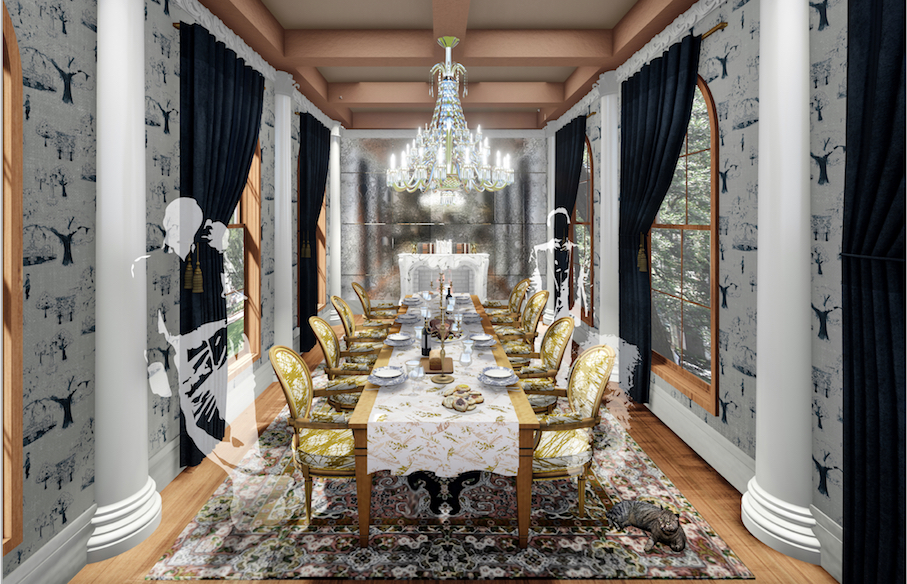
The collection receiving the highest accolade was "Accentuating Eccentricities" by Sheridan Markham (M.F.A., interior design) and Shelby Pogue (B.F.A., fibers), notable for what Scott Kravet deemed its "spectacular detail and layering, including the ghost. As a buyer of art and textile design, I would buy the feather design today as an indoor print or outdoor print. Well done."

Having won the competition last year, Markham and Pogue were delighted to repeat their top honors. Their collection contains coded, idiosyncratic nods to Clint Eastwood's adaptation of John Berendt's best-selling novel, demonstrating a profound commitment to design excellence.

close up detail of "Accentuating Eccentricities"

"As part of our research, we visited the Mercer House, where part of ‘Midnight in the Garden of Good and Evil' was filmed," Markham said. "We learned there are certain colors unique to the home: wild herring peach, Indian bluff blue, and Jim's taupe. We incorporated elements of the ornate, historic space and the characters who inhabited it into our collection."

"To create the feather print, I dipped real a feather in ink and dropped it on the paper," explained Pogue. "Then I scanned it into Photoshop and played with layers and opacity and color replacement. The inspiration came from the movie character Serena, who is always wearing dramatic feathered ensembles."

As Markham and Pogue were congratulated by their peers and professors, all participants received a certificate of commendation from Kravet, a valuable accolade to have in a student portfolio.

"Kravet is consistently supportive of what our students do," professor Gonanao added. "They encourage these collaborative opportunities, which are really gateways to professional success. We look forward to doing it again next year."

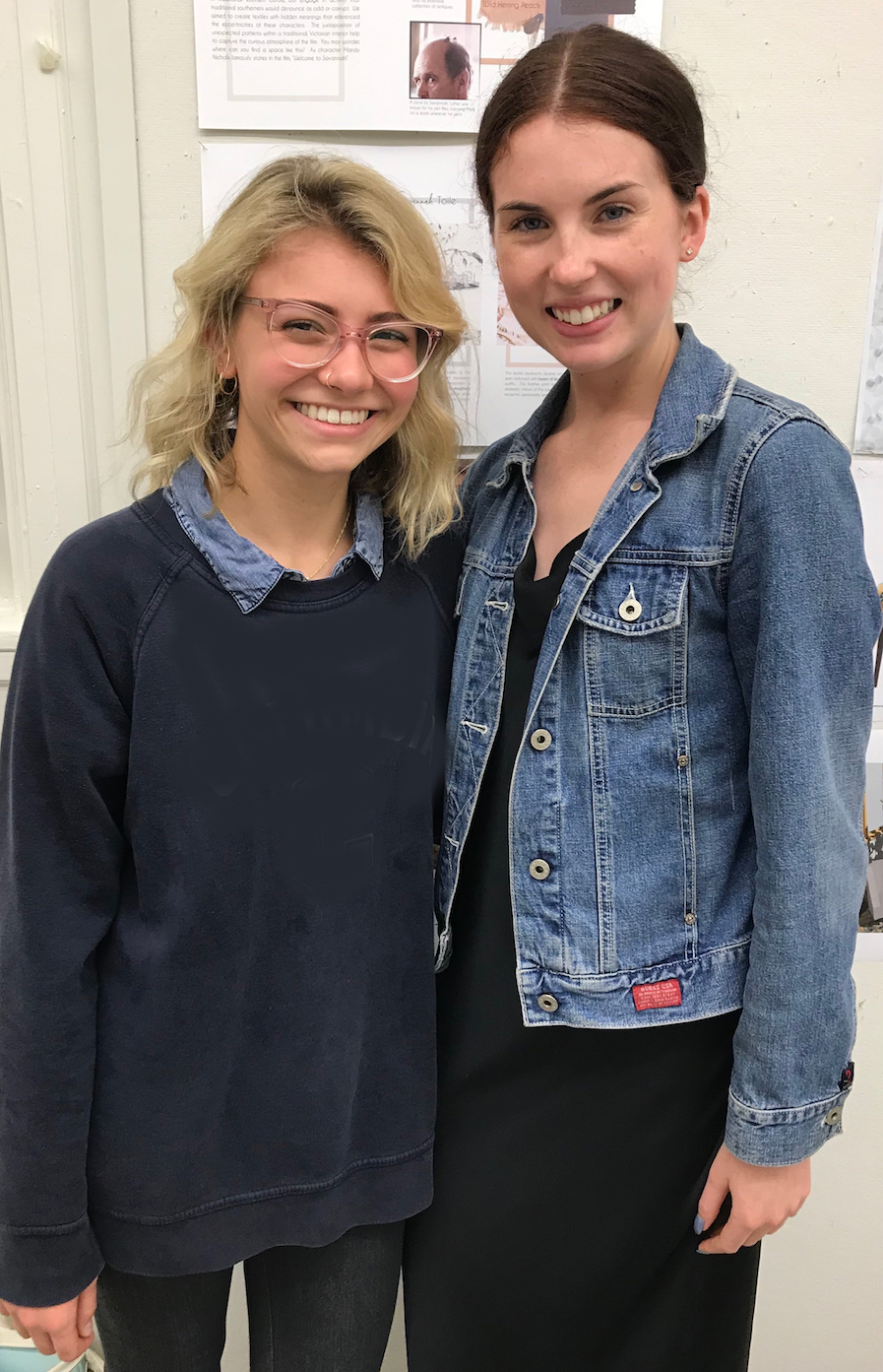
 Shelby (left) and Sheridan

Congratulations Shelby (left) and Sheridan!


DRAW 115: 'parti' time

November
16
2018
By
Tags:

Reposing on the SCAD Museum of Art floor, eighteen SCAD school of building arts students apply graphite pencils to oversize sketchpads, t-squares and tape measures at the ready. It's the mid-point of professor Ryan Madson's ten-week class DRAW 115 Graphics for the Building Arts. An afternoon field trip to SCAD MOA is underway, as student create section sketches—renderings of complete cross-sections of the museum's distinctive architecture.

Constructed atop the ruins of the 1853 Central of Georgia Railway Up Freight Warehouse, SCAD MOA incorporates the original brick walls as an aesthetic design element in the functional new classrooms and gallery spaces. The DRAW 115 students converse, compare, and look at the structure with newly aware eyes.

"When you're making your sketch, think about how the original brick wall works with the new architecture to create new spaces," Madson instructs.

Professor Madson conducts graduate-level architecture classes almost exclusively; he can make granular analysis of the work of Swiss architect Valerio Olgiati seem like casual banter. But here, in DRAW 115, Madson is teaching undergraduates at a key point of fundamental skill acquisition and design awareness. 

"These students learn to see the tangible link between visual thinking, design, drawing and architecture," he explains, "as well as how choosing materials affects space and human experience."

Required of all building arts majors, DRAW 115 supplies students with fundamental tools to carry forward into their respective majors and studios. Crucial to this class: students draw by hand.

"With the rise of computer assisted drafting, some aspects of traditional drafting fell by the wayside. Software, especially for a young student, can overly determine your process. When you can draw the structure, your possibilities are unlimited," asserts Madson. "It's something we do really well at SCAD: know how to make things by hand, and then recombine that with digital software."

In the weeks that follow, DRAW 115 field trips include an afternoon around Madison Square, where students draw a building of their own choosing, a sojourn to the intersection of Habersham and Jones Streets and its mix of 19th century houses and modern townhomes, and a day inside Poetter Hall, SCAD's flagship building, originally the 1892 Savannah Guard Armory, currently home to the SCAD welcome center, department of admission and shopSCAD.

"SCAD buildings are almost all adapted for use from existing historic buildings," Madson explains. "To achieve that, there are always thought processes and design decisions in play for interior architectural designers, this museum included. Our museum of art is not exactly adaptive reuse, it's more creatively incorporating the ruin of the brick wall into a totally new facility."

In week ten, the last day of class finds the students in an Clark Hall critique room, final projects pinned to the wall. Each student displays "parti" diagrams (showing the organizing concept of the SCAD MOA architecture), isolated hand renderings of critical details of the museum, and complex axonometric diagrams of the its eighty-six-foot-high steel and glass "lantern" tower. These are accomplished technical drawings, with watercolor, colored pencils and pens adding depth, texture and distinctive personal aesthetic choices to their work.

"You're not as plan-literate if you haven't hand-drawn it," says student Brian Lasack of the benefits of the class. "Doing the work is a hugely satisfying rite of passage."
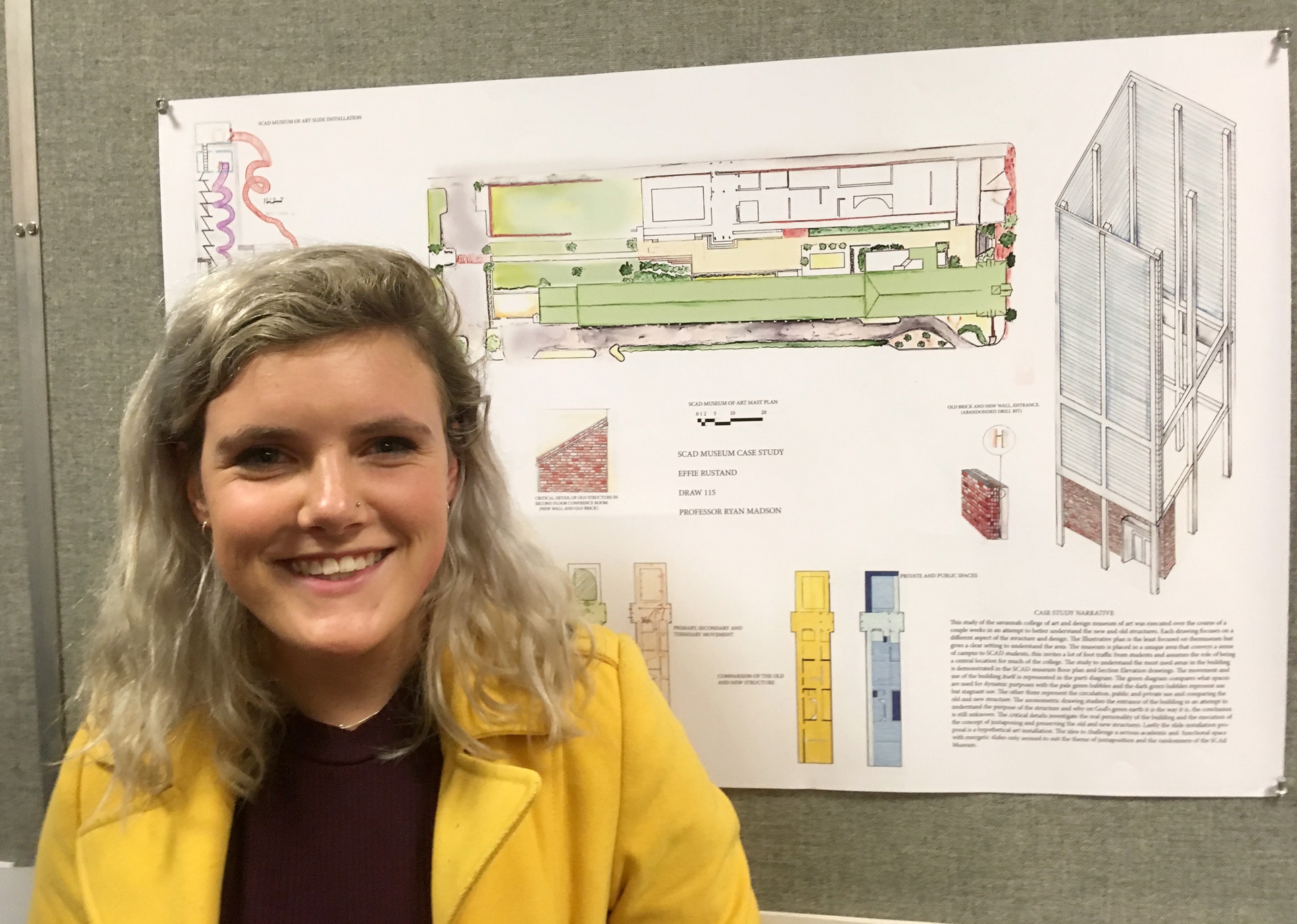
Effie Rustand smiles in front of a poster of her work

Effie Rustand shows her work.

"Professor Madson gives enough restrictions so an assignment is clear, but allows for personal freedom of choice," says Effie Rustand, a sophomore. "He has a lot of knowledge and he's passionate about sharing it. What I did in this class wasn't hypothetical—it's clear I'm going to use these skills in my major."

The final minutes of the quarter tick down. The last of the pastries on the conference table have disappeared.

"One more thing I want to mention as you go," Madson says to his class. "The future is you."
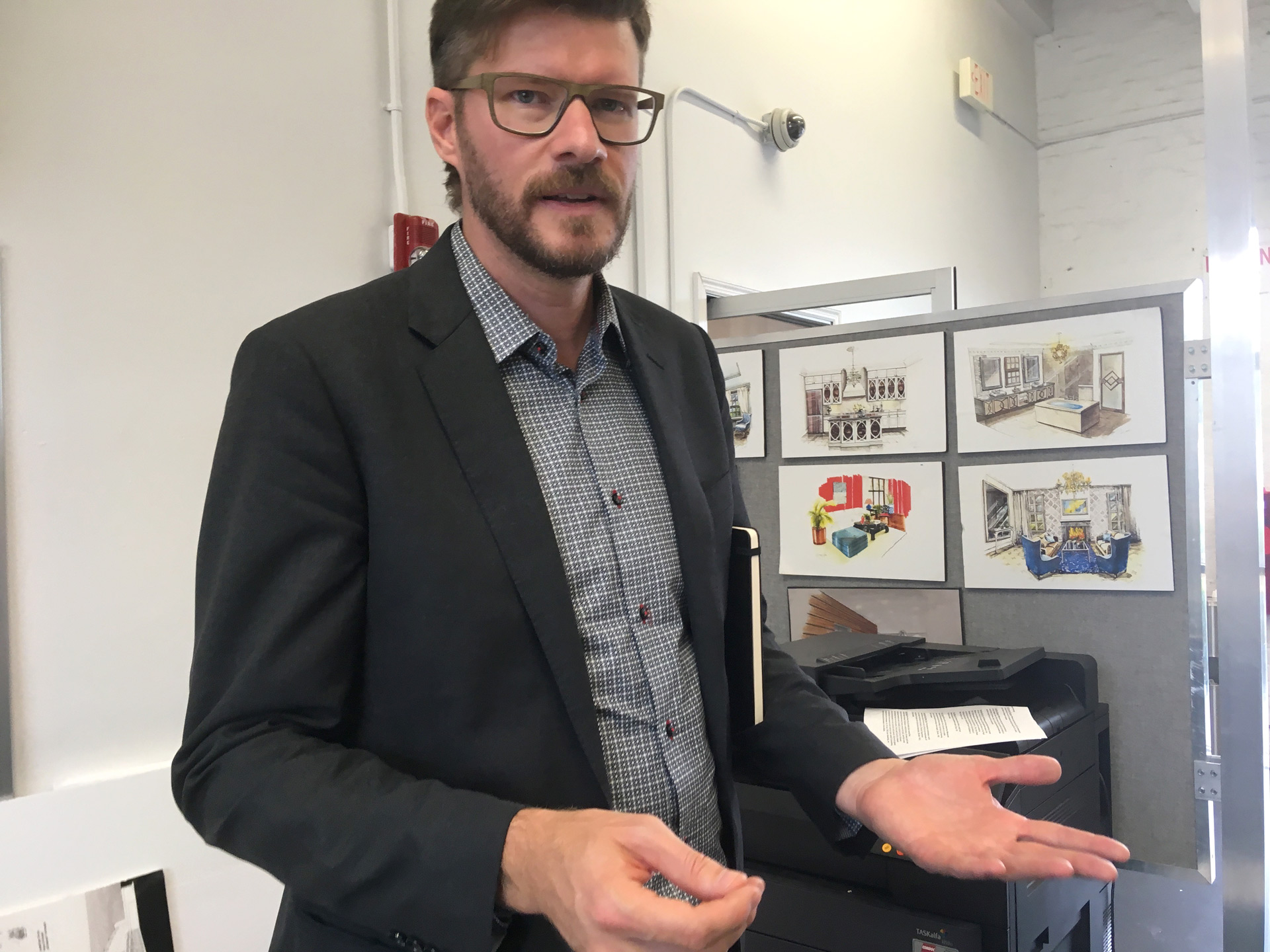
Professor Ryan Madson stands as he explains something

SCAD professor Ryan Madson


Thanks to the SCAD students of fall quarter DRAW 115:

Ellie Andrade (B.F.A., interior design)
Johnny Chang (B.F.A., architecture)
Emily Cook (B.F.A., interior design)
Alexa Diamond (B.F.A., interior design)
Rachel Eakin (B.F.A., interior design)
Alyssa Farmer (B.F.A., interior design)
Dara Holmberg (B.F.A., interior design)
Brian Lasack (B.F.A., interior design)
Yu (Liz) Liu (B.F.A., interior design)
Hanzhong Luo (B.F.A., interior design)
Alex Morse (B.F.A., interior design)
Ju Yuen Park (B.F.A., interior design)
Kaitlyn Pernas (B.F.A., interior design)
Effie Rustand (B.F.A., interior design)
Allison Thierry (B.F.A., interior design)
Mikiko Tsuchiya (B.F.A., interior design)
Caryn Turner (B.F.A., architectural history)
Ryan Tynan (B.F.A., architecture)


 

Interior design, fibers and Kravet unite

November
9
2018
By
Tags:

On a cinematically misty Wednesday evening, a group of SCAD interior design and fibers students gathered in a corner classroom of Pepe Hall for an awards presentation. Representatives from Kravet, the industry leader in to-the-trade fabric and home furnishings, were joined by SCAD chair of fibers Cayewah Easley, chair of interior design Ryan Hansen, school of building arts dean Geoffrey Taylor and honorary dean Margaret Russell, as well as a number of SCAD fibers and interior design professors.

Thirty-four student teams, each comprised of one SCAD fibers student and one SCAD interior design student, displayed mock-ups of collections based on historic and current Savannah. It was the culmination of the Kravet Design of Distinction Competition, part of the company's Design Grad initiative facilitating students becoming working professionals. It was a full house.

At the front of the room stood Beth Greene, Kravet executive VP of marketing and strategic branding. "You know the guy at the end of 'Fiddler on the Roof' holding the sewing machine? That's our founder, Samuel Kravet," Greene said. A film commemorating the 100th anniversary of the family-owned business was screened, depicting its founder sourcing fabric on the Lower East Side and scenes inside the company's current spacious design studio in Manhattan. Then it was award time.

"We judged based on your inspiration," Greene told students, "the way you told your story, the way you presented it visually, and the way you interpreted the prompt to create fabrics."

Four runners-up received lavish coffee table books and certificates, before Greene announced "the winning team…Shelby and Sheridan!" An extended ovation followed as Shelby Pogue (B.F.A., fibers) and Sheridan Markham (M.F.A., interior design) threaded their way to the front of the room. "As a special treat for winning the competition," Greene told them, "we're going to bring you to New York to visit our archive and design studio." (Sheridan: "Trying not to cry right now." Shelby: "Thank you so much. Can I hug you?")

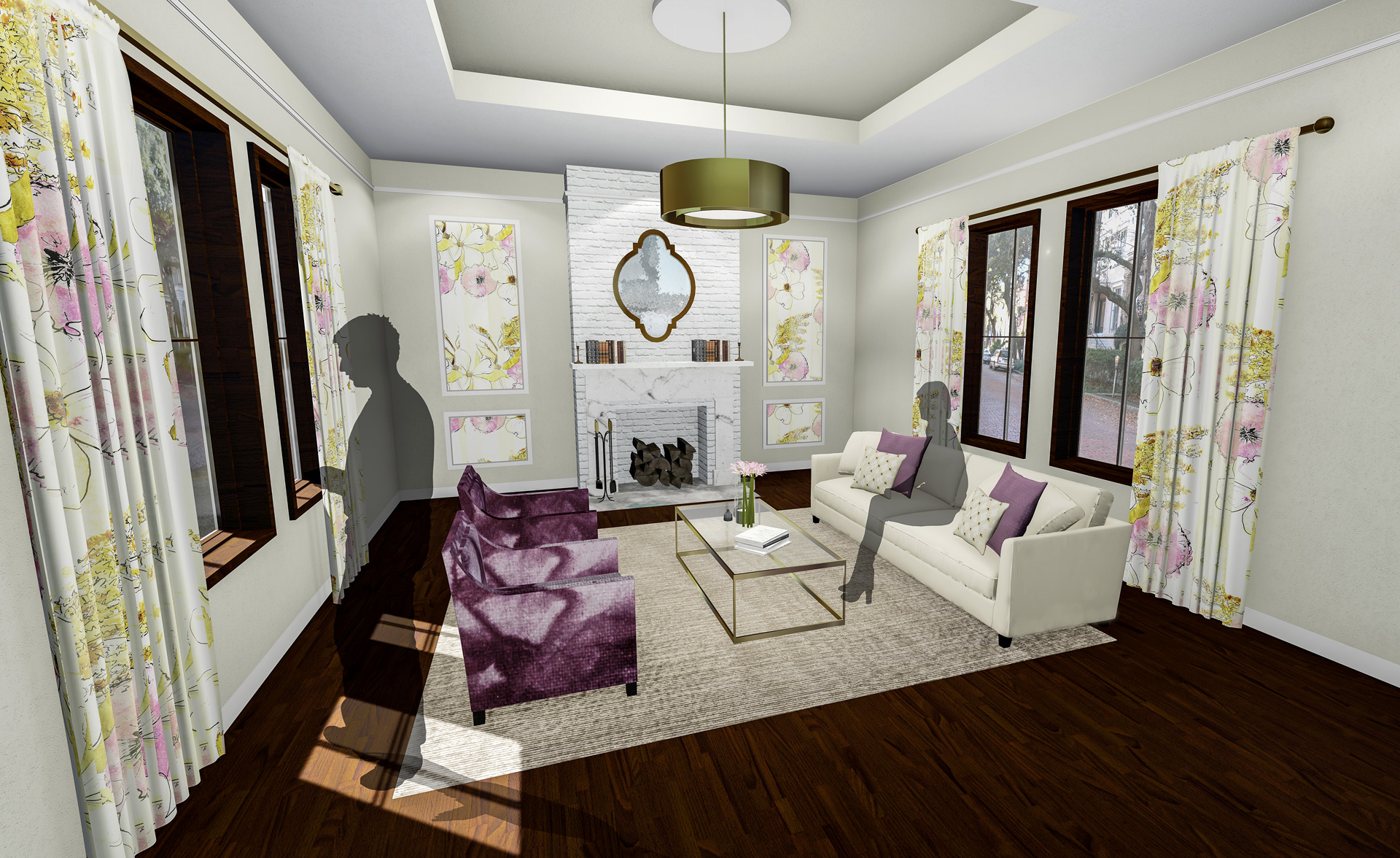
Rendering of room concept with floral curtains, purple chairs, and white couch

Room concept, part of Markham and Pogue's winning design.

After the winning duo enjoyed bonus kudos from their fellow students, everyone crowded around a table where Kravet sales representatives Tim McAlpin and Savannah Emerson unfurled sumptuous patterned fabrics from the company's Modern Tailor collection with names like London Calling, Pocket Square, Proxmire, and Catwalk.

"Wool is one of our favorite fabrics because it has breathability," McAlpin said. "Mohair velvet will last forever."

"Paisley and plaids are coming back," added Emerson. "The generational skip and granny chic are real."

The Kravet fabrics were wonderful to look at and feel. (Touching was encouraged). Afterwards, the winning team spoke about their work.

Sheridan Markham: "We're actually friends. We're both from Clearwater, Florida."

Shelby Pogue: "I went to the fibers club interest meeting for this Kravet competition, and thought, maybe Sheridan will want to do it with me. Then she reached out to me and said, why don't we work together?"

Sheridan: "We started by identifying three key elements of Savannah: native plants, building materials like Savannah brick, and distinctive architectural motifs."

Shelby: "I love to draw flowers, so we went to a botanical garden and found flowers native to Georgia. Our color palette came from that, as well as the print that wound up on the curtains and planters."

Sheridan: "It was amazing to watch Shelby work because she drew all the flowers herself, scanned them in after she watercolored them, then pieced them all together. And as we were walking around town, we started seeing the quatrefoil everywhere. It's a detail from the historic homes of Savannah, and we used that motif in our fabric design."

Shelby: "That inspired the print on the pillows. I took a potato and carved that shape into the potato and put in ink and stamped it and made an embroidery stitch."

Sheridan: "She used a real potato!"

At the event's conclusion Kravet's Beth Greene came forward with a final enticement to all participating SCAD students.

"We've made a commitment as a company to support the future of this business, and that starts with you," Greene said. "When you're in the New York vicinity, you have an open invitation to visit us."

Sheridan Markham and Shelby Pogue are already on their way.

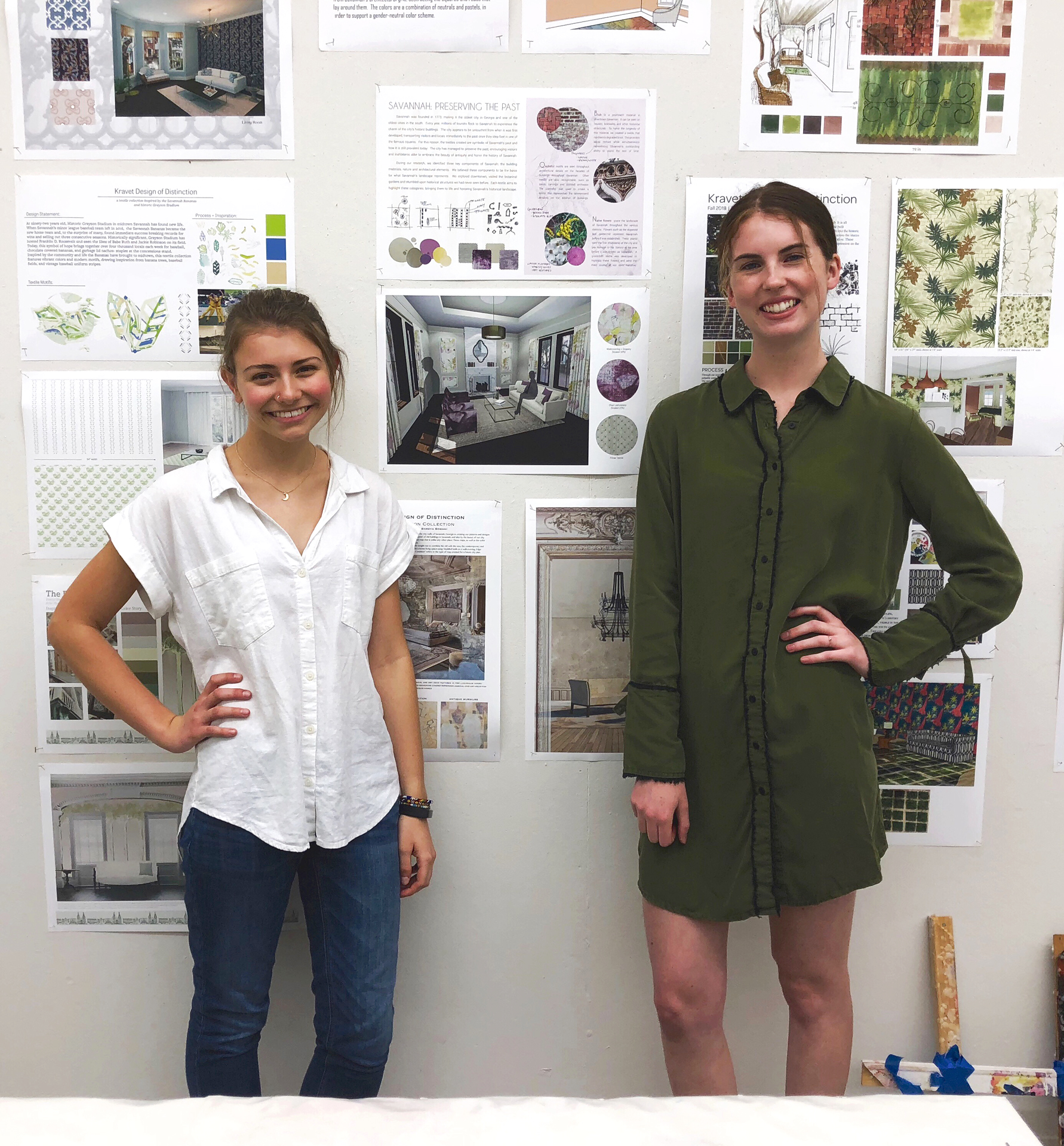
Pogue and Markham smile in front of print-outs of their design

Kravet Design of Distinction Competition winners Shelby Pogue (left) and Sheridan Markham.

Interior designers foster change

March
26
2018
By
Tags:

The last day of winter quarter feels like spring, but inside Clark Hall, interior design students Lauren Brackett and Sydney White are focused on foster care.

Presentation boards, capsules of their 26-week, double-quarter projects, stand alongside books detailing their designs and supporting research.

"Our professor Christina Gonano told us to find a gap in society, something we can fix in design," explains Brackett (B.F.A., interior design, 2018). "I have a family friend who started an organization called Fostering Youth Independence, so my idea was to design the dream facility for what they're doing with foster children."

"I was in foster care as a kid," says White (B.F.A., interior design, 2018). "My experience revealed how unstable it is. So, I designed a place separate from foster homes, for foster children ages 7-13. It doesn't matter how many times foster kids move within a city, they still have a place that's there for them, outside of a home."

Lauren and Sydney had never met when they showed up on the first day of Gonano's "Interior Design Studio V: Design Thinking for Innovation" class, though both already planned on creating capstone projects focused on foster care. As Brackett explains, "We wound up sitting next to each other and sharing research, reading as many relevant scholarly articles as we could and dissecting them so we had facts and evidence to back our ideas up."

Brackett's "Third Point" design targets young adults who are leaving foster care and need a resource center where they can better manage that challenging transition. "The resources that are currently available are spread across so many platforms, so I thought, if I can bring career counseling and financial aid help into one place, they have a better chance to succeed." Bracket designed a center that also features a gym and a teaching kitchen, for a holistic, life skills approach to health.

Interior design student sits in front of a poster of her work with material samples at her side

White's "Tree House" design, with its ligneous materials palette, modular and organic, includes touch screens for activity planning, rearrangeable furniture, and lockers "where kids can put their stuff and leave it the entire time they're in the program."

Interior design student sits in front of a poster of her work with lime green material samples at her side

The coursework made White reflect on her own experience: "Going to school as a foster kid, you know that you're different from everyone else. At a place like Tree House, everyone is equal. It creates camaraderie and community that kids might not have otherwise. That's important."

Brackett designed her center to be located in Santa Clarita, California. White set hers in Winter Park, Florida. Both explored specific details of site building, examining issues including transportation and proximity to adjacent services like restaurants, shops, schools and indoor and outdoor recreation.

Having both graduated after winter quarter, they now go forth into their lives: White moving to Florida where she will work as interior design associate for Marc-Michaels Interior Design, while Brackett heads to Texas to explore opportunities in Austin's professional interior design sector.

"We'll be back in Savannah," Brackett says. "We have a senior show Friday, June 1, the same day as our graduation ceremony."

White nods in enthusiasm. "It's definitely been a great experience at SCAD."

Interior design programs named nation's best by DesignIntelligence

September
26
2017
By
Tags:

Savannah College of Art and Design is home to the nation's top interior design programs. The DesignIntelligence report of "America's Best Architecture & Design Schools 2017-2018" ranked SCAD undergraduate and graduate interior design programs first overall.

This prestigious recognition is determined by leading practitioners in the field, guiding students and industry leaders to discern which universities are best preparing students for successful futures in the profession. Savannah College of Art and Design's graduate architecture program was also recognized as one of the top 25 programs in the nation.

"I'm proud that the SCAD undergraduate and graduate interior design programs earned No. 1 rankings for 2018," said SCAD president and founder Paula Wallace. "Over the past seven years, SCAD's undergraduate and graduate interior design programs have been ranked No. 1 together an unprecedented five times. This fall, the university is also delighted to welcome the founding editor of DesignIntelligence, James P. Cramer, as a distinguished professor of architecture."

SCAD interior design is part of the school of building arts, under the leadership of Dean Ivan Chow. Interior design students learn to employ aesthetic theory, culture, materiality and function in the design of interior spaces. SCAD B.F.A. programs are accredited by the Council for Interior Design Accreditation, affirming SCAD graduates are thoroughly qualified for professional practice. The M.A. curriculum emphasizes emerging materials, human response and research methods. M.F.A. students investigate the design discipline in-depth to become expert practitioners and educators.

A recent official survey determined 99 percent of SCAD graduates of the school of building arts report are employed, pursuing further education or both within 10 months of graduation, including employment by notable firms Gensler, Ainsworth Noah, ASD | SKY, and Roger Ferris + Partners.

"The annual DesignIntelligence rankings honor university design programs that best prepare students for professional success," said President Wallace. "At the vanguard of design education, SCAD continues to earn top recognition."

DesignIntelligence survey deadline extended to June 9

May
31
2017
By
Tags:

For the past 17 years, DesignIntelligence has conducted its annual survey of America's Best Architecture & Design Schools. If you are a hiring official in a leadership role, now is the time for you to participate in the 2017-18 survey. These annual rankings are today's leading resource to rank architecture and design programs on their ability to prepare graduates for professional practice.

Artistic rendering

The survey invites individuals who hire architects, interior designers, landscape architects or industrial designers to share their experiences and perspectives on the strength of the architecture and design programs in the U.S.

This survey will take about 15-20 minutes and can be completed in more than one sitting should you need to exit and return to complete it at a later time. Individual responses will be kept confidential but a listing of all responding firms may be published.

Your input provides prospective students and their families the information necessary to make informed decisions regarding educational options.

Access and complete the surveys

Please use the following links to access the surveys. If you hire in more than one discipline we invite you to complete a survey for each discipline for which you hire. The survey closes at 11:59 p.m., EST, Friday, June 9, 2017.

Architecture
Landscape Architecture
Interior Design
Industrial Design

Artistic rendering

View the results

Results will be published in the third quarter edition of DesignIntelligence Quarterly which will be released towards the end of September 2017. In thanks for your participation, all respondents will receive access to the third quarter edition of DesignIntelligence Quarterly via a new online digital reader. The Third Quarter edition will be available towards the end of September and will include the survey results as well as industry challenging thought leadership articles authored by many of the best minds in A/E/C.

Artistic rendering

If you have questions or comments, contact DesignIntelligence Senior Research Analyst Darlene Penner at [email protected].

Get ready for SCADstyle 2017!

April
4
2017
By
Tags:

Clear your calendar and free your design mind, as SCADstyle 2017 comes alive this April 6—13! Join international luminaries of fashion, interior design, fragrance, typography, sustainability and much more as SCAD celebrates style as only SCAD can.

Headlined by Imran Amed, SCADstyle 2017 promises a week replete with inspiring lectures, panels and workshops at SCAD locations in Savannah, Atlanta and Hong Kong. All events are free and open to the public.

Amed, this year's honorary chair, is the founder, CEO and editor-in-chief of The Business of Fashion and a leading writer and industry thinker. He will speak about his work as an agenda-setting journalist at the SCAD Museum of Art theater, 601 Turner Blvd. in Savannah on Tuesday, April 11 at 6 p.m. Over the past decade Amed has grown BoF from an online passion project into an indispensable resource for the fashion industry, with more than one million unique visitors per month.

Best-selling author and editor Derek Blasberg, Fashionista creator Faran Krentcil, Bedrock Manufacturing founder Tom Kartsotis, and L'Oréal USA group president Carol Hamilton are among the other fêted guests who will share their expertise at this year's SCADstyle. As the preeminent source of design knowledge, SCAD is honored to directly connect these superstars with the next generation of design-minded Bees.

SCADstyle 2017 kicks off Thursday, April 6 at 6 p.m. at Arnold Hall with "Play at Your Own Risk," a presentation by Jessica Walsh, art director and partner at Sagmeister & Walsh. Walsh will offer advice on how to conscientiously cultivate freedom by working in a state of play.

The following Thursday, April 13 at 6 p.m., SCADstyle 2017 concludes at the SCAD MOA theater with a lecture by exalted designer Norma Kamali, inventor of the "sleeping bag coat” and vital presence on the design scene for over four decades. Kamali will lecture on timeless style as the quintessence of modern fashion.

The newest edition of this annual gathering is destined to transform preconceptions about design across all disciplines. Check the full schedule of SCADstyle 2017 events, and be part of the process!

SCAD Style 2017 logo

Interior design student's pleasing palettes take over Zhing Kitchen

August
24
2016
By
Tags:

It’s hard to think of a family business that better deserves that cozy classification than Malaysia’s Zhing Kitchen. SCAD student Wan Zhing Aw (B.F.A., interior design) — that’s Cammy to you! — identifies love as the not-so secret ingredient for branding and designing a family restaurant. 

Owned by Cammy’s sister, Stefanie Aw, Zhing Kitchen is a celebration of the entire clan. The menu proclaims the family’s culinary inheritance: Japanese and Taiwanese fusion. And the restaurant’s name, Zhing, meaning sunshine, is derived from Cammy’s own appellation.

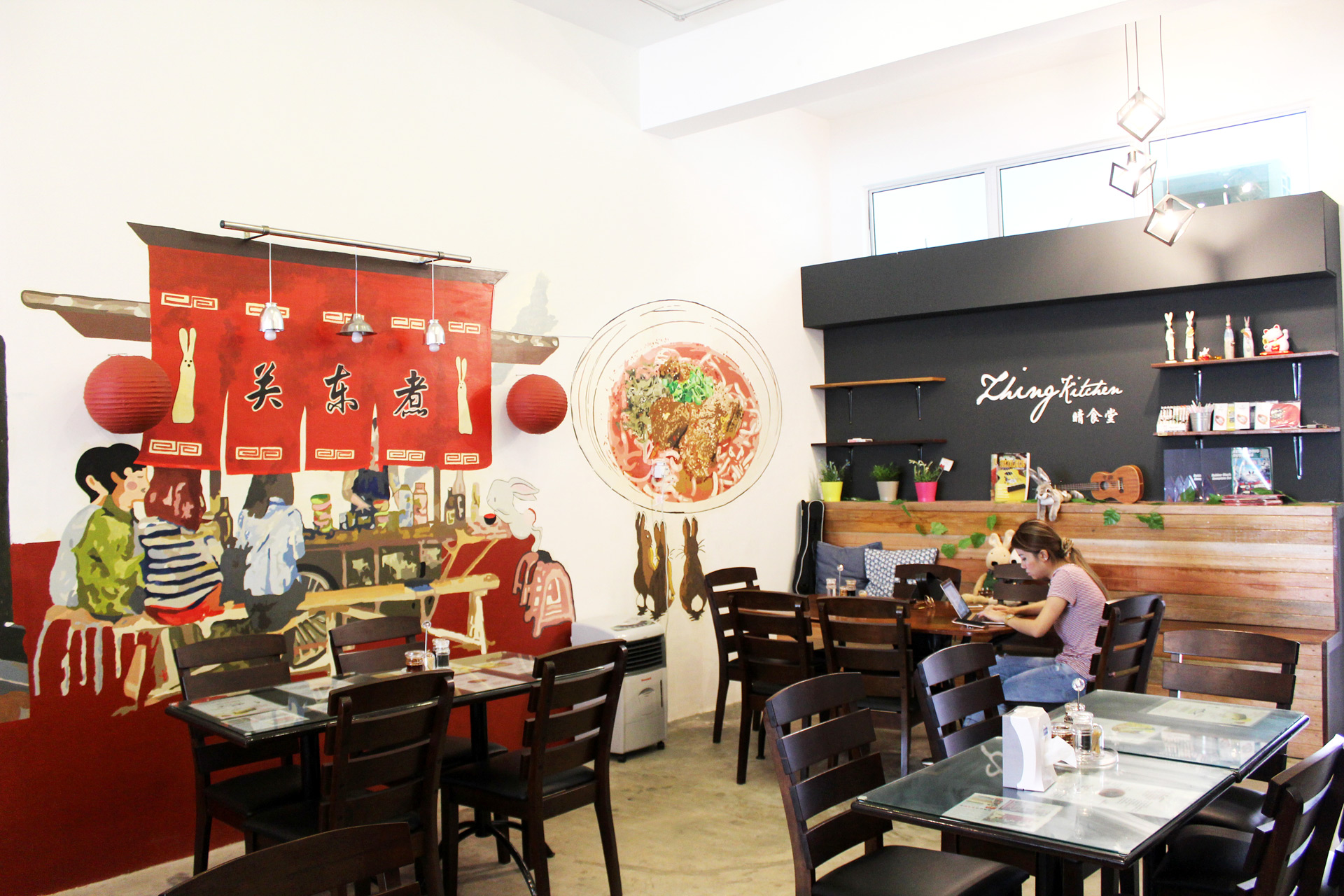
Interior of Zhing Kitchen designed by SCAD interior design student Wan Zhing Aw

With a name like that, some designers would have reached for an easy graphic pairing — the sun, for instance. Not Cammy. She chose a rabbit — a zodiacal nod to her sister’s birth year and modest spirit — for the logo. The sisters privately refer to the critter, often delicately etched, as the ‘ghost rabbit’ or ‘Jackson Bunny’ (after their brother’s sobriquet). By any name, the rabbits are everywhere once you learn to spot them, just like the influence of the owner. 

Cammy wove the theme of family love throughout every nook and cranny of the restaurant and its collateral, including the menu, name cards, stickers and merchandise. She even designed and directed the interior renovation, which was carried out by her self-professed soulmate and handyman, Xiong. Love, everywhere!

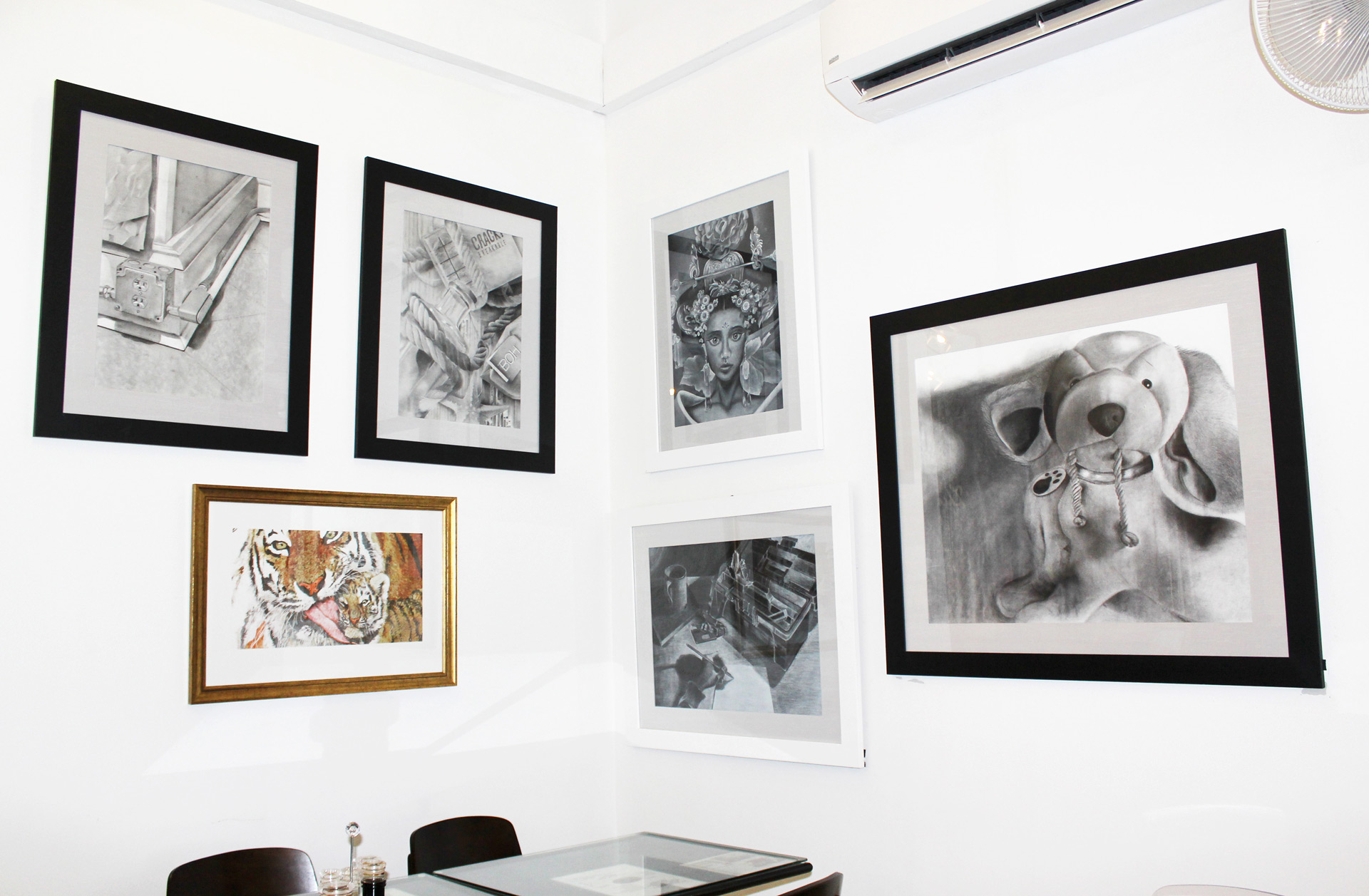
But before love, money. It’s the ultimate design constraint, Cammy admits. And that’s not a bad thing. Armed with economy, imagination, and SCAD know-how, Cammy transformed Zhing Kitchen into a bona fide art destination. She stretched her budget by incorporating pre-existing resources, namely her completed foundation studies assignments. These beautiful works are all the more impressive considering that Cammy did not consider herself an illustrator prior to enrolling at SCAD. “I learned drawing and design from SCAD foundation studies. If there were no foundation courses, I wouldn’t know that I could create a small art gallery in the restaurant!” she said. Cammy also hit upon another key budget saver: paint. Nine shades of paint, to be exact.

Interior of Zhing Kitchen designed by SCAD interior design student Wan Zhing Aw

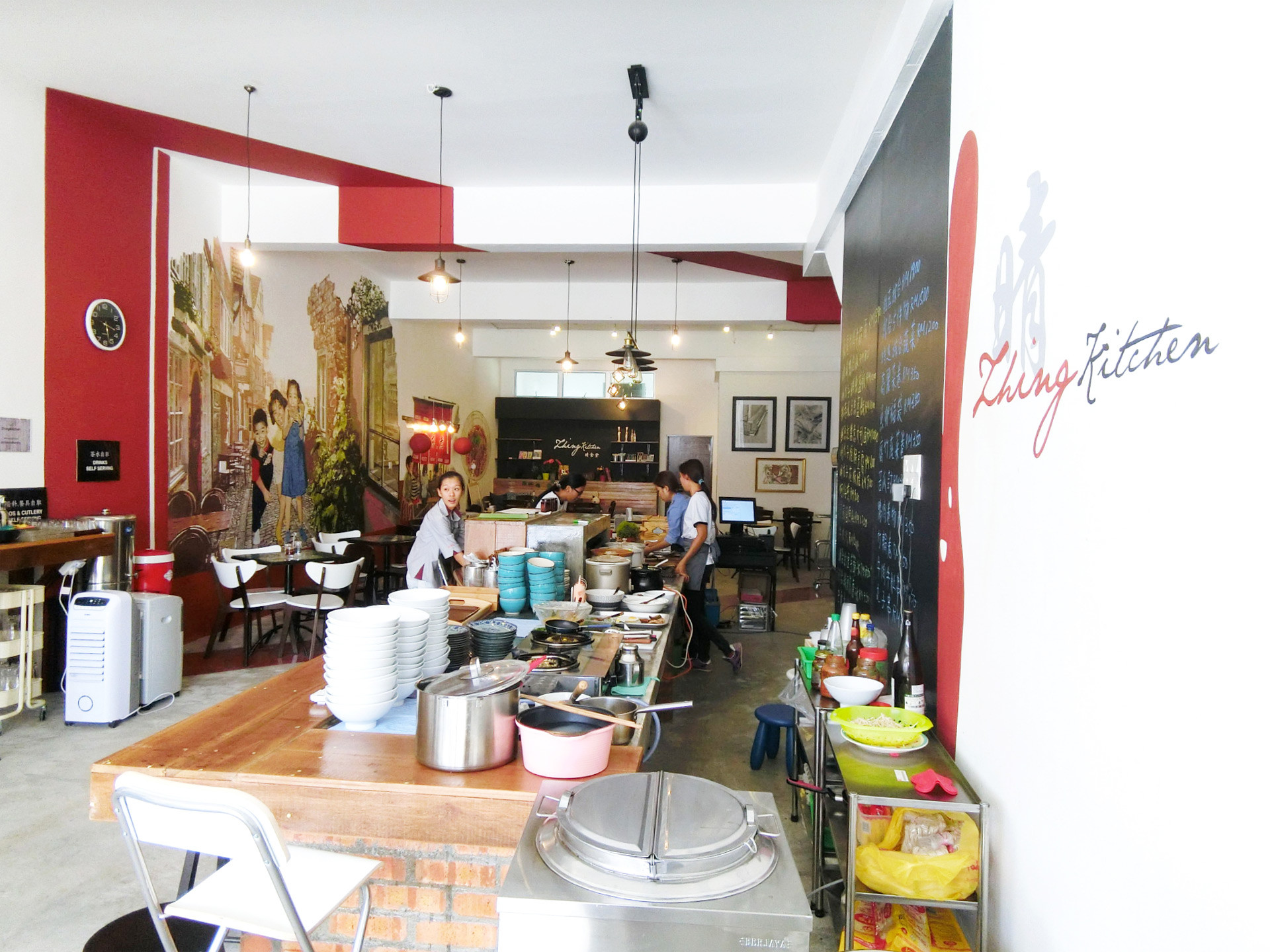
Using paint, Cammy created visual cues for the flow of dining traffic. A major challenge was to give the illusion of divided space without walls, clearly demarcating the workspace from the dining area while encouraging patrons to interact with kitchen staff. Her solution was to splash a bold ribbon of red paint across the floor, up the walls, and over the ceiling to frame the threshold. The vibrant line has the added benefits of increasing optical interest and extending the line of sight.

Interior of Zhing Kitchen designed by SCAD interior design student Wan Zhing Aw

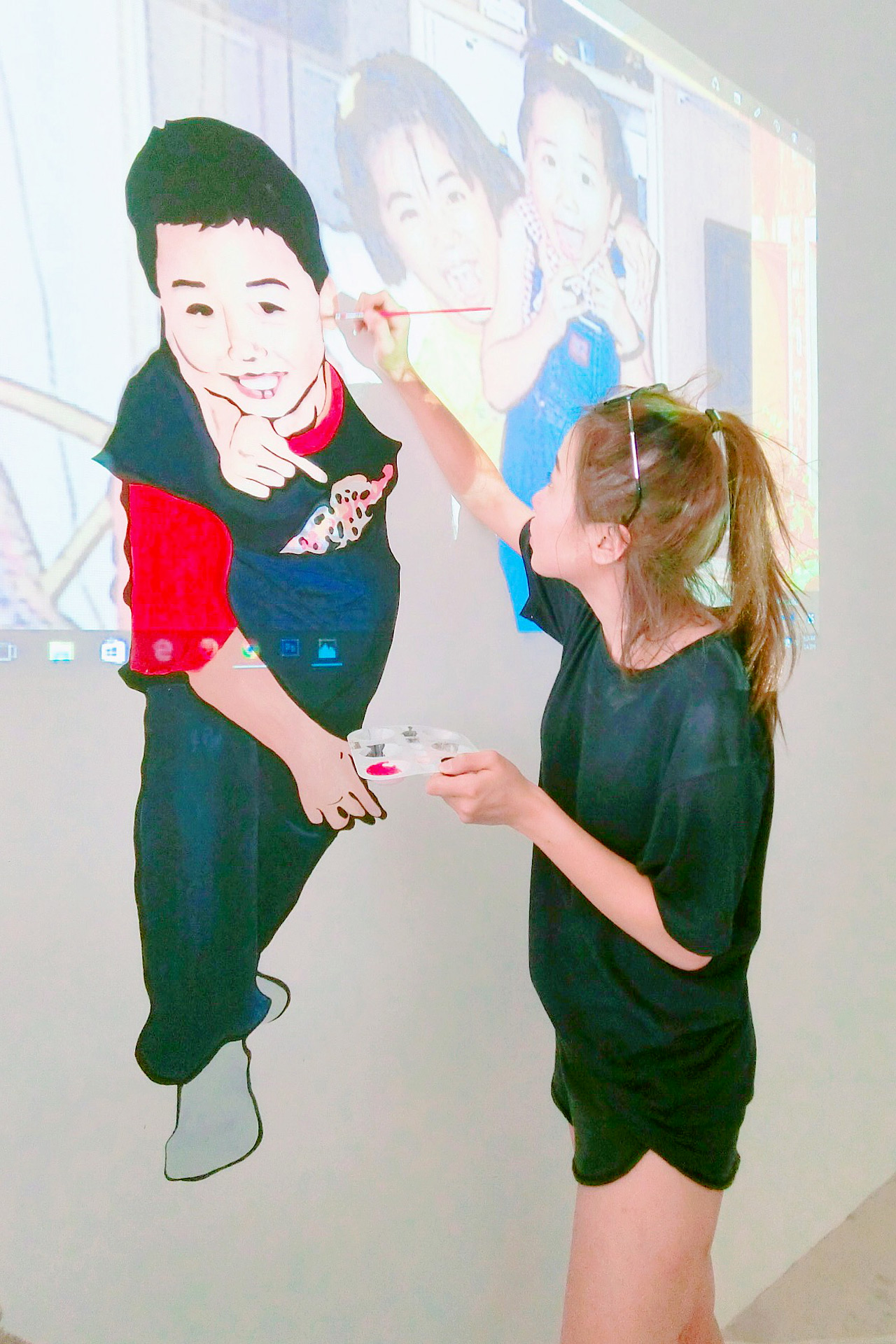
The most striking application of Cammy’s newfound color theory is the restaurant’s focal point: a mural depicting her family beside a Parisian café. While geographically removed, the scene is emotionally congruent with the convivial spirit of the business. If the choice of subject matter was easy, the process was decidedly not. First, Cammy had to expand her available palette by manipulating hue, value, and saturation. “Sensitivity to color is the key factor in making a work succeed or fail,” she said. Using a projector, Cammy painstaking reproduced the image, stopping frequently to readjust the image and transport her paints — a necessity further complicated by the act of ascending and descending simple scaffolding. You might say the main ingredient in the mural was patience.

SCAD interior design student Wan Zhing Aw paints mural

From a design and branding standpoint, Cammy’s work is a success. But she also evaluates her work according to the emotions it evokes in casual diners. And it is on this count that Cammy really shines: clients agree that Zhing Kitchen is the restaurant equivalent of your grandma’s hug!

SCAD’s best and next shows at international furniture trade show

July
7
2016
By
Tags:

The International Contemporary Furniture Fair is the premiere trade show for fine interior design in the United States. Twenty furniture design students, along with program coordinator Fred Spector, represented SCAD at ICFF New York in May with a custom-built booth.

The SCAD exhibit at ICFF was designed by students in furniture design professor James Bazemore’s spring “Design Studio: Furniture for the Market” class. Their final design was a clean-cut combination of open and closed structures: a solid wall behind an angular, geometric wrapping platform fenced in by skeletal walls, the perfect pedestal to put SCAD student furniture design in the spotlight.

Some of the furniture on display came from collaborative projects created in the fall 2015 studio class taught by furniture design professor Sheila Edwards. The senior class worked with EcoMadera, a sustainable forestry company, to design products using sustainable woods.

ICFF features “What’s Best and What’s Next” in global contemporary design, luxury interiors and high-end furniture. Extraordinary styles by top international furniture brands and emerging new talent highlight unique furniture, accessories, lighting, outdoor furniture and more.

AT ICFF, the students gained feedback from industry professionals. They also received offers to buy or commission pieces on display, and networked with companies for internships and job opportunities. With the experience of how a trade show works from start to finish, these students are ready for the next step in their careers. They might even return to the exhibition as the next big names in interior design