Skip to main content Accessibility Policy

Nick Baker's bright idea

June
9
2015
By
Tags:

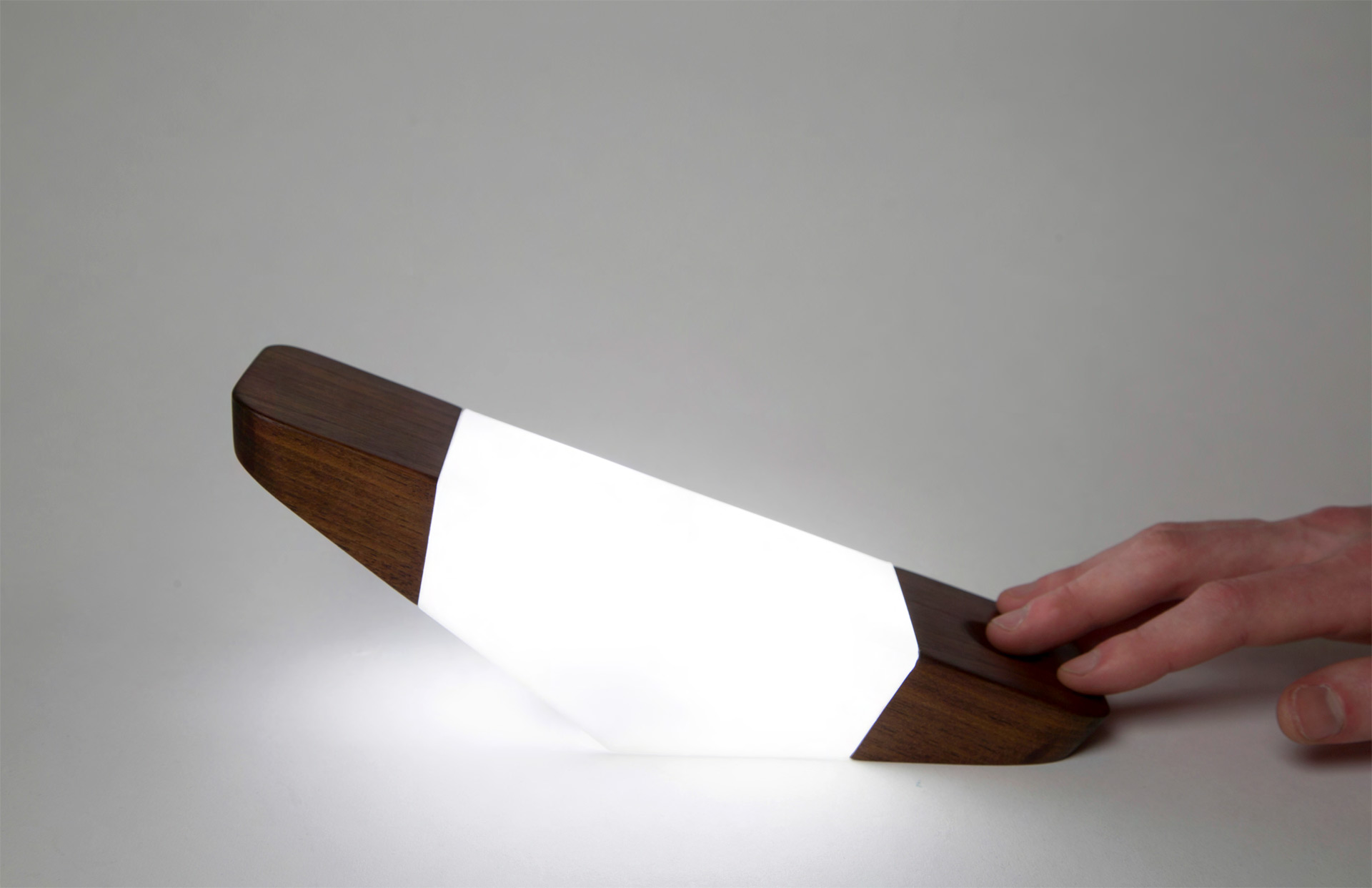
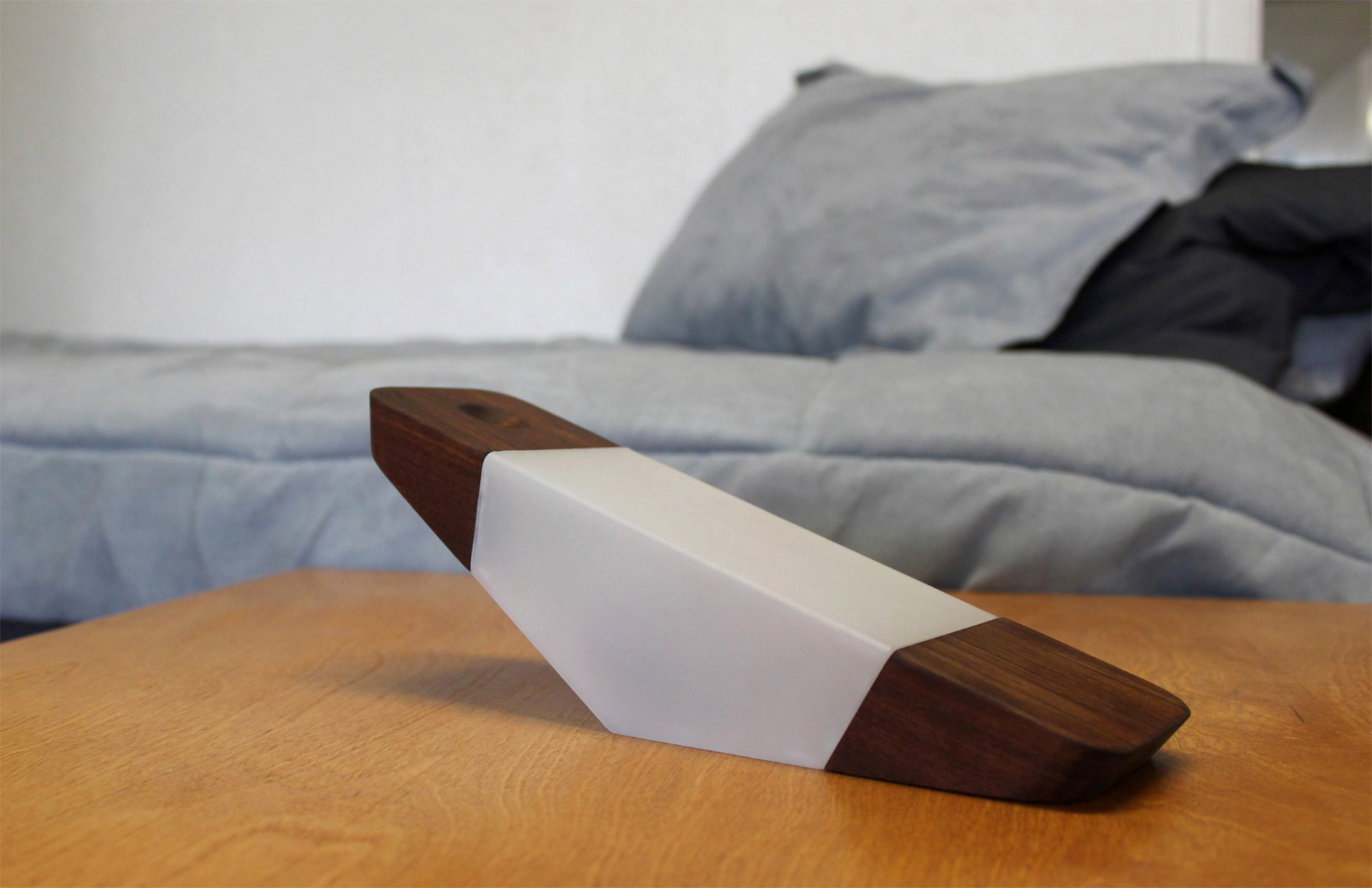
Good design can transform the countless daily interactions in which we engage, interactions that are critical to our productivity and our quality of life. Nicholas Baker’s (B.F.A., industrial design, 2015) bedside lamp, illuminated by a simple tilt, may very well transform how we start and end our days. A jury of top designers named Baker’s “Prism” light the first-place winner in the Applied Industrial Design category of the 2015 Royal Society of Arts U.S. Student Design Competition. It’s an award given to the best product design that can create or solve a problem, and who hasn’t tangled with a lamp that’s too bright for tired eyes and complicated for weary limbs?

Industrial design student Nick Baker's Prism bedside lamp

Here’s Baker on an idea worth waking up for:

SCAD: Where did you get the concept for your Prism nightlight?

NB: I did a lot of research around nightlights and found this one problem that everyone goes through. It's the middle of the night and you need to get up and get a glass of water, but you can't see your lamp switch because it's dark. You finally find it after fumbling around and switch on this bright lamp that hurts your eyes. I saw this opportunity and took some inspiration from one of my favorite designers, Naoto Fukasawa. His philosophy revolves around taking familiar actions and implementing them into products to make them more user-friendly. I was thinking of how light switches are familiar actions and how it flips back and forth. Then it hit me how a seesaw does the same thing and is really simple and intuitive.

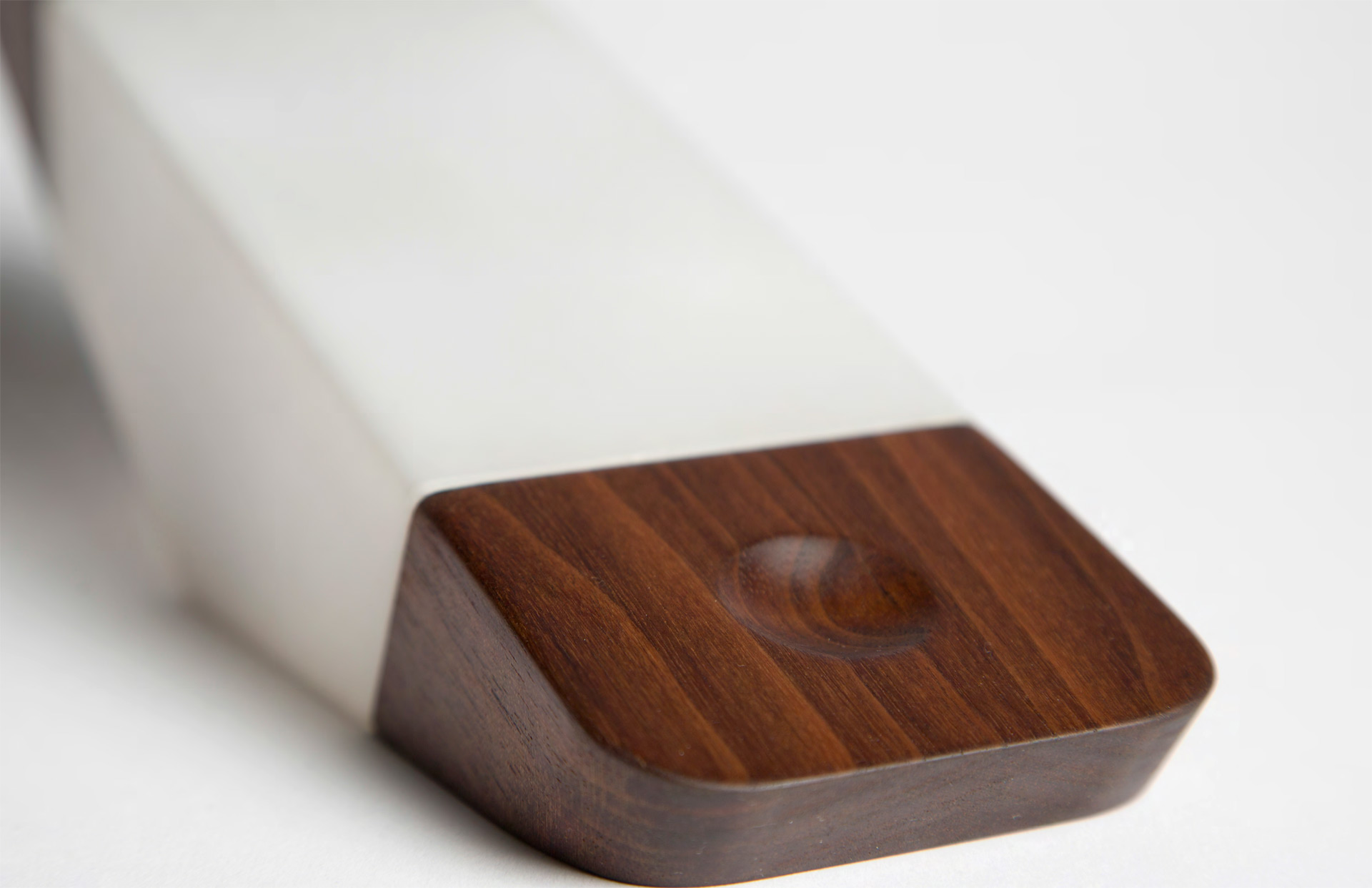
Wooden detail of Nick Baker's Prism bedside lamp

SCAD: What is your design process?

NB: I always start out fantasizing about what I am about to create, but I have to reel myself back in and start researching. After I have a good amount of research, I start sketching out ideas and continue to research those ideas. Once I have several solid concepts, I will make mock-up models to test on people and get their reactions. After testing, I will take my findings and finalize one design to create a prototype.

Demonstration of how to turn the Prism bedside lamp

SCAD: How did your professors help throughout the process?

NB: Owen Foster was my professor for this project. Owen is really good at making me discover the answer myself. It's almost as if he gives the answer I don't want just to see if I can choose what I think is best. Design is all about making the right decisions and that can't always be taught by someone else. It's discovered through one's self. Owen really does a great job at facilitating design and discovery.

SCAD: What's next for the nightlight?

NB: The Prism is currently up on Unbranded Designs and can get manufactured if it gets enough support.

Look for more by Baker soon. His dream is to own a design studio where he can produce products like Prism. We anticipate that the 2015 Billings Jackson Design Internship, an additional honor from the RSA, is just the beginning of a long and fruitful design career.

Who will Lululemon design for next?

April
2
2015
By
Tags:

The downward trend for Lululemon’s sales and reputation seemed to stall with its announcement of a line of pants tailored to the male anatomy. The yoga and activewear brand is likely considering additional strategies for reviving its business, and it just might find answers in case studies by students from Savannah College of Art and Design. Challenged by the Young Menswear Association to develop a new product or marketing tactic to help Lululemon regain its footing, these aspiring leaders of the fashion industry each won $5,000 YMA Fashion Scholarships for their ingenuity. Here are the consumers they believe Lululemon should target next.

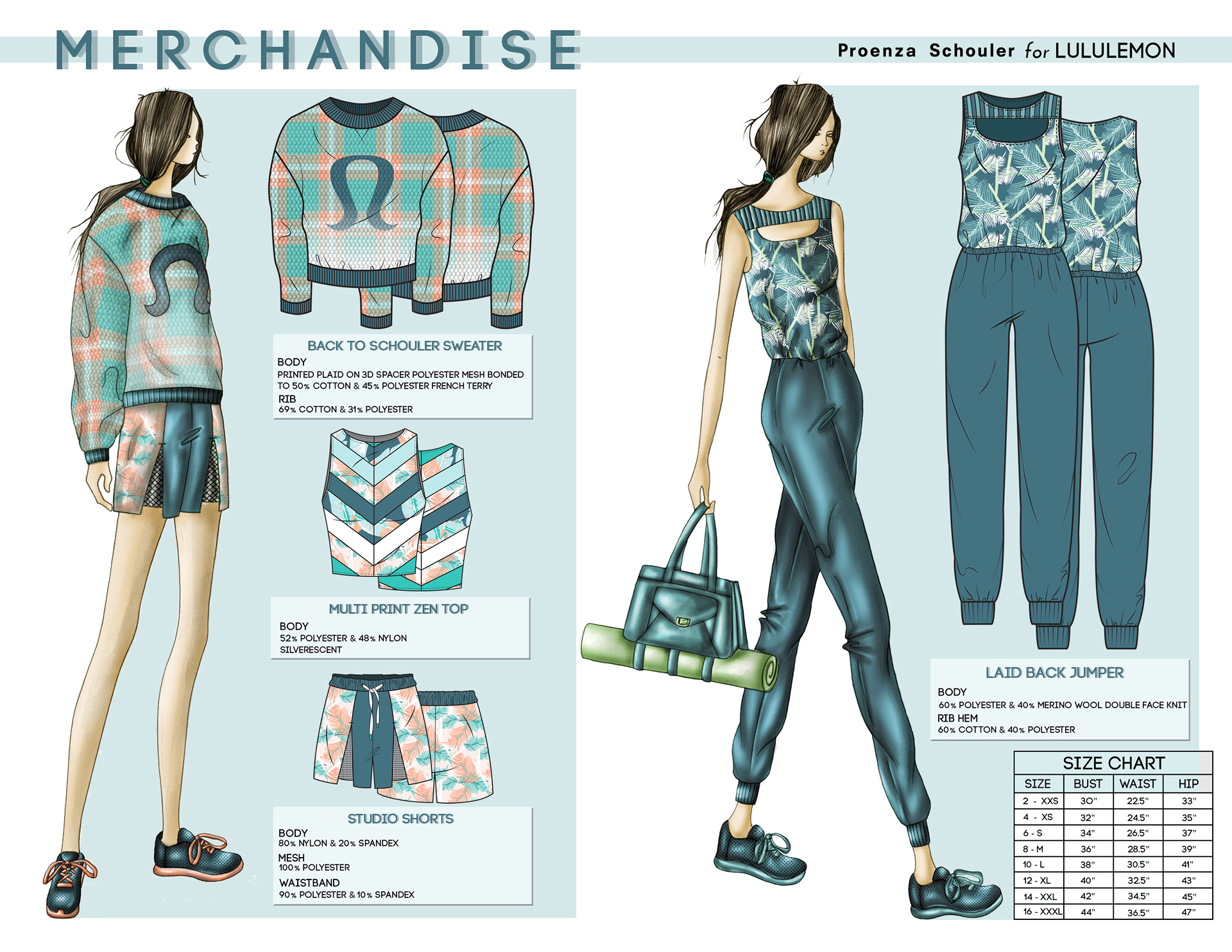
SCAD student Jessica Ferreira’s sketches for Lululemon
The style conscious
Jessica Ferreira’s (B.F.A., fashion) solution is to tap the talent of emerging American designers to revive the struggling brand. In her plan, Lululemon partners with the Council of Fashion Designers of America to select designers who can bring luxury to the high-performance athletic gear, thereby attracting a new base of trend-savvy customers. For example, Jessica recommends the designers behind Proenza Schouler, who are known for their prints. Her sketches illustrate how graphic leaf prints could infuse a Lululemon capsule collection with overtones of Zen and nature.

The plus-sized
Annalise Lao (B.F.A., fashion) created ELEVATE, a high-end, exclusive division of Lululemon, to be offered in sizes four to 24. ELEVATE would integrate plus sizes into a regular line, with clothes designed to flatter the body using high energy prints and cuts that resonate with an urban customer base. In an attempt to reach the global traveler and the growing Asian market, ELEVATE would debut in American Airlines lounges across the United States and with its affiliates Cathay Pacific, Malaysia Airlines and Quantas.

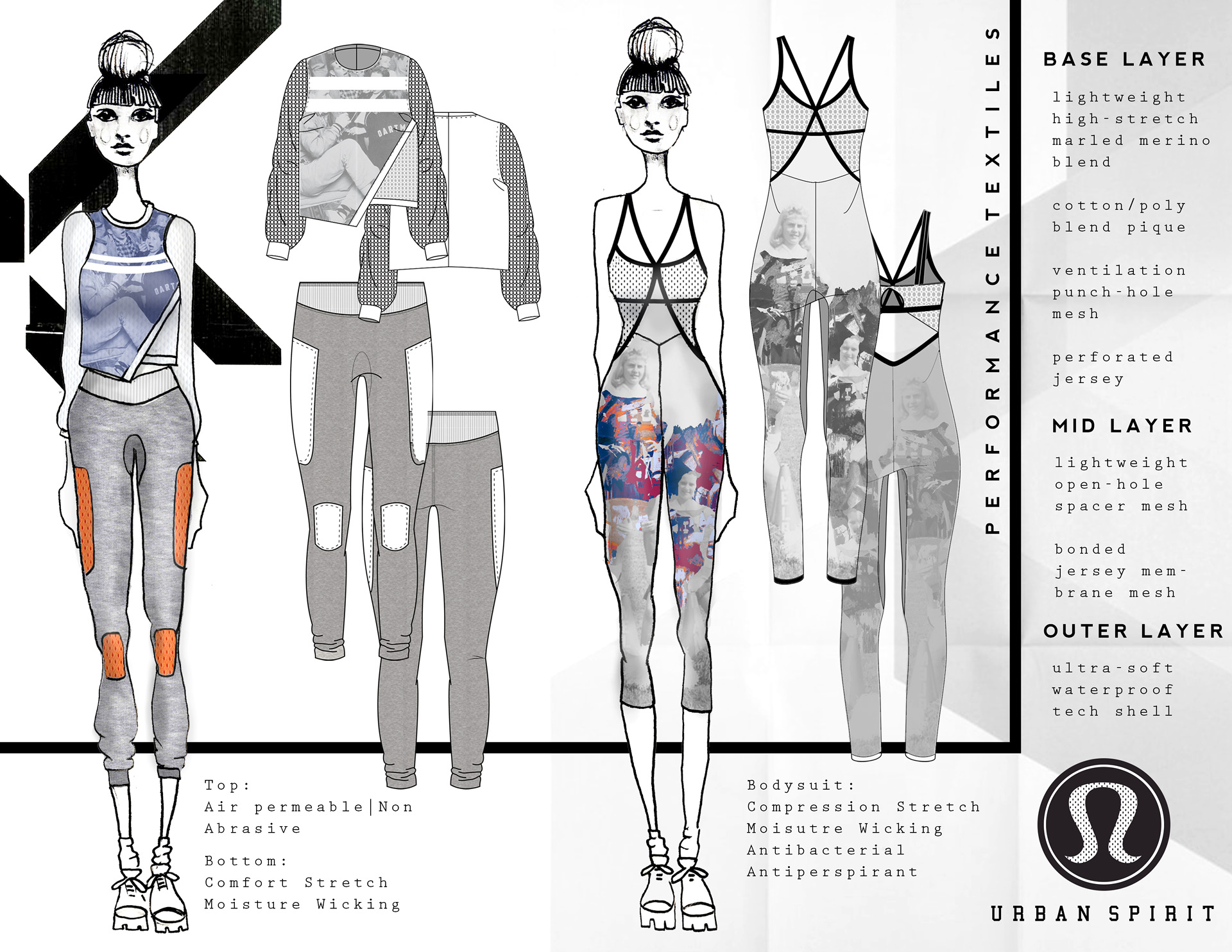
SCAD student Lindsay Cousins' sketches for Lululemon

The young
Lindsay Cousins (B.F.A., fashion) chose to target new blood. Her brand extension for Lululemon, Urban Spirit, would appeal to a younger customer base. She designed a collection of yoga garments for this modern customer that would be functional for athletes of all kinds and incorporate performance enhancing materials.

Mood board featuring active young men created by Daniela McIntire for Lululemon

The millenial male
Lulu Warrior is Daniela McIntire’s (B.F.A., fashion marketing and management) answer to the question: "How can Lululemon take a bite out of the big dogs Nike and Adidas?" The menswear concept is geared toward the male customer, ages 18 to 35, who enjoys rock climbing in Norway, zip lining in the Puerto Rican rain forest, and skateboarding in Santa Monica, California. A partnership with retailers like Patagonia and REI would further enable Lululemon to capture these discerning and adventurous sports enthusiasts.

SCAD student Shaina Levin's vision for Lululemon's foray into swimwear

The swimmer
Shaina Levin (B.F.A., fashion marketing and management) noticed that Lululemon was ‘landlocked’ in its approach to personal fitness. To build on the brand’s commitment to the well being of its loyal followers, and recognize the many activities that encompass the lifestyles of modern women, she developed Amphibian. Her collection of exclusive swimwear revolves around a concern for sustainability and the values of the Lululemon brand.

The environmentalist
Nikolas Hakanson (B.F.A., fashion marketing and management) created the Green collection, incorporating sustainability into all aspects of the activewear. From fabrics to styling, and production across the supply chain, this concept would allow Lululemon to position itself as a leader in sustainability.

The androgynous
S / He by Vicky Ma (B.F.A., fashion and fashion marketing and management) incorporates unisex styling and versatile fabrics as a way to tap the trend toward androgyny, while also empowering Lululemon to expand their current level of business with men.

If a lack of inclusivity bedeviled Lululemon in the past then, taken together, these fresh ideas should have the brand covered. 

Hero image courtesy of Neil Hieatt (M.A., advertising, 2011).

Bienenstock Furniture Library: these chairs have our attention

March
24
2015
By
Tags:

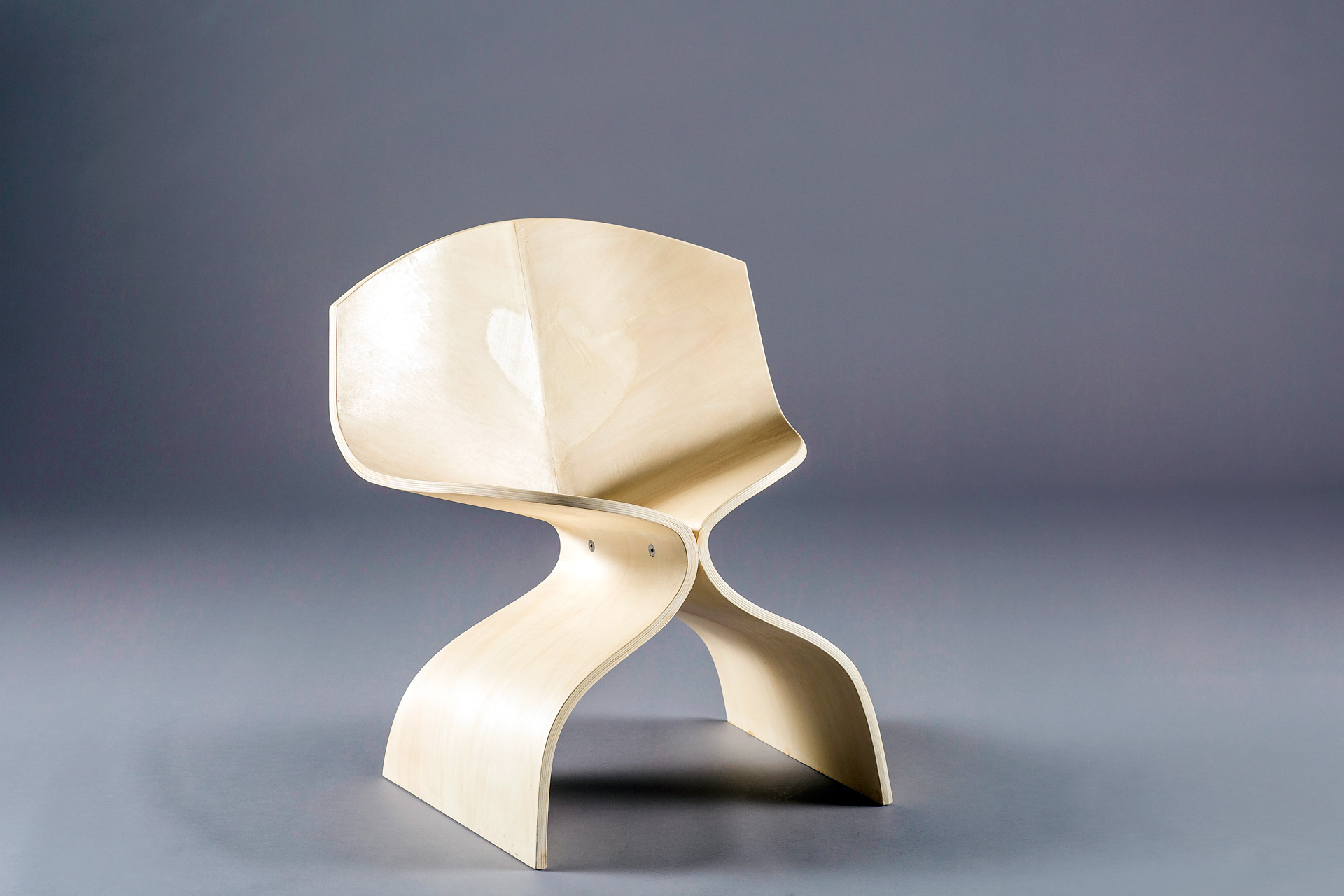
When was the last time you felt loved by your chair? It’s a rare expectation from our furniture, but it’s possible. That's because good designers can imbue inanimate objects with human characteristics. The Honest Chair by Eny Parker, winner of the 2015 Bienenstock Furniture and Interior Design Competition, illustrates how this dynamic is achieved with something that we use every day, but rarely notice.

As designers, we should not only appreciate materials, but push their natural characteristics to become something unimaginable. - Eny Parker

The body-embracing curves of The Honest Chair, the first prototype that Eny has manufactured as a graduate student in furniture design at Savannah College of Art and Design, are hard won. Its simplicity masks the difficulty of crafting a compound curve, a wood bending technique requiring the maker to bend Italian plywood in two different directions - one along the grain and the other against it. 

Many cracked sheets of plywood later and the Frank Gehry-inspired chair was born. Here’s how Eny made it:

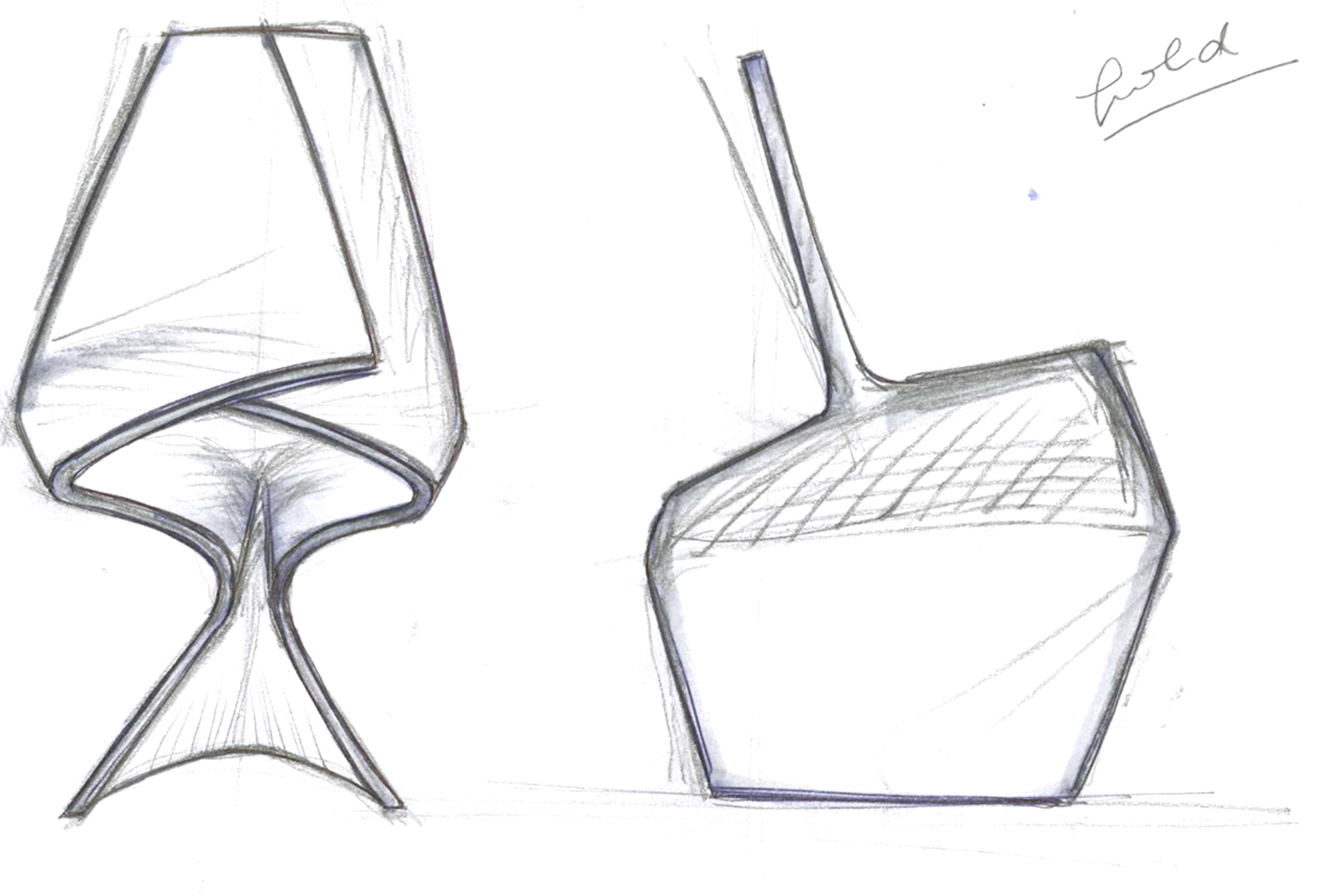
"The start of my process included sketches made in conjunction with paper models. Design No. 4 was chosen for further development."

Sketches for the honest chair

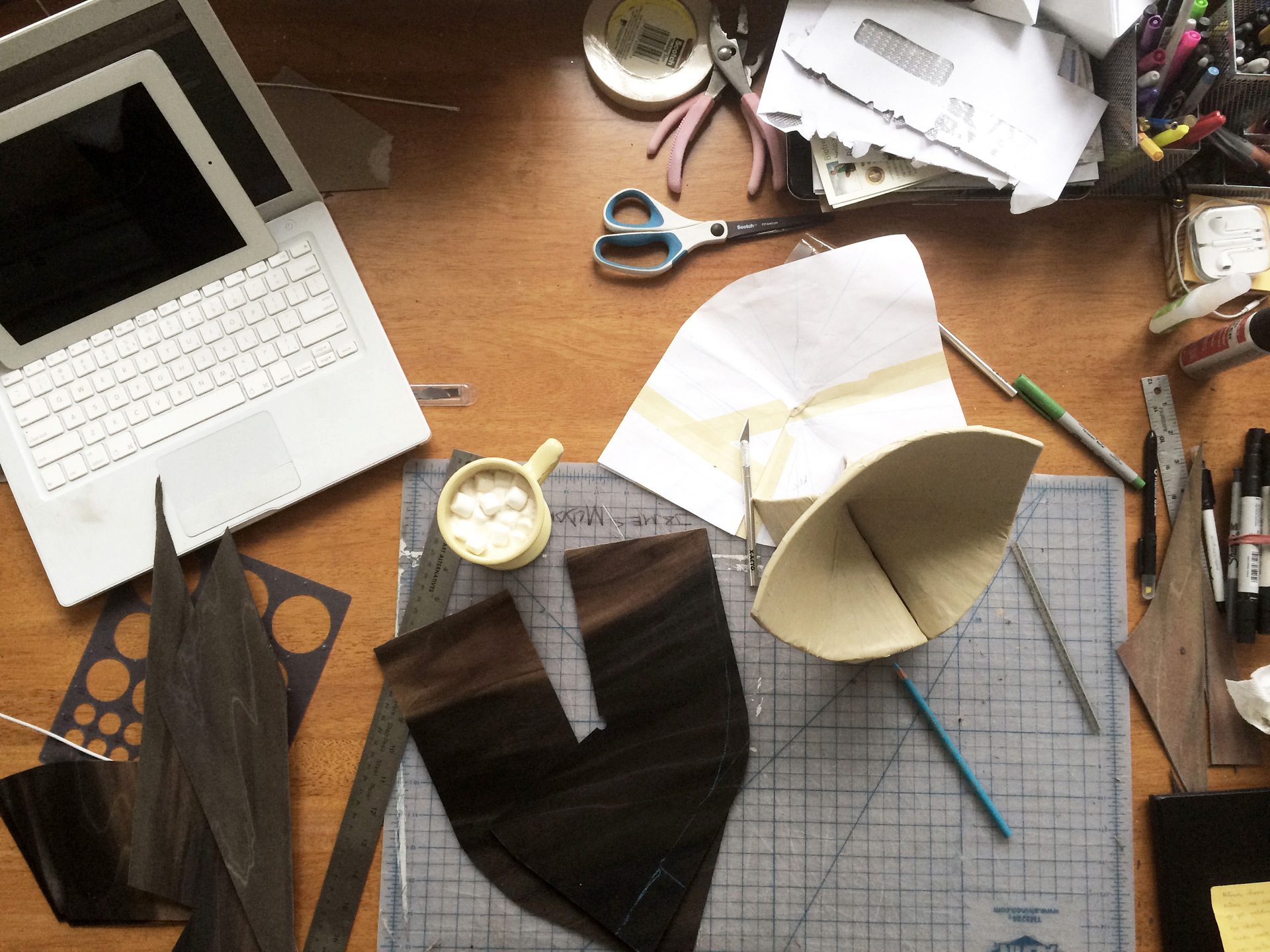
Worktop full of materials, a laptop, and a cup of hot chocolate

"Due to its organic form, shaping the prototype mold by hand was the best approach. I traced the elevations to establish the shape and then cut the foam to its profile using an electric wire, which took many hours."


A video posted by @enyleeparker on


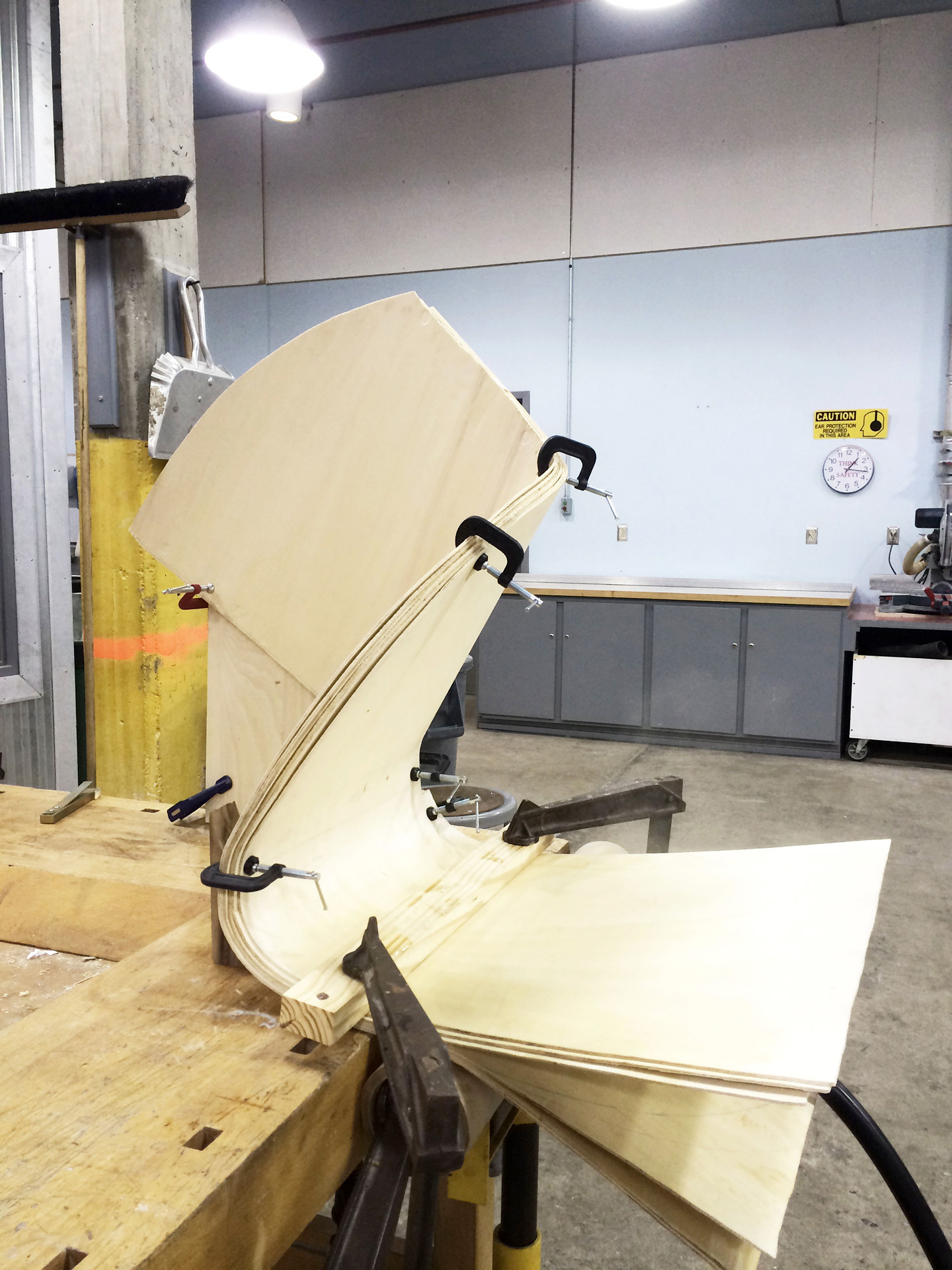
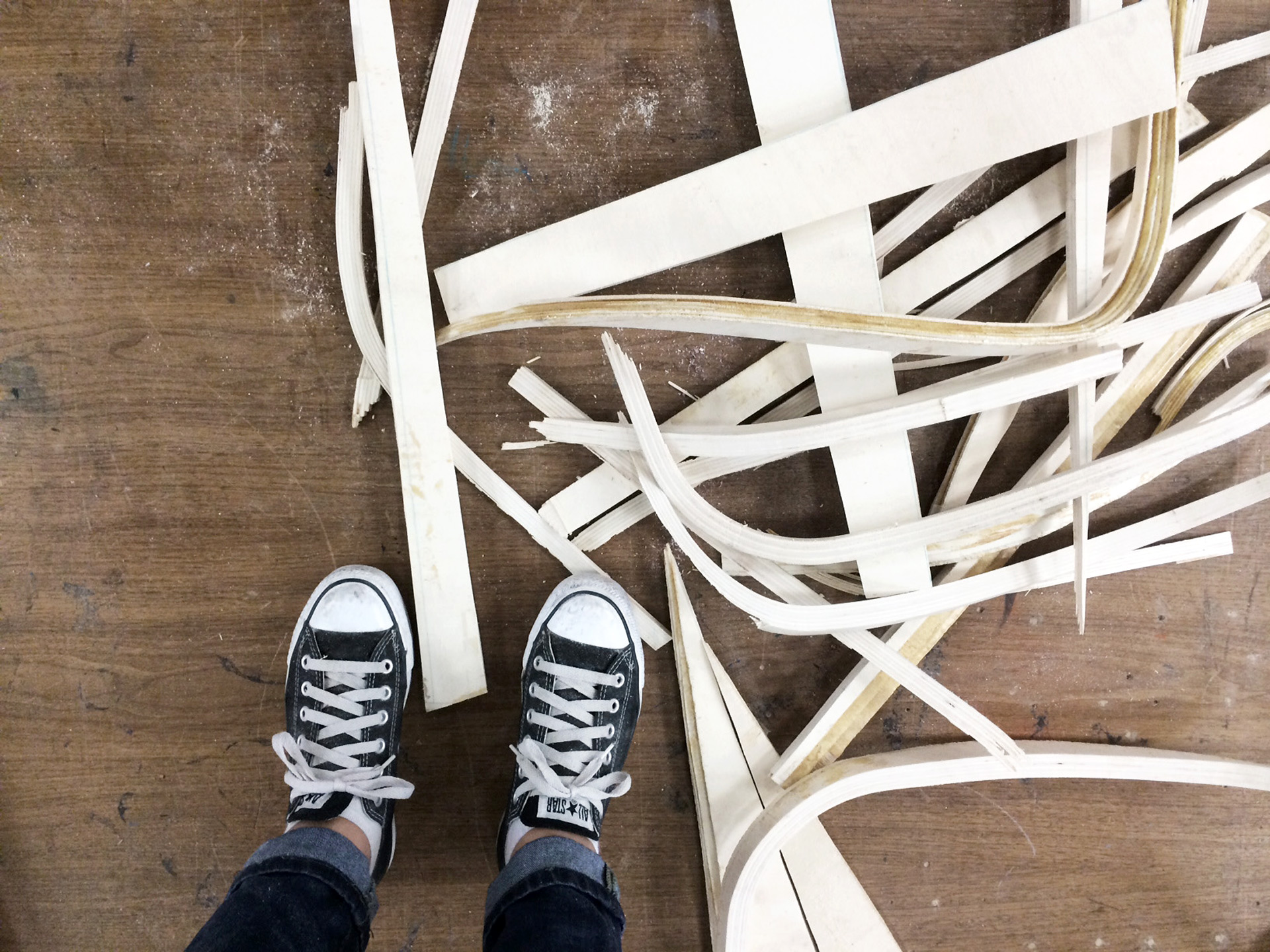
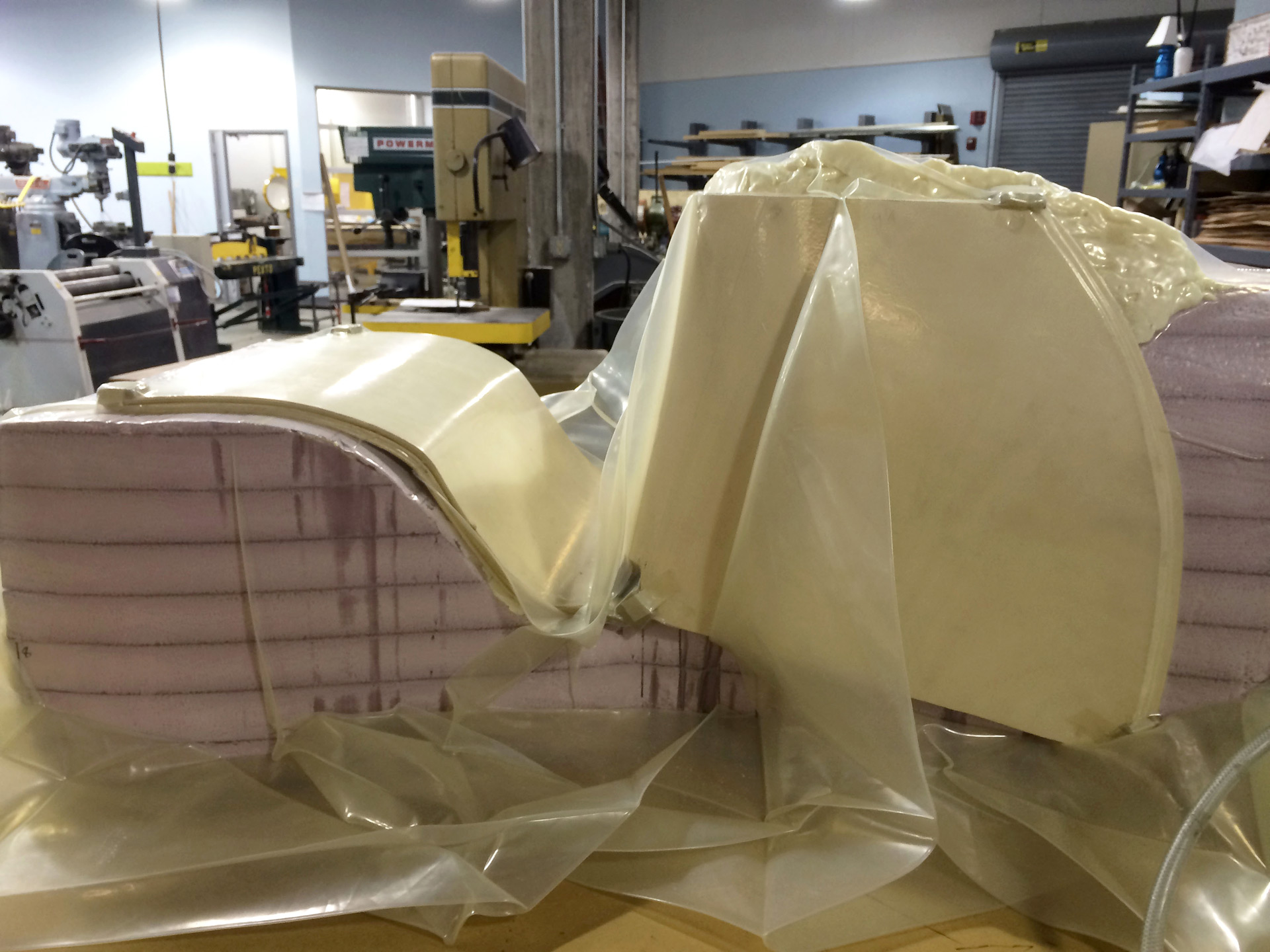
"Because the bending ply prefers to bend in one direction, pre-steaming was necessary for the compound curve. This was done several times until I found the desirable radius. After several attempts, which included some cracking, an acceptable form emerged. Six layers of bending ply were successfully used for the prototype. After steaming each layer, the pieces were left to dry for the gluing process in the vacuum bag with the mold."

Wood being formed into a curve

Scraps of wood

Chair in progress covered in plastic

"The chair was then trimmed to the right shape and height. Biscuits were added to create a flush seam between both shapes, while two stainless steel Chicago screws were added on the slim area where the legs meet for support."

The complete honest chair

The Bienenstock Furniture Library will award Eny a $5,000 scholarship at the High Point Market in April. Eny has a background in interior design, like fellow SCAD graduate student Christian Dunbar, a finalist in the 2015 competition.

Arcal chair

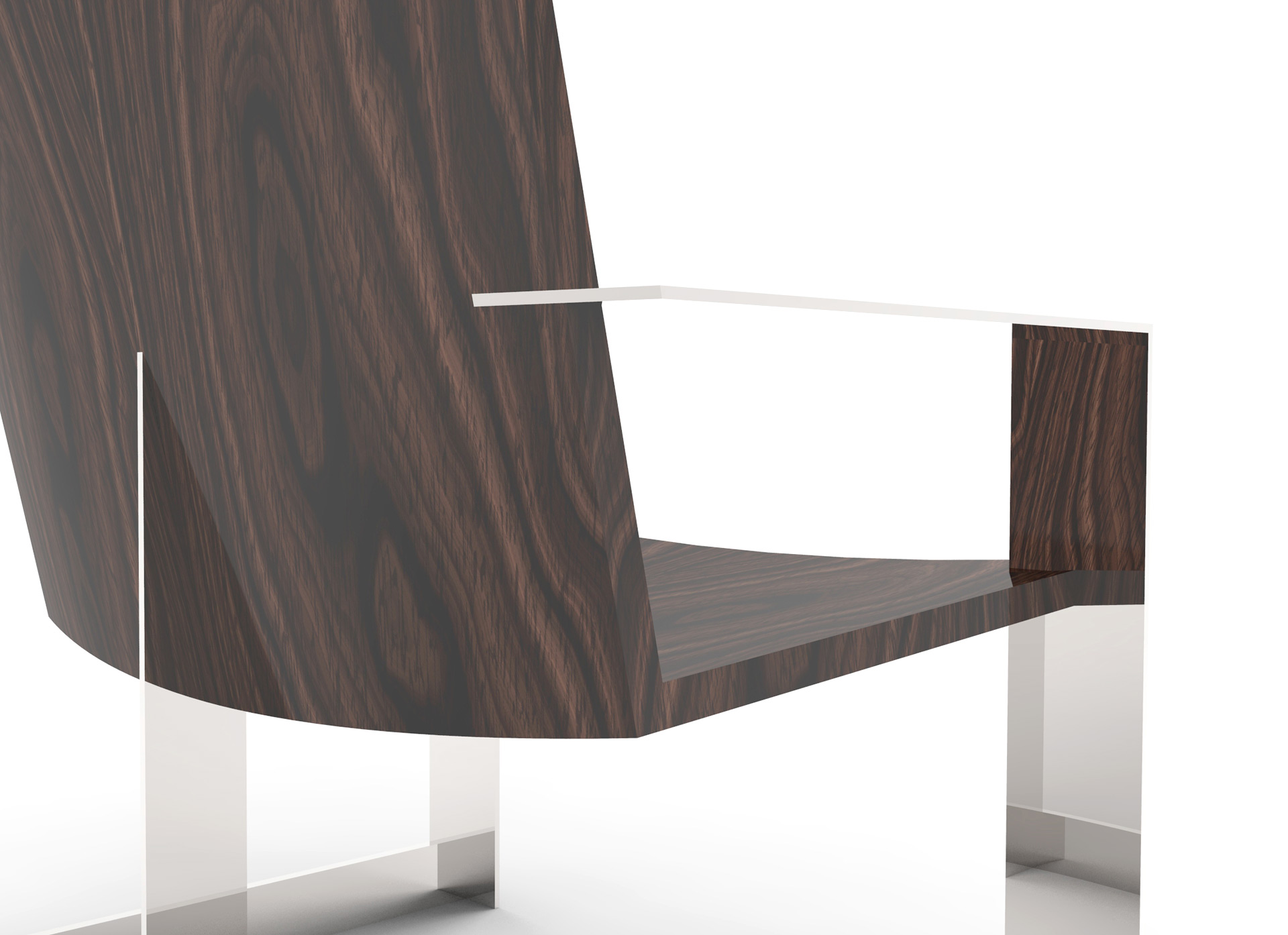
Christian’s Arcal Chair is a salute to designer Milo Baughman. His visit to the Thayer Coggin plant during the High Point Market in October inspired the mid-century modern piece. "During the factory tour, I saw a few unfinished chair backs with slots removed from the backs," said Christian. "I thought it would be interesting to design a piece that celebrates slots like those."

These emerging designers will make sure we take our seats more seriously.

A museum’s worth: artists’ perspectives on SCAD Museum of Art

July
1
2014
By
Tags:

This week, the Savannah College of Art and Design brings home three honors from the American Institute of Architects convention: the AIA Young Architect’s Award, the AIA Fellowship for Emerging Leaders and the 2014 AIA National Honor Award for Architecture for the SCAD Museum of Art. The mission of the latter is to ‘establish a standard of excellence against which all architects can measure performance, and inform the public of the breadth and value of architecture practice.’

But what do artists think? Here, Kehinde Wiley, Liza Lou, Stephen Antonakos, Alfredo Jaar, Rosemarie Fiore and Trenton Doyle Hancock lend an artist’s perspective on the value of SCAD Museum of Art. They join the ranks of exhibiting artists like Jason Middlebrook, Fred Wilson and Nicola López who have responded to SCAD Museum of Art's distinctiveness by creating site-specific installations for the museum.

Congratulations, SCAD Museum of Art, for successfully connecting past and present, emerging artists with established artists, in both form and substance, and for being a magnet the draws the world in to contemplate the transformative power of art and design.

Architecture: a return to art is the way forward

June
26
2014
By
Tags:

What would it look like if architects were allowed to be artists again; as comfortable in the manual and intuitive realms of drawing, painting and sculpture as with parametric modeling and digital imaging? What if we were to reject the limitations of product-driven, systematic design and production and re-engage the full range of tools innately available and refined over the course of millennia?

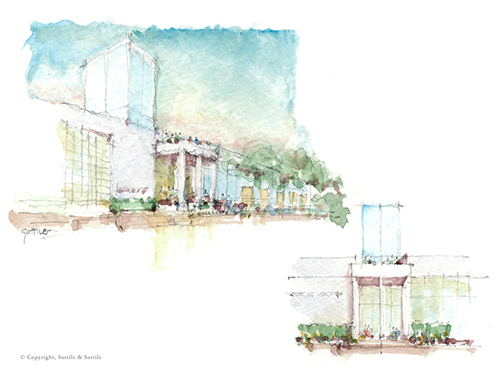
Watercolor of SCAD Museum of Art
Watercolor by Christian Sottile.

The evolution from humanities to technology
Once considered to be among the principal arts, Architecture has passed through a technological revolution over the course of a century, moving from the art based approach of the famed French academy, the École des Beaux-Arts, to the functional dictums and objectivism of the German Bauhaus that would forever alter the course of design and education.

This revolution in education culminated during the digital era. Both the product and process of design entered the last phases of a radical transformation, unmoored from centuries of humanistic origins. Its success proved the potential of something distinctly other, with little emphasis on anthropomorphic, geographic or cultural connection; thereby embracing the full, expansive possibilities of the virtual and the synthetic. This last stage of the revolution has now passed its third decade, and we have grown increasingly detached from humanistic concerns.

An opportunity within reach
Firmly planted as we are in the digital era, the opportunity exists to reconsider the practices that preceded the revolution, to rescue tools that may have been set aside too quickly; tools that will prove essential in charting a way forward for architecture and design. What was jettisoned in the exuberance and upheaval of unprecedented technological innovation is the elusive quality that allows our buildings to speak to us: their humanity - evident and embedded in the pursuit of beauty and the art of making.

Today, this places the architecture profession at an extraordinary moment in history, an era in which we may now synthesize the best of the past with the victories of the digital revolution to embrace a truly hybridized future. It’s not the tired old debate between the École des Beaux Arts, a school of art, or the Bauhaus, a school of building, but rather a ‘BeauxHaus,’ a School of Building Arts.

Dean Christian Sottile shares sketchbook to young woman

Activating a fresh approach
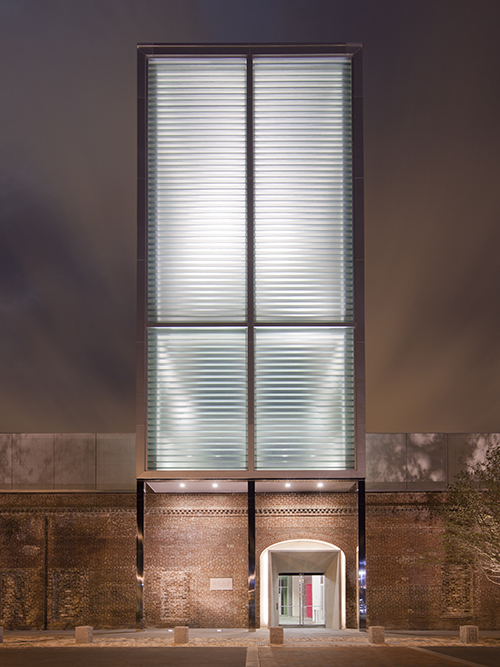
At Savannah College of Art and Design, this approach to architecture is reflected in the SCAD Museum of Art. Built in 2010, SCAD MOA embodies what has long been taught in the SCAD School of Building Arts: the dissolution of boundaries between design disciplines. The museum is a place where the highest ideals of urban design, architecture, interior design, architectural history, historic preservation and furniture design all find distinct yet integrated expression.

Exterior of SCAD Museum of Art at night

SCAD Museum of Art: a case study
So how would a renewed emphasis on the tactile art of making - on the real - change the design process and the built environment?

Wall with support braces
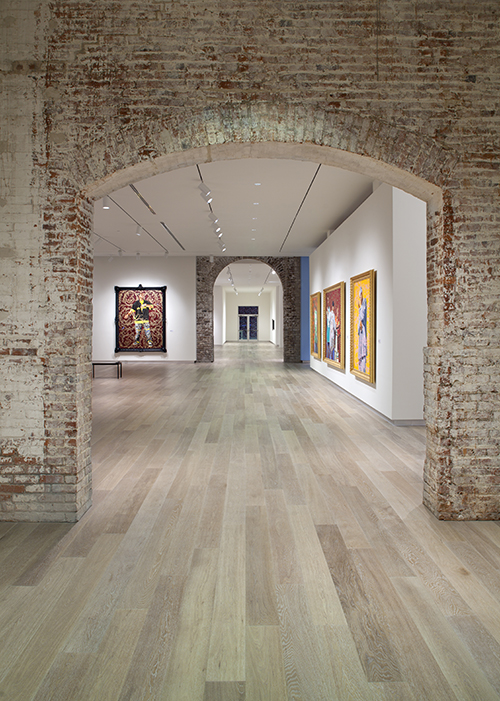
Interior of SCAD Museum of Art gallery

Returning to SCAD MOA as a case study, at its core, the museum is a testimonial to synthesis, created using a design process that included the full spectrum of available tools and methods, from digital modeling and BIM, to physical model making, in situ mock-ups, sketching, painting, and digital collage. It’s a building brought about through a construction process that included full scale enlargements of hand-drawn details to create field templates; that included prefabricated modular building envelope components, integrated with local craftsman, practicing the most ancient of building trades, hand-crafting the building using the human hand and eye as their primary tools.

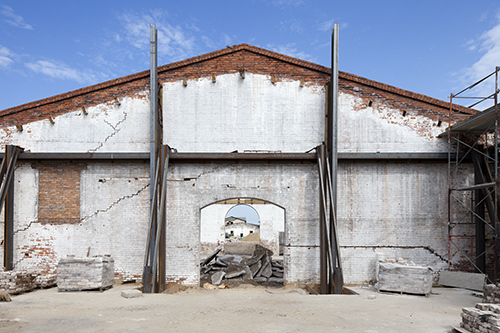
Exterior of wall needing repair
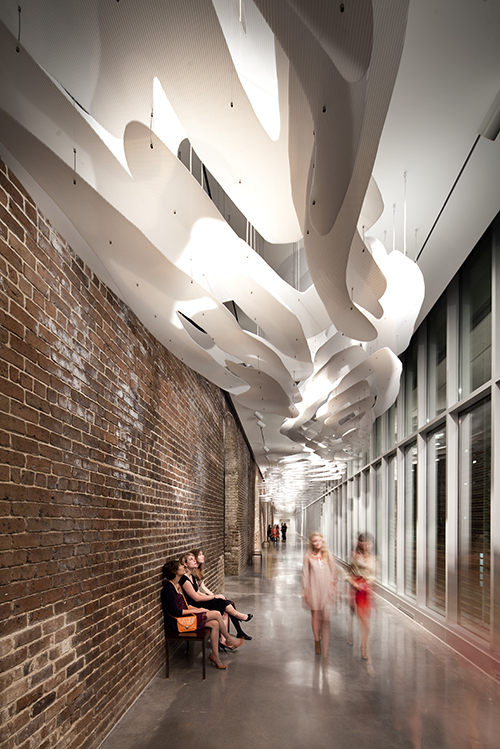
Ceiling installation in hallway of SCAD Museum of Art
The confluence of disciplines embodied by SCAD MOA makes it one emblem for a new order of design that will allow architects to create the next generation of cities, to reject the soulless, placeless design strategies that characterized city centers created or recreated in the latter half of the 20th century; that will empower architects instead to create new places that come alive with a synthesis of art, humanism and delight, as well as technology and innovation.

This is the way forward.

Christian Sottile (M.Arch., 1997) is the dean of the School of Building Arts at Savannah College of Art and Design where he oversees programs in architecture, urban design, interior design, historic preservation, furniture design and architectural history. He is also design principal of Sottile & Sottile and the design architect for the SCAD Museum of Art.

Emerging filmmakers 'see' their dreams come true

June
4
2014
By
Tags:

Updated June 4: Congratulations to director Olivia Riley Day and her crew from Savannah College of Art and Design for winning the Sprite Films Fan Favorite Award for the short film “See Your Dreams.” America voted on “See Your Dreams” and five other student films that were finalists in the 2014 Sprite Films competition at sprite.com/films this spring. In return for racking up the most votes by the public, Olivia and the film’s co-producer Akmyrat Tuyliyev will receive a trip to the American Film Institute’s (AFI) film festival in November and a $5,000 donation to SCAD’s film department.

Posted on April 3: Breaking into film requires more than talent. It requires access and visibility. Olivia Riley Day (B.F.A., film and television, senior) from Savannah College of Art and Design found a direct line to both. She's one of six finalists participating in the Sprite Films program for student filmmakers and vying for a chance to win a contract to produce a Sprite branded project.

With her short film “See Your Dreams” up for the world to vote on now through May 15 at sprite.com/films, we delved into what makes director Olivia tick. She and Akmyrat Tuyliyev (B.F.A., film and television, senior), one of the film’s producers, just returned from CinemaCon in Las Vegas, Nev., where "See Your Dreams" was screened for industry leaders.
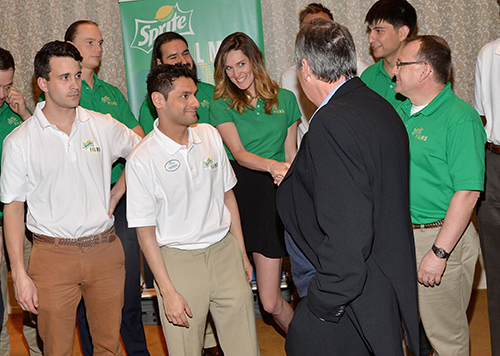
Sprite film finalists

Sprite film finalists
Olivia and Akmyrat, with the 2014 Sprite Films finalists, meet producer-director Ivan Reitman whose film "Draft Day" will be released on April 11. Photo credit: Michael Buckner/Getty Images.

Thread: Name one “pinch me" moment from CinemaCon?

O: The most unforgettable moment of CinemaCon, and probably my life, was at the awards ceremony. The announcer called my name and I stood while big-name stars actually clapped for me. It was kind of insane, and I still can't believe it happened.

T: What inspired the concept for “See Your Dreams”?

O: Everyone in life has had to overcome challenges, and some people face challenges that they believe are too great to overcome. This story is about believing in yourself and always staying true to your dreams, and if you don't give up, your dreams will one day become a reality.

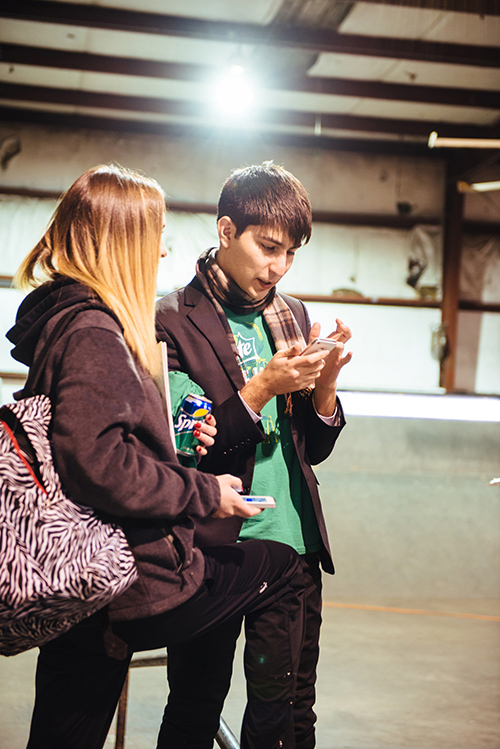
Olivia Day provides direction on set of her film

Students look at cell phones on the film set
Olivia and Akmyrat at work on the McDonough, Ga. set of "See Your Dreams."

T: How did you develop your passion for film?

O: I always loved the escape that going to the movies gave me, however I did not realize my passion for film until I went to three and a half years of business school and knew that I needed to express my creative side to be happy. I am a natural born leader/director so it was only fitting to control the creative side of the one thing in life that I love more than anything, the movies.

T: What are some trends, techniques or technologies that you’re watching?

O: I don't worry about the latest trends or technology past what is going to get my story across the best. If a new technology comes out that strikes my interest and benefits my story I will utilize it, but as of right now I stick to digital. One day I would love to work with the robots Bot & Dolly, they are a very expensive and unique technology that only extremely successful filmmakers get the opportunity to work with.

Student uses camera to shoot filmStudent readies a clapperboard for filming

T: What’s your advice to aspiring student filmmakers?

O: I recommend looking out for opportunities like Sprite Films. The program has allowed me to compete at a higher level, thus gain recognition at a higher level, and has helped me get one step closer to seeing my dreams become a reality. If you are in film school, I recommend that you attend all the film festivals you can because that’s where you can meet industry professionals and establish connections that could lead to greater opportunities once out of college.

T: How has the Savannah Film Festival molded you as a filmmaker?

O: The Savannah Film Festival has allowed me to establish connections with industry professionals I otherwise would not have been able to meet and given me wonderful insight from famous directors that I will carry with me forever.

T: Anything else that you want Thread to know?

O: Never stop 'seeing your dreams,' and if you don't know what they are, do not stop searching until you find them.
'Waste to Art' exhibit redefines reuse

April
30
2014
By
Tags:

One last nod to Mother Earth before Earth Month slips away. Behold the thought-provoking and stunning pieces that comprise the Hong Kong exhibition, "Waste to Art." The show is a result of HSBC's partnership with 29 Savannah College of Art and Design freshmen to raise environmental awareness within the bank's community. In three months time, the students made sculptures composed entirely of recycled waste provided by the bank, including plastic, paper, and electronics. The 23 sculptures, which bear the fruit of the students' diverse academic pursuits at SCAD Hong Kong as much as they do an astute social conciousness, will be displayed at HSBC locations until June 22. Additionally, HSBC is considering adding several of the pieces to its permanent art collection, which includes works by Chinese and western artists, like George Chinnery.

"E-body" by Abinanth Ashok
"E-body" by Abinanth Ashok (B.F.A., visual effects) and Mariam Zamani (B.F.A., graphic design). Made of cardboard, wire mesh, cable wires, clock, motherboards and printer gears.

E-body represents a human race that contains electronic parts which many of us carelessly discard. It foretells the future of mankind if timely precautions are not made.
 

"Lai See/Paper Tapestry" by Rhéa Duckworth
"Lai See/Paper Tapestry" by Rhéa Duckworth (B.F.A., advertising) and Rhea Nayar (B.F.A., architecture). Made of newspaper and shredded paper.

Lai See/Paper Tapestry was inspired by one issue: We sought to portray the falling motion of waste entering the landfill, where 25% of Hong Kong's paper ends up.

"Tech Smog" by Anastasia Simone
Detail of "Tech Smog" by Anastasia Simone

"Tech Smog" by Anastasia Simone (B.F.A., advertising) and Jonathan 'Jay' Lee( B.F.A., advertising). Made of keyboards and wires.

Tech Smog represents a sinister cloud because this deadly form of pollution is not often brought to light. It's about treating e-waste like dangerous pollution. We believe recycling is not enough. We don’t really want to make something look like waste. We want to make something that looks like art, not just screaming 'recycling.' It's just there quietly and sends you the message that you don’t really have to think about it.

"I wasted time, and now doth time waste me" by Inga Nelli
"I wasted time, and now doth time waste me" by Inga Nelli (B.F.A., painting). Made of steel, acrylics and recycled plastic pellets.

The monumental hourglass, with waste trickling down, reinforces the idea that time runs out as waste becomes a permanent part of our nature. Viewers are invited to invert the hourglass.

"Take-A-Waste" by Daniel Kostianos
"Take-A-Waste" by Daniel Kostianos (B.F.A., graphic design). Made of cardboard, cables and bamboo.

Based on the premise of consuming less and reducing more, this piece is made entirely out of discarded computer cables, cardboard and a pair of bamboo sticks rescued from the rubbish bin.

"Plastic is the New Porcelain" by Dawn Bey
"Plastic is the New Porcelain" by Dawn Bey (B.F.A., fashion). Made of plastic bottles and wax.

By making plastic bottles resemble modern-day Ming vases, this piece elevates the status of such material into imperial ornaments, leading viewers to reflect on the widespread usage of plastic in our society today. I melted wax and dipped the plastic bottles and coated them a few times until they look really smooth, like porcelain. I made three types of bottles: plain, a layer of rice paper under a layer of wax, and wax printed on wax. All made of classic Chinese imagery like bamboo and plum blossoms.

"SPLURT" by Andre Ho

"SPLURT" by Andre Ho, (B.F.A., interactive design and game development), Ellen Siu (B.F.A., interior design) and Jenn Lam (B.F.A., illustration). Made of shredded paper and foam.

This piece symbolizes the excessive use of paper in Hong Kong, showing that our landfills are overflowing and warning us that it soon may fill our streets.

"Stained City" by Jeselle Leung
"Stained City" by Jeselle Leung (B.F.A., photography). Made of plastic bottle labels and steel.

When will we start to take care of the place that we live in? A city made from waste prompts viewers to reflect on how they are affecting the community.

"E Bird" by Wesley Yau

"E Bird" by Wesley Yau (B.F.A., visual effects) and James Hou (B.F.A., fashion marketing and management). Made of wires, metal, and CDs.

We love nature; and since birds are fragile creatures, we have created this bird sculpture to raise public awareness of e-waste harming animals in Hong Kong. 
 

DesignIntelligence’s 2014 rankings name SCAD interior design #1

November
12
2013
By
Tags:

For the third year in a row, DesignIntelligence has ranked Savannah College of Art and Design's graduate and undergraduate interior design programs number one in the nation.

Leading professionals and educators determine “America’s Best Architecture & Design Schools.” SCAD’s close relationship to industry and unique interdisciplinary environment are two factors that keep its programs at the top of the list.

Interior design students who study at SCAD benefit from exposure to more than 40 degree programs and the Collaborative Learning Center, through which they solve real-world design challenges for major corporations and brands.

In one of the first such partnerships between SCAD and industry, for example, interior design students worked directly with Benetton and their North American staff to design a new flagship store for the retailer. The students tapped the university's graphic design, advertising, fashion and marketing management, architecture, furniture design, and service design programs to present Benetton with plans for a retail store of the future.

In an increasingly competitive economy where the demand for skilled talent is high, these projects give students an edge, especially within a multi-disciplinary profession like interior design. The result is a success story for higher education and employment for a new generation of designers.

Ninety percent of students who graduated from SCAD’s interior design program in Spring 2012 reported that they were employed or pursuing further education within nine months of graduating.

A few recent projects by SCAD faculty and the 1,500 alumni of SCAD’s interior design program:

Interior of Gritti Palace in Venice

Restoration of Gritti Palace in Venice, Italy by Chuck Chewning.

Interior of New Balance Experience Store in Boston, Massachusetts

New Balance Experience Store in Boston, Massachusetts by Nikole Nelson.

Interior of Nectar Skin Bar in Washington, D.C.

Nectar Skin Bar in Washington, D.C. by William McGovern.

Interior of Celebrity Cruise's Sky Observation Lounge

Celebrity Cruise's Sky Observation Lounge by Professor Charles Boggs for RTKL.

Interior of sales and design center in Dallas, Texas

Gulfstream's 9,300 square-foot sales and design center in Dallas, Texas by Tray Crow.

SCAD will celebrate its number one ranking tomorrow with events in Savannah and Atlanta.

Environmental documentary captures exhilarating footage and a prize

October
18
2013
By
Tags:

If you haven’t noticed, cable television is awash with channels dedicated to wildlife. Discovery, Nat Geo Wild, Animal Planet, all of them rely on the unique craft of environmental filmmaking and, in many cases, the bravery of the crew behind the camera. Despite the often harrowing field conditions, the genre is exploding.

The work of several emerging environmental filmmakers was on display recently at the annual Gray’s Reef National Marine Sanctuary Ocean Film Festival. A team of student filmmakers from Savannah College of Art and Design showed their short film “Ocearch” (Oh-search), a documentary about the king of the underwater jungle, the great white shark.

OCEARCH: Documentary Teaser from Shea Lord on Vimeo.

Ocearch,” which tells the story of a team of dedicated researchers that track and tag great white sharks, took the top prize of the festival’s 2013 Dr. Robert O. Levitt Emerging Filmmakers Competition. The occasion marks the first award and festival acceptance for the crew.

The 14-minute film was one of 11 student documentaries shown at the festival and judged by leading environmental filmmakers, such as Emmy Award-winning documentarian Keenan Smart of National Geographic.

Synopsis:
“OCEARCH is an organization dedicated to finding a sustainable path forward for ocean life by leading unprecedented white shark research expeditions around the world. This documentary follows their struggle to stay mission based and all inclusive in the search for answers to the ocean’s greatest mysteries.”

This weekend “Ocearch” will play at the Riverfront Film Festival in Apalachicola, Florida. Look for it soon at a festival near you.

Credits:
Producer: Courtney Roth, B.F.A., Film and Television
Director of Photography: Leah March, B.F.A., Film and Television
Director: Shea Lord, B.F.A., Film and Television
Editor: Jane Gray, B.F.A., Film and Television
Sound Supervisor: Preston Goodson, M.F.A., Sound Design
Graphic Designer: Alex Krohn, B.F.A., Graphic Design

Jason Hackenwerth sculpture honors SCAD School of Building Arts

October
10
2013
By
Tags:

Everyone likes balloons at a party. In the case of installation artist Jason Hackenwerth’s (M.F.A., Painting) buoyant sculptures, balloons are the party. Miami’s Art Basel, New York’s Guggenheim and London’s Victoria and Albert Museum have hosted Hackenwerth's stunning creations. Last night, he debuted his work in Atlanta at the Savannah College of Art and Design.

The city’s botanical gardens have exhibited Dale Chihuly’s blown glass sculptures but, floating from the sky, Hackenwerth's similar sea-like behemoth made those reveling beneath it feel as though they were sitting on the bottom of a prehistoric ocean. It’s safe to say those in its shadow hadn’t seen anything like Hegemonster’s blue-green glow, which emanated from the terrace above Peachtree Street at SCAD Atlanta. Eighteen feet tall and 21 feet in diameter, Hackenwerth's sculpture was the envy of Midtown’s rooftops.

In the exclusive one-night showing, Hackenwerth unveiled Hegemonster high over the heads of giants of a different kind: captains of interior design and architecture who gathered to celebrate the School of Buildings Arts’ most recent honors.

For the second year in a row, DesignIntelligence ranked SCAD the No. 1 interior design program in its list of “America’s Best Architecture and Design Schools.” This summer, SCAD’s Master of Architecture program became the first in Georgia, and one of the first in the U.S., to earn the new maximum eight-year term of reaccreditation by the National Architectural Accrediting Board (NAAB).

Jason Hackenwerth with Hegemonster
Jason Hackenwerth with his installation

Throughout the reception Hegemonster’s audience couldn’t take their eyes off the otherworldly form. In a nod to the company he kept, Hackenwerth reflected on the sculpture’s construction and the design cues it takes from his alma mater.

“This towering sculpture stands on four strong legs which support a cavernous form,” he noted. “These four legs could be compared to SCAD's four campuses and the supported body, the limitless potential of the students that come to SCAD to begin their careers."

Just like his sculptures, Hackenwerth keeps rising to the occasion.