Skip to main content Accessibility Policy

Where there's a 'Wil'

March
18
2021
By
Tags:

All the virtual world's a stage! Wil, a new feature project written and produced by SCAD Atlanta professor of dramatic writing Dan Rosen, will be presented via virtual reading this Friday-Tuesday, March 19-23 to benefit the Actor's Fund and the Actor's Fund Canada.

An acclaimed cast of esteemed industry luminaries have volunteered their time for the performance. The ensemble includes Eric McCormack (Will & Grace, Perception, recipient of SCAD aTVFest 2020 Impact Award), Oliver Dench (Ride, Pandora), Will Swenson (Broadway's Hair, Les Misérables, Central Park), Jonathan Scarf (Van Helsing, The Equalizer 2), Colm Feore (Thor, The Chronicles of Riddick, Chicago), Luke Humphrey, Lucy Peacock, Zuleikha Robinson, and more.

Set in 1590, Wil introduces us to 26-year-old Wil Shakespeare, a promising but floundering playwright with a wife, three children, a ballooning mortgage, and a new play that just closed on opening night at the Stratford-Upon-Avon Supper Theater. Things look bleak until Wil's trusted agent, Bernie Shylock, lands Wil his first professional gig — running the summer stock theatre program at Elsinore Castle in Denmark. Upon arriving in Denmark, ready to work out his new play Romeo & Juliet, Wil finds the royal Hamlet clan under siege by thieves and murderers looking to overthrow the kingdom. He realizes that putting on a respectable performance of the world's greatest doomed romance might be the least of his worries.

"I originally wrote Wil back in 1994 just as I moved to Hollywood," says Rosen. "Since then, I've written and directed a few films (The Last Supper, Dead Man's Curve, Freeloaders), but Wil holds a special place in my heart, and has always been my favorite script. The story is not just about a young William Shakespeare trying to break into showbusiness, but it also tells my story and all the hoops and obstacles every writer or creative person has to jump through and get around to make it in Hollywood!"

The screenplay reading will be produced by Rosen along with Academy Award winner Richard Middleton (The Artist, Hitchcock, I Love You Phillip Morris) and Kelly McCall (Big Little Lies, The Morning Show, Little Fires Everywhere). Writer and director Sara Botsford (Those Damn Canadians) will direct and co-produce, and Christopher "CB" Brown (The Strain, The Morning Show, Little Fires Everywhere) will stage manage and co-produce.

Tickets can be purchased at MuchAdoAboutWil.com for the pre-recorded Zoom performance to be shown March 19-23. All proceeds and donations from the virtual reading will be donated to The Actor's Fund and The Actor's Fund Canada to support working and performing actors whose livelihoods have been impacted by the Covid-19 pandemic. Since March 2020, The Actor's Fund has distributed over $18 million in emergency financial assistance to almost 15,000 professionals in performing arts and entertainment.

Dan Rosen

Author of Wil, SCAD dramatic writing professor Dan Rosen.


A visit to Colas Modern

March
16
2021
By
Tags:

"When you invite someone into your space, they should see the essence of your intentions," says David Colas (B.F.A., furniture design, 2012), greeting a visitor to the meticulous Colas Modern design studio. The combination workspace and marketplace proves his point: "I'm in love with order flow and how things get made. When the process is efficient, the pieces speak for themselves."

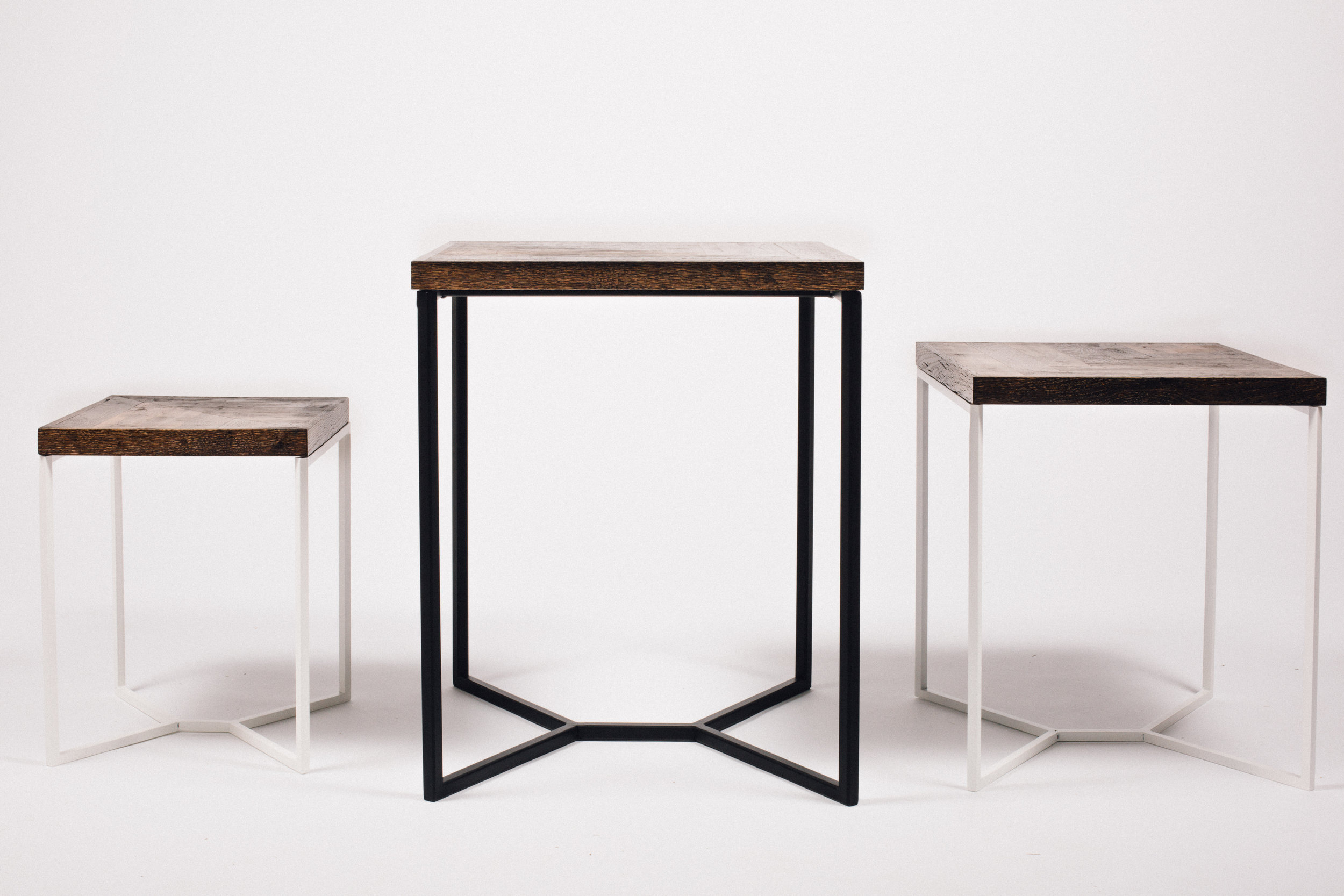
Modern Heritage is appropriately eloquent: hand-hewn furniture, stylish and timeless, the collection at the heart of Colas Modern. David and his wife founded Colas Modern in 2014 after Lara, then a local curator, displayed David's SCAD senior collection in her gallery. Today, the young parents run a burgeoning business where family is key. The Colas lineage of French master craftsmen goes back eight generations, explains David, proudly displaying a prized relic, his great-grandfather's antique wooden hand plane: "When I hold this in my hands, it's almost like a mission. I feel driven to do it, on both good and challenging days."

Tables

David Colas:

Everything with Colas Modern is concerned with wellbeing in your home. Our goal is to bring people in to see the Colas Modern marketplace because that's where you get to see our Modern Heritage collection: the bar top, the shelving units, the stools, the coffee table, that nightstand, everything is part of the collection. All the woodworking and welding, we do in-house. Potential customers can see this is being built here in Savannah and say, "Hey, this is very different than what I could get at Target!"

All our materials are locally sourced. Our wood comes from a supplier in Savannah that I've been shopping with since I was at SCAD in 2010. As a SCAD student, I would stay at Gulfstream Design Center as long and late as I wanted, working in the 3D printing and laser cutting and rapid prototyping areas. SCAD students have an incredible amount of technology at their fingertips. That Gulfstream production space has been a direct influence on how I've designed our shop and how we maintain it. Everything is cleaned and put away so that when we come in the next day, it's ready.

My journey to SCAD began when in 11th grade at Mont'Kiara International School of Kuala Lumpur (MKIS). My plan was to play basketball at a Division III college in the U.S. When my class at MKIS took a trip to Petronas Towers to see an exhibition by the artist Latiff Mohidin, it was an epiphany. A recruiter from SCAD visited MKIS, and SCAD became my first choice.

We offer Colas Modern internships for SCAD students that are about real-world practical training and providing a look at operating a small business. Lara posts the internship positions the SCAD portal for employment. One recent intern, Griffin Feeney, we saw his SCAD portfolio and could tell he made everything himself. We're looking for interns who love the building and fabricating process.

shopSCAD currently sells our Savannah Beehive cutting boards. They're fun, they're original, and have a message. The fruit boards include papaya, avocado, and pear, a nod to our favorite superfoods. The Irobo boards are inspired by my West Cote d'Ivoire heritage, with the look of the board based on African textiles.

Ours is truly a family business. If you want to get better at this trade, pay attention to details. It's extra work to maintain quality, but if you start out that way, it's not something you build towards, it's part of who you are.

Portrait

Visit Colas Modern.


SCADpro Fund digs Deepr

March
12
2021
By
Tags:

"Technology has advanced everyone's access to music," says Deepr founder and CEO Austin Webster (B.F.A., industrial design, 2006). "As music lovers in the streaming era, there's nothing nicer than making a music discovery that speaks to your soul."

At this nexus of exploration and curation, Webster and co-founder and COO Darrell Thompson have created a suite of Deepr products, chief among them the Deepr App, rooted in an unabashed love of music.

"The first time I met Austin and Darrell, we spent hours breaking bread and swapping stories about Muscle Shoals, Muddy Waters, and the future of music and tech," says SCADpro Fund managing director Ray Crowell. "Their passion, business hustle, and devotion to creators made it an easy choice for SCADpro Fund to invest." 

A streaming discovery tool, currently available to download for iOS and Android devices, the Deepr App coordinates with users' Apple Music, Spotify, and/or YouTube accounts, using audio recognition technology to instantly identify a song, as well as diving into advanced options including songwriting, sampling, and musician and production credits. "Our proprietary technology connects the dots between millions of songs, enabling listeners to craft personalized playlists in an instant," Webster explains.

'Deepr' app and web mockups

As a high school student at Ridgeway H.S. in Memphis, Tennessee, Webster hoped someday to design sneakers like the coveted joints he saw in Kicks Magazine, leading him to pursue an industrial design degree at SCAD. He continues to view his SCAD experience as foundational to his business development.

"At SCAD I had an influential professor named Jon Kolko. I told him I was trying to get into athletic apparel, and he encouraged me to take an intro class centered on human and computer interaction. My team's project was a music startup that included a music player where a listener would interact with their device. I came out knowing how to build out a concept and create a user journey, which became two of the keys to the creation of Deepr."

As a music-obsessed youth, Webster scoured the credits in CD booklets to see artist and producer credits, building an associative database in his mind of music he figured he'd dig based on its creators: "That was my process of discovering new music, and learning what I liked." Deepr, then, is a smarter, more attuned way of discovering music than the often-homogenous algorithmic approach of other apps. "The spirit of discovery birthed our company," Webster says. "With the Deepr App, we've eliminated those pain points where you'd have to use Google or Wikipedia to learn more about an artist, album, or song."

An interview with Webster can encompass recommending new female artists like Flo Milli and Arlo Parks, or how the samples of 1970s Motown mack Willie Hutch run through the Grammy-winning anthems of Three6Mafia. It's all love, Webster explains: "Deepr is for all music. You'll find country, pop, rock, hip-hop. Our mission includes making sure creators get the respect and due that they deserve."

"In a time when music listeners have no shortage of options for accessing content, Deepr is offering a substantially more thoughtful option," says Crowell.

In late 2020, Deepr was backed by Google For Startups new Black Founders Fund. Now with the support of SCADpro Fund, financial investment is paired with developmental consultancy.

"Getting SCADpro behind us is important not only from the significant funding, but from the business acumen that Ray and SCADpro executive director Josh Lind bring to the table," says Webster, who served as mentor at StartUp 2020 and 2021, and SCAD FutureProof and Diversity in Design 2020.

"I'm grateful to SCADpro Fund for having made this investment in us, and to Ray and Josh for connecting us with all the other incredible entrepreneurs in the SCADpro family."

Banner photo: Deepr founders Austin Webster (left) and Darrell Thompson.

Award-winning interior designer Jessica Ma

March
9
2021
By
Tags:

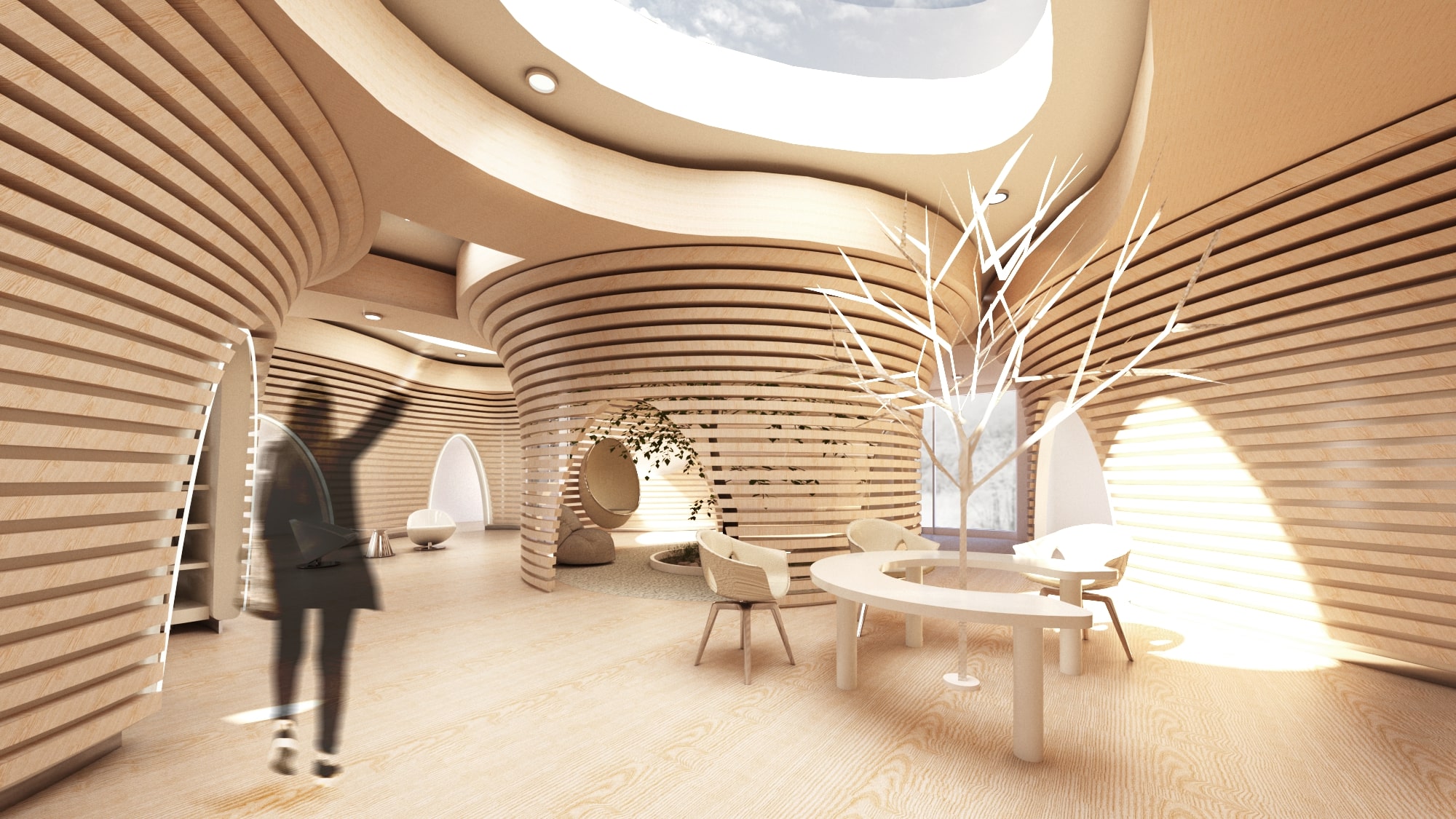
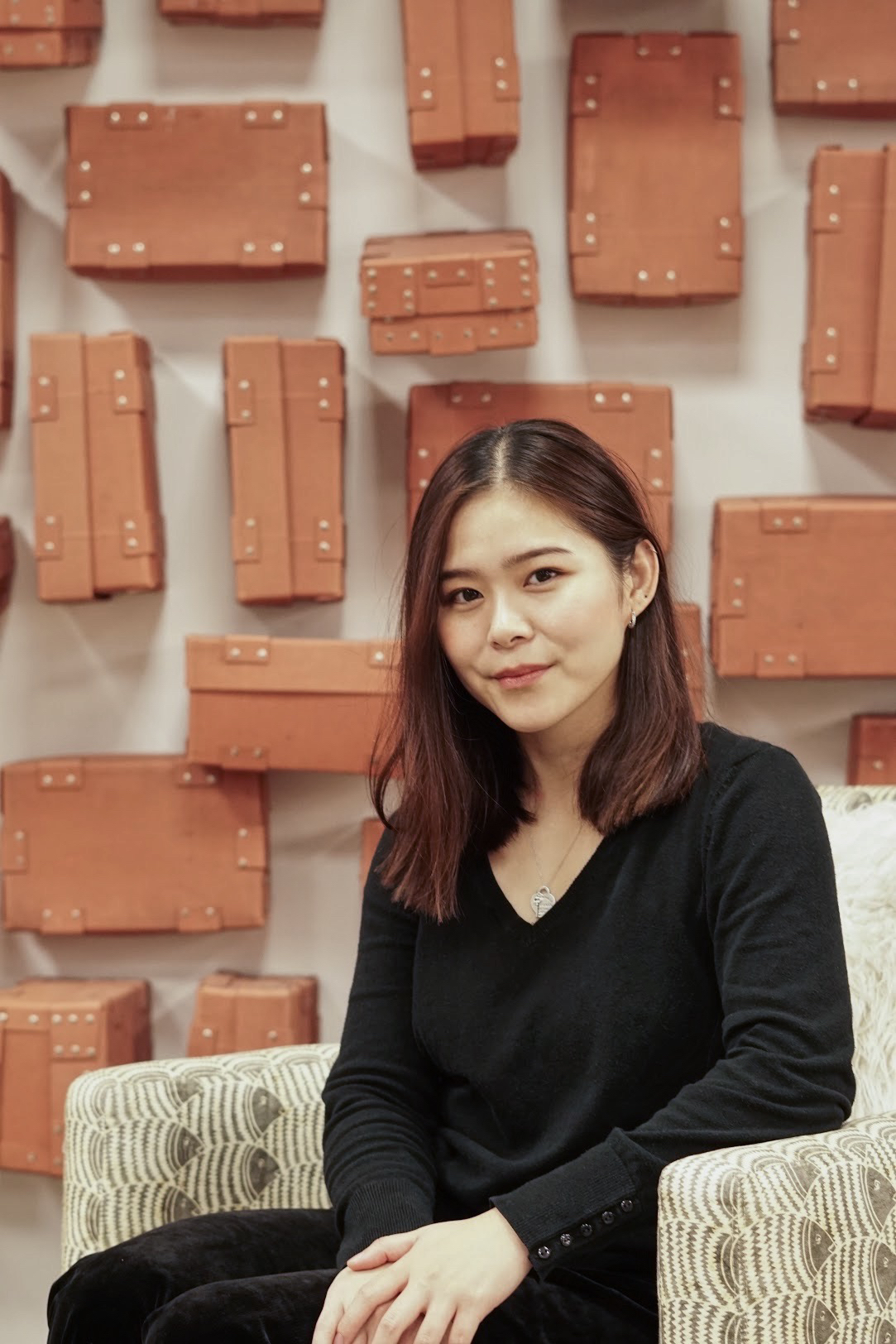
Jessica Ma (B.F.A., interior design, 2020) has been named Emerging Interior Designer of the Year by the International Design Awards (IDA). Her award-winning portfolio focused on helping people, companies, and venues surmount obstacles that hinder human interaction. 

"Interior design is truly a way to make substantial differences in our well-being," Ma says. "As a creator, I shape experiences and the feelings associated with them."

Born in Bloemfontein, South Africa, Ma grew up believing she would be a doctor. As a teenager, her family moved to Macau, where she attended International School of Macau. As a volunteer desk clerk at The Macau University of Science and Technology hospital, Ma saw first-hand how a building's inefficiencies and outdated design components impact the treatment and well-being of patients.

The SCAD Atlanta 2020 valedictorian lives in New Jersey, speaks Mandarin, Cantonese, and English and, in her downtime, plays classical piano.

interior design rendering

Jessica Ma:

As a child, I was always drawing and expressing myself creatively through art. As I got older, I started making my mom take me to open houses in our neighborhood. I loved seeing how people decorated their homes. When I got into The Sims, I played it a lot. My mom should have probably understood then that I was going to become an interior designer.

Before transferring to SCAD Hong Kong in 2017, I was studying medical engineering at The Hong Kong Polytechnic University. While I was doing well in my courses, I realized I had to make a change. I remember telling my parents, "I have to follow my heart. I'm going to be an artist."

At SCAD, I became a different person. I was finally able to embrace my creative spirit. Following my heart and studying interior design was the best decision I ever made.

Interior design truly is a way to help people and make substantial differences in our well-being. We are constantly indoors, and we use spaces to connect with each other hundreds of times a day, whether in an office, home, café, hotel, or other public or private space. As a creator, I shape those experiences and the feelings associated with them.

My professors at SCAD provided guidance, and gave me space and freedom to create. There were no boundaries placed on what was possible, and that allowed me explore groundbreaking ideas. Working with chair of interior design Ryan Hansen, I was able to embrace new concepts on each new space I worked on.

In my submission to the IDA, I included designs I created for The Independent Living, Inc. I began working on the concept my junior year in the class Interior Design Studio II: Specialized Interior Environments. Professor Hansen encouraged us to reimagine and design a space that would assist autistic individuals integrating more fully into society.

The project helped me realize the power of designing for specific industries. For example, healthcare providers are constantly upgrading their facilities as the needs of their patients change. Interior designers are crucial to that effort.

Interior design is a young industry. It will be crucial to our society for years to come. We need safe havens to curate relationships, create connections, and rejuvenate ourselves. I see myself as a difference maker. I wouldn't have gotten here without SCAD.

portrait of jessica ma

Learn more about SCAD interior design.

Alexandra Tunstall: Reading Creatively

March
4
2021
By
Tags:

Dr. Alexandra Tunstall, professor of art history, SCAD Atlanta, is an expert in the Chinese woven tapestry art of Kesi (K'o-ssu). Dating to the Tang dynasty (618 to 907), Kesi thrived for over twelve hundred years, until the end of the Qing dynasty in the early 20th century. The Kesi weaving process was used to create royal garments, tapestries, and paintings, requiring meticulous techniques and a special loom, irreplicable by modern machines. 

Dr. Tunstall has lectured and written about the art form's refinement throughout Imperial China, and is known as a prominent voice on the ancient technique. In October, 2020, New York Textile Month, she delivered her virtual lecture "Technology of Imitation: Silk Tapestry Weave in Imperial China" at the annual Talking Textiles Conference. Her Reading Creatively recommendations focus on artistic mediums, Asia, and the blending of Eastern and Western cultures.

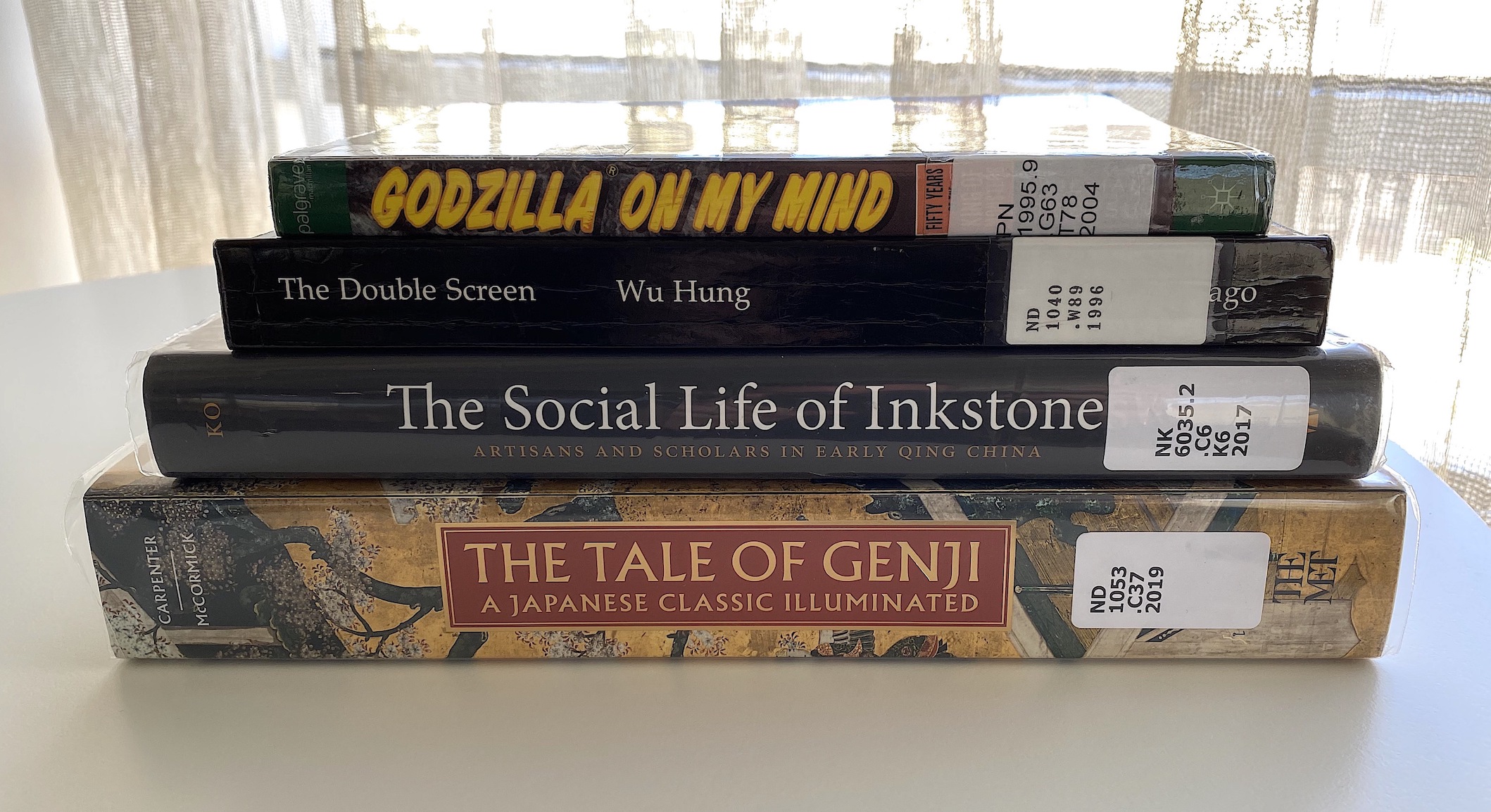
Wu Hung, The Double Screen: Medium and Representation in Chinese Painting (University of Chicago Press, 1996). "This text addresses Chinese paintings and their formats, focusing on the screen. Wu Hung studies paintings, not simply as images, but as objects.  By examining how the viewer's interaction with a work of art creates meaning, Wu Hung gives depth and specificity to the study of scrolls, screens, murals, and fans, among other painting formats."
 
Dorothy Ko, The Social Life of Ink Stones: Artisans and Scholars in Early Qing China (University of Washington Press, 2017). "Ko, a brilliant historian of China, writes about an important object for scholars throughout the history of China – the inkstone. By exploring the object and different histories of making, owning, and using inkstones, Ko writes a history of early Qing China that includes women, artisans, emperors, scholars, and merchants, always touching on the material object that unites these different groups."

Craig Clunas, Pictures and Visuality in Early Modern China (Princeton, 1997). "This book challenges how we define what a picture is and redefines the term "picture" according to how words and images were used in early modern China. Clunas breaks down the divide between artist and artisan, showing how high culture was incorporated into popular culture."

Francesca Bray, Technology and Gender: Fabrics of Power in Late Imperial China (University of California Press, 1997). "In her study of early modern Chinese history, Bray focuses on women and technology. Bray's work has opened the dialogue about technological innovations, and asks the reader to rethink ways textile artisans approached pictorial problems in their weaving, re-positioning pictorial problem-solving as technological breakthroughs in tapestry weave."

William Tsutsui, Godzilla on My Mind (St. Martin's Press, 2004). "Tsutsui, a renowned Japanologist, writes a joyful study of the famous movie kaiju. While focusing on Godzilla, the author incorporates political and cultural history as well as the history of filmmaking in the U.S. and Japan in the 1950s. This book provides the reader with a deeper understanding of how Godzilla was developed and became a beloved icon in Japan and the United States."

John T. Carpenter, Melissa McCormick, and Mónika Bincsik, The Tale of Genji: A Japanese Classic Illuminated (Metropolitan Museum of Art, 2019). "This catalogue for a recent exhibition at the Metropolitan Museum of Art offers a beautiful approach to images from "The Tale of Genji," the most famous work of literature in Japan. The exhibition explores how myths and stories emerged around the author of the tale and how the novel took on different meanings for different readers. This catalogue breaks new ground in giving historical interpretations for a wide variety of Genji images."

stack of library books

Learn more about the SCAD art history department.


Rose B. Simpson's deFINE 'Countdown'

February
26
2021
By
Tags:

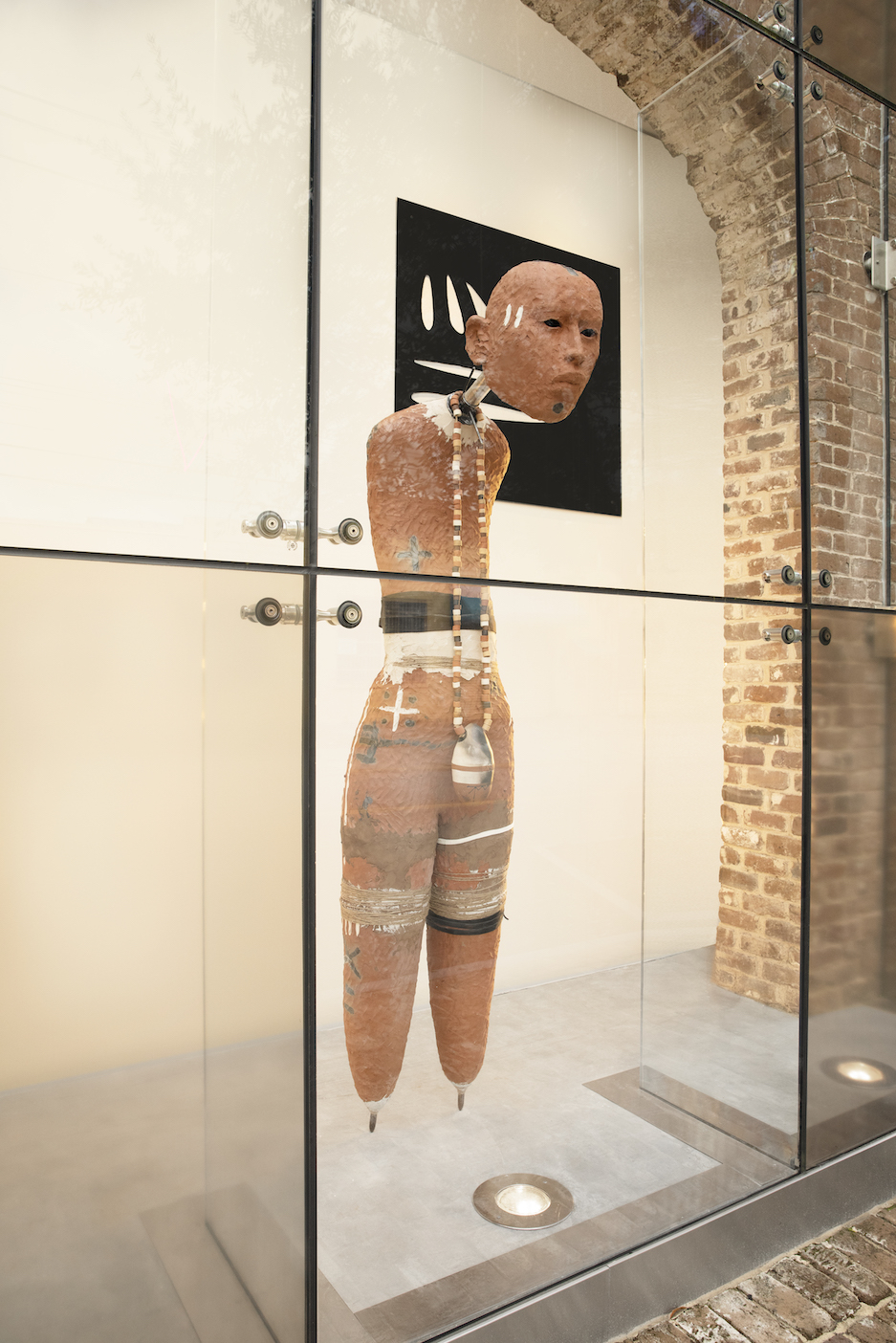
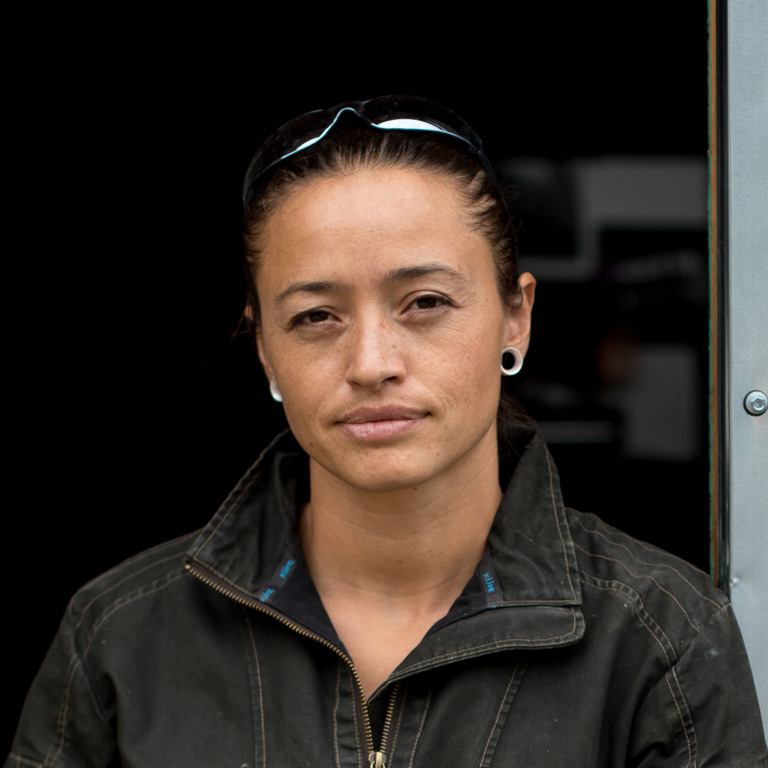
"Being in an agitated state wasn't going to allow these pieces to come into being," artist Rose B. Simpson said of the four large-scale sculptures that occupy the jewel boxes of the SCAD Museum of Art. "The water in the clay is listening to my internal molecular water, so it's going to respond and break. Or explode in the kiln. The tension is already in the work. These really heavy clay works are leaning against this glass…that's tension enough."

Simpson's frequent, sweet laughter when discussing her serious Countdown sculptures seemed particularly suitable to the moment. As she spoke with curator DJ Hellerman during this year's virtual SCAD deFINE ART, the artist was in her home studio in New Mexico's Santa Clara Pueblo, just across the Rio Grande from her tribal center ("If you yelled from the center of the pueblo, I could hear you") while the curator was in the museum in Savannah.

"I can't relate to the feeling of placelessness," Simpson said, "because I had the privilege of growing up in my ancestral homelands, spending time with my great-grandmother in the house that her great-great-great grandmother built."

Simpson credits her mother, the noted artist Roxanne Swentzell, with creating her foundation: "Ceramics was my mom's livelihood, and it fed our entire family. I didn't realize until I was in grad school that I had the privilege of coming from a family that supported itself through its artwork. That's a neural pathway I didn't have to build."

As Simpson peered through her computer screen, it made for a powerful if unintended corollary to her works at SCAD MOA, where the Countdown sculptures — enormous, armless stoic beings, adorned with glyphs — lean against the inside of the jewel boxes, in conversation with passersby.

"I see the glass as a material you work with, not a spacer between human and art," Simpson explained. "It's really a vital point of interaction."

Rose B. Simpson, “Countdown,” 2020, ceramic, metal, epoxy, cement, string, leather, and mixed media.

Rose B. Simpson, “Countdown,” 2020, ceramic, metal, epoxy, cement, string, leather, and mixed media.

Courtesy of the artist and Jessica Silverman.

The Countdown sculptures were created as a commission for SCAD MOA, although Simpson has only ever visited the museum virtually. "The first time I went onto Google maps and wandered around the streets and looked at these things, the metaphor that they provide is spectacular. The shape of the brick cut out from the side of the building is a threshold. The art has to engage with sunlight, with birds, with trees, that all becomes a part of it and that's so exciting."

Metal, epoxy, cement, string, leather, and mixed media all play literally supporting roles in Simpson's Countdown, though her primary material preference is set:

"I keep choosing clay. Clay is full of molecular water. Whatever your intentions are, it listens and responds to those intentions. I keep returning to clay because we have an ancestral, familial relationship, and clay keep me honest. It has the capacity to rip open my chest cavity and reveal what's inside. If we don't have compassion for ourselves, we will self-destruct, just like clay."

Rose B. Simpson

Visit Rose B. Simpson.


Sanford Biggers' deFINE keynote

February
25
2021
By
Tags:

"What is presented to you in an artwork is not the whole story," said honoree Sanford Biggers during his keynote address at SCAD deFINE ART 2021. "There is a lot of code, and a lot of layers, to what you're looking at."

A 2020 Guggenheim Fellow, Biggers was speaking not of a specific piece, but of resonant works that have informed his own practice and world view, from "Rapper's Delight" to the Venus de Milo to the quilts of Gee's Bend. He was referring too to the work in his current solo exhibition Contra/Diction at the SCAD Museum of Art's Walter O. Evans Center for African American Studies, the occasion for his deFINE presentation.

Biggers' keynote was an artwork unto itself.  He integrated aspects of his childhood in L.A., the subsequent mentorship of Spelman College's Frank Toby Martin, and the patronage and friendship of collagist Varnette Honeywood into the hour-long talk. Delivered virtually in an open-to-the-public format, his keynote specifically addressed the concerns and interests of SCAD students. Biggers' allyship was enhanced by the intimacy of the in-camera address.

"I started to consider myself an artist even before high school, maybe junior high," he said. "This was the early 80s, and I was a first-generation fan of Rap music. It was not hip-hop at that point. A cultural revolution was happening. As an early practitioner of the b-boy and b-girl arts, I found myself loving DJs, graffiti, and breakdancing. One of my earliest art experiences was sneaking out of my parents' house and painting graffiti in the train yards of Los Angeles. This was pretty influential to the way I perceive art as not something one does in a vacuum or just in a studio, per se. It has performative elements, it has collaborative elements, and it has resonance beyond the galleries and museums where we typically show. I always strive to make art that can translate between those different contexts."

Biggers discussed pieces from throughout his career, including ground-breaking works "LOTUS," "OM II," and "BLOSSOM." He addressed Shinto singing bowls, melted-down boom boxes, and how art objects need to be not merely created but "activated." He referred repeatedly to the formative experiences of his youth.

"In my high school AP class, I was assigned to paint portraits of the people around me," he said. "The final day, I showed my oil paintings of my family and friends, and the white teacher held up my work and said, ‘Why do you always paint black people? Is this something political?' I was 15. I thought it was a joke. Somehow painting my family and friends was a political statement? What we were considering normative was coming from one particular lens. Right there, I knew there was a polemic set up between my work and what my work was being perceived as. It had a profound effect."

Biggers' keynote culminated in a Q&A where he considered what students should do when they feel they have reached a limit in their art.

"Creativity presupposes output. If you've hit a wall, respect that and put it down for a while. You can overwork a muscle and at that point you're destroying the muscle, and it's time to work on other muscles. Creativity also has many different modes. It is not always output. Sometimes creativity is intake. It can mean taking time off to read, or not to think about art. I guarantee if it's in your bones, creativity will find a way out. You have to not be so hard on yourself sometimes. The creative process is an unwieldy beast — we can't control it all the time."

See Contra/Diction at SCAD MOA.

Get set for deFINE ART 2021

February
22
2021
By
Tags:

Tuesday begins the 12th edition of SCAD deFINE ART, the university's annual program of talks, tours, and exhibitions featuring work by contemporary art's most vital voices. This year's dynamic online programming, presented February 23–25, includes a keynote lecture by renowned New York-based conceptual artist Sanford Biggers, a Q&A with prominent Brooklyn-based artist Marcel Dzama, and a conversation on Dzama's work with famed comedian Amy Sedaris, among additional inspiring talks, gallery tours, and studio visits.

The virtual program complements new exhibitions on view at the SCAD Museum of Art in Savannah and SCAD FASH Museum of Fashion + Film in Atlanta, featuring work by Biggers, Dzama, and other globally recognized artists including Christto & Andrew, Kate Cooper, Helen Frankenthaler, Emily Furr, Carlos Garaicoa, the Haas Brothers, Paulina Olowska, Brandon Sadler, Rose B. Simpson, and Albert Watson. These artists' evocative works present new ideas or different ways of being in the world and encourage greater reflection on the narratives we inherit, the identities we create, and the roles we are expected to play. While many of the artists challenge the status quo, their unique perspectives on art and culture ultimately offer the viewer a sense of hope for the future.

"SCAD deFINE ART 2021 marks another first in the event's 12-year history — our inaugural virtual edition," said SCAD President Paula Wallace. "In a season of reimagination, SCAD's renowned fine arts program showcases the shifting explorations and revelations of self. From Sanford Biggers' ‘future ethnographies' to Kate Cooper's representations of the feminine ‘ideal,' SCAD deFINE ART constructs and deconstructs identity through works by internationally celebrated contemporary artists. This year, your home and SCAD museums become one."

For more than a decade, SCAD deFINE ART has brought together an international roster of culture-defining arts leaders to engage with audiences through curated experiences and encounters with thought-provoking work. This year's programming includes a series of virtual conversations and a new season of exhibitions at SCAD museums featuring evocative works that encourage greater reflection on the narratives we inherit, the identities we create, and the roles we are expected to play, and ultimately offer a sense of hope for the future. SCAD deFINE ART 2021 offers opportunities for connection and contemplation, uniting our university and local communities across nations, generations, and mediums.

define art graphic

Top image: from Carlos Garaicoa's A City View from the Table of My House, presented as part of deFINE ART 2021.

SCADpro Fund laces up with Q4 Sports

February
17
2021
By
Tags:

"We founded Q4 to change the shoe game," says Quintin Williams (B.F.A., industrial design, 2011), chief global designer at athletic and leisure apparel company Q4 Sports. "We are building something that will fundamentally revolutionize how athletes and influencers work with their brands."

Williams and co-founding business partner Aaron Sokol launched Q4 Sports in 2016. Today, SCADpro Fund has committed to providing investment backing and creative business consultancy for the young company. "Quintin is a next-level designer who understands what makes shoes desirable and functional at the highest competitive level," says Ray Crowell, SCADpro Fund managing director. "For us, partnering with Q4 means backing an entrepreneur whose business mind and values make him a pioneer in his industry."

At Q4 Sports, Williams works with athletes, influencers, and entertainers to create distinct, highly functional products that reflect the individual designer. "We cultivate true partnerships," he says. "We want to help our athletes monetize their full potential, and we are here to help them capitalize on their extraordinary talent."

Williams grew up dreaming of one day playing in the NBA. Standing at six-feet-seven-inches, it's not difficult to imagine the life-long Chicago Bulls fan gliding up down court, draining seventeen-foot jump shots, wearing his favorite pair of Q4 495 Lo SP White Streaks. "I always wanted to play. Designing sneakers was my hobby when I wasn't on the court."

As a SCAD industrial design student, Williams participated in an internship with Simple Factory Group (SFG). "Michael Mack, who was at SFG and is now a SCAD accessory design professor, helped ignite my entrepreneurial spirit," Williams explains. "He showed me that designing my own shoes was achievable if I learned the business."

In 2010, as a SCAD junior, Williams was selected to participate in the inaugural Pensole Footwear Design Academy. "I was one of twenty-three students from across the nation to work with D'Wayne Edwards, the design director of Brand Jordan, and godfather of sneaker design," Williams says.

Shortly after graduating in 2011, Williams won Power Force Apparel's Design the 'YOU' Shoe competition and took home the twenty-five-thousand-dollar cash prize. "After that competition I got offers to join all of the big brands; Nike, Adidas, Puma, New Ballance. I turned them all down to lead the design team at Power Force. I wanted the challenge of establishing something new."

Williams spent the next five years fully immersed in every aspect of the footwear design industry. "I lived in Dongguan, China for a time, meeting suppliers, learning the machinery process, researching where the materials were produced, all in the understanding that it would lead me to where I am today."

Williams and Q4 Sports currently partner with two NBA stars, E'Twaun Moore and Langston Galloway, both of the Phoenix Suns. "Working with E'Twuan and Langston has been special," Williams says. "They have design input from the colors of the shoes to the special touches to the box the shoes come in. These are their shoes, and we work hard to make sure they see themselves represented when they hit the court."

Williams is committed to building his brand from the ground up. As a Black entrepreneur in a space not traditionally rich in diversity, Williams says, "I'm thankful to SCADpro Fund for the commitment to Q4 Sports. I understand the importance of allies in this space, and the SCADpro team have been incredible."

Quintin Williams

Register here to tune in to Quintin Williams 'Guests and Gusto' happening Thursday, Feb. 18, 2 p.m. The virtual talk is free and open to the public.

Expanding VISIBILITY

February
16
2021
By
Tags:

You can't see Chris Fonseca boogie without smiling. The incantatory ritual of Vivian Chinasa Ezugha may make you cry out. Witness Ellice Patterson's beguiling pas de deux with an unexpected partner, and tune in to Syrus Marcus Ware's afrofuturistic transmission to ancestors. These, and other performances, are all part of VISIBILITY: A Selection of Black Deaf and Disabled Performance Artists, the amazing, ongoing online experience curated by Ikouii founder Aleatha Lindsay (M.A., arts administration, 2013).

"When I decided to curate this exhibition, I knew I had to build an assemblage of strong, unapologetically Black artists with work that celebrates the aesthetic sensibility of the Black disabled community," Lindsay says. "While each work presents a singular narrative, they all capture the ephemeral and enduring moments of the Black disabled experience. Every work within VISIBILITY explores the themes of race and disability, and importantly the intersection of the two."

VISIBILITY is free. Visit Ikouii to watch the performances. Dancer and choreographer Antoine Hunter, soul singer-songwriter Lizzie Emeh, and disabled arts pioneer Leroy F. Moore also all feature to stunning effect. Additionally, throughout the month of February, the Ikouii Instagram is home to virtual studio visits with VISIBILITY artists. Lindsay: "We want to provide a space specifically for our Black disabled artists to share and engage."

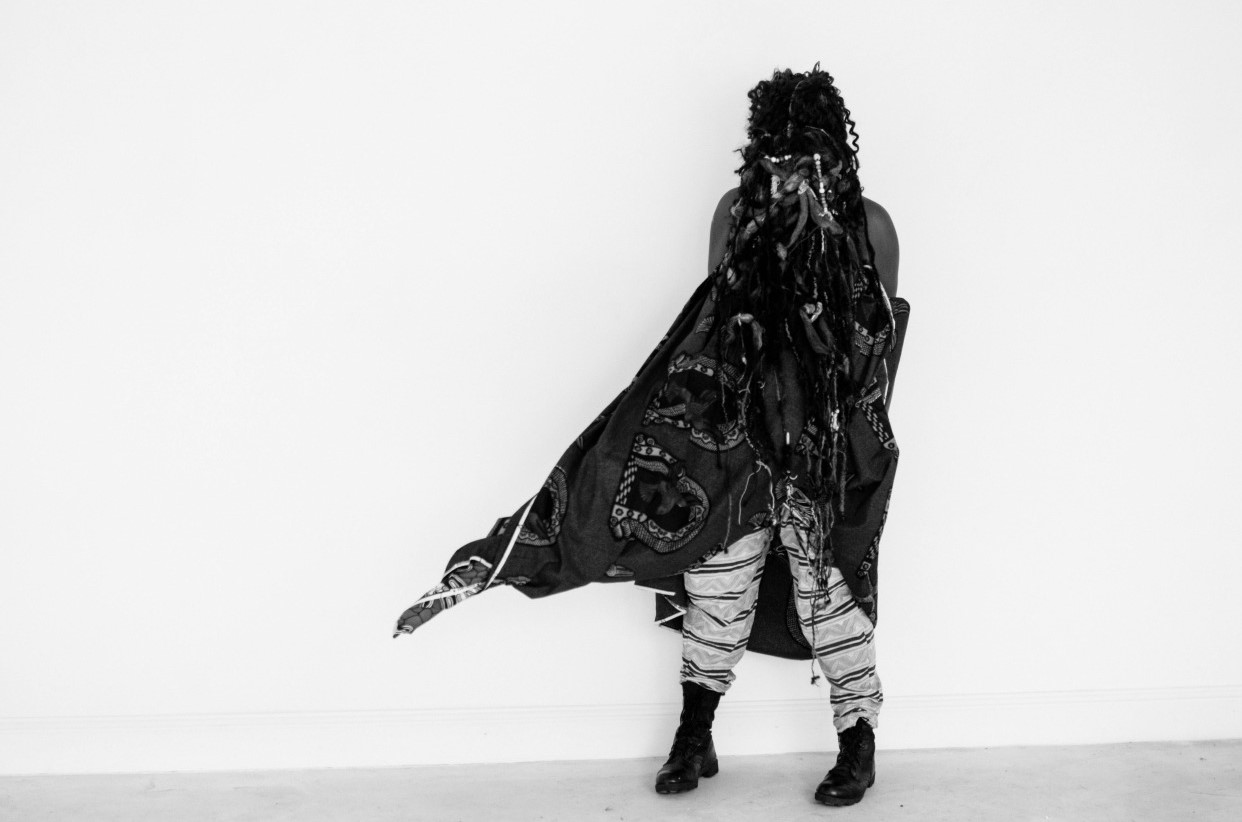
black and white photo

Photos of Vivian Chinasa Ezugha by Rosie Cooper are the iconic representative portraits for VISIBILITY. "These photos are from Chinasa's series Because of hair; the dichotomy of culture and identity," Lindsay explains. "Celebrating the intersection of Blackness, culture, humanity, and strength, the photos are really representative of the themes examined in VISIBILITY."

The precedent for Lindsay's work was set at SCAD. "I majored in arts administration, which is now called creative business leadership. I knew early on that I wanted to work with artists and audiences with disabilities, so I loved that my professors allowed me to structure my interests in disability arts, accessibility, and inclusion. My SCAD experience facilitated invaluable connections with arts organizations including Cobb Energy, Atlanta Celebrates Photography, and the Oglethorpe Museum of Art." Lindsay's senior thesis, a program designed for children on the Autism spectrum and their families to enjoy an art museum experience, won the SCAD Thesis Award.

Now this alumna is curating, collaborating, and connecting on another level. Check out VISIBILITY on view through March 10, 2021.

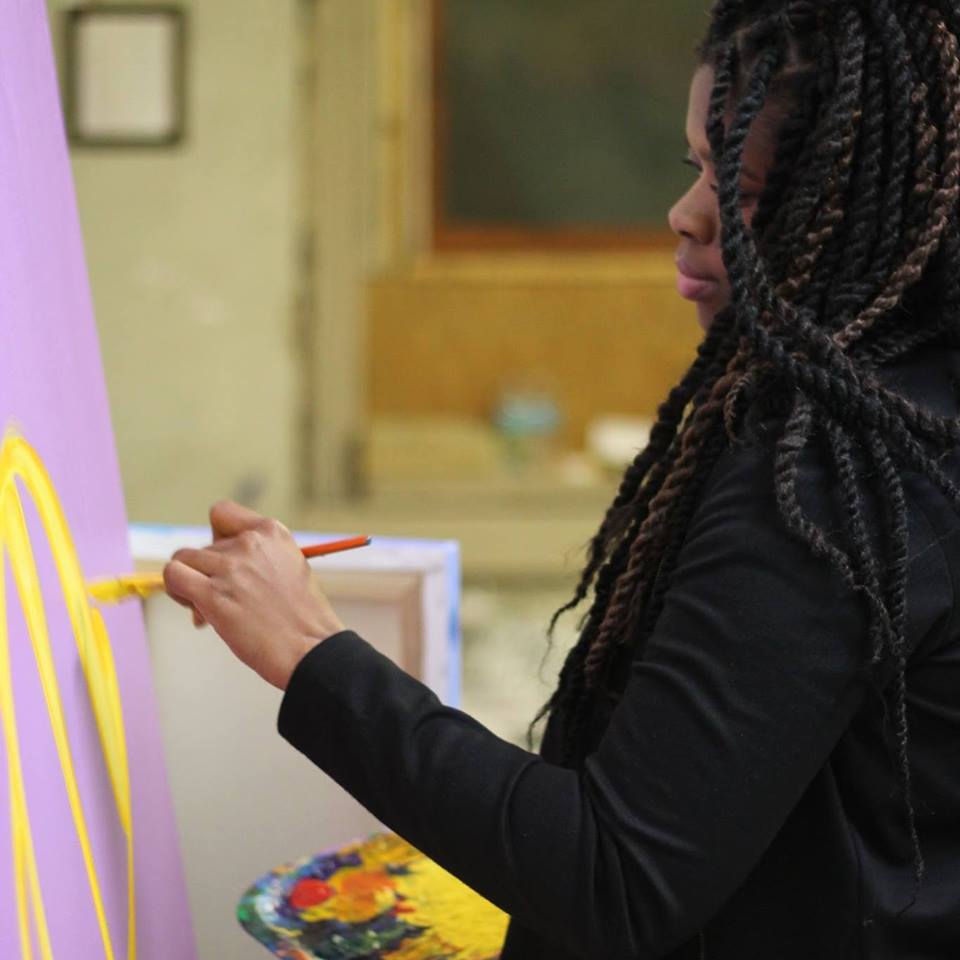
person painting at easel

VISIBILITY is brought to you by Ikouii, the Atlanta-based organization founded by Aleatha Lindsay.