Skip to main content Accessibility Policy

Celebrating 2026 FSF winners

January
16
2026
By
Tags:

Passion is in fashion: SCAD students from the university's elite fashion and business programs are due to receive more Fashion Scholarship Fund awards this year than any other institution nationwide.
 
SCAD is proud to announce that 20 talented students from the prestigious School of Fashion and De Sole School of Business Innovation have been named recipients in the 2026 Fashion Scholarship Fund (FSF) program. This achievement marks a new SCAD record, surpassing last year's historic 18 wins and securing SCAD's position as the university with the most scholarship recipients in the country for the FSF Class of 2026.
 
"SCAD earning twenty Fashion Scholarship Fund awards for 2026 is a record-breaking achievement, made even more significant with Rylee Funfsinn representing the FASM, luxury, and beauty department as a Top Four finalist," says fashion professor Andrew Fionda.
 
Funfsinn (B.F.A., business of beauty and fragrance, 2026) was named a Top Four Finalist for the Chairman's Award Scholarship with a $25,000 grand prize. She will present her case study live to an audience of top fashion industry design leaders and executives at the 2026 FSF Gala in New York City on March 23, 2026.
 
"It is an incredible honor to be named a finalist for the prestigious 2026 FSF Chairman's Award," says Funfsinn says. "I am so grateful to be surrounded by a talented group of scholars, the phenomenal FSF community, and the dedicated faculty at SCAD, whose constant guidance and support empower students to achieve their greatest aspirations."
 
Six SCAD students were named Virgil Abloh Post-Modern Scholars. Madison Osborne (B.F.A., fashion, 2026), Jasmine Cox (B.F.A., fashion, 2026), Zaria McLeod (B.F.A., fashion, 2027), Jenna Daoud (B.F.A., fashion marketing and management, 2026), Zuriel Quashie (B.F.A., fashion, 2026), and Chloe Miles (B.F.A., fashion marketing and management, 2026) were selected as recipients of the namesake scholarship founded by the late fashion designer Virgil Abloh. Created to foster equity and inclusion, the fund supports the next generation of Black fashion leaders by providing scholarships to students of academic promise. These students each receive a $10,000 scholarship and gain access to career-focused support, internship opportunities, and mentorship from industry leaders.
 
"We are immensely proud of our scholarship recipients, and every student who committed to the rigor of the case study process," says Fionda. "This level of ambition, discipline, and creative excellence continues to set SCAD apart."
 
FSF provides scholars with intensive mentorship, industry networking, internship and career opportunities, professional development, and direct access to the world’s top companies and most influential leaders in fashion and related business sectors. Since 2019, SCAD students have earned more than 90 scholarships from the FSF, totaling over $1.2 million.
 
2026 SCAD student FSF Scholarship winners:
 
SCAD FSF Scholars ($10,000 scholarship)
Rylee Funfsinn (B.F.A., business of beauty and fragrance, 2026) (Top Four Finalist)
Gianna Petitto (B.F.A., fashion marketing and management, 2026)
Ellie Warnke (B.F.A, fashion, 2026)
Shaely Stabler (B.F.A, fashion, 2026)
Trevor Lloyd (B.F.A., fashion marketing and management, 2027)
Emmalee Allbritton (B.F.A., fashion marketing and management, 2026)
Ella Epstein (B.F.A., fashion marketing and management, 2026)
Maeve Murray (B.F.A., fashion marketing and management, 2027)
Catalina Olsen (B.F.A., fashion marketing and management, 2026)
Karla Quinones (B.F.A., fashion marketing and management, 2026)
Tess Clemens (B.F.A., fashion marketing and management, 2026)
Lily Arnold (B.F.A, fashion, 2026)
Gabriela Gastone-Guilabert (B.F.A., fashion marketing and management, 2027)
 
Virgil Abloh Post-Modern Scholars ($10,000 scholarship)
Madison Osborne (B.F.A, fashion 2026)
Arya Shah (B.F.A, fashion 2026)
Jasmine Cox (B.F.A, fashion 2026)
Zuriel Quashie (B.F.A, fashion 2026)
Zaria McLeod (B.F.A, fashion 2027)
Jenna Daoud (B.F.A., fashion marketing and management, 2026)
Chloe Miles (B.F.A., fashion marketing and management, 2026)
 
The SCAD School of Fashion offers a dynamic, innovative curriculum in design and construction, fashion history, and merchandising and marketing. Fashion students hone their creative and intellectual thinking, master inventive design skills, and gain the practical expertise necessary to succeed in global fashion careers. SCAD students and alumni continually innovate at the forefront of fashion and design, and are known around the globe for their industry-redefining labels and ventures. SCAD fashion alumni elevate design studios at global brands like Chanel, Jean Paul Gaultier, Thom Browne, Marc Jacobs, The Row, and Anthropologie, and dress cultural icons like Beyoncé, Rihanna, Zendaya, Michelle Obama, Madonna, Tracee Ellis Ross, Heidi Klum, and Jodie Turner-Smith.

Banner photo (left-to-right): Rylee Funfsinn (B.F.A., business of beauty and fragrance, 2026), Arya Shah (B.F.A., fashion, 2026), Jenna Daoud (B.F.A., fashion marketing and management, 2026), Chloe Miles (B.F.A., fashion marketing and management, 2026).

'Cornellskop': pride of lions

January
8
2026
By
Tags:

"If they like you, they like you. If they don't like you, they kill you."

There is a wild, willful glint in Luke Cornell's eye as he speaks of lions, cheetahs, and hyenas in "Cornellskop: Freedom From Fear," the capstone thesis film by Nathan Oliva (B.F.A. film and television, 2025). The founder of Cornellskop Animal Sanctuary in Bot River, South Africa does not flinch. "The fact that I'm still alive, and they trust me, is a tribute to them," Cornell says.

Directed and written by Oliva, produced by Jack Bart (B.F.A., film and television), and edited by Grace Lavery (B.F.A. film and television, 2025), the documentary short shows the beauty of zebras and ostriches mingling across the verdant veldt. Cornell feeds a lion named Mojo hunks of raw meat as narrator Peter Coyote intones: "Amid South Africa's troubled wildlife industry, places like Cornellskop offer a refuge for animals rescued from the brutal realities" of poaching and corruption.

"Cornellskop: Freedom From Fear" has been newly nominated for the Television Academy Foundation's 45th College Television Awards. Pretty sweet for a film whose origin dates to Oliva watching YouTube as a kid growing up in Robbinsville Township, New Jersey.

"Watching travel videos, Cape Town became a dream destination for me," Oliva says. "When I got to SCAD, my first friend, James Ross Fraser, happened to be from Johannesburg, and that summer I visited South Africa and just fell in love with Cape Town."

Following his sophomore year, Oliva returned to South Africa to intern at a film company called Moonsport, where he met siblings Dixie and Luca Cornell. "One day Luca said to me, 'You probably think all South Africans have lions as pets. Well, actually I do. They're in my backyard.' I thought that was funny, then I put two and two together and we went and visited Cornellskop. I met their father, Luke, and I thought oh, if I can tell this story, it would be amazing."

Cornellskop BTS zebra

Earning his stripes: on location at Cornellskop.

In November 2024, Oliva began filming. "It was my first time directing, normally I'm a DP. I knew I needed to tell a story people might never experience firsthand." Shooting with lightweight FX6 and FX3 cameras, he and his South African crew soon accumulated four terabytes of footage.

Enter editor Grace Lavery, who had met Oliva in Senior Project I: Preproduction (FILM 431). Oliva was able to send proxy files via LucidLink from South Africa to Savannah, and Lavery began sorting and assembling the footage "almost immediately."

"As we dug into the footage, it became clear that the focus was on the animals being targeted, and Luke Cornell's mission and deep passion for protecting and working with them," Lavery explains. "We reworked the film a thousand times, some versions leaning more emotional and music-heavy, others more grounded in the reality of the poaching world. For us, it was really about doing Cornellskop justice and telling their story in an honest, respectful way."

Cornellskop vertical cheetah

Connecting the dots: Luca Cornell meets a cheetah.

SCAD film and television professor Chris Brannan guided the project's development from the start. "Nathan has a strong cinematographic eye, a genuine curiosity about the world, and the ambition to follow through on challenging work," Brannan says. The professor also taught Lavery in Production Lab: Picture and Sound Editing (FILM 474). "One of Grace's greatest strengths is her willingness to explore every possible avenue in service of the material."

The SCAD team looks forward to the College Television Awards ceremony in Los Angeles along with three days of professional development events March 26-28, 2026. "Cornellskop is a strong example of what a SCAD capstone film can be when students bring together skills developed across the curriculum," says Brannan with admiration.

Meanwhile, "Cornellskop: Freedom From Fear" will continue to screen at festivals, advancing Luke Cornell's sobering message: "If you don't treat your animals properly, then there's not much hope for us as humanity, because that's indicative of how you treat people."

Cornellskop poster

Connect with Nathan Oliva on LinkedIn and Instagram.


Xiaoyue Shen: from glitch to grace

January
8
2026
By
Tags:

From pixel glitches and coffee aromas to United Nations reports and poetic brand identities, Xiaoyue Shen (M.F.A. graphic design and visual experience, 2025) designs at the intersection of emotion and innovation. Her portfolio spans tactile branding, retro-digital experiments, and global collaborations. Each project reflects her belief that design is both seen and felt.

"For me, design starts with emotion," Shen says. "I want people to feel something before they even think about what they're seeing."

Xiaoyue Shen Woodkite

Textures and forms combine for Woodkit Coffee Bar.

That philosophy shines through her work. In her Woodkite Coffee Bar identity package, Shen turned the feeling of looking up at a kite into a daily experience. "The café shifts from coffee to cocktails as the day unfolds. I wanted the brand to feel like imagination itself: light, curious, and free," she says. Shen blended handcrafted textures and telescope-inspired forms to capture that sense of wonder.

Her conceptual book, A Story of HAL, takes a different path — one that embraces the imperfect. "I've always been fascinated by the ‘flaws' of early digital culture," Shen explains. "The pixelation, the flicker, the awkward beauty. The ‘90s internet wasn't perfect, but it was full of courage and mystery."
 
The project, with its silver foils and broken image codes, reimagines 2001: A Space Odyssey as a tactile tribute to that era of exploration. The balance of concept and craft earned Shen an Official Selection in Communication Arts magazine's 16th Annual Typography edition, Jan./Feb. 2026. A Story of HAL demonstrates how she turns imperfection into visual poetry, proving that even the language of error can become art.

Xiaoyeuy Shen glitch

'A Story of HAL,' a narrative project exploring AI, trust, and control through cinematic storytelling.

That same curiosity and precision led Shen to create The Everyday Space Traveler, a sensory-driven visual narrative that explores how isolation and imagination coexist in modern life. The project's poetic execution and experimental typography earned her a 2025 Red Dot Design Award, one of the industry's highest honors.

"Winning Red Dot showed me that personal emotion can still resonate globally," she says. "It's proof that honest storytelling matters."

At SCAD Atlanta, Shen learned how design creates real-world impact. Collaborating on community and global projects from a large-scale installation with SCADpro x Coca-Cola to her graphic design internship with the United Nations Development Programme (UNDP), she discovered how to balance creativity with accountability. The Coca-Cola collaboration culminated in a large-scale artwork installed outside the historic Fox Theatre.

"That project taught me patience and respect for process," she said. "It took a long time, and I understood how much communication and coordination were needed to protect brand copyrights."

Shen remembers the moment her mentor, SCAD associate chair of graphic design Sam Eckersley reached out to share that the design had finally gone live.
 
"Seeing it in the real world after all that collaboration was surreal. That's when I truly felt what design for impact means," Shen says. "I like to say that I live in a retro future. Technology changes, but our emotions don't. That's the timeless part of design."

Xiaoyue Shen UN

Selected work from Xiaoyue Shen's internship with United Nations Development Programme.

Connect with Shen on LinkedIn and view her portfolio.

Learn more about top-ranked graphic design programs at SCAD.

Ruei Shah: from doodles to design

December
10
2025
By
Tags:

A tiny flower doodled in the corner of a school notebook. That's where the practice of Ruei Shah (M.A., illustration, 2023) began.

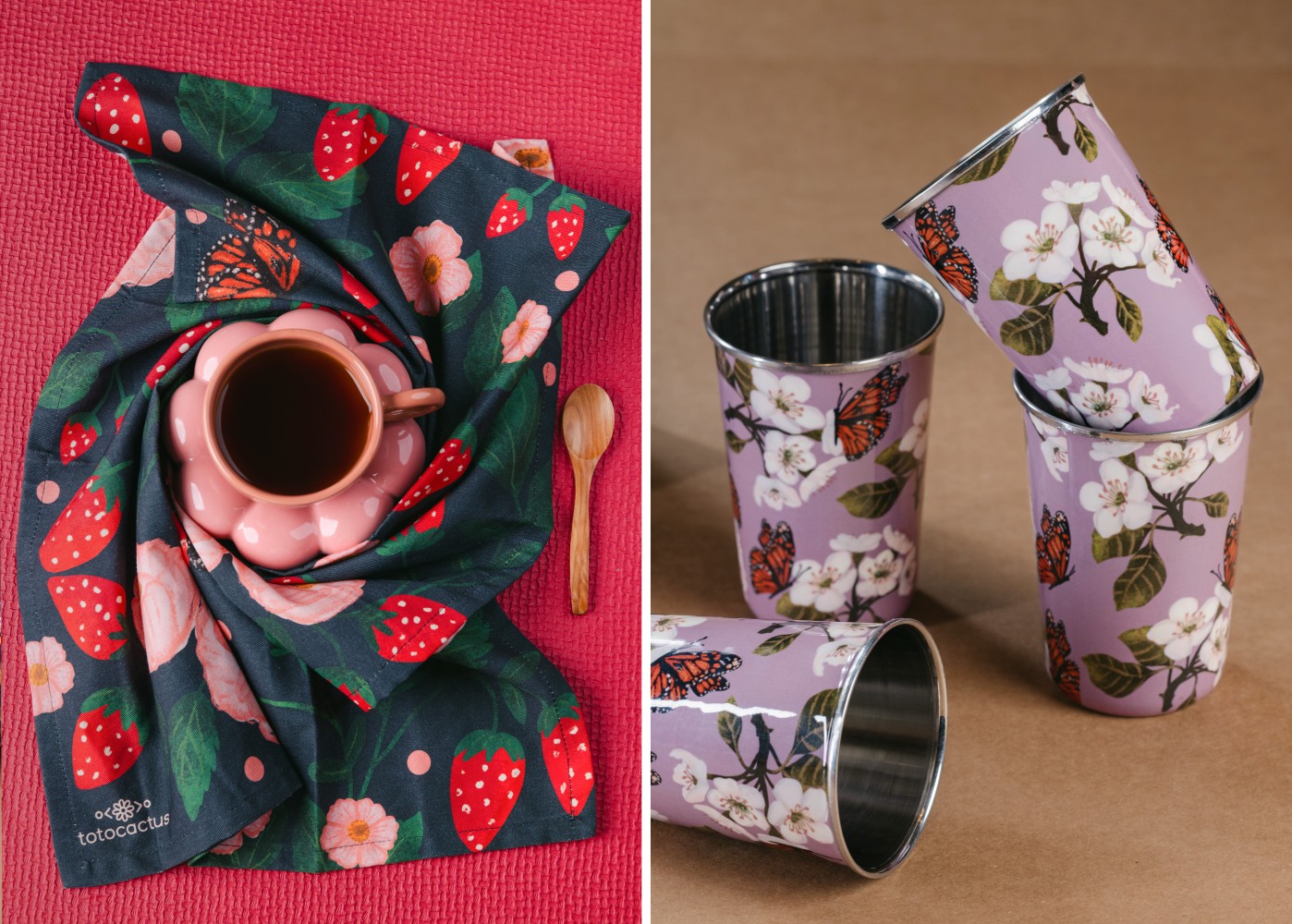
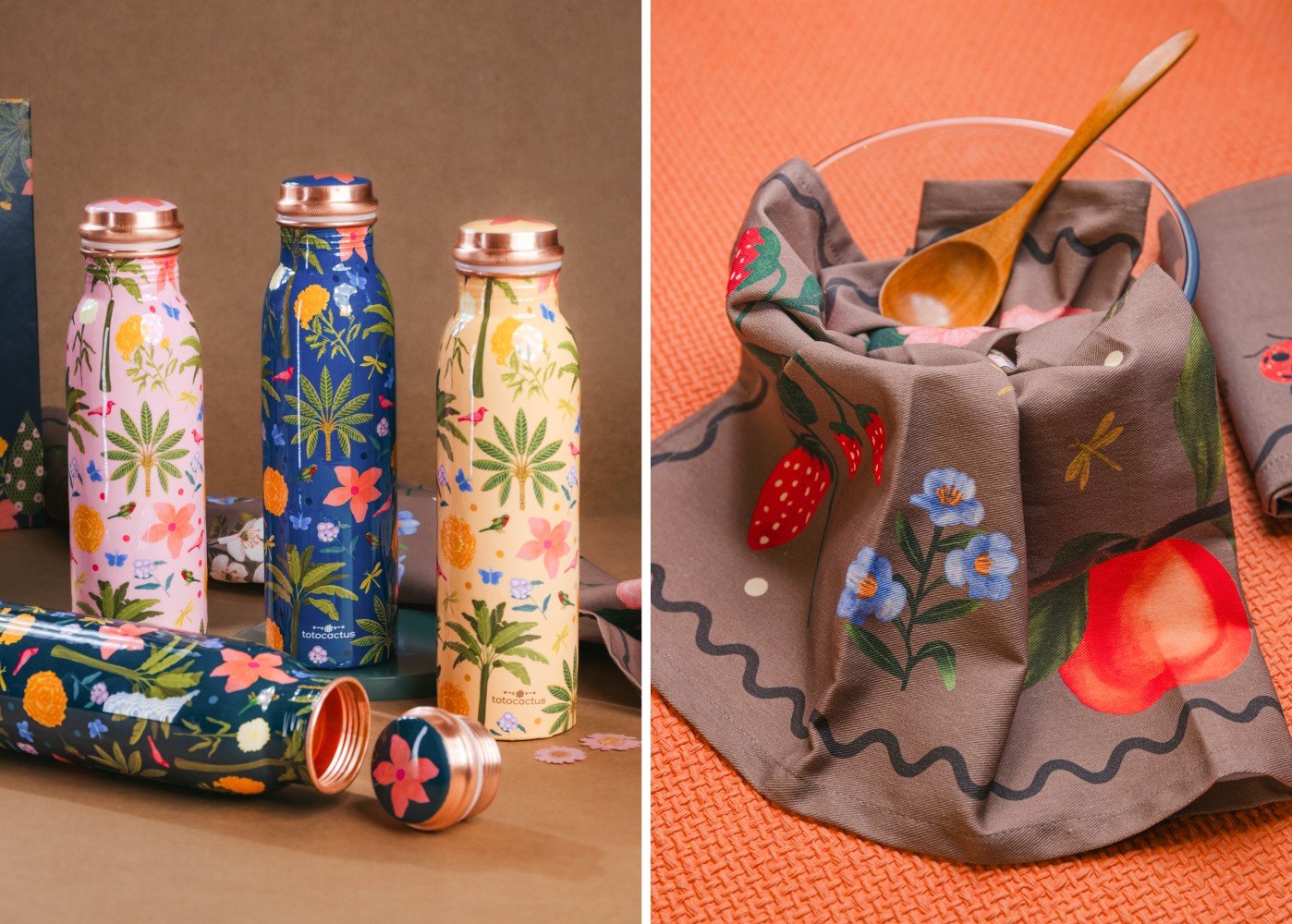
Today, the artist's margin doodles have blossomed into a creative career honored by the International Design Awards and the Society of Illustrators Los Angeles. Shah's illustrated stationery and home goods brand Totocactus is currently expanding across the U.S. and India.
 
The brand is "a dream in the making for over ten years," Ruei says. Sparked by her fascination with paper, binding, and print techniques, Totocactus centers storytelling in everyday objects: notebooks, textiles, keepsake boxes. Patterns repeat like refrains in a song; variations keep the story alive.
 
"Every pattern and every motif must have a purpose, [they are] carriers of meaning, guiding the viewer through the narrative," Ruei explains.

Totocactus goods 2

Doodle bugging: homewares design by Ruei Shah. Copyright © Totocactus, 2025

She starts with research and story, sketches extensively (at least ten variations), refines in grayscale for rhythm and hierarchy, and moves to color when the concept and feeling are clear.

Growing up in India ("I was surrounded by layers of visual information"), she absorbed traditional forms including Warli, Gond, and miniature painting. That journey yields illustrations rooted in place yet fluent across cultures.

Corporate experience sharpened the production demands of her craft. As a graphic designer for Hobby Lobby, Ruei learned the invisible rigor behind beautiful things: audience calibration, color management, print readiness, and trend cycles. The discipline manifests in Totocactus releases, where concept, palette, and production are engineered together from day one.

"Preparing files for print taught me precision from setting correct color profiles and resolutions to thinking through how a design will translate onto paper, fabric, and other materials," she says.

Totocactus goods 1

Flowered up: homewares designs by Ruei Shah. Copyright © Totocactus, 2025

Early in her career, Ruei delivered more than 30 watercolor motifs for a clothing brand that had only briefed five; later, she walked into the store and saw an entire collection built from her work, a moment that "taught me to value my work, charge fairly, and trust my instincts."
 
On tools, she's pragmatic. A hybrid analog-digital workflow lets her iterate quickly without losing hand-drawn warmth. AI is a reference companion, not a replacement.

"AI can generate incredible deliverables, but it still lacks the emotional depth and human touch that come from lived experience. Right now, I see AI as a collaborator that helps with ideation and speed," Ruei says.

For students and early-career creatives, Ruei's counsel is direct: keep learning, build a portfolio even before client work, design with purpose and audience in mind, and protect your value. "Knowing your worth is one of the most empowering lessons you can carry with you."

What's next? Totocactus is preparing launches in India alongside new collaborations in textiles, kitchenware, ceramics, "affordable yet luxurious" pieces that bring "a little magic into people's everyday lives. Ruei continues to pursue book illustration, where narrative and image meet.

And when she's stuck?

Shah smiles. "When I first started drawing, every doodle began with a simple flower. It's still a creative reset button for me."

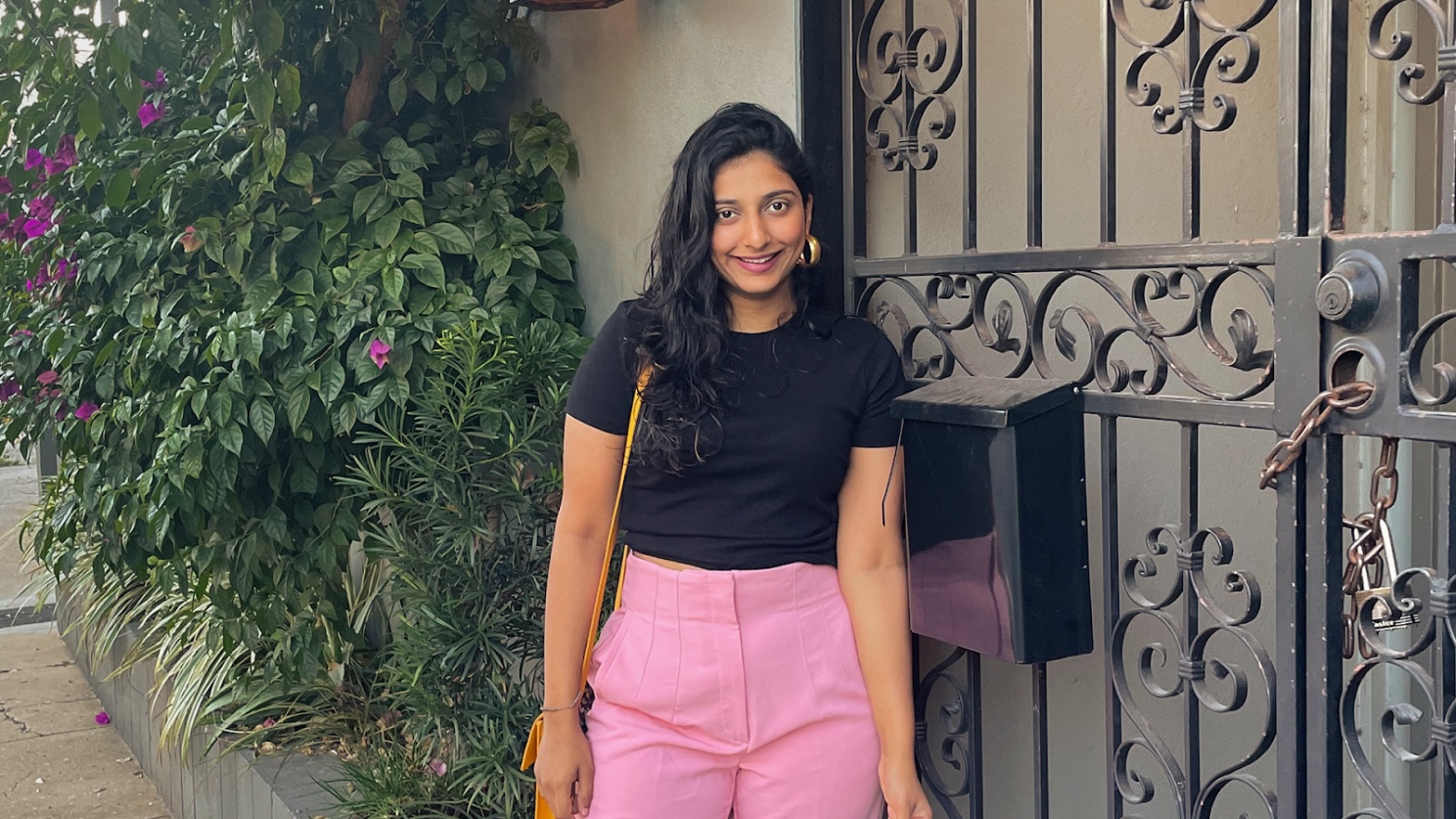
Ruei Shah photo

Connect with Ruei Shah on LinkedIn.

Shop the wonderful world of Totocactus!

Lydia Wollard: smells like zine spirit

December
1
2025
By
Tags:

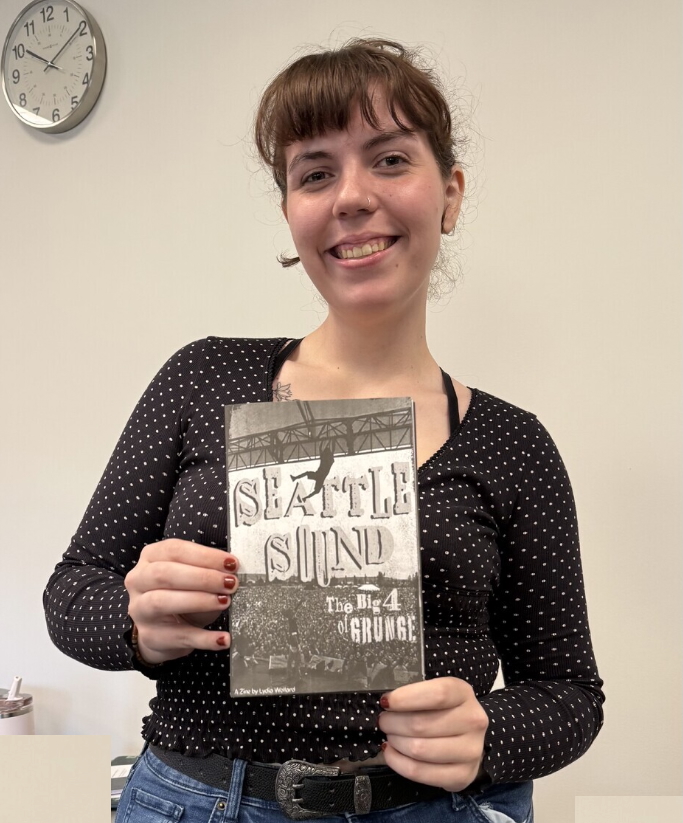
Eddie Vedder's swinging from the scaffolding. An unwashed horde of fans roils behind him. It's a classic, unhinged moment from Pearl Jam's performance at the 1992 "Drop in the Park" concert in Seattle's Magnuson Park. The image graces the cover of "Seattle Sound: The Big Four of Grunge," a zine written and designed by second year student Lydia Wollard (B.F.A. writing).

"It's a photo by Lance Mercer, a prominent photographer of the Seattle scene from the nineties. He was close with Alice in Chains and he took that photo of Eddie Vedder and Pearl Jam, and I knew I had to use that picture on the cover of my zine, because it represents the ethos of grunge, and doing what you want," Wollard says. "My zine explains why grunge was important, that it's more than an aesthetic. That was my goal."

Wollard zine cover

Come as you are: the cover of the zine.

Generational change surged through rock music at the dawn the 1990s, when the insipid poodle metal of the eighties was obliterated by bands charging hard out of the Pacific Northwest. The music of those bands — Wollard's zine focuses on four key acts — resonates decades later, as she writes in her opening essay: "As I grew up in the early 2000s, my folks frequently introduced me to the hits of Soundgarden, Nirvana, Alice in Chains, and Pearl Jam. [...] When I reached high school and began exploring music with my closest friends, I fell in love with grunge's vulnerability and intensity."

Professor Tish Hamilton taught Wollard in Writing for Arts and Entertainment (WRIT-205), the ten-week fall course where the zine was created. "I launched the Zine Project to give my students the opportunity to understand content creation and execution, from idea to finished product, and from the jump, Lydia excelled," Hamilton says. "Lydia's writing is conversational, cogent, and convincing, and her design, type treatment, and visuals perfectly complement the grunge scene." (It's worth noting that prior to teaching at SCAD, Hamilton was an editor at Rolling Stone, and experienced the grunge era firsthand.)

"On the first day of class, Professor Hamilton mentioned zines, and I was like oh, this my moment," Wollard says. "When I came to SCAD, I initially thought I'd major in graphic design. Then I became a writing major, and making this zine I was able to use those passions and blend them."

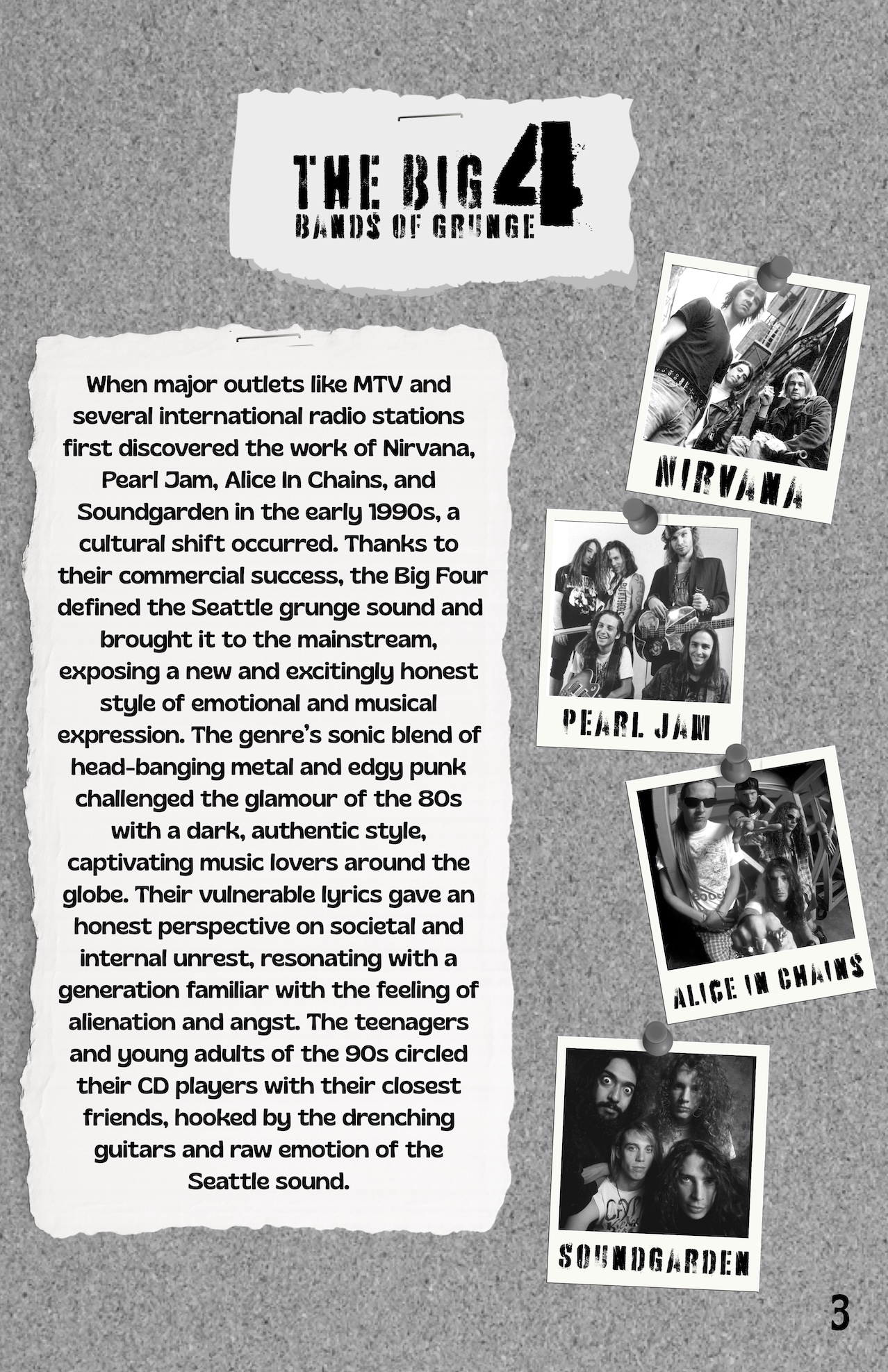
Grunge big four

Here we are now: a page of Wollard's work.

Across 20 punchy pages, "Seattle Sound: The Big Four of Grunge" features a timeline, song recommendations ("Your Grunge Prescription: Seven Tracks for the Emotions You Can't Escape"), an analysis of Soundgarden's "Black Hole Sun" music video, and original reporting including an interview with drummer Mark Vaquer of Rody's Records in Savannah.

"I had a checklist of every piece, and went through every single one, dissecting it, ripping out unnecessary stuff, took my classmates' and Professor Hamilton's notes, and edited and edited and edited, listening to grunge the whole time. When I got sick of Alice in Chains, I found Mudhoney, and Green River, and then I ended up on, like, Temple of the Dog and Audioslave."

At the end of the quarter, WRIT-205 students brought their completed, printed zines to class to share and judge. "Lydia's time, care, and dedication showed, and her peers easily voted her zine as the winner," Hamilton says admiringly.

Readers of a certain age may likely recall the moment they first heard Nirvana's "Smells Like Teen Spirit" — a song that once usurped classic rock, only to become classic rock itself. After this aging fan bestows an original grunge generation seal of approval on Wollard's zine, its creator offers fresh perspective: "Every generation experiences something that came before them, and they don't make it like that anymore. That's how I feel about grunge, and that's what makes it so special."

Lydia Wollard color zine

On a cobweb afternoon: connect with Lydia on LinkedIn and check out her SCAD Radio show "Tune Den."

Anushua Sinha: illustration as activism

November
19
2025
By
Tags:

What if activism were embedded in children's books? What if it resembled frogs in bow ties, otters full of curiosity, and gorillas in gentle embraces? For alum Anushua Sinha (M.F.A., illustration, 2023), this question is not a hypothetical — it's a reality she brings to everyday life.

"I like to think of myself as an environmental translator," Sinha says. "Kids might not connect with melting ice caps or biodiversity statistics alone. They do connect with a frog who is leading a marching band."

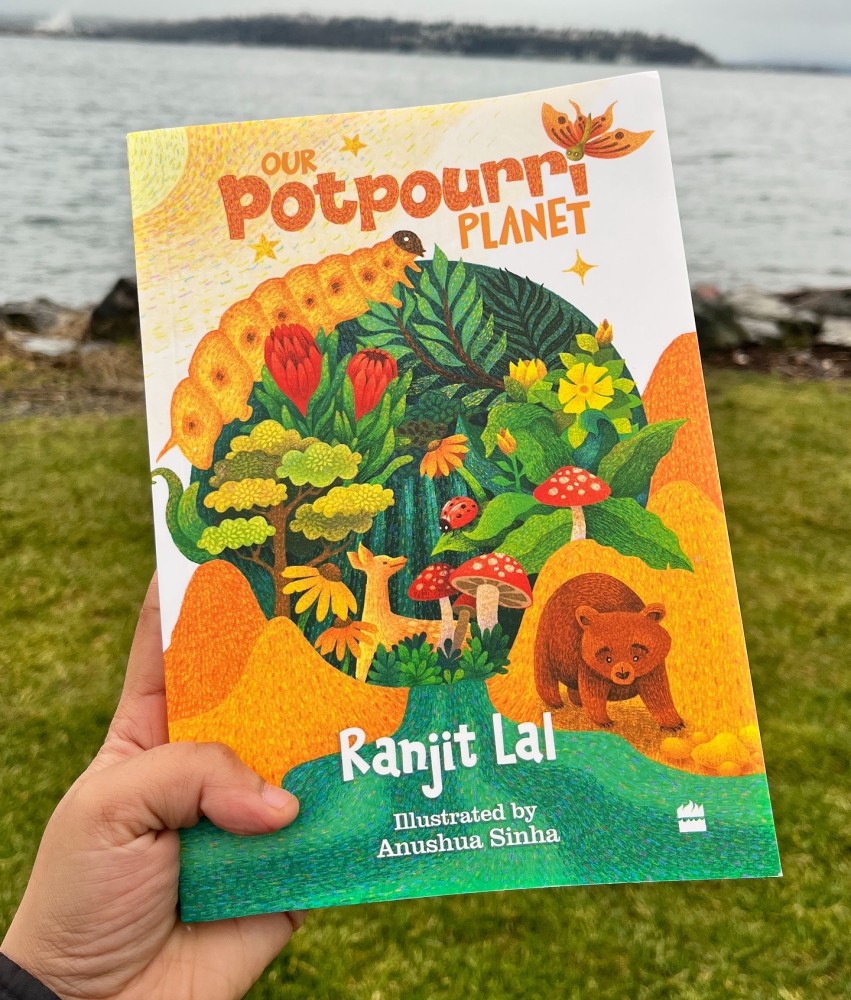
Anushua's career started with an illustration of that bandleading frog for Our Potpourri Planet (HarperCollins), a book about climate change and the need to save the planet. She sees her work on Our Potpourri Planet as a "make-or-break" moment that led to her first book deal and earned her recognition at the Society of Illustrators of Los Angeles' Illustration West competition. It showed that persistence — even when driven by challenging circumstances — can open doors that talent alone might not.

"What started as a job became the piece that others recognized as award-worthy," Sinha says.

Anushua Potpourri

Modeling the lively cover of Our Potpourri Planet (HarperCollins).

Through her SCAD thesis, she sharpened her skill at making complex topics accessible without losing their importance. Professors advised her to find a balance between creativity and discipline. "SCAD taught me to weave playfulness into precision," she says. That balance, combining responsibility with imagination, remains a hallmark of her work.

Sinha's illustrations, published in Maritimus Magazine and in collaboration with HarperCollins, Slate, and the Algorand Foundation, animate facts with emotion and depth. A gorilla mother's embrace makes deforestation personal. A husky named Luna turns daily routines into tender comedy. An otter sneaks ecological data into a bedtime story.

"Animals are the bridge," Sinha explains. "They spark empathy and make abstract ideas vivid."

Styled to resemble a painting and rich in texture and patterns, similar to Indian Impressionism, her illustrations draw on Mumbai's visual chaos and the traditions of Gond, Kalamkari, and Madhubani. At SCAD, she learned to translate those influences into a universal language. Now, whether reimagining The Book of Doors or illustrating children's stories, she emphasizes her belief that "decoration shouldn't just look pretty, it should serve the story."

Anushua Hornbill

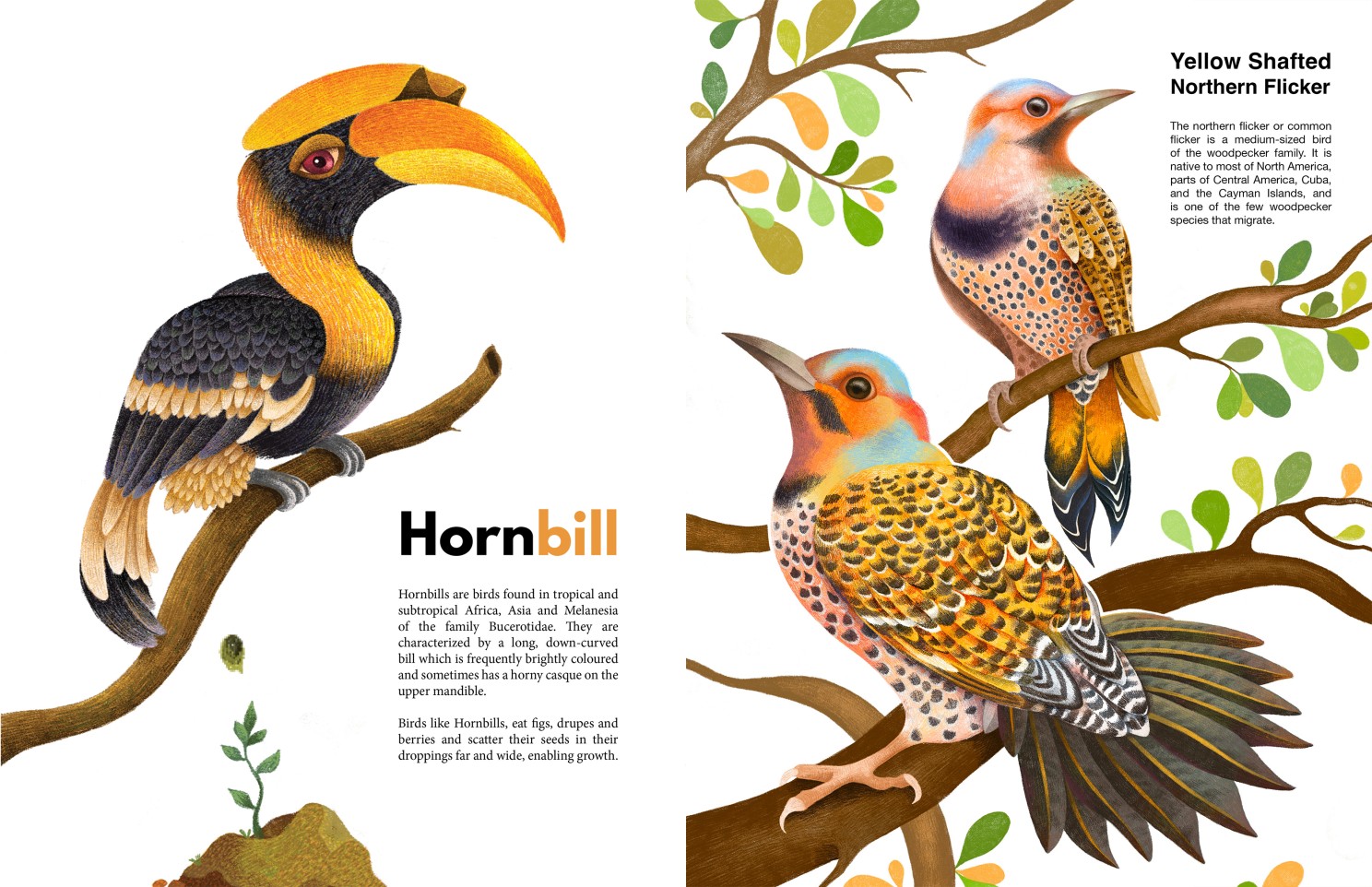
Illustration by Anushua Sinha for Denver Audubon.

While she has been honored by 3x3 Magazine, iJungle, and Creative Quarterly, Sinha still reacts to accolades with disbelief. That humility keeps her grounded. Even in client work, she protects her "doodle spirit," sneaking playful details into deadlines as reminders of why she started. At a time when AI produces instant aesthetics, Sinha champions illustration as art couture — measured, intentional, and built to last.

"It takes longer than a prompt," she says, "but that time and intention are what make it resonate."

Her current projects include children's books, games, and illustrations for magazines like Maritimus and Bento. Each one expands her skills, and they all share a common foundation: empathy interwoven with imagination.

So, can illustration serve as a form of activism? Sinha's work suggests yes. Her frogs, gorillas, and doodles demonstrate that art doesn't need to shout. It can enter subtly, cloaked in color, pattern, and tenderness. In her hands, illustration isn't surface, it's story. It's empathy, and it's activism — disguised as wonder.

Anushua working

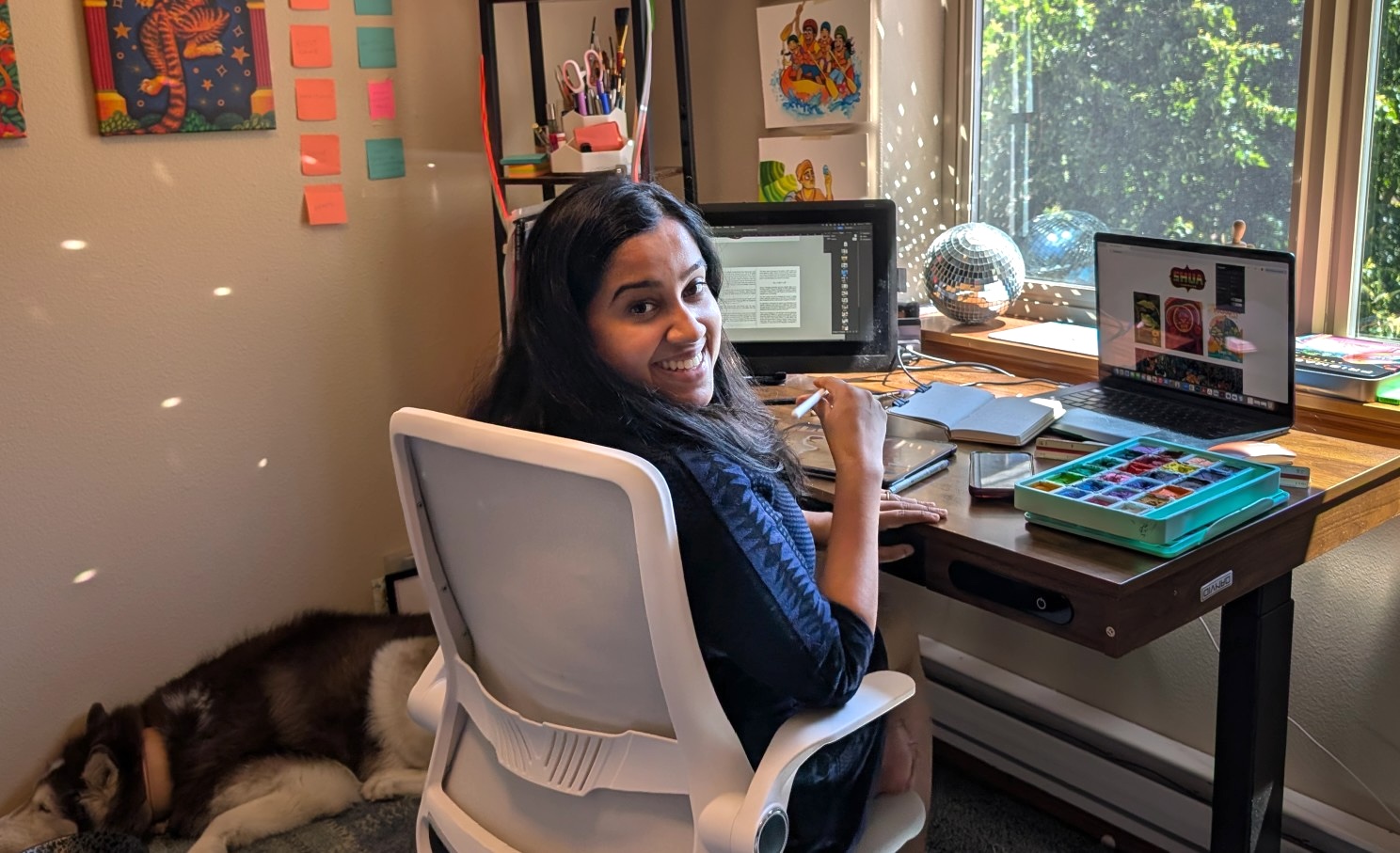
Discover more of Anushua Sinha's work on her website and Instagram.

Learn more about how SCAD illustration programs empower the next generation of visual storytellers.

Sam Gualtieri's cosmic 'Red Rabbit'

November
7
2025
By
Tags:

A rabbit slumps in a spaceship. Starlight strafes its face. Marks on a wall indicate many years spent in deep isolation. Then the rabbit — perhaps it's a human being with the head of a rabbit — opens a portal into another dimension, where it witnesses a crotchety grandfather bantering with his family as they enjoy dessert in their cozy home.

"To establish the state of this character, with no dialogue, I was really looking to indicate that the rabbit has some concept of what life on Earth would look like, and that he wants it, or remembers it," says Sam Gualtieri (B.F.A., visual effects, 2024).

The sequence is from the beginning of Gualtieri's "daring and inventive" Academy Award-qualified film Voyage of the Red Rabbit, winner of the Grand Jury "Best Animated Short" Award at the 2025 Florida Film Festival. The film was developed at SCAD as a thesis project in spring 2024 in Visual Effects Studio II (VSFX 448) under the guidance of Professor Joe Pasquale. "When Sam brought in several large library books to show the class ideas, I knew we had a winner," Pasquale says.

Red Rabbit Stairs

Infinite hero: a film still from Voyage of the Red Rabbit.

More than homage, the film accrues visual and emotional power through its synthesis of influences. (Fans of A Scanner Darkly, Daffy as Duck Dodgers, and Moebius' Silver Surfer are in luck.) Stylized 3D renderings and hand-drawn 2D textures combine to retro-futuristic effect. One of Red Rabbit's end credits reads "Artwork inspired by Maurice Noble," a nod to the Looney Tunes layout artist of 1958's Hare-Way to the Stars. "I knew I wanted the spaceship to look something like a soap bar," Sam says.

"During production, Sam was steadfast," says Professor Pasquale. "He knew the story needed to be told with animation and visual effects, and if you want to explore the meaning of life, do it with animation and visual effects. Visual effects doesn't have to mean superheroes blowing up stuff, and animation doesn't have to be bouncy comedy. Sam found inspiration in everything from classic Saturday morning cartoons to hot apple pie. His film shows us what life really means."

Red Rabbit poster

Praise be: Voyage of the Red Rabbit "could now break through" at the Oscars, says RoberEbert.com.

"I hadn't made a traditional animated film before, and I hadn't considered it until Red Rabbit," Sam says. Pressed about the presence of pie in his film, he responds: "Those are actual 3D scans of my Nona's pies, and the kitchen is exactly as my grandparents' kitchen really looks."
 
"I had the honor of taking Intro to VFX with [professor] Pat Perrone before her passing [in 2022], and learned about the different ways of combining disparate images using traveling mattes and optical printing. I was observing multi-planar projection, where Disney would have different animation cells stacked on top of each other, and a camera could move forward and backward through these, like, 2.5D vistas. So, I designed a lot of my shots, especially the moving ones, with that in mind."

While Gualtieri pushes the limits of the psyche into deep space, his personal journey is earthier. Born and raised in Philadelphia's historic Washington Square West neighborhood, Sam attended public magnet school Science Leadership Academy, where one of his teachers was alum Anna Walker Roberts (M.A., arts administration, 2014; B.F.A., performing arts, 2013). "Anna really gave me a positive reference point for the culture at SCAD," Sam says.

As a SCAD double degree holder, Walker Roberts speaks with informed insight: "SCAD is an environment marked by talent, which Sam has in spades — yet it's work ethic that makes or breaks success at SCAD," she says. "One must enter into the iterative process and keep learning and improving, and it was this aspect of the culture that I felt would suit Sam. He needed a place to try and fail, find his niche, and build a collaborative network. He gained access to the best equipment and relationships with professors who had real industry experience. Watching Sam's thesis film now, I am deeply moved by the depth of space and soul it explores."

Red Rabbit bocce

Bocce sketch: Gualtieri's character studies of grandpa Ed.

If Red Rabbit reveals his grandfather's inner child, Sam's own youth is visible. "The way I conceive of the world around me is greatly informed by the pictures that were shown to me at a formative age — my concept of space is influenced by Interstellar, for example," Sam says. "We live in narrow tracks when we're kids, but we're capable of imagining far more then than we do as adults."

Yet imagination, like memory, creates loops. Sam's grandfather's recollections of a beloved pet rabbit grow vivid. The voice of Sam's grandpa Ed is really his grandfather's voice, culled from hours of audio that Sam semi-surreptitiously recorded at his grandparents' house. At one meta moment in Voyage, the rabbit watches a cartoon "The Red Rabbit: Nobody Lives Forever," a phrase uttered by Ed during his rumbling ruminations on life, the universe, and everything.

Gazing ahead to next year's Oscars, and the festival circuit Red Rabbit will ride between now and then, Sam says of his Voyage: "I'm grateful my film was incubated in the SCAD community."

Sam Gualtieri headshot

Hare here: Connect with Sam Gualtieri on LinkedIn.

Open Studio spotlight: Hannah Esquenazi

October
23
2025
By
Tags:

When Hannah Esquenazi (B.F.A., photography) arrives at Dr. B's on her scooter after afternoon class in Alexander Hall, she's smiling in the sun: "This weather is the best!"

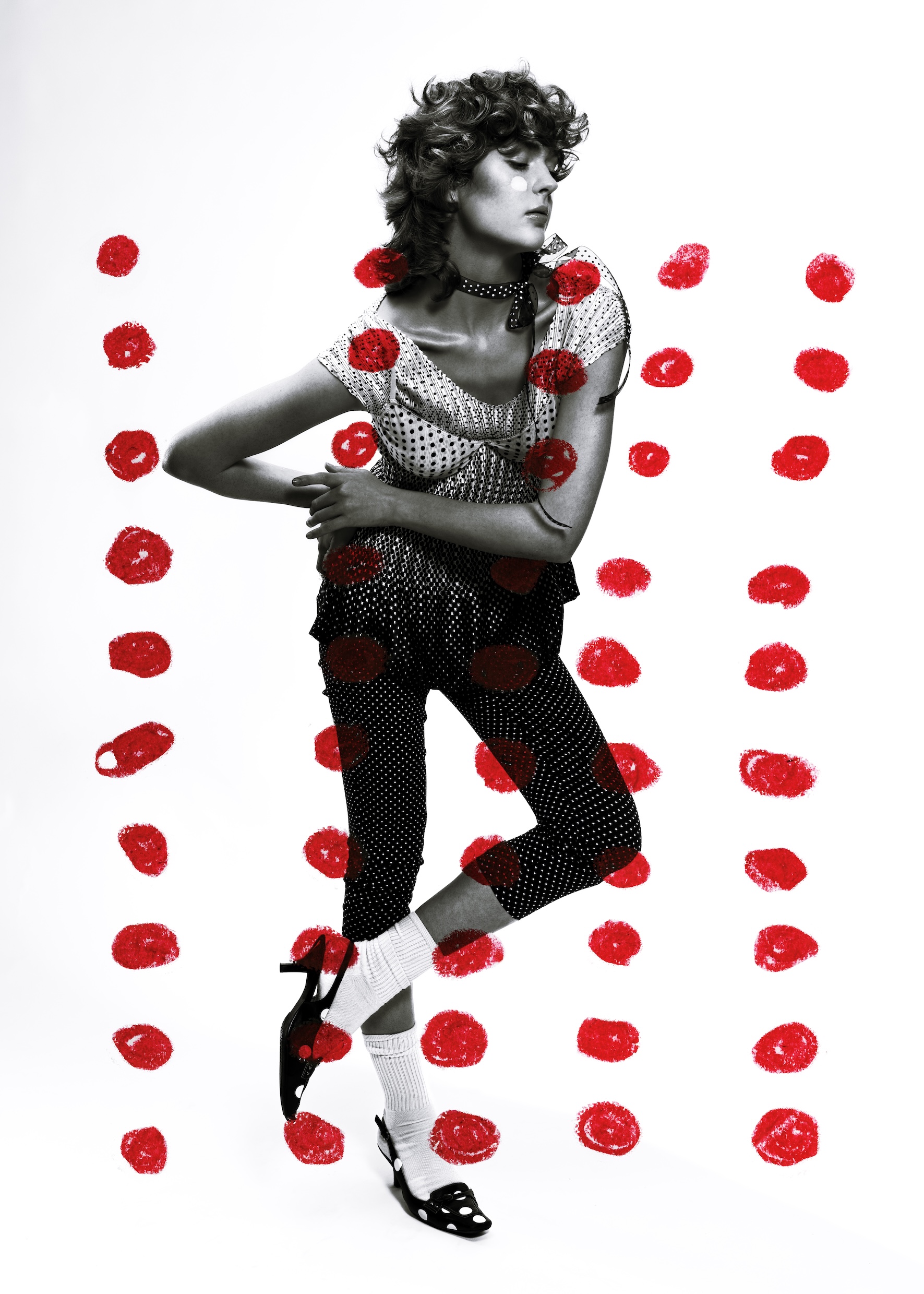
Between sips of iced oat milk latte, Esquenazi happily discusses "Dots and Stripes," her signature image for this Friday's Fine Arts Showcase, while giving enthusiastic shout-outs to photography faculty Chris Lane, Dillon McDaniel, Vivien Allender and chair Josh Jalbert, as well as printmaking professor Debora Oden.

"Hannah’s photographic work with mixed media additions mirrors her complexity and playfulness," observes Oden, who taught Esquenazi in Screen Printing for Fashion, Luxury, and Interior Spaces (PRMK 260). "Her joy regarding the process of creation elevates the classroom experience, and she has a beautiful way of allowing her subconscious mind to drive her artistic process."

The following remarks are condensed from a longer conversation.

Esquenazi art

Hannah Esquenazi, Dots and Stripes, 2024, pigment print, 25 x 18 in.
 

Hannah Esquenazi:

I would describe myself as a very tactile person. I grew up in Cali, Colombia, touching leaves and flowers, with nature all around me. So, with photography, I need to feel it in my hands and do something with a photo to make it a little bit more personal.

Sophomore year I started printing my photos on matte paper. The ink really gets into the paper, and I liked that. Someone in my class told me, oh, then you're really going to like screen printing! I signed up for the class, not knowing what it was really about. That was with professor Debora Oden.

Deb is wonderful. She dives in with each student's individual project, and pushes you to approach and achieve your vision with clarity. Her class is where I first screen printed one of my photos with polka dots. I started to see my photos as raw material for mixed media pieces, that a photo would not be the end product but the start of something.

All my work is highly collaborative. "Dots and Stripes" began as a project I did with SCAD Manor. It was a photo shoot on a white background with the model doing different poses, using her body to create geometrical shapes. The model is Isabelle Leaf, she knows how to move. We were playing with poses, finding triangles with her arms and legs.

Once I had the digital photo, I started figuring out, how can I add an element to give it that Hannah stamp? I printed it on regular printer paper and drew on top with a crayon, like a mock test of how polka dots would look if I were to screenprint it large-scale, though I never got around to making that screen print. Later I went back and saw the test version that I'd done really quickly by hand and thought, oh, there's something to this.  

I wanted to have the elegance of her pose be as sharp as could be. I scanned what I had and masked out the dots, layered it to preserve my hand element, and made the final version.

Fine Arts Showcase is an exciting and rewarding event where you get to see what you've worked on for months or years being on display for your peers. So much art is created just for your phone, and although I think that's important, there's something about seeing work in person that changes everything and forces you to be with the piece, the sizing, the framing, you look at it and appreciate it without having to scroll.

To have this image used on the physical flyer card for Fine Arts showcase, it goes back to the tactility of the original work, and makes me so happy. I'll see you there!

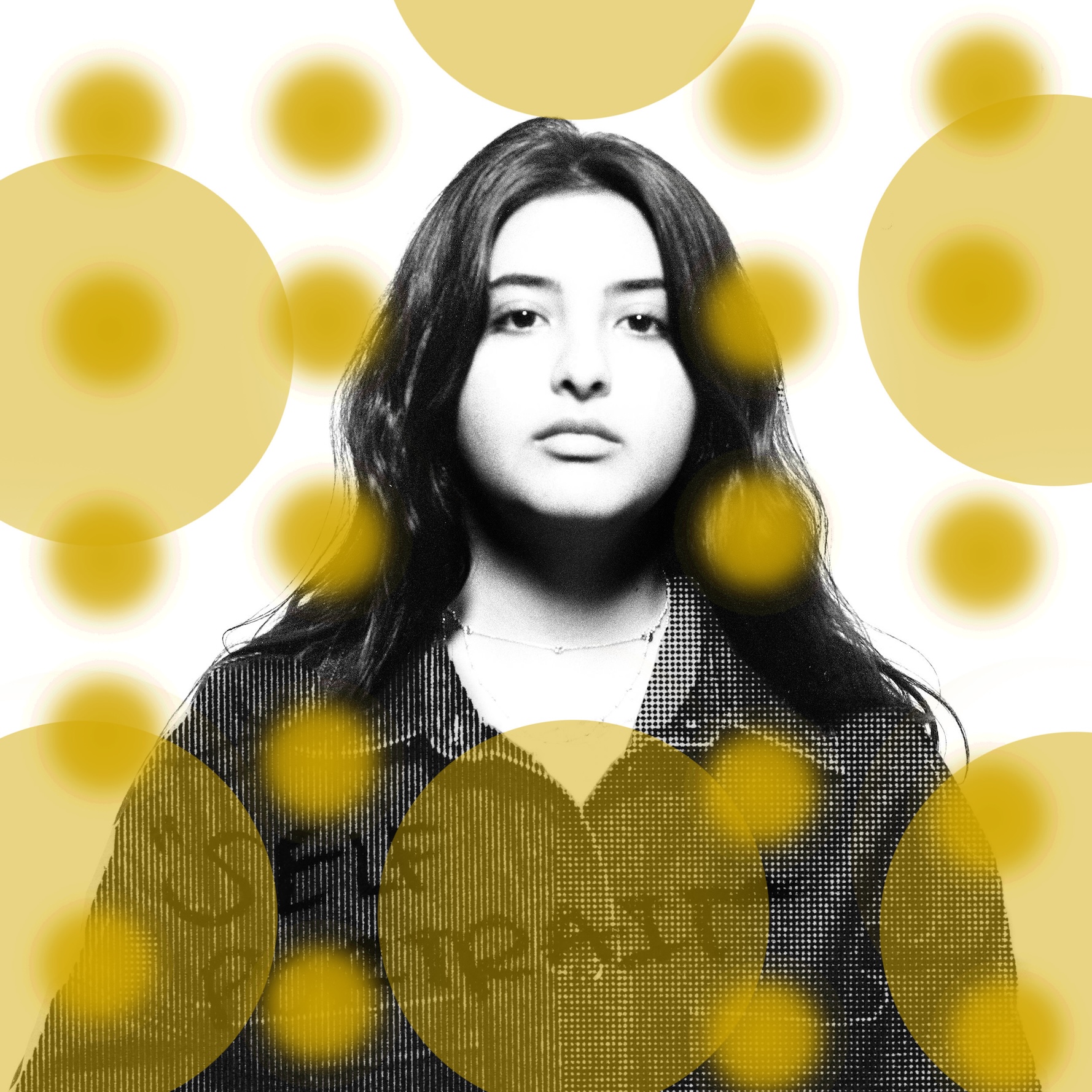
Esquenazi self-portrait

Connect with Hannah Esquenazi on LinkedIn.

Gene Pressman: more than a store

October
16
2025
By
Tags:

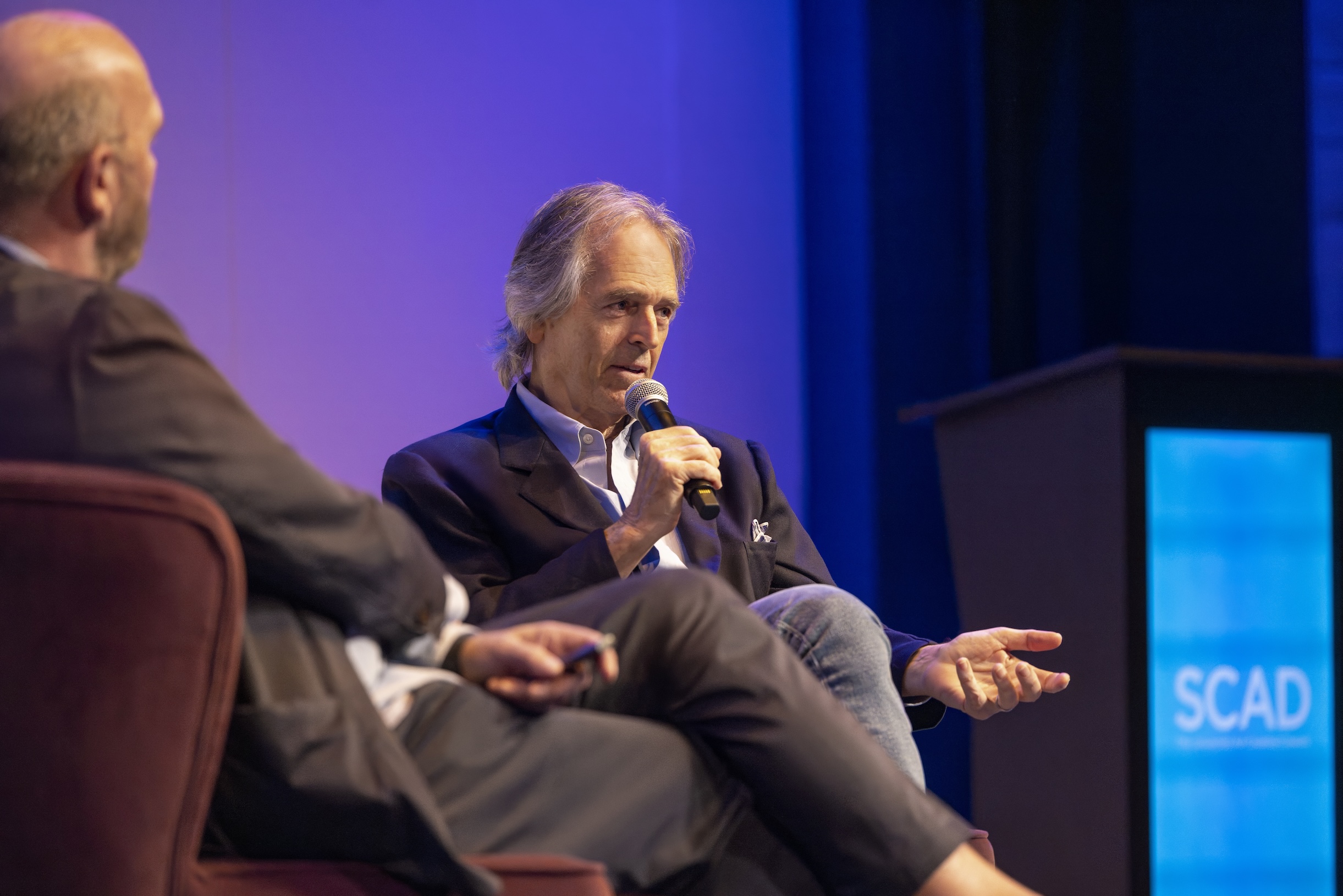
"I much prefer talking to young people," Gene Pressman said from the stage of the SCAD MOA theater. His wish was SCAD's command.

Fashion, fashion marketing, photography, and advertising students all packed the house for Pressman's conversation with SCAD School of Fashion dean Dirk Standen, marking the publication of Gene's scintillating new memoir, They All Came to Barneys: A Personal History of the World's Greatest Store (Viking/Penguin Books).

Cooper Critchley (B.F.A. production design) delivered a personalized introduction, describing Barneys as "a mythological place with a gravitational pull" that "remains the pinnacle and the embodiment of the experiential effect of fashion."

Honored guest Pressman spoke for a flowing hour about the legendary Manhattan department store founded in 1927 by his grandfather Barney Pressman, and how Barneys was transformed into a cutting-edge destination ("more than a store") by his father Fred's decision to bring Armani menswear to the U.S. for the first time in 1976.

"My father was very clever because he never pushed the business on me, and I didn't want to be in the business, I wanted to make films," Gene said, reflecting on his youth. "After I came to the realization that there were a lot of unemployed 21-year-old film directors in Hollywood, I came back to New York and ended up in the business. I worked in a warehouse because, you know, being the owner's son, I wanted to prove something to myself. Then I got into merchandizing. I learned how to buy, and I spent a lot of time in Europe. Barneys started only buying European designers, and when my father brought Armani to this country, we noticed that we were attracting a different type of customer.”

Pressman on stage

In his jeans: NYT best-selling author Gene Pressman speaks at SCAD MOA.

With his silvery mane, white canvas kicks, and just-so faded jeans, Pressman expressed his delight at being in Savannah for the first time ("Wow, what a city, and SCAD, I'm so impressed!") as images lit up the screen behind him. A young Gene with his father. The opulent expanse of Barneys' Madison Avenue location. Linda Evangelista kissing a chimpanzee on the lips.

"That one was taken by the famous photographer Steven Meisel, who was just starting out," explained Pressman. "In fact, Meisel was so young he didn't even own a camera, we had to rent him one for the shoot." Calling Evangelista "Barneys' mascot, our Lucille Ball," Gene lauded the supermodel for her role in the signature Barneys print ads from that era.

And what an era it was. Many designers of cultural ubiquity were first sold in the U.S. at Barneys. Pressman rattled off names like old friends: "Prada, Helmut, Versace, Dries, and of course Azzedine Alaia." Pressman reserves special affection for the Tunisian legend, recounting the moment in 1981 when Barneys began selling the designer's long, black, grommeted gloves.

“Things that are more risky are what drive customers to the store," Pressman said. After referring to the women's hat section as a "loss leader," he recalled the moment accountants complained that hats weren't selling. Gene knew that they didn't understand the Barneys experience, or why Barneys had thrived for the better part of the 20th century.

"Build something relevant, then it can become cool. After it becomes relevant, maybe it'll become cool," he said in response to a student's query about what defines a successful brand.

"There's no value in most of these things hanging on the racks now. There's an opportunity here, you guys, in the fashion world, to make things of value, things that will last. Because that's what we sold at Barneys."

Not bad for a department store. But then, Barneys was much more than a store.

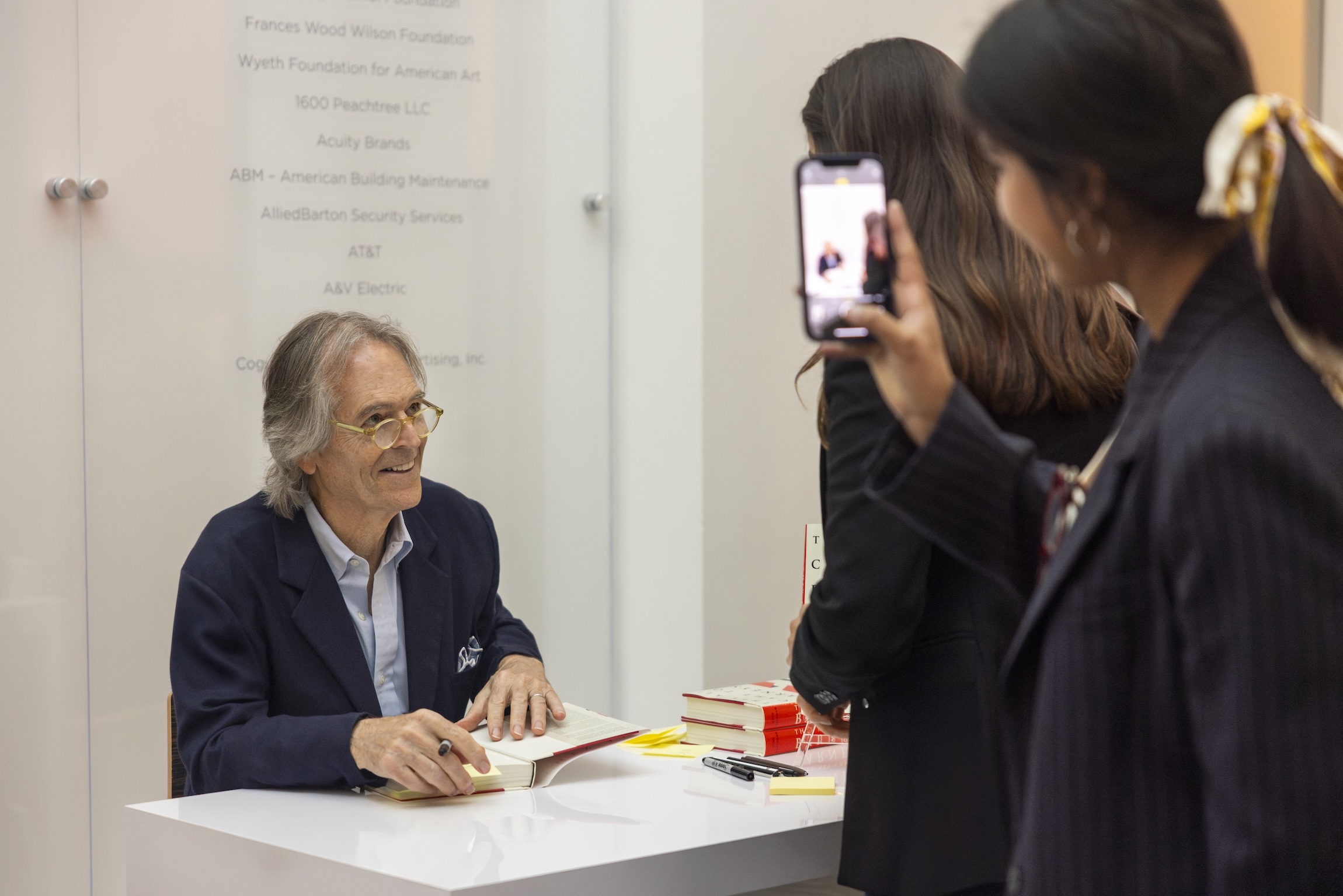
Gene Pressman signing

Bookwise: Pressman signs for students following his talk.

Marleah Flajnik's cheeky photography

October
10
2025
By
Tags:

A lemon balances on upturned soles of blue-stockinged feet. Pistachio-colored sneakers encroach upon a forest green checkerboard tablecloth. "I love punchy colors that evoke joy," says Marleah Flajnik (B.F.A., photography, 2022). "If someone sees my photos and smiles, I feel like I've done my job successfully."

Five of Flajnik's photos, each at least three feet high and bursting with narrative possibilities, line the primary hallway of the Graham Scott, home to SCAD's photography department. They include selections from Lighthearted Youth, a series Flajnik created in Digital Imaging and Compositing (PHOT 114), taught by professor Steven Bliss.

"The one with the orange sweatshirt and orange hairclips and orange nail polish, that's me, I took that photo in my dorm room with a self-timer," Flajnik says. "One of my favorite things about my dorm room at the Hive was that the light was tremendous!"

In 2018, Flajnik came to Savannah from her hometown of Warren, Ohio as a self-described "artsy kid" who "discovered a joy I never knew was possible" at SCAD. She began majoring in advertising, and when her father sent her down his old camera ("a Nikon D3200 he got from Sam's Club") she realized her fate was in her own hands. "I was like, photography needs to be my major."

Photography professor Thomas Sanders taught Flajnik in courses including Commercial Lighting Applications: Studio and Location (PHOTO 314). "Marleah developed a quirky, tongue-in-cheek photography style that is identifiable and marketable. As a student, she was willing to grow, be experimental, and was confidentially humble, qualities that all manifest in her work," Sanders says. 

Flajnik feet

Marleah Flajnik, Lemon, 2023, Digital print, 45 x 36 in.

Since graduation, Flajnik has worked full-time in her chosen field, first as a fashion photographer at Buckle, now as a digital technician at clothing retailer Aerie. Her strong SCAD connection is exemplified by the "amazing full-circle moment" represented by SCAD acquiring her work.

"When I was a student, I'd look at everyone's artworks on the walls for inspiration, it was always so exciting to see," she says. To have her photographs chosen represent SCAD was "one of my big internal goals," and Flajnik gives a shout-out to SCAD Art Sales executive director Amy Keith for initiating the purchase of the images on display in the Graham Scott.

"The Tony's Chocolonely one, that's one of my favorites," Flajnik says, referring to her sweet photo of SCAD track star and industrial design major Shammah Dosunmu chomping on chocolate. While the image seems focused on a single body part, it elides objectification in favor of what Marleah calls "cheekiness."

"I've always enjoyed abstracting the human form, treating it more as a prop," she says. "There's control that you can have with arms or legs or a mouth, where it can tell more of a story. I love incorporating the human body into my work."

SCAD photography department operations manager Jon Horey supervised Flajnik during her time as a student studio monitor in 2021-2022, an experience that Marleah believes "assisted me greatly in my knowledge, problem solving, and skills in photography, and was a major talking point in taking my role at Aerie as digital technician."

"Working with Marleah in our SCAD photography studio was a genuine joy," Horey says. "Her positive spirit brightened every day, and her creative talent always stood out in her beautiful work. It fills me with pride and happiness to see her photography displayed in our new studio building, a true reflection of her hard work, passion, and dedication."

A joyful job well done.

Flajnik portrait

Connect with Marleah Flajnik on LinkedIn. (Portrait by Michael Parente.)