Skip to main content Accessibility Policy

Illuminating ‘Short Circuits'

April
3
2018
By
Tags:

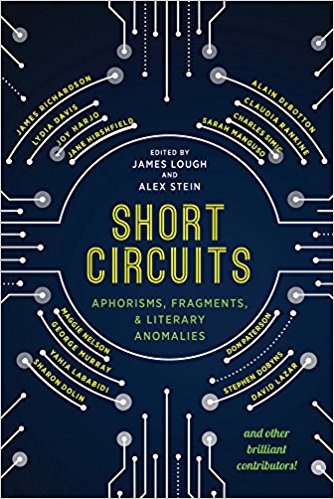
A collection of short works by 64 writers, with a fantastic cover designed by SCAD alumna Jordan Wannemacher (B.F.A., graphic design, 2012), "Short Circuits" (Schaffner Press, 2018) may offer the rewiring the contemporary mind requires. Co-edited by SCAD writing professor James Lough and fellow author Alex Stein, the book delves into literary liminal zones that feel both primeval and postmodern. As "Short Circuits" contributor Lily Akerman writes: "The map's creases are another map."

Paradoxically, the book's longest piece of writing may be its most stimulating. In his introductory essay "This Is Your Brain on Words: The Neurological Fruits of Literary Surprise" Lough posits the indivisibility of form and function, where pithiness approaches godliness. Rather than lambast Twitter, Lough traces the history of shorter forms, connecting their enlightening potential on human thought and action.

"The reading experience has gotten choppier, more distracted than focused, more associative than linear," Lough writes, "This book…can be seen as a brick and mortar adaptation to digital trends."

"Short Circuits" is available now.

Dark blue book cover for Short Circuits

SCAD: How does "Short Circuits" differ from the previous anthology you and Alex Stein edited, 2015's "Short Flights"?

JAMES LOUGH: "Short Flights" contained only aphorisms. "Short Circuits" is a completely new book. This time we decided to feature a wider variety of types of work including haiku, flash fiction, micro-essays and concrete poetry. We also have writers like Claudia Rankine, Maggie Nelson and Sarah Manguso, whose names you may recognize.

We'd sent out a request to all of our writers from "Short Flights" asking if you know anyone who's doing interesting stuff on Twitter and is somewhat literary, please let us know. We got some great stuff. There's one Twitter account @dogsdoingthings which is dogs who are nihilists commenting on the state of the planet and the state of humanity. And there's a guy named @WernerTwertzog, a pseudonym of an academic and journalist named William Pannapacker, who's fantastic. "Short Circuits" also features stand-up comedians Charlene deGuzman and Mike Ginn. They write jokes but they're so informed and ironic that they went in.

SCAD: What's the origin of the aphorism?

LOUGH: I'd say it goes back to the Hindu Vedas, a religious text that was as much instruction manual as it was testament to faith. The Vedas are not exactly aphorisms in the sense they don't have a twist, they're not what we'd call literary, but they are pithy and condensed pieces of wisdom in sequence.

The aphorism as we know it today really starts in the 18th century, with the sardonic or radical twist that upsets expectation and can be scandalous. Oscar Wilde was the king of that. Prior to Wilde, Benjamin Franklin wrote proverbs, but he also wrote "Fish and visitors smell after three days" which is more an aphorism.

SCAD: Is the aphorism a teachable literary form?

LOUGH: Absolutely. I'm teaching WRIT 707 "The Art of the Sentence" now, and to get students started writing aphorisms, we look at other aphorisms and riff on them. "Healthy, wealthy and wise? No one gets all three." That kind of thing. The first assignment is to write ten aphorisms. A lot of ruminating goes into that. Aphorisms are fun to work with, because you just sit down and write one. The final project is to write mini-essays of no more than 100 words.

Two of the students who took the class last year are featured in "Short Circuits": Zara Bell (M.F.A., painting; B.F.A., writing, 2016) and Emily Peck (M.F.A., themed entertainment design, 2017). We're going to do a reading at SCAD MOA on April 26 at 5 p.m. and Zara will join me, as well as another special guest. The reading should be a lot of fun. As one of our contributors Hart Pomerantz said: "An aphorism is a joke that went to college."

The unlikely trajectory of Kayo Chang

February
26
2018
By
Tags:

Kayo Chang is an intriguing global citizen. The Taiwanese-Canadian graduate student, formerly head librarian at SCAD Hong Kong, is now enrolled as an M.F.A. candidate in the SCAD writing program. She has penned essays for SCAD Manor on subjects including clothing designer Janet Wong (B.F.A. fashion, 2016), who not so coincidentally designed the dress for Chang's wedding to Derek Black, associate dean of academic services, SCAD Hong Kong. Currently studying at SCAD Savannah, Kayo will return to Hong Kong next quarter to begin an internship at ArtAsiaPacific. There's more to come from this busy Bee.

SCAD: How does your SCAD story begin?

KAYO CHANG: I started working at SCAD Hong Kong in January 2014, after the human resources director messaged me to say: "We're looking for a librarian." At that specific moment I was in Causeway Bay picking up my runner's pack for a marathon. The following Monday I went to the SCAD Hong Kong building in Sham Shui Po for an interview. I fell in love with SCAD as soon as I walked into the building oozing color and beauty. When I started working at SCAD Hong Kong as head librarian, I had two staff and four part-time employees. I loved the students and the books and my colleagues. It was ideal.

SCAD: How did you, as librarian, collaborate with professors?

CHANG: One instance is when Professor Cristina Kountiou and I developed an assignment for her class "FASM 400: Contemporary Issues in Fashion Merchandising." Instead of writing a research paper, each student would edit an existing Wikipedia page on a topic of their choice. For example, one student chose the topic "fast fashion." When we looked at the Wikipedia page it had nothing on the environmental impact of fast fashion, so the student added the whole section. The point was to teach critical thinking, improve students' writing skills, and gain insight into the bias present on Wikipedia. It was a really cool project.

SCAD: How did you go from being head librarian to becoming a student?

CHANG: I always wanted to be a writer. My husband Derek said, "You should!" So, I took my first writing class in winter 2017, "Nonfiction I" in Hong Kong, via SCAD eLearning, while I was still working full-time as the head librarian.

This quarter I'm here in Savannah taking "The Publishing Process" with the professor Lee Griffith. I'm writing a proposal for a book I want to write, part of my M.F.A. thesis. I'm using this book to explore different ideas and combined narratives. I had a secular and Canadian worldview as a young adult, so one narrative is about growing up in Vancouver. Another narrative is about going to Taiwan as an adult and learning about my family. And a third concerns Guan Yin, "The Goddess of Mercy," who my grandmother has a statue of and who has special significance to me.

The writing is a challenge, but with the support of my thesis chair, Dr. James Lough, it's going well. The SCAD curriculum is perfect for the kind of writer I want to be.

Artist Kayo Chang smiles in this black and white portrait

Do the Veit thing

November
14
2017
By
Tags:

Embracing a lively schedule, Veit Hoenle exudes clarity and calm. This week the SCAD writing student travels to Vancouver, Washington with his Sun Conference-winning teammates and SCAD Coach Patrick Reagan for the NAIA Men's National Cross Country Championships. Hoenle, a native of Freiburg, Germany, is a two-sport, same-season athlete who also races with the SCAD cycling team. "I don't need a lot of free time," the amiable Hoenle says. "I'm happy working, training and competing." The key to Hoenle's placidity may be in an essay he composed for a SCAD writing class: "Patience not only affects ourselves, but our environment and the people around us."

SCAD: What's your key to getting everything done?

VEIT HOENLE: I've been disciplined before coming to America, so I know what it is to not have a lot of free time. I enjoy being at SCAD, and I've figured out a way to combine my athletics and my education.

On our recent drive to Florida for the conference championship, I interviewed Coach P., the bus driver, and two runners for an essay for my non-fiction writing class. When we reached Ave Maria, the race started at 8:30 in the morning, and we got to the course at 6:45 a.m. The moon was still up, a full moon with a lake all around the racetrack, a magical feeling before the race.

I didn't want us to be the first team in years not to win the conference. I tried to set a good pace. We were supporting each other. As soon as one of us fell behind there was another guy who could push him. Coach P. said that's the kind of running he wants the program to do. Why is SCAD men's cross country so strong that we won the conference championship three times in a row? Coach P. creates team spirit.

SCAD: How has your writing progressed at SCAD?

HOENLE: Before coming to SCAD I never wrote about things that interested me, only for assignments. Now with Professor Lough I write about what's interesting to me and look forward to it. I really enjoy his non-fiction writing class. I've learned to make my writing more specific, more concrete. Editing is the most important thing I've learned, when a sentence is not necessary. Sometimes it's hard, because the words are good but you can cut them.

SCAD: What's the connection between athletics and creativity?

HOENLE: Physical exertion stimulates the mind. When I ride my bike or when I swim, I come up with good ideas. There's a reason, neurologically. You can write in a romantic way, and you can swim with exaggerated strokes. I want to have flow while I'm writing, the same as when I'm on my bike. And there is pleasure when I finish. It's important to have goals and to be happy with what you have achieved. Sometimes it's easy and sometimes it's a struggle and nothing seems smooth. Improvement comes with effort over time.

SCAD: Good luck this week at Nationals!

HOENLE: This will be my first time traveling to the Pacific Northwest. I'm looking forward to it. As Coach P. says, "The competition is the celebration of all the hard work we put in."

WordCast offers media insights

October
4
2017
By
Tags:

Students filled the halls of the SCAD Museum of Art Saturday, Sept. 30, 2017, for WordCast, a day-long media conference connecting students with industry leaders in journalism, broadcast and multimedia storytelling through hands-on seminars, career advice workshops and one-on-one critiques.

Presented by SCAD Student Media, WordCast speakers included Adam Cole, science writer and multimedia journalist for National Public Radio, Mary Anthony Green, featured columnist for GQ magazine, Miguel Fuller, WPOI Hot 101.5 radio personality, and documentary filmmaker Gabriella Garcia-Pardo (B.F.A., film and television, 2012).
 
"Making it as a food and travel writer," a workshop led by Hannah Hayes (M.A., arts administration, 2013), associate travel editor at Southern Living, offered a meme-filled PowerPoint presentation complete with straight-talk about the business of being a freelancer. Hayes began her workshop discussing the current state of magazine industry, including recent editorial cutbacks and decreasing freelance rates.

"But there's good news!" Hayes said among a wave of relieved laughter. "There's never been a better time to be a younger person in the industry — we know how to do all the things!"

Hayes encouraged students to learn skills that complement their writing, including video production and editing, and experience with CMS, coding and analytics. On a slide titled "What do you need to show people to get a job?," Hayes spoke about the importance of holistic storytelling.

"Consider all the different ways to tell your story," she said. "If you can show an editor real reasons to spend money on a video component, they'll be impressed by the amount of research you already put into the story."

Following Hayes' class was "Editing for broadcast," a technical audio editing workshop taught by Tracie Hunte, a reporter for RadioLab/WNYC.

With the Avid Pro Tools application projected onto a monitor, Hunte reviewed the post-interview steps she took in one of her favorite RadioLab stories, "One Vote," about how a single state legislator's vote in 1920 changed the outcome of the American suffrage movement. Throughout her presentation, Hunte played clips from the both the edited and unedited versions of the interview, showing how audio was changed.

"The first thing I do with an interview is cut anything unusable and group by topic," Hunte said, cutting and pasting her favorite quotes from the interview to demonstrate. "I'm already thinking about the story arc when I do this—how should we open the story and what will make a good ending?"

Another tip Hunte shared concerned the process of finding and logging each interjection in an interview — every time a person says "and," "but," "yes," "no," and other connective words.

"Once I have a log of interjections, it is much easier for me to connect sentences and ideas when I edit an interview," Hunte said.

Hunte concluded her workshop by suggesting resources for students interested in podcasting, from books about ethical editing to the best microphones and other equipment.

"Always feel free to pitch me story ideas," Hunte said. "Maybe you're more interested in the storytelling aspect than the technical editing. We need it all!"
Wordcast logo

Talkin’ dialogue: A Writers’ Studio workshop

August
10
2016
By
Tags:

“Consider what you want to say to whom, and how you can say that most effectively,” explained SCAD writing consultant Carrie Nelson. “When you’re writing dialogue, you don’t need to include every word of a conversation.”

On Friday, July 29, 2016, Nelson conducted her workshop "Writing Effective Dialogue" as part of the SCAD Writers’ Studio Summer Workshops series. Nestled in a corner of the award-winning Jen Library, the studio was quiet except for the low hum of the air conditioner as Nelson addressed the attendees directly: “The most valuable resource for learning how to write dialogue is listening to the way people talk. When Nabokov was writing ‘Lolita’ he used to sit behind girls on the bus to hear their conversations. As if the book wasn’t already creepy enough!” Everyone laughed.

"Writing Effective Dialogue" is an important skill for students in a variety of SCAD majors, including dramatic writing, cinema studies, film and television, writing, performing arts and sequential art. This workshop focused on the form and function of dialogue, while clarifying how the conventions of dialogue differ depending on genre. As Nelson said, dialogue in a screenplay has different requirements than dialogue in fiction or comic books, but all writers should consider each character’s distinct voice, as well as how the dialogue can move the plot forward. “You want dialogue to build,” she said, “but not be redundant.”

Without giving away all Nelson’s pointers, here are some basic guidelines for writing effective dialogue in any creative endeavor:

  • Show, don’t tell
  • Ground your dialogue in the scene
  • Use dialogue tags (e.g., he said, she said) to avoid confusion
  • Instead of relying on adverbs or exclamation points, use word choice to convey emotion
  • Avoid writing phonetically in dialect or using long, grammatical sentences
  • Read your work aloud to check for pacing and flow

About the SCAD Writers’ Studio

The Writers’ Studio is located in Room 220, on the second floor of Jen Library at the corner of East Broughton and Abercorn streets. For more information on workshops geared toward SCAD students, faculty and staff, log in to MySCAD. Students seeking a one-on-one session with a writing consultant can make an appointment or stop in during drop-in hours daily until 5 p.m. Follow the Writers’ Studio on Facebook.

5 Things I Learned at SCAD with Amanda Surowitz

November
25
2015
By
Tags:

It's no surprise students spend their whole time at SCAD learning and preparing for their creative careers, but learning goes beyond the classroom. As alumni, we looked back at what we've learned during our time here. This week, we have a list from Amanda Surowitz (B.F.A., writing).

Writing student Amanda Surowitz

  1. When you're respectful to everyone and give a fair, thorough critique of their work, whether or not you like each other becomes irrelevant. You can focus on the craft without worrying about hurting anyone's feelings.
  2. Just about everything has an ugly baby stage: a drawing, a short story, even your career. It's revolting and disheartening, but it doesn't last forever. The lines will create a form, the words will form an image, and you can move up from menial tasks. It just takes time.
  3. Save apologies for things you actually regret, which should never be your work or your opinion. Your presentation of either, however, is fair game.
  4. I decided on a writing degree thinking exactly what everyone told me: there are no stable, well-paying careers in writing. SCAD's been saying otherwise since my first day of class. Now I'm living proof that writers can be successful.
  5. You can spend the rest of your life fixing and refining any project; know when to call it quits before you sacrifice sleep and personal health.

5 Things I Learned at SCAD with Lauren Wolf

October
22
2015
By
Tags:

It's no surprise students spend their whole time at SCAD learning and preparing for their creative careers, but learning goes beyond the classroom. We reached out to students across all disciplines and asked what they've learned during their time here. This week, our list comes from Lauren Wolf (M.F.A., writing).

Writing student Lauren Wolf

  1. Connections, connections, connections. Here, I will make them. Later, I will thrive with them.
  2. SCAD's real-world experiences are more real than real-world experiences.
  3. High school superlatives like "most creative" are challenged at SCAD. No amount of watercolor tattoos can regain that exceptionality, but introspection and hard work can.
  4. Walking a leashed cat in public is an acceptable pastime.
  5. I will absolutely, positively get a job upon graduation.

5 Things I Learned at SCAD with Brianna Howarth

October
8
2015
By
Tags:

It's no surprise students spend their whole time at SCAD learning and preparing for their creative careers, but learning goes beyond the classroom. We reached out to students across all disciplines and asked what they've learned during their time here. This week, our list comes from Brianna Howarth (B.F.A., writing).

Brianna Howarth, writing

  1. It took time for me to appreciate my foundation classes, but even as a writing major, they proved helpful. Thinking in terms of the visual took me out of my comfort zone and challenged my creativity. My first design class honed in on my artistic voice, which carries into my written work.
  2. Save your electives for senior year. In my freshman and sophomore years, I was one of two underclassmen in a room filled with soon to graduate seniors. Though intimidating, I’m thankful I challenged myself those first two years. Now my senior year will be filled with electives and exploring other interests I have, which will take some pressure off as I search for and apply to jobs.
  3. Art comes in many forms. A writing major at an art university? Absolutely. SCAD is home to various artists whose form of expression can be anything under the sun. The best part is that we need each other. Artists work individually and collaboratively.
  4. Print any assignment the day before class. Come prepared as opposed to risking a printer jam, no ink or turning in your work late. This will remove any stress the morning of class.
  5. Take advantage of the gym. A good workout can help reduce stress and make you feel good about your body and the day ahead of you.

5 Things I Learned at SCAD with Zara Bell

September
3
2015
By
Tags:

It's no surprise students spend their whole time at SCAD learning and preparing for their creative careers, but learning goes beyond the classroom. We reached out to students across all disciplines and asked what they've learned during their time here. This week, our list comes from Zara Bell (B.F.A., writing).

Writing graduate Zara Bell

  1. The line between fiction and nonfiction may only be a matter of point of view.
  2. Some stories can't be told with words. Some stories are better told with images.
  3. It’s best not to let words get in the way of what you need to say.
  4. Humor writing is really difficult. I should have a joke here, but I don’t. Sorry.
  5. Some truths are better told with fiction.

Inside the preservation story of Atlanta's Ivy Hall

May
20
2015
By
Tags:

In honor of Preservation Month, we celebrate Savannah College of Art and Design's Ivy Hall. On May 21, 1917, the Great Fire of Atlanta spared one of the South’s rare examples of Queen Anne-style architecture, the Edward C. Peters House, or Ivy Hall after the Peters family symbol. Flanked at the time by a long dirt road, now the busy thoroughfare of Ponce de Leon Avenue, Ivy Hall landed in the National Register of Historic Places in 1971. In 2000, as The Mansion Restaurant, Ivy Hall barely survived another devastating blaze. It took more than fate to intervene and save the house a third time.

“We worked seven years on the process and we were glad to see SCAD come in on a white horse to really save the building,” said Boyd Coons, executive director of the Atlanta Preservation Center. "We stopped the destruction, but we needed SCAD to come in and be the steward of this.”

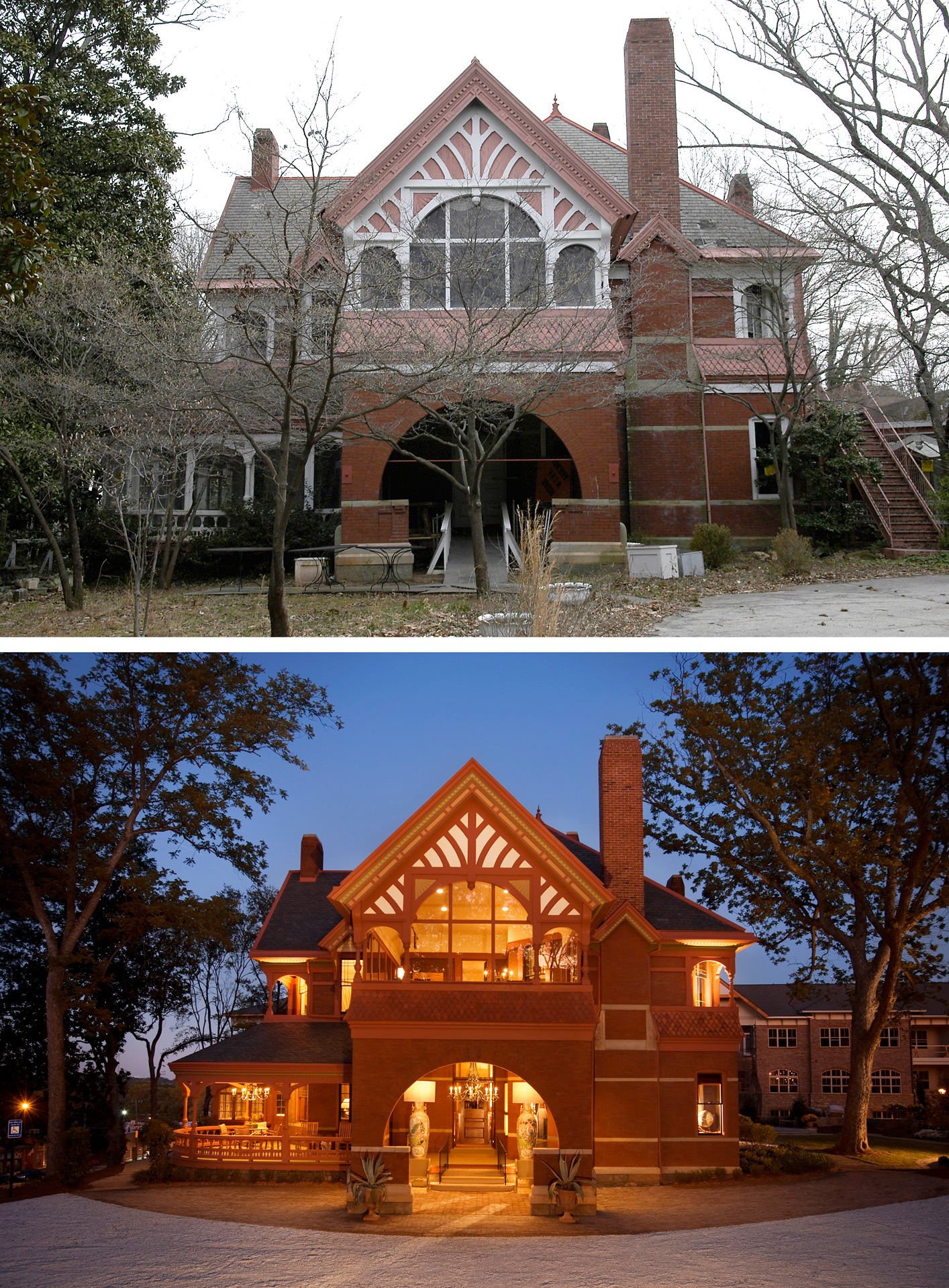
Exterior view of Ivy Hall before and after restoration

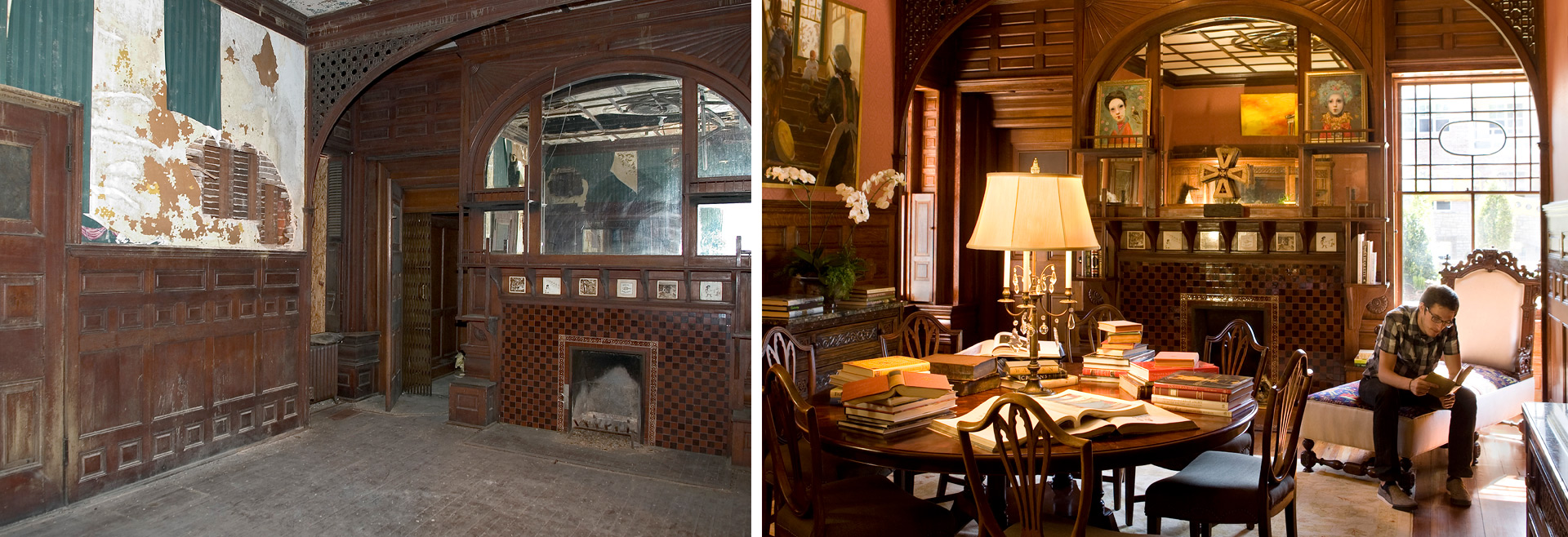
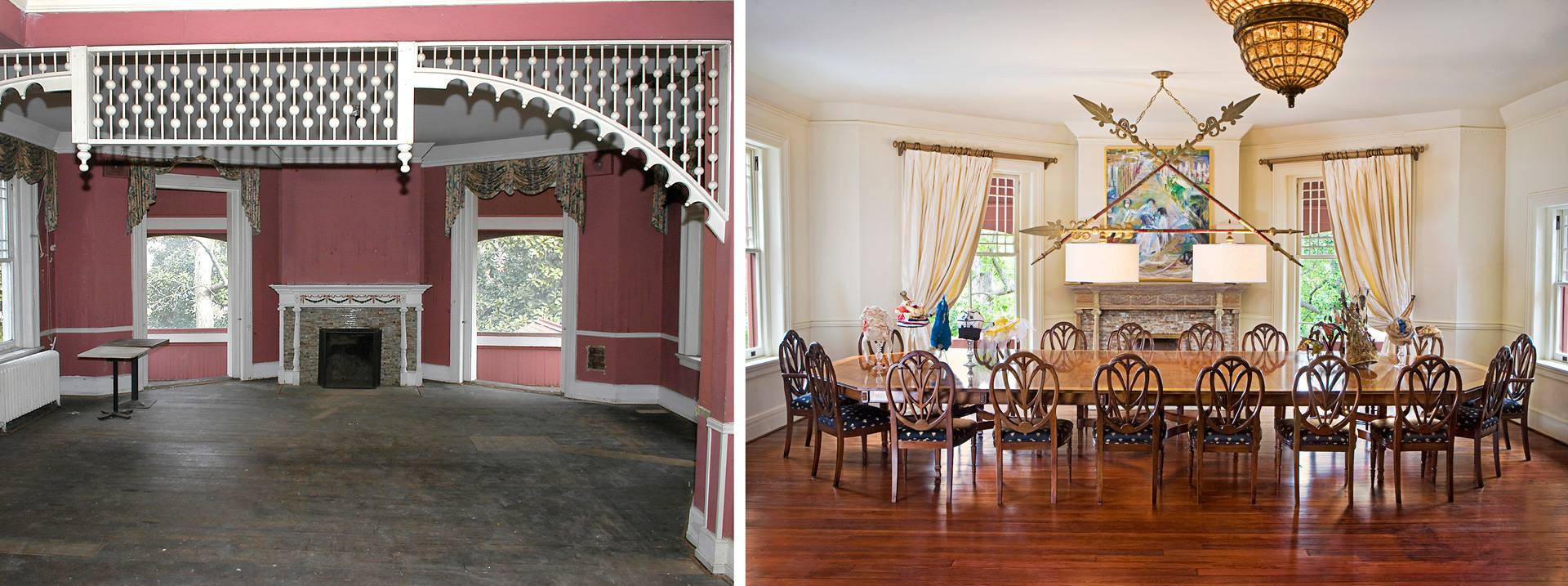
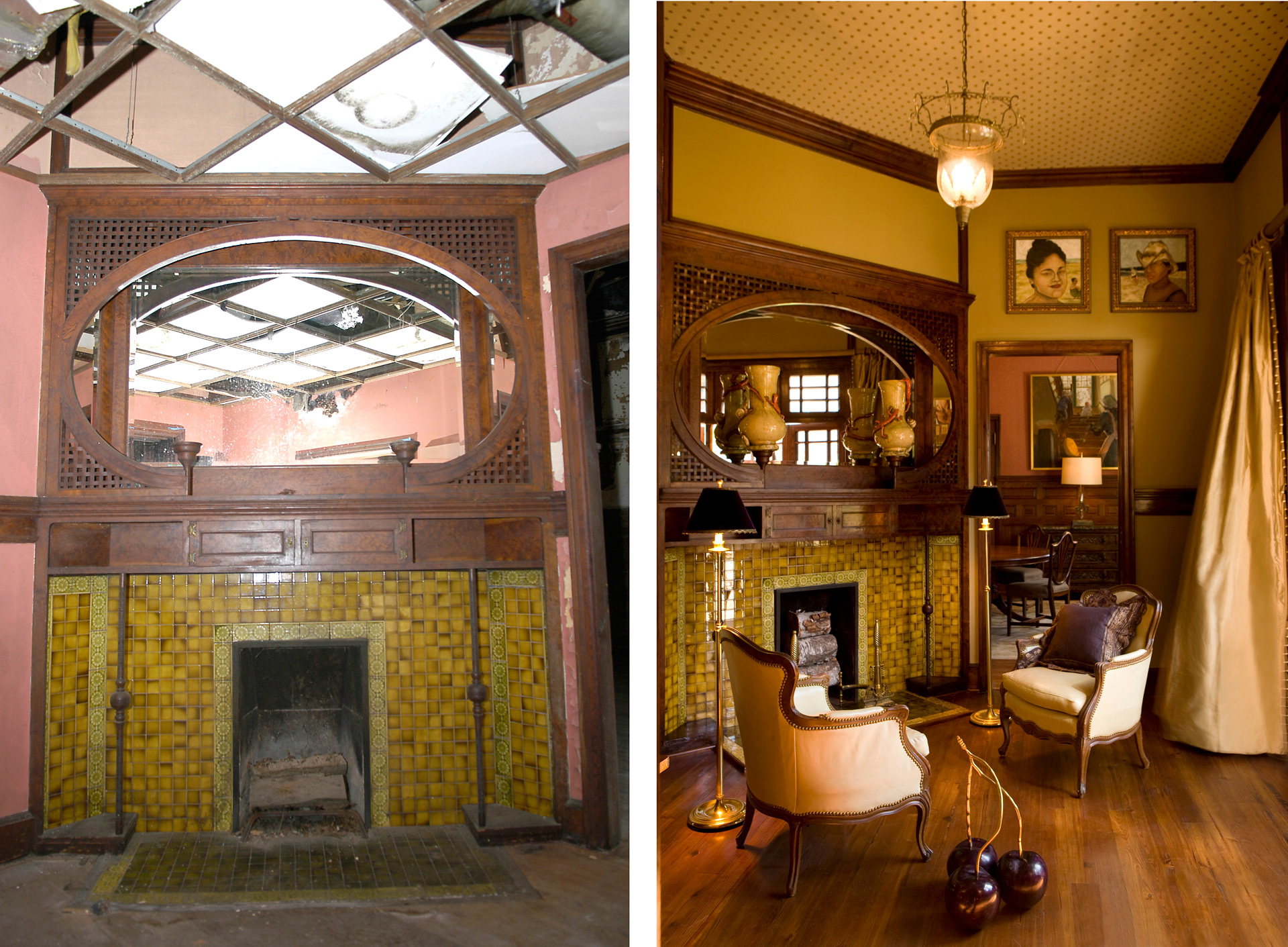
As Atlantans and tourists may recall, the once grand manor resembled a haunted house until SCAD received it as a donation in 2007. After undertaking an award-winning restoration that involved interior design and historic preservation students, the university reopened Ivy Hall in 2008 as home to SCAD Atlanta’s writing program.

That’s good preservation because it’s not just making a house a museum, it has a sustaining purpose. That kind of use and adaptive reuse is what’s really important. - Boyd Coons

interior of Ivy Hall with fireplace before and after restoration

Large interior room of Ivy Hall before and after restoration

Ivy Hall hosts writing classes and connects students and the public to renowned writers like New York Times best-selling author Augusten Burroughs, Camille Paglia, Pearl Cleage and Cinda Williams Chima. In this way, Ivy Hall’s importance has come full circle.

Fireplace inside Ivy Hall before and after restoration

Another pivotal author, Margaret Mitchell, is said to have based Gone with the Wind’s character Rhett Butler on Richard Peters, father to Edward Peters who built Ivy Hall in 1883. His home lives on as a center for aspiring writers. Quite a journey for what was once considered one of Atlanta's most endangered places.