Skip to main content Accessibility Policy

Heejung Kim: all in her backpack

October
4
2022
By
Tags:

"As someone whose career is multidisciplinary, I learn a lot as I go," says Heejung Kim (B.F.A., fashion marketing and management, 2017).

Working as art director for agency Harper + Scott, Heejung is part of the team that launched wildly successful backpack company Dare to Roam in 2021. Owned by R&B megastar Ciara, DTR has been acclaimed for its colorful, antimicrobial accessories by everyone from HYPEBAE to Oprah.

"I appreciate my title as art director, but it's not something that wholly encapsulates all the different tasks that I'm doing on a day-to-day basis," Heejung says. "I'm the person where, if you need help, I'm going to be there to support in any necessary capacity. That's the best way to learn about the production side, the marketing side, and all different aspects of a brand."

A native of Seoul, Korea, Heejung belongs to the exclusive coterie of alumni who began their SCAD experience in Hong Kong and finished in Savannah. Now based in San Diego ("It's eye-opening how much creativity comes out of this city"), she embodies the best of SCAD fashion marketing and management.

Heejung Kim:

On preparing for a creative career: "Harper + Scott hired me as a graphic designer because they saw my SCAD portfolio. That says a lot about the fashion marketing department. Professor Alessandro Cannatà taught me hard skills, like how to apply my photography minor to a campaign. Professor Oscar Betancur pushed me to be a better creator and try different approaches to get messages across. At the time, fashion marketing still primarily meant retail and merchandising, and Professor Betancur brought a fresh perspective with his multimedia class, which was visionary."

On creating a successful brand launch: "I touched on all aspects of building Dare to Roam, from prototyping to branding and speaking with the client. We launched with our hero product, the Prodigy backpack, which is minimal and antimicrobial and water-resistant, so you can wipe it and go. I got to be behind the camera and watch the campaign take shape, helping photograph and produce those shoots. Now, one year later, we're in Target and on Good Morning America. It's amazing."

On working with a Black, famous, female founder: "Working with Ciara as a founder has been educational. I've never worked with such a high-profile celebrity before, and it's inspiring to see how she's able to market strategically. Dare to Roam is only one aspect of her multi-multi-entrepreneurial goals, and it's exciting to see how she and her team think through what she wants to put out there."

On SCAD as the differential: "I don't take my SCAD education for granted. I use all the skills that I learned at SCAD: social media, website, and email marketing, creating look books, all directly applied to my job. I actually had the opportunity to look back at my SCAD portfolio recently, and I'm really proud of the professionalism that I put into my work. I miss living in Savannah and working in SCAD buildings, because that's where inspiration finds you. I've brought that vibrancy with me on my creative journey as I continue to move forward and grow."

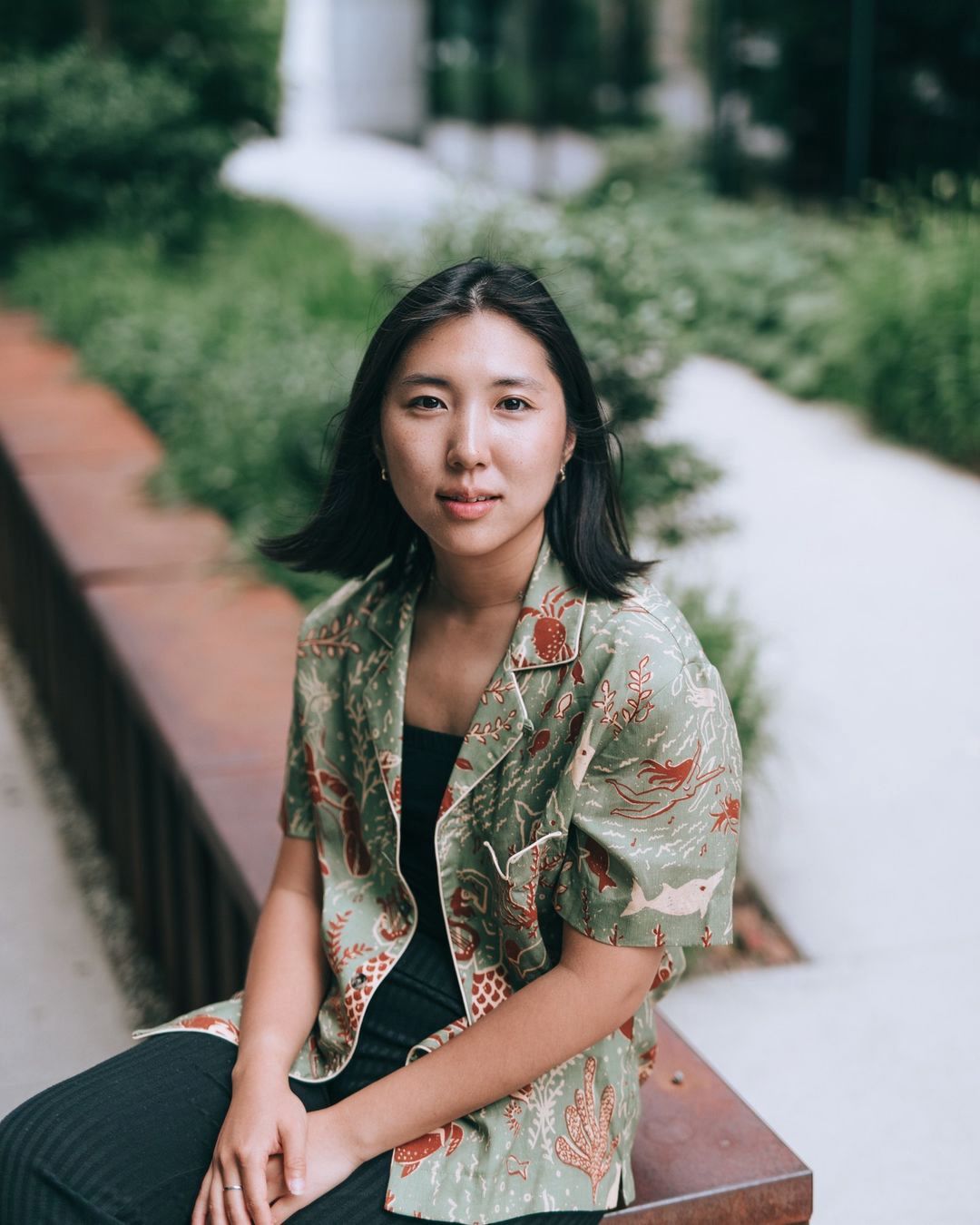
portrait of Heejung Kim

Photo of Heejung Kim by Minnow Park.


"Tokyo Rose" creators bloom

September
26
2022
By
Tags:

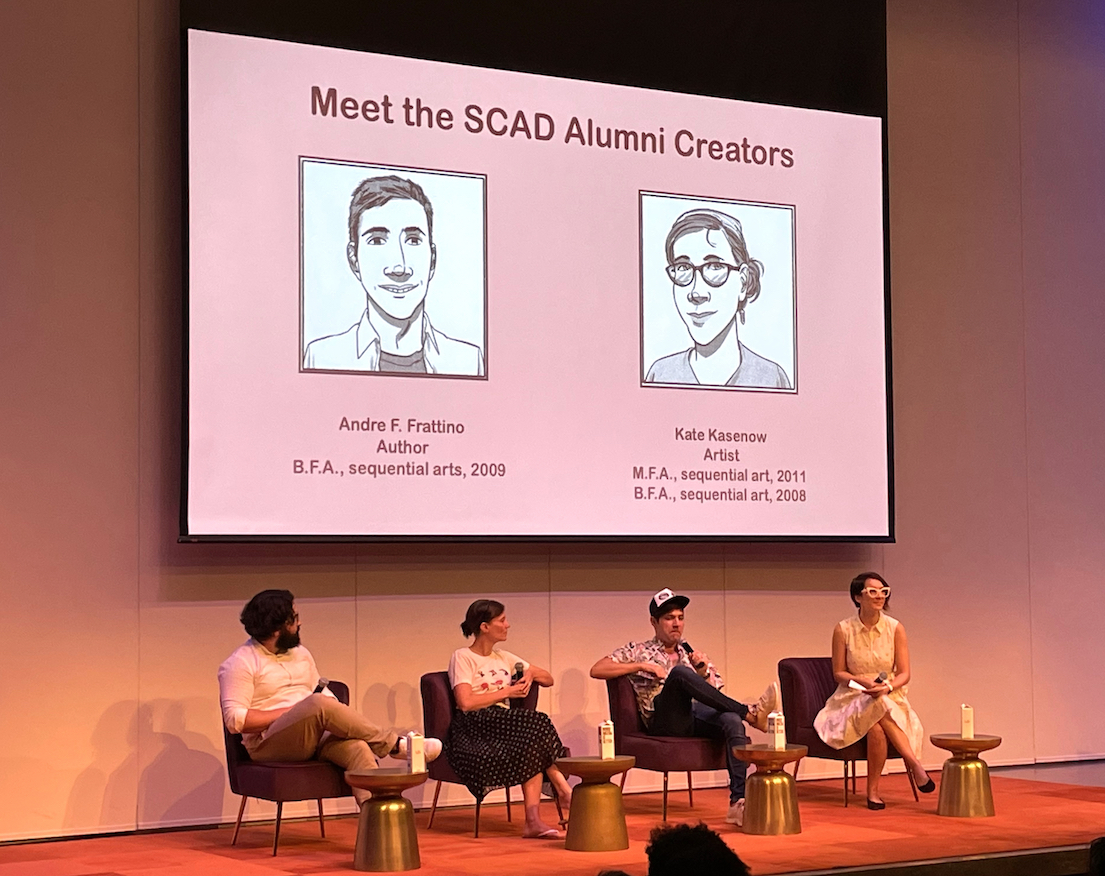
"How many of you here are studying sequential art?" asked Andre R. Frattino from the SCAD MOA stage. Across the theater seats, almost every student's hand went up. Frattino: "Those of you raising your hands, how many of you write and draw?" Nearly every hand stayed up.

Frattino (B.F.A., sequential art, 2009) and collaborator Kate Kasenow (M.F.A., sequential art, 2011; B.F.A., sequential art, 2008) were back at SCAD to discuss their intersecting professional journeys. The occasion was the publication of their brand-new graphic novel Tokyo Rose: Zero Hour (Tuttle Publishing, 2022).

Panel

Already reviewed enthusiastically in Forbes, the graphic novel tells the true story of Iva Toguri, a Japanese-American woman persecuted as a propagandist during World War II, and her postwar redemption. As Kasenow put it: "I'm telling her story—it's not mine."

Frattino mentioned that his grandfather was an artist who'd been a Marine at Pearl Harbor in 1941. "He would tell me about his experiences in the war, and when I watched war movies growing up as a kid, there was always this Tokyo Rose character, this disembodied woman's voice being broadcast, standing in for the Japanese in the Pacific, and I thought who is this? Is this the enemy?"

Frattino researched Toguri's story, deciding to tell it in graphic novel form. Over oysters at The Crab Shack on Tybee, he convinced Kasenow to come on board. They consulted with Asian American and Pacific Islanders regarding issues of authenticity and sensitivity. Recounting this process led to a larger discussion of the importance of collaborating.

Kasenow: "I made a lot of friends at SCAD, including Andre.  We met at one of my first classes and collaborated during school. Collaboration is immensely important, especially in comics. The relationship you have with other artists, writers, concept artists, editors—everything is collaborative. Comics is a storytelling medium, so you're not just thinking of your own perspective on things, you're constantly getting feedback from other people."

Frattino: "In some instances, when I work on a graphic novel, I'll write and illustrate it. My style is like Bruce Timm's Batman meets Archie Comics. On certain stories I might collaborate with someone whose visual style fits better. When I went to SCAD, I met Kate and saw her art and how intricate and delicate it was. I'd never seen illustration done that way. I thought, I've got to work with her!"

The pair funded Tokyo Rose: Zero Hour via Kickstarter. When the project was acquired by Tuttle Publishing, a key member of the creative team joined. "Tuttle said they could get Janice on board," Frattino said, referring to veteran letterer Janice Chiang. "Janice showed how the lettering could work with visual elements to enhance the story," Kasenow added. "We were lucky to work with her." 

Collaboration, teamwork, patience, pliability, passion: all accounted for. As Kasenow put it: "The most important thing is the respect you have for the people you're working with."

Poster

Visit the official page for Tokyo Rose: Zero Hour by Andre Frattino and Kate Kasenow.

Event presented by Director of Alumni Programs Grace Grund and career advisors Erin Berkery-Rovner and Juan Murillo Noguera.

Learn more about SCAD career and alumni success.

SCAD Atlanta debuts XR stage

September
23
2022
By
Tags:

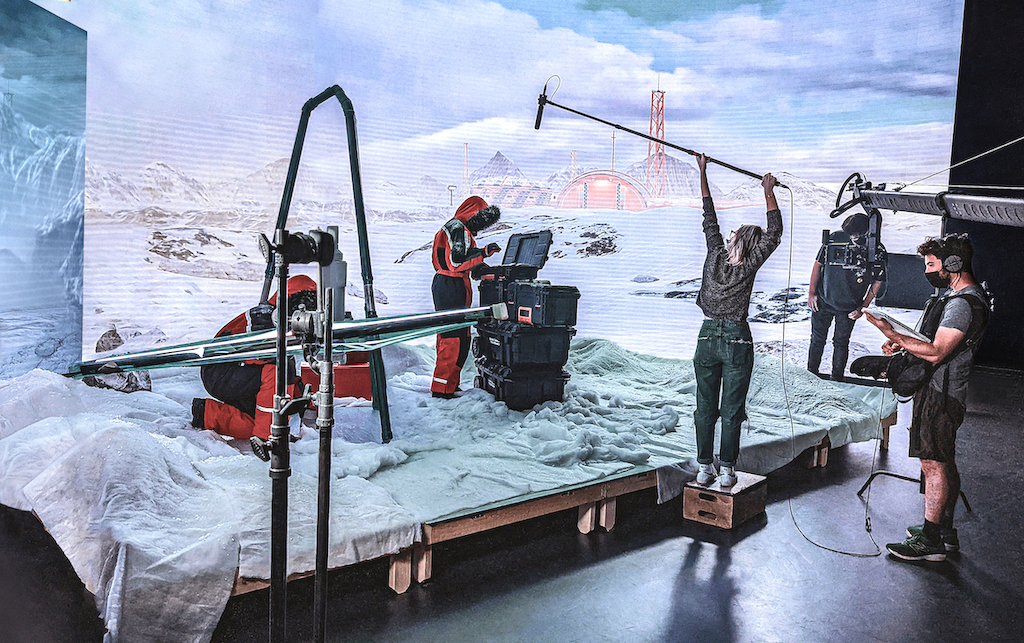
SCAD is proud to announce the opening of the university's state-of-the art extended reality (XR) stage for virtual productions at the recently expanded SCAD Digital Media Center in Atlanta. The debut of the XR stage, or LED volume, will take place this week during SCAD AnimationFest, the university's annual festival dedicated to exploring the latest trends in creative technology in entertainment.

Extended reality (XR) technology represents an innovative game-changer for SCAD students pursuing professions in entertainment and digital media. Extended reality technologies are groundbreaking innovations that represent filmmaking's next frontier. With the opening of the SCAD Atlanta stage, SCAD is the only university in the world with two LED volumes, following the opening of SCAD's first XR stage at Savannah Film Studios in 2021.

SCAD's LED volumes are also the largest at any academic institution in the U.S.. Students from top-ranked degree programs in the SCAD School of Animation and Motion and SCAD School of Film and Acting will be among the first in the world actively working and collaborating on LED volumes, taking their filmmaking and storytelling capabilities to new heights.

SCAD is committed to providing unparalleled resources and opportunities for students and alumni, helping empower students with an elite, industry-ready skillset upon graduation. SCAD Atlanta's trailblazing LED volume is an investment in the future and reinforces the university's contributions to Georgia's multibillion-dollar film and television industry.

"Collaboration and innovation are two of the cornerstones that make SCAD the only film school in the country offering students the opportunity to create content on two LED volumes," said SCAD School of Film and Acting dean Andra Reeve-Rabb. "Students from film and television, performing arts, production design, interactive design and game development, sound design, and visual effects have already begun collaborating in these industry-standard, cutting-edge spaces. Our students are working on professional sets all over Georgia because we train them to be working professionals in environments like these, singular only to SCAD."

Atlanta's XR stage was designed exclusively for SCAD in collaboration with Atlanta-based MEPTIK, an extended reality and virtual production studio co-founded by SCAD alum Sarah Linebaugh and Nick Rivero. At SCAD AnimationFest, Rivero will host a session discussing the evolution of this production technology and how this new frontier will impact content creation across the globe.

"SCAD is already leading the way in the future of education, and the completion of this stage is lightyears ahead of anyone else in thinking and execution," Rivero said. "SCAD is setting the standard in the future of our industry. This facility is on the leading edge of what's next. Whether film, television, or experiences, this technology, powered by disguise, is paving the way for what's ahead in our digital future."

SCAD is recognized as the preeminent global leader in art and design in higher education. In 2021, SCAD was named by The Rookies as the No. 1 university in its list of the Top 50 Creative Media and Entertainment Schools and Colleges in the World, while Animation Career Review consistently ranks SCAD as a top university for animation and visual effects. MovieMaker magazine recently named SCAD on its 2021 Best Film Schools in the U.S. and Canada list for its outstanding production training. Most recently, the university was named Art & Object's Best Art School in the U.S. for the second consecutive year.

View virtual and in-person attendance options for SCAD AnimationFest, to experience the XR stage panel on Friday, Sept. 23.

View virtual and in-person attendance options for SCAD AnimationFest, to experience the XR stage panel on Friday, Sept. 23.

New faculty spotlight: Sandra Daley

September
13
2022
By
Tags:

"The DNA of writing is authenticity. How do you get really honest with yourself?" asks dramatic writing professor Sandra Daley with a knowing smile. "I'm here to push students to access that place, which means tackling fears, being gutsy, and putting it all on the page."

Daley joined SCAD faculty full-time in Fall 2021. Previously a professor at Sarah Lawrence, she earned her MFA at Hunter College, where she studied under Pulitzer Prize-winning playwright Annie Baker and Pulitzer finalist Branden Jacobs-Jenkins. Daley's vibrant resume includes lauded work as an actor, director, writer, and dramaturg, as well as a producer with the OBIE Award-winning collective Harlem9.


"Professor Daley is a dynamic addition to SCAD dramatic writing, and her strong commitment to our students is evident in the open, supportive, and creative environments she fosters in all her classes," says dramatic writing chair Averie Storck. "Her passion and energy are tremendous! In her first year, she led the writers' room of Episode 3 of the SCAD original sitcom G.R.I.T.S., while student scripts from her playwriting classes are being used in cross-departmental collaborations. We're lucky to have her as part of our faculty."

This quarter, Daley is teaching courses including Introduction to Playwriting (DWRI 272) and Writing the Television Drama Pilot Script (FILM 438). "I feel grounded in what it is I bring to the classroom and what I bring to the SCAD community, and to these new, young student writers," she says. "Being a Black woman and being Caribbean means having a different perspective around the conversation of identity—especially for young people who are identifying around gender, sexuality, and mental health challenges. Students are looking for validation for their voices."

Within the space of a few minutes of conversation, Daley references Lynn Nottage, Alvin Ailey, Charles Mee, Lorraine Hansberry, Henrik Ibsen, Dominque Morisseau, and Sophocles. This significant swathe confirms her expansive knowledge base—and stimulates curiosity.

"Most of my students are not only learning how to write, they're trying to understand what playwriting is really about," she explains. "The biggest thing I can show them is how to tell compelling stories in short form, and how to honor the words on the page."

Daley's nurturing approach is feedback-based. "I take a lot of time to give students individual attention, so that they feel heard and respected, because the process is hard." Coddling is avoided. "My prompts take students out of their comfort zones. I'm giving you something that frees your brain."

SCAD dramatic writing embraces both stage and screen. While noting the disparities between playwright and TV writer as professions, Daley envisions a new working model for today's dramatic writer.

"There's something about the TV world right now that I love: the platform is broad, with experimental work. TV has that type of collaborative writers-room writing that is reassuring, whereas playwriting can feel lonely. I'm happy teaching both here now at SCAD. I feel appreciated in our wonderful and quickly growing dramatic writing department."

Alexander Newton: editing creatively

August
4
2022
By
Tags:

"In every avenue of media, editors are in high demand, so there is a lot to be excited about if you want to be an editor," film and television professor Alexander Newton told SCAD District in 2020, regarding the then-new SCAD Video Editor's Club.

Newton (M.F.A., film and television, 2008) has continued to emphasize the professional opportunities available to students studying editing. In May of this year, he oversaw the inaugural networking event The Cut, connecting industry-leading alumni with current students for a slate of panels and workshops.

Before joining SCAD film faculty in 2015, Newton worked for Digitas, Vice, and The New York Times. A certified AVID instructor, he continues to work on film projects whenever possible, including the forthcoming documentary The Price of Hope. A modest master of time management, Newton contributed the following list of films he believes exemplify the transformational power of editing.

Hiroshima mon amour film still

Hiroshima mon amour (Dir. Alain Resnais, 1959)

"A film well known to lovers of cinema history. From Marguerite Duras' story to Emmanuelle Riva's performance, there is much to discuss, and we often delve into it in my class Editing Aesthetics (FILM 330). For me, the main reason this film stands out is the way that it moves. Right from the start, it feels as though you're being carried by a current downstream. You realize you are someplace entirely different from where you had been moments earlier, and wonder, ‘How did I get here?' The answer, of course, is masterful storytelling shaped by masterful editing."

Moneyball (Dir. Bennett Miller, 2011)

"The structure and editing of this film puzzled me when I first saw it in the theater. Interesting choices are being made in what would ordinarily be considered conventional dialogue scenes; holding on a character's closeup far longer than usual to reveal subtext, for example. Sound drops off completely in certain key moments of action, then creeps back in. In its shot design and editing, Moneyball shares a lot with All the President's Men (1976). There is a cadence and rhythm that I find effective; I'll sometimes have it playing in the background, like music. It probably helps that I'm a baseball fan."

The Vietnam War (Dir. Ken Burns & Lynn Novick, 2017)

"This may be the most potent PBS series Ken Burns and Lynn Novick have yet produced. America's involvement in Vietnam was an underexplored subject in my early schooling, so this series was an education both intellectually and emotionally. The Burns aesthetic is clear, but there is a willingness to experiment with new structural approaches. In the first episode, the history of the war is traced to the French colonial occupation of Vietnam in the late 1800s. The episode employs a parallel structure, where the ‘dry' historic elements of the story are intercut with more contemporary American and Vietnamese accounts. The result is compelling."

Days of Heaven (Terrence Malick, 1978)

"Terrence Malick films are famous for impressionistic storytelling, often featuring swooping shots, scenes that seem to have no dialogue, all layered with voiceover narration. His second feature is where the mechanics of the film are visible and reveal the filmmaker's evolutionary process. A heavy conversation between characters is distilled to body language in the edit—a glance, a knowing look. Malick invites the audience to pay closer attention and fall deeper into the world of the film. Young Linda Manz was recorded in the studio as she watched an edit and shared her impromptu reactions. This audio then formed the basis of the film's narration. Malick's later films The Thin Red Line and Tree of Life were made possible by his willingness to use post as a creative and exploratory process in Days of Heaven."

Star Wars (Dir. George Lucas, 1977)

"As a kid, I watched the original Star Wars films over and over. In the days before the internet, I even managed with my father's help to hook up an audio cassette player directly to the TV so I could record portions of the soundtrack and dialogue, making it the first material I ever edited. Marcia Lucas' editing of the final act is an absolute masterstroke."

See the work of Alexander Newton, and learn more about SCAD film and television.

Jana Marie Cariddi: imagist punk

July
29
2022
By
Tags:

Tucked on a back wall at the Gutstein Gallery, Jana Marie Cariddi's painting "Dwelling to Devise a Way Out" is a lurid bombshell. Part of the group show Supernatural!, the acrylic-on-wood-panel pulses with humor and color. Its sense of being alive is, perhaps paradoxically, something a 2D artwork can achieve only through total commitment and kinetic intent.  

The title of the painting may be a nod to Ibsen's 1879 play A Doll's House, that enduring urtext for domestic dissatisfaction. As Cariddi (B.F.A., painting, 2015) says: "I'm trying to bring the house and the body together. They're both dynamic things that shelter us, and I like blurring the qualities that separate the two."

The work has kinship with Suellen Rocca's skew-whiff oils, Gilbert Shelton's freaky underground comix, and the uncanny visions of Leonora Carrington. But it is manifestly in touch with Cariddi's roots as a New Jersey punk rocker too. That aspect of the painting—its punkness—bristles with barely-tamed energy.

Disembodied facial features grieve; a lone molar languishes behind bars; a bulbous bicep powers a hand gripping a bouquet of funky tendrils. Meanwhile, a cutaway appears to reveal the studio of the artist herself. The brave painter embraces anarchy to achieve unity.

With her toy poodle Sid Vicious on her lap, Cariddi connected via Zoom from her home in Wisconsin to discuss the work.

artwork by Jana Cariddi

Jana Marie Cariddi, "Dwelling to Devise a Way Out," 2021. Acrylic on wood panel.


Jana Marie Cariddi:

The painting in Supernatural! is actually the first painting I made in grad school. I'm now in the graduate painting program at University of Wisconsin-Madison, where I'm also teaching drawing to undergrads. One of the things about teaching is that it's super important to be confident. Students can pick up on that readily, and I think that's made me more confident in my abilities to teach. In my studio practice, I've been forced to be more confident because I have less time—I make decisions quicker and get in the studio when I can.

I consider myself somebody who really resonates with humor. I need it to get by. It's cathartic and it's necessary. For that to come out in my work is only natural. It's also quite a dark painting in some ways, but the fact you can look at it and laugh is part of my intention. I want it to resonate and feel familiar.

My drawing process is intuitive and spontaneous. I use Micron pens, and let the drawing evolve from my subconscious. My painting process is the opposite: I take the drawing and plan and execute step by step to turn the drawing into the painting.

When I made the sketch for this painting, I was looking at Rube Goldberg devices. I love how they go in all sorts of directions and can defy gravity. The environment is nonsensical. The dollhouse comes up in my work a lot, as a nod to girlhood. I grew up in the ‘90s watching a lot of Nickelodeon like Pee-wee's Playhouse, and Polly Pocket toys, where houses open up and have little rooms that somehow connect. I use a lot of geometry, but I consider myself an organic thinker.

As a SCAD undergrad I had a great professor for color theory, Deborah Mosch (M.F.A., illustration, 1991), who completely flipped me on my belly and taught me the power of colors. I started out studying illustration, and then was told: "If you like to solve problems be an illustrator, and if you like to ask questions be a painter." A week later I switched my major to painting. The SCAD painting faculty is wonderful. Professor Vanessa Platacis taught me so much about professionality, and she influenced and inspired me to be a hard-edge flat painter.

For me, my attraction to painting is that I have this crazy imagination and a need to express myself all the time. It could never be anything other than painting.

portrait of Jana Marie Cariddi

Visit Jana Marie Cariddi!

Supernatural! is on view at Gutstein Gallery through Fri. Sept 16. The exhibition is free and open to the public.

Gabriela Saadia's illuminations

July
20
2022
By
Tags:

"I want the lamp to be like the building's necklace," says Gabriela Saadia (M.A., furniture design) of her award-winning lighting fixture Aria. "Aria is borne from the idea that not only humans wear jewelry; buildings can wear it too."

A sleek fixture ten feet in length, Aria is a fabulous feat of fabrication. Its three acrylic orbs, inspired by a pearl necklace, nestle into sleek metal tubing. Saadia built her design by hand in Gulfstream Center, soldering, drilling, tube bending, belt grinding, and lathing. When the ceiling-mounted Aria illuminates, Saadia's extensive labor is invisible. Aria's Red Dot Award is well earned.

"I wanted to make something big, but not too heavy for the eyes," Saadia explains. "My intention with Aria is to highlight a building's beauty, just as a piece of jewelry highlights a person's beauty."

lighting design by Gabriela Saadia in place in lobby

Hailing from Mexico City, Saadia earned her undergraduate degree in industrial design at Universidad Iberoamericana in 2020, then worked at Lamparas Yvonne, creating technical drawings and 3D models and interacting with clients and suppliers. Her experience prompted her to pursue a master's degree at SCAD focused on lamps and lighting.

"Gabriela's research, design exploration, and design development are always thorough and well-done," says associate chair of furniture design Frederic Spector, who taught Saadia in classes including Methods of Furniture Fabrication (FURN 715). "She has a great way of working through challenges and coming up with interesting design solutions, while continually developing a sophisticated design language. Her dedication is obvious, and her work ethic is awesome."

The M.A. program at SCAD has enabled Saadia to focus intensely on her work. "Not many universities have a program that felt complete in one year. SCAD allowed me to take extra classes, so I took three electives, including the class where I built Aria," she says, referring to Experimental Metal Fabrication (FURN 760) with professor Aaron Heisler (M.F.A., furniture design, 2004).

After three quarters in Savannah, Saadia is currently completing her degree via SCADnow online while living at home in Mexico City. 

"SCAD has been an amazing experience," Saadia says. "I love the furniture design department. As a student you get personal attention from professors who are always willing to help, both during class and outside class too. With my fellow students, many international, I made great friends, and their critiques were very important to my work. Living in Savannah was nice as well. I got a bicycle and was able to see the city."

Saadia's goal is to open her own lighting store in Mexico City, selling her own line. "I want to have a residential lighting store, fixtures for the home. I'll make a design like Aria, but smaller and suited for a dining room."

Now that will be the dinner party to attend.

portrait of Gabriela Saadia

View Gabriela's portfolio and follow Saadia Design.


Lily Adams: sound design for the soul

June
1
2022
By
Tags:

"How can I use my sound art powers for good?" asks Lily Adams (B.F.A., sound design).

It's three days before commencement, and the senior sound artist is in Hamilton Hall Room 201, delivering their talk "Sound Art for the Soul" to 20 enthusiastic fellow sound design students—all members of the official club called SCAD PASO (Professional Audio Student Organization).

Adams, the club's outgoing president, is discussing sound conservation and acoustic ecology. Referencing soundscape ecologist Bernie Krause, and screening a clip of the documentary Chasing Coral, Adams makes the case for "the different ways you can take your sound talent and apply it to something you care about."

"Lily is a model sound design student with extraordinary creative and technical skills who contributes professional-level work on every project," says sound design professor Jamie Baker. "As the president of PASO, Lily masterfully collaborates with peers, professors, and special industry guests to host wonderful, educational, supportive events. Lily sets the tone and leads the troops with natural ease and competence."

In June, Adams will head west to Los Angeles, for a coveted internship at Formosa Group. It will be their second time in L.A. this calendar year: in March, they received the Student Recognition Award at the 58th Annual Cinema Audio Society Awards, taking home a $5,000 prize. "The best part was networking with everyone there, including those I'd met previously via Zoom, like Mark Lanza, President of Motion Picture Sound Editors," Adams says. "It was fun being with all the best mixers in Hollywood in one room."
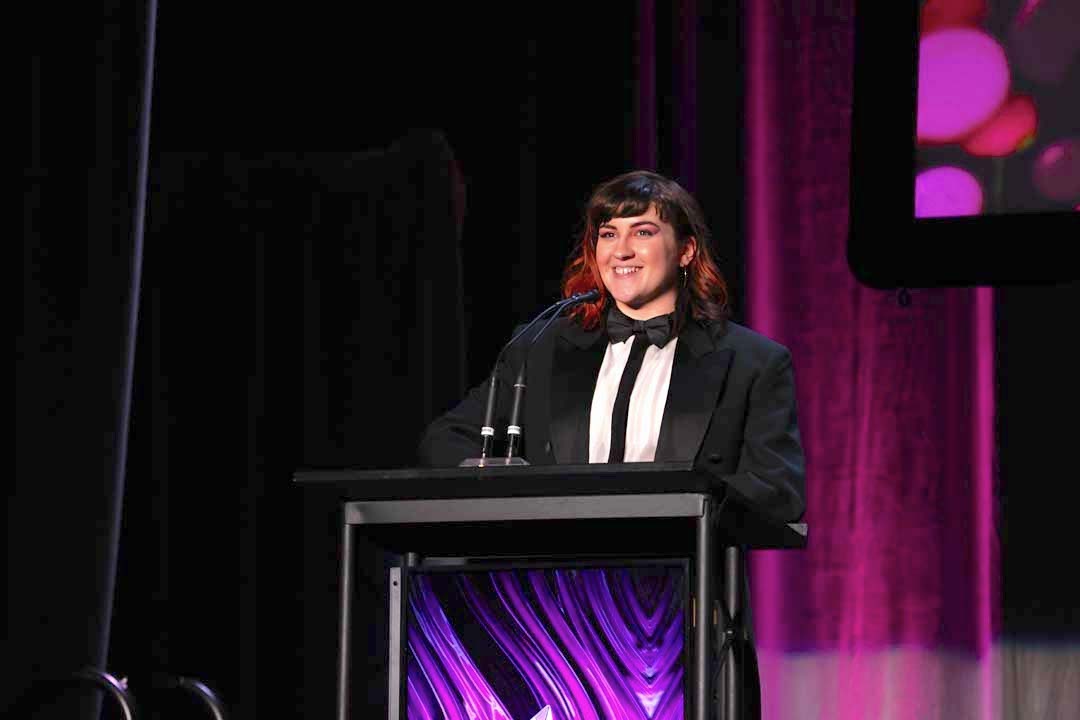
Lily Adams at the Cinema Audio Society Awards, March, 2022.

Lily Adams at the Cinema Audio Society Awards, March, 2022.


Adams grew up in Indianapolis, Indiana, and attended Park Tudor School, before coming to SCAD, specifically to study sound. "I was interested in how sound can make you feel things. As I like to say, pictures are information, but sound is emotion."

While taking first year sound design classes, Adams wasn't picking up ProTools as quickly as hoped. "So, I did peer tutoring with a student named Ashton Faydenko (B.F.A., sound design, 2020), who got me a student film to mix at the end of my first quarter. I started mixing more student films, and sound editing, and kept going to PASO."

"PASO is about offering access and fostering collaboration," Adams continues. "That includes creating a safe space for underclassmen who might not know what questions to ask. Post-production is a collaborative art form, and it doesn't mean anything unless you share it with people. It's the same in film and in theater: You build a family with the people you work with."

As a senior, Adams was in high demand as a cross-disciplinary collaborator. They worked on The Tunnel, directed by Jovianny Berrios (B.F.A., film and television, 2020), an intense psychological drama set in South Carolina in 1865. Then there was comedy short Smoothie Heist, directed by Sydney Bowers (B.F.A., film and television), a uproarious audience favorite at this year's student film showcase. "It's great to work with directors who understand how important sound is," Adams says.

Back in Hamilton Hall, PASO is still happening. Adams, wearing a pair of rainbow-soled platform sneakers, initiates the next part of the evening, inviting fellow sound design students to the front of the room to jam on the Moog Grandmother, a semi-modular analog synthesizer with built-in spring reverb. As the room swells with chromatic oscillations, pizzas appear courtesy of professor Baker. It's a conscious, soul sound party, designed for the expansive, positive possibilities of our world.

As Adams says: "Sound, because it's so emotional, is a big part of opening up someone's mind and making them think about things differently."

Visit Lily Adams Sound!
Gaming students deliver 'Hearth'-warming story

May
25
2022
By
Tags:

Stranded on an island in the middle of a stormy ocean, you must stay warm by collecting resources and upgrading your home. The further you go, the more you come to realize that these Hinterlands are not quite as empty as they first appeared — and the fate of these lands now rests in your hands.

Home is Where the Hearth is cover image

This dramatic gameplay prompt is the essence of Home Is Where the Hearth Is, an action-based RPG created by students as a 20-week senior capstone project. The game won Best of Show and Best 3D Game at the Entelechy awards, in addition to receiving multiple award nominations from The Rookies.

During the "making of" panel at SCAD GamingFest 2022, lead programmer Nathan Cartwright (B.F.A., interactive design and game development, 2021) and project lead and narrative designer James Hill (B.F.A., interactive design and game development, 2021) discussed their process. Cartwright and Hill were joined by interactive design and game development professor Jack Mamais and department chair SuAnne Fu.

"Having a well-written narrative was one of our highest priorities throughout development," said Cartwright. "Blending story, gameplay, and art style was critical to achieving the look and feel we wanted for the game."

"As the project grew, our skills grew too, and the quality of the game started to shift," Hill said. "Because we were using an agile workflow, we were able to look at what was working and what wasn't, which allowed us to iterate and address challenges before they became unmanageable."

To create Home Is Where the Hearth Is, Cartwright and Hill formed Hearthbound Games with fellow SCAD students Scarlet Blackwell, Amanda Wood, Dylan Porter, and Mei Li Ho. Much of the game's art was created using Unreal Engine, Maya, Substance, and ZBrush. The game's naturalistic color palette complements the core mission of the game's protagonist, a young woman named Aden who travels into the wilderness in search of a fresh start.

Cartwright: "These features, in combination with our collection and management mechanics, reinforced the foundational question posed by our narrative: What makes the place you live a home, and what is that worth to you?"

"This was a highly advanced project," added Prof. Mamais. "The students wanted not only to make a game that looked good, but a game that played great, with at least 10 hours of gameplay. It has its own unique voice, with the character of the hearth mechanic, and is distinct as an action-based RPG."

For Cartwright, one distinguishing aspect of development was attention paid to the protagonist's options. "When you're playing this game, your choices affect not only the narrative, but mechanical aspects as well. That's the true power of the game."

Department chair SuAnne Fu agreed: "The branching narrative of Home Is Where the Hearth Is means you can really explore the world, and get into it, because it's so rich in content."

"What I love is how much effort went into Hearthbound Games, and replicating a real industry environment for our work," Cartwright added. "That means that before we ever set foot outside SCAD, we had a real experience of what it's like to go down this career path."

Hill said, "We worked hard to put together something that could actually be played, and we were all so excited to do it."

Home is Where the Hearth Is game still

Read more about the dedicated GamingFest panel in this superb article by Andrea Rosado (B.F.A., animation).

Stella DeLaughter's 'Confabulatious' fashion

May
19
2022
By
Tags:

With the arrival of SCAD FASHION 2022, senior and graduate students are exhilarated to debut their visions and share their worlds of inspiration. One senior of note, Stella DeLaughter (B.F.A., fashion) has created a standout collection she calls "Confabulatious." Focused on using primarily vintage, secondhand, and deadstock fabric, Stella will premiere her collection on Friday, May 20, 8:30 p.m. ET, on the runway and via free livestream.

Born and raised in Dallas, Texas, Stella grew up watching her grandma sew uniforms for her parents' band, the 20-plus member musical group The Polyphonic Spree. Inspired, Stella began her journey into fashion by learning to sew at age seven, taking after her grandma by making pillows to give to loved ones.

"I loved being able to make something from scratch with my hands, and the attention to detail it took to remember how to thread the machine and wind a bobbin," Stella says. "Fast forward 16 years, and I just finished my senior collection!"

Fashion photo

"Confabulatious" began to develop while Stella took a gap year and moved back home during the pandemic. She revisited another childhood passion: going to estate and garage sales.

"My favorite estate sales are at the homes of makers, where there is always an industrial sewing machine, piles of vintage fabrics and trims and closets full of colorful vintage clothes. I'm always curious about the people who lived there and the things they collected throughout their life."

Examining the vintage bedsheets, tablecloths among other fabrics, Stella created scenarios that fit the fabrics. She immersed herself in inspiration by collaging vintage magazines, also found at estate sales, which helped conceptualize silhouette and color inspiration for the collection.

While checking local estate sales and Etsy sellers for vintage and deadstock fabric, Stella found a vintage flocked floral organza. By "going down vintage fabric rabbit holes" she acquired fabrics and trims that had been in families for decades, each with its own unique story to tell. What better way to enhance those stories by adding a little bit of sparkle sponsored by Swarovski to each look?

"Adding the crystals really brought the collection together," Stella says. "I owe a massive thanks to [fellow students] Lexi Meyer, Tom Banks, Lauryn Porter, Bonnie Chan, and Hannah Gaffney for applying the crystals one by one. The collection wouldn't be the same without them."

Fashion can be perceived as pretentious and competitive to outsiders looking in. However, DeLaughter believes creative collaboration holds the key to new ideas and what becomes possible when a team shares a creative vision.

"We've fostered a supportive, encouraging environment," she says. "Being around these people for many days and nights, who are now all good friends, has been the best part." After working alongside many talented designers on this senior collection, Stella hopes to bring that same energy of collaboration into the industry.

Student portrait

Stella DeLaughter


About the author: Celine Consolo (B.F.A., fashion marketing and management) is minoring in fashion journalism and fashion photography. She is passionate about broadening her audience's perspective and presenting emotive work in visual marketing and journalism. See more of Celine's work here.